Crazy conservatives shoot themselves in the foot, then reload

The radical right of the Republican Party keeps drifting farther and farther away from the reality where most of us exist.  The good part is they’re getting less and less likely to remain a national political force, since as they get more and more extreme in their views they’re pushing more and more moderates away while their own supporters, angry old white people, are dying off.  The overreaction to every imagined slight against The Way Things Should Be and The Way Things Used To Be has become comical, and an easy target for Jon Stewart and others.

The Daily Show took note of last week’s hissy fit in a hatbox over mandating health insurance coverage for contraception services and the requirement that employers offer such coverage, even some religion-affiliated employers, and was delighted to report that the conservative message machine didn’t miss a chance—again—to bulldoze blithely over that line that separates rational argument from hysterical exaggeration.  Click the pic, and enjoy.

image

This one guy says the evil super PACs are SAVING democracy, others are less charitable

I’m not sure if he’s right or not, but he makes an interesting argument.  Dave Weigel is an excellent political reporter who’s spent a lot of time chronicling the conservative movement.  Today at Slate he makes the provocative argument—it was to me, anyway—that the political action committees fostered by the U. S. Supreme Court’s Citizens United decisionare a good thing, that they have been a force to strengthen democracy and have made this year’s Republican presidential contest fairer.

Huh?  No, no, no, wait a minute: Citizens United is an evil thing, a twisted interpretation of dictionary English by the conservative members of the court so that now the godless, faceless corporations are considered “persons” for the purposes of political participation, and they can secretly donate as much of their giant piles of money as they like to PACs and buy elections and marginalize the little guy like me (I was going to say you and me, but I really shouldn’t presume to speak for you, should I?)…it’s already happened starting in Iowa this year, right?  I mean, that’s what we’ve all been told, right?

But Weigel argues that the super PACs have had a leveling effect: the big money from super PACs is all that’s kept Mitt Romney from outspending his opponents into submission, and essentially buying the GOP nomination.  And despite the concerns about the secretive nature of the super PACs, he notes that we seem to know more about the biggest of the big donors to super PACs than we do about the people making direct donations to the individual candidates’ campaigns. He writes, “The big fear about campaign money is that it corrupts the candidates who have to beg for it.”

But that worry applies better to the shadowy bundler than it does to the megabucks super PAC donor. Corruption can’t grow in the sunlight. The people giving big to super PACs are famous. I didn’t fully understand how famous until I tagged along with [Newt] Gingrich at a speech to Aloma Baptist Church in Florida, when a parishioner asked him to explain why he was taking dirty money from the gambling industry. Gingrich explained that he and [Sheldon] Adelson had a simpatico, guns-a-blazin’ view on Israel. Is it corruption if the candidate tells you what he’ll do for the donor?

(snip)

We know more about those guys than we know about the bundlers, who’ve been passing money under the table for years. So which of those systems is worse for our democracy?

I know what’s good for our democracy: satire and ridicule, and in the case of Citizens United it’s been coming most effectively from Stephen Colbert.  The Comedy Central comedian started his own super PAC and has been using it to expose the ridiculous reality resulting from the court’s ruling.

The line between entertainment and the court blurred even further late last month when Colbert had former Justice John Paul Stevens on his show to discuss his dissent in Citizens United. When a 91-year-old former justice is patiently explaining to a comedian that corporations are not people, it’s clear that everything about the majority opinion has been reduced to a punch line.

The court fights aren’t over, and perhaps the coolest one is in Montana where the state supreme court has told the one in Washington to pound sand.  The court voted 5-2 to uphold the constitutionality of Montana’s ban on corporate campaign contributions, finding justification for the ban that Citizens United does not consider.  Beyond that, Justice James Nelson unloaded: “Corporations are not persons.  Human beings are persons, and it is an affront to the inviolable dignity of our species that courts have created a legal fiction which forces people—human beings—to share fundamental, natural rights with soulless creatures of government.”   And that from one of the two dissenters in the ruling!

More fundamentally, the majority and one dissenter seem to understand perfectly how much the American people resent being lied to about the burning need for courts to step in to protect the oppressed voices of powerless corporate interests. As Judge Nelson wrote in dissent, “the notion that corporations are disadvantaged in the political realm is unbelievable. Indeed, it has astounded most Americans. The truth is that corporations wield enormous power in Congress and in state legislatures. It is hard to tell where government ends and corporate America begins: the transition is seamless and overlapping.”

America moves one step closer to gay marriage rights, and the silence from opponents speaks volumes

Today a panel of a federal appeals court in California ruled that state’s Proposition 8, an amendment to the state constitution approved by voters in 2008 to outlaw gay marriage, is an unconstitutional violation of the right to equal protection under the law.  The appeals panel agreed with the federal district court decision which found marriage to be a fundamental right protected by the U.S. Constitution, and that there has to be a good reason to limit the exercise of that right to only certain people—in this case, one-man-and-one-woman couples.

Although the Constitution permits communities to enact most laws they believe to be desirable, it requires that there be at least a legitimate reason for the passage of a law that treats different classes of people differently. There was no such reason that Proposition 8 could have been enacted.

(snip)

All that Proposition 8 accomplished was to take away from same-sex couples the right to be granted marriage licenses and thus legally to use the designation of “marriage,” which symbolizes state legitimization and societal recognition of their committed relationships.  Proposition 8 serves no purpose, and has no effect, other than to lessen the status and human dignity of gays and lesbians in California…

The ruling was limited in scope and does not address whether “same-sex couples may ever be denied the right to marry.”  The court found that since “California had already extended to committed same-sex couples both the incidents of marriage and the official designation of ‘marriage,’ and Proposition 8’s only effect was to take away that important and legally significant designation, while leaving in place all of its incidents,” the court was able to rule on Proposition 8’s constitutionality without need to address the larger issue.  But that is the grounds where the ultimate appeal will be argued.  Supporters of this discriminatory and downright uncharitable proposition have the choice of appealing the case to either the full U.S. Court of Appeals for the Ninth Circuit or the United States Supreme Court; since that’s where we know the case is going to have to go eventually, I say let’s get on with it.

I’ll continue to argue that there is no good reason for gay people to be treated differently than straight people under the law when it comes to the exercise of the fundamental right to marry, or in fact the exercise of any fundamental civil right.  Various religions may restrict their rites and sacraments among their members according to their beliefs, but civil law protects the rights of all Americans and there’s no room for exceptions that serve only to salve the theological objections of one religion or another.  That’s what the Establishment Clause of the First Amendment is all about: no restrictions on an individual’s religious practice, but no religion’s law takes precedence in civil life.

Many of the voices opposed to gay marriage claim to believe they are protecting “family values” or “conservative values.”  Fine; I take them at their word.  What I’m arguing in favor of are American values: equality; liberty; fairness; tolerance; justice.  The argument was made most persuasively by the plaintiffs’ attorneys in this case, Republican Ted Olson and Democrat David Boies.  In August 2010, when the federal district court overturned Proposition 8, Olson made the case so clearly in a discussion with Chris Wallace on Fox News Sunday.  Click here to look at the clip and read the transcript.

We do not put the Bill of Rights to a vote….We ask judges to make sure that when we vote for something we’re not depriving minorities of their constitutional rights.

(snip)

…we have a 14th Amendment that guarantees equal rights to all citizens. It’s not judicial activism when judges do what the Constitution requires them to do, and they follow the precedent of previous decisions of the Supreme Court.

(snip)

If 7 million Californians were to decide that we should have separate but equal schools, or that we would send some of our citizens to separate drinking fountains, or have them be in the back of the bus, that would be unconstitutional.

(snip)

…we believe that a conservative value is stable relationships and a stable community and loving individuals coming together and forming a basis that is a building block of our society, which includes marriage…We also believe that it’s an important conservative value to sustain the rights of liberty of our citizens and to eliminate discrimination on invidious bases, whether it’s race, or sex or sexual orientation. It should be a liberal and a conservative value. It is a fundamental American value.

As I’ve argued before, the tide has turned.  Homosexuals serve openly in the armed forces; more states have legalized marriage between two people of the same sex, and are giving up efforts to stop gay people from adopting children; and now, when One Million Moms (hardly…it’s the American Family Association) calls on J.C. Penney to drop Ellen DeGeneres as its spokeswoman because she is openly gay, even Bill O’Reilly thinks it’s a McCarthy-esque “witch hunt”!  Surely, the times they are a-changing.

ESPN: The Worldwide Sellout

A blind man can see that the self-proclaimed Worldwide Leader in Sports is no giant of journalism, but the hype-pool of Super Bowl week is no excuse for the eyewash ESPN put out yesterday masquerading as an Earth-moving event of epic proportion.  It was pathetic; it was sad; and it goes to the heart of my belief that many in the news media compromise their integrity every day in covering sports stories, giving control over what they ask and what they publish to the players and the teams.

Loads of reporters have wanted to interview Indianapolis Colts quarterback Peyton Manning, whose great career came to an unexpected (and perhaps only temporary) stop when he missed this entire season recovering from neck surgeries.  They’ve especially wanted to talk to him since (1) his contract is expiring and everyone wonders if he’ll come back to play with the Colts, or if the team will drop him to save money and use the first pick in the upcoming draft to secure his successor, (2) the Super Bowl is being played in Indianapolis on Sunday, (3) Manning’s brother Eli, the quarterback of the New York Football Giants, is playing in this year’s big game, and (4) anything new to report on would be a blessing.

They’ve all wanted the Big Get, but Peyton Manning has declined the offers, which is his right, until yesterday, when he agreed to an interview with ESPN’s Trey Wingo.  But you and me, the great unwashed American tee wee viewer, we had to be sharp to notice that the interview was arranged through the good offices of Gatorade, which granted ESPN access to its spokesman Manning so he could talk about a Gatorade promotional event.  As such, Gatorade leveraged its position to turn a “news” interview with a hard-to-get person at a time when he’s even more in the news than normal into a commercial for Gatorade (Manning was interviewed with Gatorade bottles lined up behind him, for crying out loud!); as a business with a product to promote, that’s Gatorade’s right.

But it only works when ESPN agrees to the charade.  Check out the interview, parts 1 and 2.  I give Wingo credit for repeatedly trying to get Manning to talk about his injury, his unfortunate public disagreement with his team’s owner, and his contract situation, all things that Manning didn’timage want to discuss—all the reasons why he hadn’t been talking to anyone lately.  As for Manning—and this is particularly true in part 2—I give him credit for not straying from his intended topics.  But for a guy who is so good on camera in so many commercials and interviews, and when he hosted “Saturday Night Live,” I thought he looked uneasy throughout, as if he were seated on something not flat or soft.  When you think about it, that isn’t surprising for a guy who agreed to be interviewed but knew he wasn’t going to be responsive to most of the questions.  I’m not the only one he thought that the very camera-friendly Manning looked uncomfortable in this “interview.”

I’m not saying you can’t do an interview arranged by a press agent or a corporate sponsor, but if you put yourself out to the public as an independent journalistic voice then you don’t roll over (insert inappropriate sexual metaphor here, if desired) and let the flaks have their way with you.  This interview wasn’t live to air—ESPN had the time, and every right, to edit it as they saw fit before airing it, or not to air the damn thing at all if they determined that it wasn’t newsworthy.  What they aired was an embarrassment…or should be.

And then I think about Newt Gingrich, and the traction he’s getting complaining about presumptuous reporters asking uncomfortable questions during campaign debates.  (Jack Shafer takes him to task for pouting and blaming journalists.)  Gingrich is smart enough to know that asking hard questions is what reporters are supposed to do, and also smart enough to know that a lot of people will find him brave for “standing up to” the hated left wing liberal news media.

Remember, most people don’t see any substantive difference between the reporters covering the candidates for president and the reporters covering high school football.  When those people see that “the media” is willing to surrender control of the content of an interview and allow a pro football quarterback to hawk a promotion put on by his sports drink company but conspicuously refuse to answer any question of substance, we shouldn’t be surprised when they think it’s inappropriate “gotcha” journalism for reporters to ask a pointed question of a candidate for president.  And we sure as hell shouldn’t be surprised when the candidate exploits those feelings for his own benefit.

Thank you, Worldwide Leader, for your contribution to journalism education—the bad example.

A peek behind the curtain at The Juice Box

“OK, folks, let’s get today’s marketing department meeting started—Ben, what’s the view from the street?”

“Guys, this is highly unusual in Houston, but the baseball team is running a poor fourth vis a vis buzz on the streets right now: the football team has everyone’s attention and sympathy after winning the division and just barely losing the game that would have gotten them into the conference championship; the Rockets have gotten back over .500 and actually have a six-game winning streak that’s starting to attract attention; even the soccer team is getting the love, prepping for the opening of their new stadium and working out without two of their star players for the first time ever. Right now, we have fallen off the radar screen, Mr. Postolos.”

“Well, at least the complaints have died down about us agreeing to go to the American League starting next year; I think the people believe that Mr. Crane really had no choice on that if he wanted the other owners to approve selling the team to our group. OK, so we need something to drive attention our 45sway this week. I think it’s probably time to announce the ‘Fan Friendly Initiatives’ we’ve been working up out of the meet-and-greets with season ticket holders. Cyndi?”

“I’d suggest we start with, you know, the bring-your-own-food initiative: the people we talked to were, like, surprisingly insistent that Houston baseball fans should be allowed to bring their own food to the game instead of, you know, having to buy from our concessionaire. I mean, even though we expanded the menu to include some super-scrumptious new entrees…”

“Cyndi, if I might interrupt; I agree with you on implementing that initiative now, but I’d like to have a little reality check, too. God knows we’ve marketed the hell out of it for years now, but the truth is that the people in the stadium know that the product Aramark’s been peddling is just awful…it always has been. If they’d only been able to serve the hot food hot it would have helped, but nothing was going to make a lot of stuff palatable.”

“OK, OK, Billy, but let’s not get sidetracked with that old topic. I agree that we should go ahead and announce the new food rules—fact is, it’ll probably come as a first bluesurprise to a lot of the people that you can bring your own food or drinks to every other major league stadium but Houston’s, so let’s go ahead and get in front of this while we still have a chance. Other ideas…Moose?”

“Well, shoot, sir, if we’re gonna go that way then I reckon we oughta go along with the big guns, too—five-dollar beer! That’s what the good ol’ boys in the cheap seats want, so let’s git ’er done.”

“Agreed, and we’ll announce all the ticket price reductions, too. Is that going to be enough bang for our bucks this time out?”

“It’s solid, sir; yes, very solid. But I remain concerned in that I fear the bloom will fall from this rose far too soon; we need something to keep the interest at peak, to spark an on-going dialogue. We need to send a signal that bigger and more cherished aspects of the entire Houston baseball orangeexperience are in play, or at the very least that they may be ripe for change. Nothing gets people roiled up like the prospect of unexpected change.”

“Oiled up? Yer gonna try to git ’em all oiled up? What’s that about, Bentley?”

“No, no, Moose, I said roiled—made turbid by stirring up the sediment or dregs. We can get people focused on the Astros by making them think there are big changes in the wind, changes they had not heretofore contemplated; yes?”

“Uh, I guess…OK.”

“Bentley, it sounds as though you have something in mind here—let’s have it.”

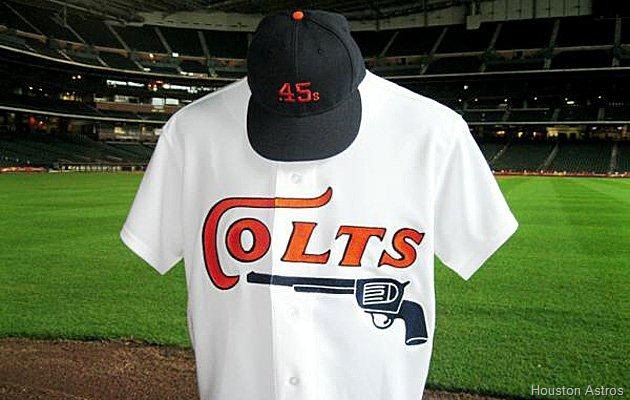
“I do indeed, Mr. Postolos; thank you. In fact I have a two-part plan, and the first element targets the team logo and uniform. In conjunction with the opening of this new stadium in 2000, our predecessors implemented a thorough upgrade of the visual branding elements of the team logo and uniforms. Although this scheme was accepted, our research shows it has never been fully embraced, and I propose we now begin planning to implement a similar refresh of the team totems and other symbology to coincide with our debut in the American League next year. Marketing is over the moon at the prospect, by the by. And FYI, should we choose to advance along this path our deadlineOpenStar copy to submit planned changes to Major League Baseball is Opening Day of this season, this April 6.”

“Mr. Crane and I have discussed that prospect and it’s very much in play; as you noted, a change in uniform that dovetails with our opening up in the AL next year makes intellectual sense and we think it will keep interest in the change brewing throughout this season, then spark a landslide of buying the new merchandise during the off-season next year. I’d say to you that this change is a virtual certainty. Now, what’s the second part of your plan.”

“Excellent, sir. Then following along this path of New Beginnings in 2013, and in conjunction with a new look for the uniforms and the logo, I propose we look at raising the wager. In its fifty years as a major league baseball organization, the Houston National League Base Ball Club has had, shall we say, a rather spotty record of achievement; no need to dredge up the details. Today, under new leadership, with promising young players, we stand on the cusp of a successful new future, one so bright that one ought to wear dark glasses. So let’s not hold back in this presentation, in this re-creation, of the team. I propose that when we unveil the new uniforms and logo, that they herald a fully new brand—we will change the name of the team!”

“Bentley…that’s pretty out there, my friend. You really want to drop the name ‘Astros’ after all these years—don’t you imagine that that will, if you’ll excuse me, piss people off?”

“Some, undoubtedly, sir; no doubt at all. But this doesn’t come from any ill will felt toward the fans or the space program, rather from that place that sees a potentially enormous marketing payday that should not be permitted to go to waste. And if I may, I propose we truly raise our gaze above the horizon: let’s be open to changing the ‘Houston’ part of the team name as well. Names indicating representation of a broader area, such ascurrent the Minnesota Twins or the Colorado Rockies, are by no means unheard of, although it would indeed be rather awkward for our organization to go by ‘Texas’ since that name is already employed by the team in North Texas. But as an organization, I suggest we give open and honest consideration to all of our available options.”

“I don’t know, it just seems so drastic to sell off so much of our history just to make a buck—oh crap, did I just say that out loud?”

“Not at all, sir, not at all.”

“I git what Bentley here’s saying, but I don’t think too much of going through with it; folks around here might feel like they’re being exploited, and you know how they can hold a grudge.”

“Excuse me, sir, but I just had an idea: we don’t have to actually make any change, but what if we, you know, just let it be known that a name change is being considered? That’ll get people paying attention to the Astros, and, like, thinking about what they love about the team, and talking about it all, and, then we’ll be all, you know, like announcing that the whole name change idea has been dropped, and they’ll thank us for supporting team history and, you know, not feel so bad about buying fresh new hats and shirts. What about that idea, sir?”

“Cyndi, lunch is on me. Good meeting, everybody. Go Astros!”

UPDATE Jan. 30: Late this evening owner Jim Crane announced a decision that the team name will not be changed. (No word on the size of Cyndi’s raise.)