I love a parade, but not this

I did not attend Saturday’s military parade in Washington, D.C, or even watch it on TV or watch the news coverage of it. I was hoping it would be a dud, that most people wouldn’t be interested in TFG’s self-indulgent display…turns out, that may be exactly what happened. Charles P. Pierce attended in person, and he wrote down some thoughts that have been published in Esquire including “I have never experienced such a joyless, lifeless, and sterile mass event in my entire life.”

I remember when parades used to be fun—bands, bunting, some big Army boom-booms for the kids to cheer over, every high school bandmaster doing their best Robert Preston cosplay. I remember when they were ceremonies of communal joy. You could mark your calendar by them. Homecoming parades. Veterans Day, which was Armistice Day when I was very young. Macy’s and Gimbel’s and Hudson’s on TV every Thanksgiving and the Rose Parade on TV for New Year’s. Memorial Day. The Fourth of July. All of them were supposed to honor something or someone, provided you could see past the cotton candy.

And then there was this leaden spectacle on Saturday, June 14.

(snip)

Grim-faced soldiers, marching past half-empty grandstands, many of them obviously wanting to be somewhere else. No bands. Little bunting. Just piped-in rock music and MAGA hats. If this truly was meant to honor the 250 years of the United States Army, all we got was an endless procession of uniformed troops looking like they’d prefer to have been at Valley Forge. The president, sitting on the reviewing stand in that weird, forward-leaning attitude that he has, rarely smiling, a skunk at his own garden party. Scores of people being funneled through cattle-runs of metal grates just for a chance to sit on the lawn of the Washington Monument and listen to bad music and speeches so dull and listless that they’d have made Demosthenes get out of the business and open an olive oil stand. I think there probably was more good feeling and genuine emotion when they took Jack Kennedy out to Arlington for the last time.

(snip)

A lot of the people waiting in line were watching on their phones, watching the coverage of the No Kings marches all around the country. Now, those were parades—laughter and singing and chanting and people in goofy costumes and exotic hair-colors, thousands of them, big cities and small towns. The streets were jammed with people celebrating the hope that this Grand Guignol period of our national life will pass one day. There was no hope in the streets of Washington. Just tanks and cannons and soldiers marching in dead-eyed cadence.

Just a taste; there’s more and it’d be worth your while to give it a read.

Reality checkers

obfuscate: to throw into shadow; to make obscure; confuse; to be evasive, unclear, or confusing (Merriam-Webster)

We — all of us, I think — we need more people in our world with clear vision about things that are happening plus both the ability and the commitment to speak plainly and honestly about those things. Today I come to praise the deobfuscators.

Have you heard, there were people in the White House during the last term who tried to cover up the president’s physical and mental decline? I know, such a shock, right? Or, as the great Charles P. Pierce puts it in Esquire, the hysteria over Jake Tapper and Alex Thompson’s revelation “that a White House will withhold adverse health information from the public…is, of course, news to those people who remember Grover Cleveland’s secret cancer operation, the unspoken agreement not to photograph FDR in his wheelchair, the relative severity of Eisenhower’s heart problems, the staggering medical record of John F. Kennedy, Nixon’s manic boozing during the height of the Watergate crisis, and, in the closest parallel we have, Reagan’s staff’s successful concealment of the fact that he was a symptomatic Alzheimer’s patient for most of his second term.”

It’s not to say that what is reported in this book is not true; it is to say, rather, “duh.” The diminishment of public dialogue in our time, to a focus on what is shiny and new to the exclusion of all else, makes it easy for us to lose sight of the things that should really matter to our country, to our children’s future. Of course, there are those who prefer it this way:

Life will go back to normal for the elite political media and their useful idiots in the Democratic party. They won’t have to think much about assaults on habeas corpus, deportation of tiny cancer patients, destruction of the regulatory safeguards of the federal government, or clear-cutting of American democracy. Game on!

Earlier this month we all learned that Rob Manfred, the commissioner of Major League Baseball, decided to lift the “permanent” ban from baseball issued in 1989 to Pete Rose, which makes Rose eligible for election to the Baseball Hall of Fame. Columnist Mike Finger at the San Antonio Express-News elegantly gives voice to the clear reading of events which corporate Baseball would prefer you ignore: MLB dishonestly re-defined “permanent” to mean “lifetime” and cravenly capitulated to a president who can’t keep his tiny tiny hands off of other people’s business.

In one view of America, apparently shared by Manfred, character counts, but it doesn’t count that much. Some sins are unforgivable, but only for a while. History should be honored, but the parts that make us uncomfortable can be omitted.

And above all, principles are what matter, right up until the day someone in power asks you to abandon them.

Within three years, baseball’s all-time leader in hits might be enshrined at last in the Hall of Fame in Cooperstown, New York. Thanks to Manfred’s decision, Rose is eligible to be considered by the veteran’s committee, even though he repeatedly broke the game’s most hallowed rule, even though he denied it for more than a decade, even though he never apologized, and even though the ban he accepted in 1989 was supposed to be “permanent.”

None of those facts changed after Rose died last September at age 83. The only big development since then was that Rose received a public show of support from the president of the United States.

If your consideration is limited to Rose’s career as a player, there’s no doubt he deserves the honor of being in the Hall, starting with the fact the had more hits than any other player, ever. But he was banned because he broke the rule that no player is allowed to bet on baseball, ever. Period.

Rose had his chances to atone for his misdeeds while he was alive, and he never did. He applied for reinstatement in 2015, initially claimed he didn’t bet on sports anymore, then admitted he still did. He kept making appearances in casinos, even after then-commissioner Bud Selig suggested that staying away could provide a path to removing the ban.

(snip)

And now is the time that Manfred chooses to ease off the most notorious betting rule-breaker of his generation?

Apparently, now is indeed the time. Now is the time, even though betting wasn’t the worst of Rose’s alleged transgressions. In 2017, Rose was accused in federal court documents by a woman who claimed to have had a sexual relationship with him when she was 14 or 15 years old in 1973, when Rose was in his 30s. According to the Philadelphia Inquirer, Rose issued a response acknowledging he had sex with the accuser, but “said he believed she was 16 at the time, old enough to legally consent in Ohio.”

In 2022, when an Inquirer reporter asked him about the incident, Rose responded, “It was 55 years ago, babe.”

That, of course, is not an admission of guilt. It’s also probably not a line likely to be included on Rose’s Cooperstown plaque, if he gets one.

It is, however, a reflection of one version of America. As long as the right man is vouching for you, any source of shame can be overlooked, if not outright ignored.

We need people who are on the lookout for attempts to warp the facts of the reality we share, and I’m pleased to have found two more.

After Such Violence, the Center Must Hold

New York Times opinion writer David French had these thoughts soon after the apparent assassination attempt against Donald Trump on Saturday evening. I hope we can all share his sentiments as we go forward.

“Things fall apart; the center cannot hold.” William Butler Yeats wrote these words in his poem “The Second Coming” in a different time of violence and fear. The year was 1919, Europe was still reeling from World War I, a deadly influenza pandemic was sweeping through the world, and the Irish war of independence was underway. Yeats was writing from the heart of a storm, a storm that would grow indescribably worse in 20 short years.

I think of Yeats’s words often. By “center,” he’s referring not to some kind of moderate political middle but rather to the moral center of civilization. When the moral center gives way, nations fall.

I thought of those words again when I saw the blood on Donald Trump’s ear on Saturday. Now is the time for America’s moral center to rise up and declare — with one voice, neither red nor blue — “Enough.” We either recover our sense of decency and basic respect for the humanity of our opponents, or we will see, in Yeats’s words, the “blood-dimmed tide” loosed in our land.

The cultural conditions for chaos are created by a lack of courage and character. Yeats lamented that the “best lack all conviction, while the worst are full of passionate intensity.” And already, we’ve seen the passionate intensity of the worst on display. Members of one extreme faction have claimed the shooting was an elaborate ploy to generate sympathy for Trump. At the same time, members of the opposing extreme faction have attempted to claim that President Biden is responsible for the attack.

How does the center hold? Democrats and independents must stand in solidarity with Republicans, grieving for the dead, praying for the wounded and giving thanks that Trump survived with only a minor wound. Virtually every leading Democrat has condemned the violence with a loud voice, and Biden has both condemned the violence and spoken to Trump directly.

All of this is good and necessary, but it is not sufficient. Each of us has our own role to play, in our own circles of influence, either big or small. There has rarely been a better time to love our enemies, to pray for our nation and to remember — during one of the most fraught political campaigns in generations — that each and every one of us is a human being, created in the image of God.

Fingers crossed, hoping for the best

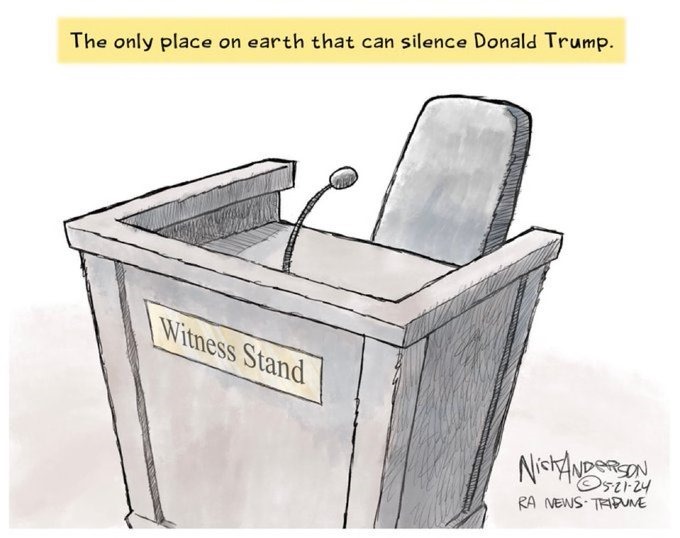
A few thoughts while waiting for the New York jury to return a verdict in the business fraud/election interference trial of you know who:

I hate it every time a news report refers to Donald Trump’s “Hush Money Trial.”  Not only is it inaccurate and lazy, but it plays into his overheated claim that he’s being persecuted, that there was no crime committed.

  • It is NOT against the law to have sex with a porn actor.  Of the many things it may be (and you have your own list of the things that it is), “against the law” is not one of them.  I pray we don’t return to an age in this country where it is against the law for consenting adults to engage in some non-hurtful behaviors.
  • It is NOT against the law to pay hush money.  Blackmail is a crime, for the person committing it; it’s not illegal for you to pay money to keep someone from telling a secret about you.
  • It is NOT even a crime to use your private company’s funds to pay that hush money, provided your paper trail does not lie about the use of the money.  Your investors or directors probably won’t like it much and may take action against you, but it’s not business fraud.  (And if Trump is SOOO rich, as he claims, why didn’t he just write a check himself and not get the company money involved?  I know, hindsight is 20/20.)

BUT, if you doctor your company’s books to falsify the record about why the money was spent – like, saying it was “legal fees” when it was really reimbursing an employee for fronting you the hush money to conceal a private matter – that IS a crime.  It is business fraud in New York, and that is the crime the Manhattan district attorney is prosecuting.  It became a major felony when, in this case, the fraud was committed to advance another crime: improperly interfering with the 2016 presidential election by covering up information that could harm Trump’s chances.  (Man, isn’t it hard to get your head around the idea that it was Trump and Republicans who actually were committing the election fraud, not the liberals and the illegals?)

Lately I’ve been running across many clever, funny, and to-the-point posts that take the varnish off of efforts to obscure what Trump has done, and what he promises to do if elected.  On ABC’s This Week George Stephanopoulos had a terrific summary as the current trial began.

GOnN-WNXcAAD5my

Last week Jennifer Rubin had a good roundup of Trump’s pratfall-filled week leading up to the trial’s closing arguments, including his not-unexpected cop-out when it came to fulfilling his repeated promise to testify in his own defense (something that I know no defense lawyer wants a client with a total lack of self-control and a well-documented history of serial lying to do).

Finally, Trump predictably chickened out of testifying. He repeatedly boasted he would testify, but like so many other attempts to look tough, this one fizzled into the ether. The episode underscored his cowardice and fragility. At some level, he likely knew that if he had taken the stand, he would have wound up either perjuring himself, digging his own legal grave or both.

What explains these serial debacles? This is who Trump is. He cozies up to neo-Nazis and white nationalists, so naturally he attracts aides with the mind-set to borrow material from fascists. He has contempt for women and tries to please his white Christian nationalist base at every turn; unsurprisingly, he has no idea where to stop and how far is too far. And he bullies his lawyers, insisting on making dumb arguments and calling witnesses he thinks are swell but who implode under examination. (And because he surrounds himself with disreputable charlatans and yes-men, one can hardly be surprised when they reveal their true character.)

For all Trump’s braggadocio, it may be that he just isn’t all that bright, cannot think strategically beyond the moment and lacks any common sense. Without aides or family members empowered to stop him from colossal missteps, he racks up the blunders. And perhaps like a good many bullies, he really does fear taking a punch.

GONmYbbWgAAAmpP

GOR52y_X0AA1_J_

Trump’s family, which finally began to trickle in to the courthouse to act like they support him, joined in the family business – lying to our faces – when Eric Trump clearly and cleanly misstated the facts:

And beyond the current trial, the situation has become severe enough to get the historian and documentarian Ken Burns off the political sideline; he had this warning to America during a commencement speech at Brandeis University.

Just a couple more..I can’t resist:

Storm warning

First, point out to anyone who complains when all of the ballots in Tuesday’s elections have not been counted by their bedtime Tuesday night and says that is evidence of widespread voter fraud that that is pure bull.  All the votes have probably never been counted just a few hours after the polls are closed, certainly not in an era when we encourage everyone to vote and accommodate their exercise of their rights with early voting and voting by mail and voting from overseas and such modern developments.  And second, don’t listen to anyone who argues on election night that there is evidence of widespread voter fraud – especially if they do so on the Fox “News.”  First, it would take a thorough investigation to prove that accusation.  Second, no such investigation has ever proven that fraud pervasive enough to change the results of elections has ever happened.  (OK, retiring the italics now.)

I don’t know what the results of Tuesday’s elections will be, but I feel confident we won’t find that the poisonous political divide across our country has miraculously healed.  The fight for democracy, as some have cast it, won’t be over whenever this week’s votes are finally tallied, because the fight never ends.  “The price of liberty is eternal vigilance” said…someone, I guess, but apparently not Mr. Jefferson despite many citations, but it’s a great thought to keep in mind: any system designed to guarantee freedom will face threats from those who find your freedom and mine an impediment to their own power.  (You know who I mean.) So how do we keep our spirits up in the face of that on-going threat?  Dahlia Lithwick has a great prescription in Slate.

It is easy to feel despair. The folks who keep disparaging those who worry about the future of democracy seem uninterested in the fact that one party refuses to accept election results, inflames election violence, admits the entire plan is one-party rule, and brushes off and even jokes about vigilante violence. Those same people have been adept at pushing us into semantic arguments about whether we’re using the right words to describe what we see happening right before our eyes. The problem with wasting our time fighting about whether the best word to use in this particular situation is “authoritarianism,” or “fascism,” or “vigilantism,” or “lawlessness,” is that such things can often only ever be empirically established in retrospect. We can hold the I Told You So Olympics in 10 years. Let’s get that on the books.

Call it whatever you like, but this speedy descent into a world in which people who are fundamentally unethical and unserious hold too many levers of power is not normal and it’s not funny. Even for the people striving to find meaning and purpose in the ugliness, the temptation to cede ground, give up, and go small is alluring. That they want you to cede ground, give up, and go small is in fact the problem we can name right now.

My rabbi recently reminded me of a useful way to think through the fog. Citing another spiritual hero last weekend, Aurora Levins Morales, she reminded me that there is always a difference between the weather and the stars. Morales, teaching in 2017, warned that it is too easy to be buffeted by the changeable weather, and in so doing, to lose sight of the immutable stars. The stars, in this telling, are a “constant to steer by, sometimes hidden by storm clouds, but high above them, untouched by wind or rain.”

The weather is different. Weather, Morales conceded, can be “violent, drenching, harsh.” But it isn’t constant. If we do nothing but chase and feel the weather, she wrote, “we could spin forever from emergency to emergency, shouting no to each new crime—but that would be steering by chasing clouds.”

The weather, and the stars: I think that’s a great way to think about it.  There’s the weather, that which we see every day and which changes day to day and in some cases hour to hour—it seems big and important, but it’s transient within the span of our own observation.  The stars, although not permanent in that firmament, can give each of us something long-lasting to steer by.  Lithwick again:

I spent the week before midterm elections that could help determine the fate of democracy in the United States trying to pick my own way through a careening mess of the world into those buckets: Weather versus star. Elon Musk is weather; so is Marjorie Taylor Greene. Tucker Carlson is weather. Even losing tens and thousands of followers on Twitter is, respectfully, just weather. It all matters, sure, and it’s all painful. But it’s a series of transient states to distract you from what is real.

Stars are the things that don’t ebb and flow with the showy Twitter feuds, or the mutable hourly outrages, or public performances of ghastly daily mediocrity. For some of us, the stars are the upcoming elections and the extraordinary acts of voter registration, postcarding, election protection, and democratic engagement. For some of us the stars are the law, the rule of law, and the efforts to bring accountability for lawbreaking. For some of us the stars are efforts to build a tolerant, pluralist world in the face of rising racial and religious intolerance and xenophobia.

(snip)

As we move through the frightening and destabilizing days to come, the weather will attempt to consume more and more of your time and attention and energy. Fascists will tweet more fascism to try to distract you from the impacts of their fascism. My entirely inadequate advice will remain unchanged: Sit in the foulness of the roiling storm and do your work, whatever that may be, and triangulate by the light of whatever star feels eternal to you. Take care of your family; they need you, and take care of your health. Take care of your community; it needs you, and take care of someone in your community who doesn’t know Twitter is even a thing. Vote. Help others vote. Register voters. Staff voter protection hotlines. Place your own body between someone unkind and someone vulnerable. Read a book. Help a kid. Give someone food and love and respect. Donate something you don’t use. Ask for help. Don’t give your time or attention to anything small enough to diminish you along with it.

We’re in the weather, and the temptation to do nothing but talk about the weather is fierce. But above and beyond there are still fixed and immutable values and principles and we must try as best we can to steer by those things instead.

(snip)

You won’t always be able to see them, but the stars are still there. And we will get through the storms ahead, even if we don’t yet believe it, because the storms are not the story. We are the story. Keep looking up.