Actual malice, meet demonstrable truth

…not long after Joe Biden had been officially declared the winner of [the 2020 presidential] election, a bunch of disreputable right-wing sore losers—that’s the technical term—began to claim that the Dominion machines had somehow been tampered with, and that votes that had been duly cast for Donald Trump via Dominion machines had been secretly switched over to Biden’s column.

The fact that this thesis was very stupid did not stop it from gaining credence among many Trump voters. These people weren’t just angry that their candidate had lost the election; they were angry that Fox News wasn’t reporting that Trump had actually won the election. In retaliation, many of these Trump fans began to unofficially boycott Fox News, instead tuning in to other right-wing news networks, such as Newsmax, which were much more willing to indulge their conspiratorial fantasies.

Check out more of this nice, fun summary of Dominion Voting systems libel suit against Fox News here.  The libel suit is scheduled to go before a jury in a Delaware court tomorrow, assuming the two sides don’t reach a settlement between now and then.

As a recovering journalist myself, I’ll say it is my belief that it should be hard to get a libel verdict against a journalist, a newspaper or broadcast company.  The U.S. Constitution envisions a free press that facilitates a lively public debate of issues, and in the decision that set today’s judicial standard on libel law, New York Times v. Sullivan, Justice William Brennan wrote for a unanimous court that “debate on public issues should be uninhibited, robust, and wide‐open, and that it may well include vehement, caustic, and sometimes unpleasantly sharp attacks on government and public officials.”  The threat of litigation is often used to by people who come out on the bad end of those debates to try to scare a paper or a station into not running tough stories (see: Trump, Donald J.; litigation; threats of).

But that doesn’t mean that those who publish on paper, who broadcast through the air, or who post online, should have a free hand to say anything they want at any time with impunity; those who have truly been libeled do have recourse.  But keep in mind, reputable publications can make a strong defense by proving the truth of what they published: if a published statement is true, it is not libelous or slanderous. (It was not ever thus: courts no longer automatically consider statements that damage the reputation as obviously libelous.)  If what was published is factually true, it is not libelous and you cannot win a lawsuit alleging libel.

In a case where the plaintiff is a public figure or a public official, Times v. Sullivan set a high bar for proving you were libeled by a publication: you must prove that the defendant published a story “with knowledge that it was false or with reckless disregard of whether it was false or not.”  (A term you’ll often hear that is used to describe that state is to say the publication acted with “actual malice.”)  While publication of an erroneous story is bad and hurts the reputation of the publication, it is not a case of libel against a public figure or institution (which Dominion is) if the publication believed the story was true and had done the required work to gather the facts to come to believe it was true.

In Dominion Voting Systems v. Fox, the voting machine company claims Fox defamed the company by “spreading false claims that the company rigged the 2020 presidential election to prevent former President Donald Trump’s reelection.”

As noted in a New York Times story last week,

While legal experts have said Dominion’s case is unusually strong, defamation suits are extremely difficult to win because the law essentially requires proof of the defendants’ state of mind. Dominion’s burden will be to convince a jury that people inside Fox acted with actual malice, meaning either that they knew the allegations they broadcast were false but did so anyway, or that they acted so recklessly they overlooked facts that would have proved them wrong.

During standard pre-trial discovery in this case, Dominion uncovered information from inside Fox that Fox News Channel and its on-air talent and some of its management leaders knew that the claims against Dominion were not true (“with knowledge that it was false”) but published the stories anyway—over and over again—to keep from offending their viewers who believed the claims from Trump and his lawyers and other sycophants of a rigged election (“with reckless disregard of whether it was false or not”).

As it often does, Fox defends itself by wearing the mantle of mainstream responsible journalism operating in the public interest; it argues it reported the claims made by Trump and others because they were newsworthy.

Fox has argued that while it understood many of the claims made by its guests about Dominion were false, they were still worth covering as inherently newsworthy. Fox’s lawyers have taken the position that there is nothing more newsworthy than claims by a former president of the United States that an election wasn’t credible.

But Judge [Eric] Davis disagreed.

“Just because someone is newsworthy doesn’t mean you can defame someone,” he said, referring to pro-Trump lawyers like Sidney Powell and Rudolph W. Giuliani, who appeared repeatedly on Fox News and Fox Business in the weeks after the 2020 election and linked Dominion to various conspiracy theories.

The judge admonished Fox’s lawyers, saying they cannot make the argument that the false statements about Dominion came from guests like Ms. Powell and not from Fox hosts. That argument is irrelevant, he said, because the fact remains that Fox is responsible as the broadcaster.

“It’s a publication issue, not a who-said-it issue,” he said.

There’s no guarantee to the outcome of a jury trial, of course…but if I may presume to summarize a closing argument for Dominion:

  • Fox lied about Dominion rigging its election machines to steal the 2020 presidential election from Crybaby He-Man
  • Dominion made every effort to inform Fox that what its guests and its hosts were saying on the air was incorrect
  • Fox knew that the accusations against Dominion that were being made on its programs were lies, but permitted them to continue
  • Dominion suffered monetary losses and losses to its reputation as a result of Fox’s broadcasts, and asks for money damages

Nice and neat, and not confusing.

Fox has been lying on the air to its audience for years, telling them (1) what they want to hear, regardless of whether it is true, and (2) what certain politicians have agreed to parrot, to build political consensus and power.  But this time, it lied about a company that was willing to call them out in a court of law, and the case has landed before a judge who has demonstrated his loyalty to demonstrable truth and facts.  For Fox, that is a whole new kind of audience.

Saboteurs in sheep’s clothing

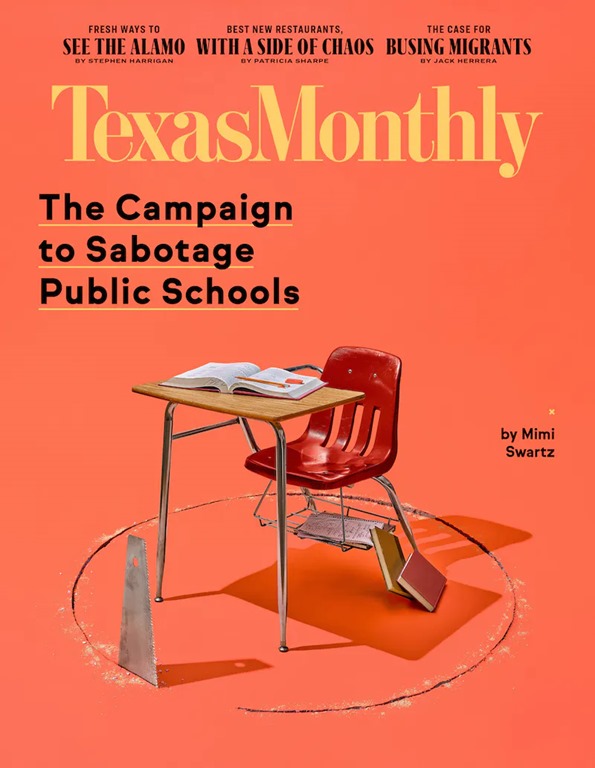
“They” say the depredations of age get each of us eventually, and maybe that’s responsible for what feels like my increasingb530dca6-86c1-4d7b-9fd1-e6ebb1bf3b41 inability to think of just the right word on short notice.  But whatever the cause, I owe a big thanks to whoever wrote and approved the headline on the March cover of Texas Monthly: “The Campaign to Sabotage Public Schools” hit perfectly as the word to describe the effort I’ve witnessed for years as radical evangelical Christians have undermined Texas public schools while insisting they are trying to save them.  Butter wouldn’t melt in their mouths.

For a quick refresher on the history of free public education in the United States, check out this short summary by the Center on Education Policy at The George Washington University.  The effort wasn’t without its shortfalls, but the driving force was the thoughtful insight that the future of America depended on educated Americans.

The Founding Fathers maintained that the success of the fragile American democracy would depend on the competency of its citizens. They believed strongly that preserving democracy would require an educated population that could understand political and social issues and would participate in civic life, vote wisely, protect their rights and freedoms, and resist tyrants and demagogues. Character and virtue were also considered essential to good citizenship, and education was seen as a means to provide moral instruction and build character. While voters were limited to white males, many leaders of the early nation also supported educating girls on the grounds that mothers were responsible for educating their own children, were partners on family farms, and set a tone for the virtues of the nation. The nations’ founders recognized that educating people for citizenship would be difficult to accomplish without a more systematic approach to schooling. Soon after the American Revolution, Thomas Jefferson, John Adams, and other early leaders proposed the creation of a more formal and unified system of publicly funded schools. While some Northeastern communities had already established publicly funded or free schools by the late 1780s, the concept of free public education did not begin to take hold on a wider scale until the 1830s.

It became understood across society that educating all of our children would be a benefit to the nation as a whole, and that the tax money needed to fund that effort was one of the responsibilities of citizenship, whether or not you had children and whether or not you sent them to the public school in your town.  Today, that desire and responsibility to promote a societal good is diminishing in some sectors of society; you’ve probably seen these people at work in your community as I have in mine.

The people who believe America is a “Christian nation” and that any effort to respect and accept other beliefs is misguided and unpatriotic.  The people who cannot abide that some people have different beliefs and ideas about what is right and how things should be done, especially when those other people do not share their religious beliefs; for these people, “freedom of religion” as a concept means that all Americans are free to worship as they do.  The people who protested COVID vaccine mandates as another flavor of criticism of established authority outside their “faith tradition.”  The people who now suddenly protest school library books as insufficiently representative of Christian evangelical mores.  The people who demonize the people who are willing to acknowledge the history of racism in this country, and the persistence thereof.  For them, public schools that teach children about math and science and literature and history to prepare them for participation in the secular world at large, and that do not take as their primary responsibility the religious indoctrination of students, are enemies to be defeated.  To be sabotaged, if necessary.

Taken individually, any of these incidents may seem like a grassroots skirmish. But they are, more often than not, part of a well-organized and well-funded campaign executed by out-of-town political operatives and funded by billionaires in Texas and elsewhere. “In various parts of Texas right now, there are meetings taking place in small and large communities led by individuals who are literally providing tutorials—here’s what you say, here’s what you do,” said H. D. Chambers, the recently retired superintendent of Alief ISD, in southwest Harris County. “This divisiveness has been created that is basically telling parents they can’t trust public schools. It’s a systematic erosion of the confidence that people have in their schools.”

The “they” behind this crusade are the current generation of a movement that has been trying to destroy public education for years.

The motivations for these attacks are myriad and sometimes opaque, but many opponents of public education share a common goal: privatizing public schools, in the same way activists have pushed, with varying results, for privatization of public utilities and the prison system. Proponents of school privatization now speak of public schools as “dropout factories” and insist that “school choice” should be available to all. They profess a deep faith in vouchers, which would allow parents to send their children not just to the public schools of their choice but to religious and other private schools, at taxpayers’ expense.

But if privatizing public education is today cloaked in talk of expanded liberty, entrepreneurial competition, and improved schools for those who need them most, its history tells a different story. In 1956, two years after the U.S. Supreme Court handed down its landmark Brown v. Board of Education decision, a group of segregationist legislators in Texas, with support from retiring governor Allan Shivers, began concocting work-arounds for parents appalled by the prospect of racial integration of public schools. One idea: state-subsidized tuition at private schools. That never came to pass, but it was Texas’s first flirtation with vouchers.

The dreaded vouchers.  The current effort in Teas, supported now for the first time by the governor as well as the lieutenant governor, uses the buzzwords “school choice” and “educational excellence” to advocate for a system that will take tax money out of the public schools and hand it over to the private schools, including private religious schools.  Yes: take public tax money and use it to pay for a religious school education for Texas children.

I don’t know that there was ever opposition to parents pulling their children out of the local public school and sending them to private schools—when they do so at their own expense.  My own parents footed the bill to send me to a private high school where they believed I would get a better education than in the Houston public schools.  Maybe they were right about that part.  But they never presumed to think that their public school tax money should be drawn out of the local public school district to pay their son’s private school tuition.  And I don’t want my secular tax dollars today supporting your favored religious institution, regardless of denomination.  And yes, that is exactly what this plan would do.

Pro-voucher people reject the argument that vouchers will only benefit the rich: they say vouchers will help the poor save their children from underperforming public schools.

That hasn’t worked out either. In various experiments across the nation, funding for vouchers hasn’t come close to covering tuition costs at high-quality private schools, and many kids, deprived of the most basic tools, haven’t been able to meet the standards for admission.

(Besides, just think about it: why are the schools “underperforming” in the first place?  Think it has anything to do with the effort over the years to reduce spending on schools or to divert school tax money into private school tuition?)

Voucher programs in Texas have failed at the legislature in the past because of opposition to the diversion of tax money, and due to the pragmatic concern of rural lawmakers who know that public school districts employ significant percentages of their constituents.  Draining the school budgets wasn’t/isn’t in their interests.  The lieutenant governor has favored some form of voucher system for years, but not the governor.

Governor Greg Abbott, knowing all too well the political headwinds that vouchers have faced, has long been wary of publicly supporting them, so he has undermined public schools in other ways. While campaigning early last year, he promised to amend the Texas constitution with a “parental bill of rights,” even though most, if not all, of those rights already existed. By then, “parental rights” had become a dog whistle to animate opponents of public education. (As the Texas Tribune put it: “Gov. Greg Abbott taps into parent anger to fuel reelection campaign.”)

During the recent intensifying crisis on the border, Abbott publicly floated a challenge to the state’s constitutional obligation to give all Texas children, including undocumented ones, a publicly funded education—a step his Republican predecessor, Rick Perry, had denounced years earlier as heartless. Then last spring, Abbott made headlines with his first full-throated public endorsement of a voucher program.

So here we are, with distrust in public schools advancing as fast as the latest COVID-19 variant. The forces behind the spread of this vitriol are no mystery. Those who would destroy public schools have learned to apply three simple stratagems: destabilize, divide, and, if that doesn’t work, open the floodgates of fear.

Here come the foot soldiers of the modern digital offensive: they lie about and harass people they disagree with, and amazingly (at least to me) very many of people who read those lies on Facebook believe them!  Same terrifying principle as with Alex Jones and his acolytes who not only bought what he had to say about the Sandy Hook school shooting being fake, but then took it upon themselves to attack the bereaved parents.  In the TM article, Mimi Swartz’ example of these tactics come from the Central Texas town of Dripping Springs, and she explains the rich and powerful players in the game.

In 2006 [James] Leininger found powerful new allies when [Tim] Dunn, with a major financial assist from the Wilks brothers, formed Empower Texans. Public education became one of its primary targets, in part because the property taxes that funded schools ran counter to their interests as billionaires and in part because they wanted more Texas children exposed to their version of Christian values.

(snip)

What voucher proponents needed most was a powerful champion who was also a gifted salesman. Former sportscaster and right-wing talk-radio host Dan Patrick happily stepped into the role. Elected to the state Senate from Houston’s prosperous, white, northwestern suburbs in 2006, the perpetually youthful but often choleric Patrick was lieutenant governor by 2015. Patrick found school choice and its kissing cousin, property tax reduction, to be winning issues among his right-wing base and his growing cadre of big-money donors, who, along with the backers of TPPF and Empower Texans, also included the billionaire deans of dark money, the Kansas-based brothers Charles and David Koch.

The American Legislative Exchange Council, commonly known as ALEC, is a powerful Koch-supported organization that has devoted much time and money to privatizing public schools nationally. According to a study by the watchdog group Common Cause, Texas has one of the highest concentrations of state lawmakers connected to the organization, at around 32 percent. One of the first bills Patrick introduced in the 2011 legislative session called for eliminating the ceiling on the number of charter schools allowed in the state. It failed, but the relentless Patrick rammed it through two years later. Echoing Republican U.S. senator Ted Cruz, Patrick would also proclaim vouchers to be “the civil rights issue of our time.”

(snip)

The state’s leadership has found other ways to undermine public schools. Texas, according to the latest data, ranks fortieth when it comes to school spending—$10,300 per pupil annually, compared with the national average of $13,500. According to a survey conducted by the Annie E. Casey Foundation, a charitable organization devoted to child welfare, Texas gets what it pays for, ranking thirty-third in the U.S. in the quality of its K–12 education.

Then there is the state’s ongoing loyalty to the STAAR test, the results of which are used to evaluate teacher and school quality. Its efficacy has been widely challenged by educators, parents’ groups, and academic researchers, who have found that the test’s demands are often well above grade level. And because the test is used as a yardstick to grade (and potentially close) schools, test prep has taken over actual teaching in many classrooms.

There’s much more worth your time in the story, which fleshes out the story of the attack on public education, in Texas and elsewhere, in the past couple of generations.  Some of it has been simple, racially-motivated white flight to the suburbs, leaving behind city schools with fewer resources available for the students who remain.  Not satisfied with their parents’ decision to take their ball and go to a new home, the children and grandchildren of those parents of the 50s and 60s are now trying to grab every last nickel they can out of the public school system to “protect” their own children from the real world.  I feel sorry for the children who will have to deal with that world without benefit of a “real world” education.

Florida man referred for criminal prosecution

The House January 6 committee’s investigation has produced all the evidence that should be needed to send a former president to jail.  (Who would have believed we’d ever come to that point in this country?)  Testimony from Republicans – from people who willingly and eagerly worked for the former guy, yet also valued their own good names and reputations and the importance of truthfulness under oath – makes it unavoidably plain, to any clear-eyed person able to honestly evaluate the evidence, what happened.

Before the election was even held and before anyone had been able to count any votes, Donald Trump laid the groundwork for his con by asserting that any election he might lose would of necessity be fraudulent, and his hangers-on assembled baseless “legal” theories to advance the story that Trump was a victim…that all Americans and patriots were victims of Democrats and progressives and America-haters, that the people whom they had let themselves believe were pedophiles and socialists and opponents of fascism and Trump-haters had stolen their country.

As the votes were being counted the Trumpers pursued dozens of cases in court – in many cases, shopping for Trump-appointed judges they expected would be willing to do anything to please “Mr. Trump” – and they lost, over and over and over again, the judges all finding that there was no basis for the complaints and no evidence to prove them.  There was not, and still is not, evidence to prove that there was fraud committed in the 2020 general election for president that was significant enough to change the outcome.  Hence, no reason to rise up in rebellion.  Still, the crybaby con man refused to accede to reality, despite the efforts from family and friends and staff and lawyers and insightful bloggers that he man up and do the right thing: peacefully stand aside for his lawfully-elected successor as president, as American law and tradition have held for more than 225 years.

Trump encouraged supporters to organize a rally in Washington on the day Congress was to certify his defeat, where they could stage a demonstration that appealed to his overweening sense of himself, his unshakeable narcissistic belief in the grandeur of him!  After all, who else but Trump could engender such devotion from the suckers and losers he so detested, that these proud Americans would stage an armed assault on the seat of their own government on his behalf?

Again today there was an air of disbelief from committee members who told the part of the story about how Trump never made any effort to stop this attack on America – never called on any law enforcement assets or federal agencies to defend the Capitol, never issued a call to his supporters to straighten up and go home.  Are we surprised at that, really?  I’ve got a clear picture in mind of him glued to TV and patting himself on the back in the realization that this plan that was so crazy it just might work…was working!  Until it wasn’t, I guess…until enough supporters on the outside looking in, and enough members of Congress on the inside looking out and pleading for help, gained the critical mass to convince even the Great and Powerful Trump that the jig was up.  Even then he couldn’t make himself admit to being in error: he professed his love for these “special” Americans who were at that moment still committing treason and gleefully sharing the incriminating evidence of their crimes on social media.  Geniuses.

Any list of his questionable behavior since his return to private life – since his big boy pout of “snubbing” Joe Biden’s inauguration – is irrelevant to the possible criminal charges of inciting or assisting an insurrection, obstruction of an official proceeding of Congress, conspiracy to defraud the United States, and conspiracy to make a false statement that arise from the January 6 attack on the Capitol.  (Perhaps another time.)  I applaud the committee’s recognition that others in government played a role in Jan. 6 that should not be ignored: kudos for the Ethics Committee referrals against House Republican leader Kevin McCarthy and GOP members Jim Jordan, Scott Perry and Andy Biggs for (like Trump) refusing to comply with committee subpoenas.  You can’t just thumb your nose at a Congressional committee and expect there to be no consequences.

Of course this isn’t the first time we’ve had ample evidence of Trump’s…shall we say, wrongdoing; Congress made history when it twice impeached him for high crimes and misdemeanors.  Well, Democrats in Congress did that; the feckless Republicans succumbed to a partisan effort to protect their own – a president of their own party, and more crucially their own jobs and power from the electoral annihilation they expected they would suffer from their MAGA constituents.  The Republican leadership of the incoming Congress will be powerless to stop this disbanding select committee’s work or the publication of its findings.  It’s up to the Justice Department now to do something about protecting the integrity of our democracy from those who think the laws do not apply to them.

Storm warning

First, point out to anyone who complains when all of the ballots in Tuesday’s elections have not been counted by their bedtime Tuesday night and says that is evidence of widespread voter fraud that that is pure bull.  All the votes have probably never been counted just a few hours after the polls are closed, certainly not in an era when we encourage everyone to vote and accommodate their exercise of their rights with early voting and voting by mail and voting from overseas and such modern developments.  And second, don’t listen to anyone who argues on election night that there is evidence of widespread voter fraud – especially if they do so on the Fox “News.”  First, it would take a thorough investigation to prove that accusation.  Second, no such investigation has ever proven that fraud pervasive enough to change the results of elections has ever happened.  (OK, retiring the italics now.)

I don’t know what the results of Tuesday’s elections will be, but I feel confident we won’t find that the poisonous political divide across our country has miraculously healed.  The fight for democracy, as some have cast it, won’t be over whenever this week’s votes are finally tallied, because the fight never ends.  “The price of liberty is eternal vigilance” said…someone, I guess, but apparently not Mr. Jefferson despite many citations, but it’s a great thought to keep in mind: any system designed to guarantee freedom will face threats from those who find your freedom and mine an impediment to their own power.  (You know who I mean.) So how do we keep our spirits up in the face of that on-going threat?  Dahlia Lithwick has a great prescription in Slate.

It is easy to feel despair. The folks who keep disparaging those who worry about the future of democracy seem uninterested in the fact that one party refuses to accept election results, inflames election violence, admits the entire plan is one-party rule, and brushes off and even jokes about vigilante violence. Those same people have been adept at pushing us into semantic arguments about whether we’re using the right words to describe what we see happening right before our eyes. The problem with wasting our time fighting about whether the best word to use in this particular situation is “authoritarianism,” or “fascism,” or “vigilantism,” or “lawlessness,” is that such things can often only ever be empirically established in retrospect. We can hold the I Told You So Olympics in 10 years. Let’s get that on the books.

Call it whatever you like, but this speedy descent into a world in which people who are fundamentally unethical and unserious hold too many levers of power is not normal and it’s not funny. Even for the people striving to find meaning and purpose in the ugliness, the temptation to cede ground, give up, and go small is alluring. That they want you to cede ground, give up, and go small is in fact the problem we can name right now.

My rabbi recently reminded me of a useful way to think through the fog. Citing another spiritual hero last weekend, Aurora Levins Morales, she reminded me that there is always a difference between the weather and the stars. Morales, teaching in 2017, warned that it is too easy to be buffeted by the changeable weather, and in so doing, to lose sight of the immutable stars. The stars, in this telling, are a “constant to steer by, sometimes hidden by storm clouds, but high above them, untouched by wind or rain.”

The weather is different. Weather, Morales conceded, can be “violent, drenching, harsh.” But it isn’t constant. If we do nothing but chase and feel the weather, she wrote, “we could spin forever from emergency to emergency, shouting no to each new crime—but that would be steering by chasing clouds.”

The weather, and the stars: I think that’s a great way to think about it.  There’s the weather, that which we see every day and which changes day to day and in some cases hour to hour—it seems big and important, but it’s transient within the span of our own observation.  The stars, although not permanent in that firmament, can give each of us something long-lasting to steer by.  Lithwick again:

I spent the week before midterm elections that could help determine the fate of democracy in the United States trying to pick my own way through a careening mess of the world into those buckets: Weather versus star. Elon Musk is weather; so is Marjorie Taylor Greene. Tucker Carlson is weather. Even losing tens and thousands of followers on Twitter is, respectfully, just weather. It all matters, sure, and it’s all painful. But it’s a series of transient states to distract you from what is real.

Stars are the things that don’t ebb and flow with the showy Twitter feuds, or the mutable hourly outrages, or public performances of ghastly daily mediocrity. For some of us, the stars are the upcoming elections and the extraordinary acts of voter registration, postcarding, election protection, and democratic engagement. For some of us the stars are the law, the rule of law, and the efforts to bring accountability for lawbreaking. For some of us the stars are efforts to build a tolerant, pluralist world in the face of rising racial and religious intolerance and xenophobia.

(snip)

As we move through the frightening and destabilizing days to come, the weather will attempt to consume more and more of your time and attention and energy. Fascists will tweet more fascism to try to distract you from the impacts of their fascism. My entirely inadequate advice will remain unchanged: Sit in the foulness of the roiling storm and do your work, whatever that may be, and triangulate by the light of whatever star feels eternal to you. Take care of your family; they need you, and take care of your health. Take care of your community; it needs you, and take care of someone in your community who doesn’t know Twitter is even a thing. Vote. Help others vote. Register voters. Staff voter protection hotlines. Place your own body between someone unkind and someone vulnerable. Read a book. Help a kid. Give someone food and love and respect. Donate something you don’t use. Ask for help. Don’t give your time or attention to anything small enough to diminish you along with it.

We’re in the weather, and the temptation to do nothing but talk about the weather is fierce. But above and beyond there are still fixed and immutable values and principles and we must try as best we can to steer by those things instead.

(snip)

You won’t always be able to see them, but the stars are still there. And we will get through the storms ahead, even if we don’t yet believe it, because the storms are not the story. We are the story. Keep looking up.

Listen for the right alarm

Even in the best of journalism, where the story is at once true and fair, not inflammatory or emotionally manipulative, you still want to catch the attention of the reader/listener/viewer/clicker so that they will read/hear/see your story (and be enriched by the experience).  So don’t think you know all there is to know when the headline on a Pew Research Center poll blares “45% of Americans Say U.S. Should Be a ‘Christian Nation’” because the truth is less alarming than that.

In the past couple of years I’ve written a few times about the concept of Christian nationalism, and not in an approving way.  By definition,

Christian nationalism is the belief that the American nation is defined by Christianity, and that the government should take active steps to keep it that way. Popularly, Christian nationalists assert that America is and must remain a “Christian nation”—not merely as an observation about American history, but as a prescriptive program for what America must continue to be in the future. Scholars like Samuel Huntington have made a similar argument: that America is defined by its “Anglo-Protestant” past and that we will lose our identity and our freedom if we do not preserve our cultural inheritance.

Christian nationalists do not reject the First Amendment and do not advocate for theocracy, but they do believe that Christianity should enjoy a privileged position in the public square. The term “Christian nationalism,” is relatively new, and its advocates generally do not use it of themselves, but it accurately describes American nationalists who believe American identity is inextricable from Christianity.

Most of the Founding Fathers did profess a belief in a Supreme Being. If they believed that the success of their new creation was inextricably linked to Christianity as it was understood in their day – even IF  that is true – that’s not what it says in the structure for government they wrote.  Historical scholarship has lauded the American experiment that protects the rights of citizens to worship freely while disconnecting the religions from having any governmental authority.  It’s been one step on the still-being-paved path to a free society willing to give everyone a chance to contribute and to reap the rewards of their work.

So the headline roaring that nearly half of us think we should be a “Christian nation” is concerning, but it turns out there’s not so much worry there as one might imagine since the survey also finds that we don’t agree what that phrase even means:

For instance, many supporters of Christian nationhood define the concept in broad terms, as the idea that the country is guided by Christian values. Those who say the United States should not be a Christian nation, on the other hand, are much more inclined to define a Christian nation as one where the laws explicitly enshrine religious teachings.

Overall, six-in-ten U.S. adults – including nearly seven-in-ten Christians – say they believe the founders “originally intended” for the U.S. to be a Christian nation. And 45% of U.S. adults – including about six-in-ten Christians – say they think the country “should be” a Christian nation. A third say the U.S. “is now” a Christian nation.

At the same time, a large majority of the public expresses some reservations about intermingling religion and government. For example, about three-quarters of U.S. adults (77%) say that churches and other houses of worship should not endorse candidates for political offices. Two-thirds (67%) say that religious institutions should keep out of political matters rather than expressing their views on day-to-day social or political questions. And the new survey – along with other recent Center research – makes clear that there is far more support for the idea of separation of church and state than opposition to it among Americans overall.

A Washington Post analysis makes clear that this poll hasn’t found a burbling caldron of restive theocrats across the country; in fact, “comfortable majorities want daylight between politics and faith.”

Sixty-seven percent of all adults, for instance, say churches should stay out of politics, while 77% say they should not endorse candidates for elected office.

Among the 45% who want the United States to be a “Christian nation”:

  • 28% want the federal government to declare the country a Christian nation, while 52% say the government should never declare an official religion
  • 24% say the federal government should promote Christian values, while 52% say it should promote moral values shared by many faiths
  • 39% say the federal government should enforce separation of church and state, while 31% say it should stop enforcing it.

Among all United States adults, 15% want the federal government to declare the country a Christian nation (69% do not), 13% say the federal government should promote Christian values (63% favor values shared by many faiths), 54% say the government should enforce separation of church and state (19% say it should stop).

So, the percentage of Americans who don’t believe in the separation of their Christian church from state authority is small…but the success of Christian evangelicals in winning political office is undeniable: give them credit for playing the game on its own terms and taking control of the levers of power at a rate beyond their real numbers in the population.  Those people are the ones fighting to make secular society look more like their preferred variety of Christianity.  Here in Texas they are hard-charging to use public tax dollars to fund private religious education for their children and leave the rest of “the little skoolchirrun of Texas” to languish in an underfunded and second-rate (at best) public education system.

“Texas, a friend used to say, is hard on women and little things” is how Christopher Hooks started a May article in Texas Monthly that let Texas’ Republican leaders have it (no Democrat has won statewide office in Texas since 1994!) over their treatment of children and the public education system:

It is a grotesque and cruel irony that the Republican primary this year, like several years of political activity before it, was dominated by an all-consuming and comically misdirected argument about the protection of children and by a multifront war against long-neglected public schools. There were essentially no contested policy proposals in the GOP primary that would affect the practical and economic circumstances of all Texans. (There rarely are.) There was, however, ceaseless discussion about the well-being of children, their morals, their internal lives.

The most acute panic was over transgender children. In February, [Attorney General Ken] Paxton’s office issued a formal opinion holding that gender-affirming care, such as the prescription of puberty blockers to trans kids, constituted child abuse. Shortly after, [Governor Greg] Abbott tasked the Department of Family and Protective Services, an overworked and underfunded agency he had overseen for close to eight years, with investigating the families of trans kids for such abuse.

The more widespread crisis concerned books. This panic was conjured up by right-wing parents and elected officials in roughly equal measure. The first target was “divisive” material about race. Then, elected officials began to agitate about “pornography” in schools, a category that included mostly literature featuring queer characters. Lawmakers proposed lists of books to be banned. In November, Abbott ordered the Texas Education Agency to investigate cases of pornography in public schools and prosecute those responsible “to the fullest extent of the law” because, he wrote, it had to be a top priority to “protect” Texas students.
Public school teachers and children’s librarians—members of two professions that offer highly beneficial services to society, for little pay—became villains to activist parents and candidates alike. They were called “groomers” and “pedophiles” on social media. In Granbury, near Fort Worth, two women lodged a criminal complaint in May against the local school’s libraries, prompting a police investigation. At a subsequent school board meeting, one of the women opined that a committee assembled to review troublesome books comprised “too many” librarians instead of “people with good moral standards.”

That’s right: no intersection in this Venn diagram of the universes of “librarians” and “people with good moral standards,” according to this woman.  She’s not alone in that kind of sentiment.  It’s so tiresome.

A year of manufactured outrage about the specter of loose morals in public education had the effect of making all of public education worse—which, for some, seemed to be the goal. Test scores have dropped. Even parents who strongly favor public schooling have begun to search for alternatives. State leaders, including Abbott, who have presided over an education system that spends about 20 percent less than the national average on each student, began to lay the framework for a renewed push to expand school choice and perhaps introduce a voucher system in which taxpayer dollars would be used to fund private schools.

Our right-wing lieutenant governor has been championing vouchers for years, and that came up in a terrific column by Chris Tomlinson in the Houston Chronicle this summer that highlighted the on-going effort by right-wing extremists and their rich Texas patrons to “gut Texas public education.”

Their top priority is helping Lt. Gov. Dan Patrick pass a school voucher bill that allows parents to spend state money to send their kids to private, religious schools, effectively defunding public schools. To inspire support for their plan, Patrick and his allies have set public schools up for failure by cutting their budgets.

Texas lawmakers have shrunk state spending per student over the last 15 years. Occasionally, they’ll authorize an increase, only to cut it later. Texas spends $9,900 per student, while the national average is $13,185, the Education Data Initiative reported.

Political vilification, school shooters, and poor compensation have led two-thirds of teachers to consider leaving the profession, the Texas American Federation of Teachers found in polling its members.

Texas already ranks 35th in the nation for pre-K through 12 education, U.S. News and World Report determined. WalletHub ranked the quality of Texas’s education as 33rd in the country. An exodus of experienced teachers will only worsen matters.

Few Texans can afford the $30,000 or more that a top private school charges and most do not want their child enrolled in a fundamentalist indoctrination camp. If we want our children and state to prosper in a competitive global economy, we must defend our public schools from those who would destroy them.

Self-described “conservatives” who demonstrate with their actions (and their money) that they do not believe in the American ideal of a free public education for all, nor do they believe in the separation of church and state or in real freedom of religion.  I can’t say how many of them fall into the 15% of all American adults who want the federal government to declare America a “Christian nation,” but I find it alarming enough to say I will have that in mind on election day.