Things I think that I think you should think too

It isn’t any wonder that people are confused, thanks to the ongoing gratuitous lying of TFG, and the lazy characterizations of and headlines about the news of the day. There are so many examples from which to choose, here’s a recent one that’s got me annoyed.

Five years ago amid the protests over the murder of George Floyd there came a movement to end the tributes being paid to those who committed treason by taking up arms against the United States of America during the Civil War. This started with opposition to statues and other monuments to the memory of Confederate war “heroes” across the country — mainly in the states of the former Confederacy, of course — and grew to reconsidering the naming of a number of U.S. military installations, vessels and related facilities which honored the likes of Robert E. Lee, Stonewall Jackson, the Battle of Chancellorsville and many more. (I wrote about my experience in this matter ten years ago.) Over the veto of President TFG, Congress created what was known as the Naming Commission — known in that way because its full name, I swear to God, was The Commission on the Naming of Items of the Department of Defense that Commemorate the Confederate States of America or Any Person Who Served Voluntarily with the Confederate States of America — with the mandate “to create a list of military assets with names associated with the Confederate States of America and recommendations for their removal.” In January 2023 the Department of Defense leadership ordered the Pentagon bureaucracy to execute the commission’s recommended name changes.

The changes themselves generated protests. Some, like a retired Army lieutenant colonel of my acquaintance, objected to the mothballing of the familiar names of places that they felt had created their own important history, despite the character of the men for whom they were named; I get that. But the real disheartening response was from the very many people who disagreed with ending the veneration of heroes of the Lost Cause, or who dishonestly argued that the change was meant to “change history.” No, the change was meant to stop honoring people who were never worthy of the honor, people who in fact were enemies of America.

Now, along comes a president who has clearly demonstrated, over and over again in the first five months of his second term in office, that he doesn’t believe any laws or other actions of the United States Congress apply to him — a position the Supreme Court has given him some reason to believe. He also (mistakenly) believes himself the cleverest little boy in class, and of course he lies as easily and as routinely as he breathes. In a speech this week, which prompted a renewal of concerns about his improper politicization of the U.S. military, he said “he would restore the names of all Army bases that were named for Confederate generals but were ordered changed by Congress in the waning days of his first administration.” Except, of course, he isn’t doing that at all.

In a statement, the Army said it would “take immediate action” to restore the old names of the bases originally honoring Confederates, but the base names would instead honor other American soldiers with similar names and initials.

For example, Fort Eisenhower in Georgia, honoring President Dwight D. Eisenhower — who led the D-Day landings during World War II — would revert to the name Fort Gordon, once honoring John Brown Gordon, the Confederate slave owner and suspected Ku Klux Klan member. This time around, however, the Army said the base would instead honor Master Sgt. Gary Gordon, who fought in the Battle of Mogadishu in Somalia.

The Army is acknowledging reality here, stating that the “new” names just so happen to match the previous names but actually honor other people and not the Confederates who are no relation to the new honorees.

Mr. Trump, however, contradicted that explanation in his announcement, at one point saying that the Army would be “restoring” the name of one Army base in Virginia — Fort Gregg-Adams — to “Fort Robert E. Lee,” previously named for the commander of the Confederate army. The Army said in its statement that the base would be renamed to honor Pvt. Fitz Lee, a member of the all-Black Buffalo Soldiers who was awarded a Medal of Honor after serving in the Spanish-American War.

The president lied, contradicting his own Pentagon. He did it, I believe, to curry favor with those people who didn’t want the names of the traitors removed from the bases in the first place, by telling them he was undoing what Congress and the Biden Administration had done. This is just a late example of something I’ve said about him for years: he will say anything, whatever he wants to be true in that moment, with no regard for its actual truth or even if it contradicts something he himself said previously. None of that matters to him. When it comes to anything he says, I find it helpful to remember, as was suggested some years ago (sorry, can’t remember by who), that he’s behaving as he always has: he’s a real estate developer hyping his latest project, and all that matters is closing the deal.

What I also find so very annoying in this case is how The New York Times presented the story I quoted from just now: the headline is “Trump Says Army Bases Will Revert to Confederate Names” and the subhead is “The move would reverse a yearslong effort to remove names and symbols honoring the Confederacy from the military.” Not “President Pulls a Fast One, Tricks Gullible Followers Into Thinking He Stood Up To The Woke Mob And Returned Glory To White Supremacists” followed by “Bait-and-switch inserts new honorees with same names as dishonored Confederates to make MAGA mob think they beat the libs again.”

I know that everyone gets it, intellectually, that our president is full of it. We all knew that last November, but he won anyway. Still, how come we seem to have to relearn the lesson day after day after day? I believe most people, including me, still start by hearing “the president” say something and think, hmm, that’s interesting, or terrific, or stupid or illegal, but our default reaction to Trump anytime his lips are moving should be, no, that’s not right. Honest reporters of the news do a pretty good job pointing out his “errors” but they must respond to such a tsunami of crap that the constant corrections can blend into the background noise.

On a related issue, I think it’s just wrong that anyone credit Trump himself for coming up with the ideas for the many rotten things being done by our government in his name. He’s not stupid, but he’s not educated enough about how the government works to have figured out how to short-circuit it, to sabotage it, to subvert our national ethos. Those ideas are coming from the smart, educated, devious and subversive supplicants in MAGA nation and the Christian nationalist world who are and have been using Trump as a figurehead to undermine our democracy and turn (or return) America into the nation of white Christians they believe it was and should be again. Maybe we can talk more about that another day.


As the coach used to say each Monday, let’s talk a bit about the happenings of last week

It was the best of times, it was the worst of times… (Been done.)

It was the worst night of my entire life… (Take it easy, Princess.)

What in the actual f**k were you people thinking… (Leave that approach to Jon Stewart.  How about this:)

I am very disappointed with the result of the presidential election, and I’m concerned about what’s going to happen starting next year.  (OK…keep going.)

It’s not that I was firmly convinced that Kamala Harris was going to win and am now staring at the returns in disbelief.  I definitely wanted her to win, but wasn’t deluded into thinking there was only one possible outcome.  I am bewildered to think that more than 73 million Americans think the former guy – now the once and future guy, I guess? – is the best person for the job.  Unless they really don’t think that at all.

Now I’m reading (see the reading list below, and thanks to everyone who kept this such a secret until after the whole thing was over) that Trump, as opposed to Harris or Joe Biden or apparently any other Republican, represents a dramatic change from a system that these people do not trust.  Strenuously do not trust.  The theory is that Trump voters don’t really agree with everything that comes out of his mouth; some things, sure, but not everything.  But they do want a major change from the status quo.  They want to throw out the scoundrels of the political establishment, and they trust that anything is better than what we have right now.  Even crazy, lying, fascist Trump is, they think, preferable to more of the same old same old.

While recognizing that all of us only have two real choices in this race by the time we get to November, I’m still surprised that so many people would vote for Trump.  A guy who lies to us so profoundly and so often, who is a convicted criminal, who has shamelessly used public office to enrich himself; who offers a plan to fight inflation and lower prices with tariffs that will undoubtedly raise prices instead, who promises to deport tens of millions of people in a plan that will be enormously expensive and disruptive to the labor force and economy as well as probably inhumane, who promises the unattainable instantly (end the wars in Ukraine and Gaza?  Easy peasy) with no clear plan of action.  Or any plan at all.

I’m worried about what’s going to happen next.  We were surprised in 2017 when he didn’t become more presidential or tone down the rhetoric or act more like what we were used to, but this time no one should be surprised if he does some of the out-there things he promised to do.

–he promised massive tariffs on foreign goods; we’ll all pay higher prices for those goods because the higher prices will be passed along to us by the seller.

–he promised (allegedly) vaccine denier Robert F. Kennedy, Jr. control of our public health agencies; yeah, what could go wrong there.

–he promised to jail his critics; First Amendment, Schmirst Amendment.  Stand by for other protected rights to be ignored.

–he promised the largest mass deportation in American history; waiting now for the (multi-million dollar) plans to construct a new generation of internment camps while he strong-arms our allies to accept repatriation.

–he promised to settle the wars in Gaza and Ukraine; stand by for “America First” plans that will provoke Iran, threaten Ukraine’s sovereignty (to the benefit of Russia), and put the NATO alliance in jeopardy.

You get the picture.  If Republicans end up with control of the House of Representatives as well as the Senate, we’ll also see Trump’s sudden support for Project 2025 and any other effort to push the Christian nationalist agenda to remake America civil society in their image.  And he’ll do it all while, as he did the first time, illegally enriching himself (hello, Emoluments Clause, my old friend).

Oh yeah, there’s this result, too:

image


FOR MORE INFORMATION:

To those thinking, how could Trump possibly win – that’s not who we are: Michelle Goldberg makes the case that maybe it is:

“Trump’s first election felt like a fluke, a sick accident enabled by Democratic complacency. But this year, the forces of liberal pluralism and basic civic decency poured everything they could into the fight, and they lost not just the Electoral College but also quite likely the popular vote. The American electorate, knowing exactly who Trump is, chose him. This is, it turns out, who we are.”

The polls say Trump won big with male voters; Elizabeth Spiers explores just which men they mean: Trump’s appeal to men was

“a regressive idea of masculinity in which power over women is a birthright. That this appealed in particular to white men was not a coincidence — it intersects with other types of entitlement, including the idea that white people are superior to other races and more qualified to hold positions of power, and that any success that women and minorities have has been unfairly conferred to them by D.E.I. programs, affirmative action and government set-asides. For men unhappy with their status, this view offers a group of people to blame, which feels more tangible than blaming systemic problems like rising economic inequality and the difficulty of adapting to technological and cultural changes.”

Bernie Sanders’ take:

“It should come as no great surprise that a Democratic Party which has abandoned working class people would find that the working class has abandoned them…First, it was the white working class, and now it is Latino and Black workers as well. While the Democratic leadership defends the status quo, the American people are angry and want change. And they’re right.”

David French calls the vote a revolt against the ruling class and a faithful effort by those who believe Trump fulfills a prophecy.  (Honest to God)

Democratic mega-donor (and one-time candidate himself) Michael Bloomberg wonders how Democrats could possibly lose to such a bad candidate.

Just for fun, here’s a “deep dive” (as the kids say) on the scary details of Project 2025; Christian nationalists are unlikely to let this opportunity pass.

Same song, next verse

When I was a college student in the capital city of Texas, the mayor once held his regular weekly news conference and was asked to comment on the fact that the state legislature was about to begin another biennial session under the big pink dome.  His immediate reaction was to say “Lock up the kids and dogs.”

America, your legislature is back in business: the House of Representatives has selected Mike Johnson of Louisiana as its new speaker.  Who is that, you ask, and what does he believe in?  Among other things, he

So, we got that going for us…which is not nice.  Ruth Marcus writes in the Washington Post that any sense of relief you might be feeling that a well-known extremist like Jim Jordan was not elected by Republicans in Congress is misplaced.

For Jordan’s shirt sleeves demeanor and wrestler’s pugnacity, substitute a bespectacled, low-key presentation, a law degree and an unswerving commitment to conservative dogma and former president Donald Trump.

This is not an upgrade. It is Jordan in a more palatable package — evidently smoother, seemingly smarter and, therefore, potentially more effective.

Johnson, now serving his fourth term in Congress, was the moving force behind aSpeaker Johnson Supreme Court brief that helped lay the shoddy intellectual groundwork for Jan. 6, 2021. In December 2020, he rallied fellow Republican lawmakers to support Texas’s brazen bid to overturn the election results. In a lawsuit that fizzled almost as soon as it was filed, Texas Attorney General Ken Paxton sought to have the Supreme Court intervene in the election by blocking the certification of electoral college votes in four swing states — Pennsylvania, Georgia, Michigan and Wisconsin — where voting rules had been changed in the course of the election and voters, not coincidentally, had favored Joe Biden. The justices swiftly rejected the case, tartly noting that, “Texas has not demonstrated a judicially cognizable interest in the manner in which another State conducts its elections.”

(snip)

The Johnson brief was a full-throated endorsement of the “independent state legislature” theory, ultimately rejected by the Supreme Court in 2023’s Moore v. Harper. The brief asserted that under the terms of the Constitution, only state legislatures — without any review by state courts or involvement of other state parties — have power to set rules for choosing presidential electors. “The clear authority of those state legislatures to determine the rules for appointing electors was usurped at various times by governors, secretaries of state, election officials, state courts, federal courts, and private parties,” the brief argued.

(snip)

The Texas episode was of a piece with Johnson’s conservative worldview. Before being elected to Congress, he was a senior lawyer and national spokesman for the Alliance Defending Freedom, a conservative group that opposes abortion, same-sex marriage and LGBTQ+ rights.

Running for Congress in 2016, he described himself as “a Christian, a husband, a father, a lifelong conservative, constitutional law attorney and a small business owner in that order, and I think that order is important.” Johnson said he had been “called to legal ministry and I’ve been out on the front lines of the ‘culture war’ defending religious freedom, the sanctity of human life, and biblical values, including the defense of traditional marriage, and other ideals like these when they’ve been under assault.”

We shall see how well Johnson does in leading the House, or at least its too-small-for-comfort Republican majority, in handling upcoming issues like a possible government shutdown in three weeks, or requests for more aid to Israel and Ukraine, or any of the other normal kinds of business which members of Congress are supposed to take care of on our behalf.  But given his still-declared support of Trump, it’s unlikely Johnson will be much of a leader when it comes to the reality of the need to work with Democrats to get things done: as David Frum wrote in The Atlantic earlier this month, “The rules of contemporary Republican politics make it had to accept reality.  Reality is just too awkward.”

In reality, Trump has been a big vote loser for Republicans. He fluked into the presidency with a Dukakis-like share of the vote in 2016, then lost his party its majority in the House in 2018. Trump got decisively booted from the presidency in 2020; rampaged illegally on January 6, 2021; and then cost his party its Senate majority in the January 2021 runoff elections. His election-denier message damaged his party further in the elections of 2022. His demand for a Biden investigation and impeachment in 2023 is producing an embarrassing fiasco. But no Republican leader dares say these things out loud.

Most taboo of all is working with Democrats, on any terms other than total, one-sided domination: We win, you lose. So [then-Speaker Kevin] McCarthy just had to press ahead, acting as if he commanded a majority when he did not; insulting and demeaning the minority, even though he had to know that he might need their help at any minute.

That minute came. McCarthy sought Democratic votes to save him from his own refractory members, and in return he offered nothing. Not even politeness.

That proposition did not produce the desired results, and so here we are.

Where we are is a country with a solid anti-Trump majority confronting a pro-Trump minority that believes it has a right to rule without concession or compromise.

The only way to produce a stable majority in the House is for the next Republican leader to reach a working agreement with the Democrats to bypass the nihilists in the GOP caucus. But that agreement will have to be unspoken and even denied—because making agreements that show any respect for the other side will be seen by Republican partisans as betrayal. The price of GOP leadership is delivering delusions and fantasies: the delusion and fantasy that Trump won in 2020, the delusion and fantasy that the Republicans did not lose in 2022.

“Delusion and fantasy” might well stand as a new motto for the remnants of a once proud GOP: in the Public Religion Research Institute’s annual American Values Survey, one-third of Republicans believe that “because things have gotten so far off track, true American patriots may have to resort to violence in order to save our country,” almost half think we need a strong leader who is willing to break some rules to get things done, and 29% are strong believers in the QAnon conspiracy movement. In the Washington Post, Jennifer Rubin writes:

Most frightening is how many Republicans buy into white Christian nationalism, a racist ideology that rejects the basic premise of our democracy: “All men are created equal.” One-third of Americans but 52 percent of Republicans agree that “God intended America to be a new promised land where European Christians could create a society that could be an example to the rest of the world.” The number is even higher among White evangelical Protestants (54 percent). Americans who subscribe to white Christian nationalism are more than twice as likely as other Americans to say true patriots might have to resort to violence to save the country.

In a related question, 75 percent of Republicans think the Founders wanted America to be a Christian nation with Western European values.

Rubin also identifies a “positive sign of public sanity” across the ideological spectrum.

Overwhelming majorities of Americans today support teaching the good and the bad of American history, trust public school teachers to select appropriate curriculum, and strongly oppose the banning of books that discuss slavery or the banning of Advanced Placement (AP) African American History.” Moreover, “A solid majority of Americans also oppose banning social and emotional learning programs in public schools.” Though some Republicans have made “anti-wokeism” a key requirement of their political identity, their message is deeply unpopular. “Fewer than one in ten Americans favor the banning of books that include depictions of slavery from being taught in public schools (7%), compared with 88% who oppose such bans.”

Sixty percent say abortion should be legal in most or all cases, compared with 37 percent who say it should be illegal in most or all cases. In a political reversal, “Democrats are now significantly more likely than Republicans to say their support for a candidate hinges on the candidate’s position on abortion,” 50 percent vs. 38 percent.

(snip)

Taking a step back, the overall picture here is a country that is inclusive, respectful of religious differences, pro-democracy and supportive of women’s rights — except when it comes to the largely Republican, mostly White evangelical Christians who reject these fundamental ideas.

When a sizable portion of one of the major political parties, aided by a right-wing propaganda machine and infused with religious fervor, rejects the basis for multiracial, multicultural democracy, we face a severe crisis. Even if Trump does not return to the White House, this radicalized segment will not disappear. How we reintegrate millions of Americans into reality-based, pro-democracy politics in a diverse country remains the great challenge of our time.

The real RINOs

Today’s Republican Party claims to be the only truly patriotic, fully America-loving and God-fearing political party in the country, the one that will protect regular America-loving and God-fearing citizens from the perfidies of big gummint and make the country, well, you-know-what again.  So, how are they doing with that today?

Well, as I write this we are just hours away from the gummint shutting down much of its operations because Congress cannot pass the legislation needed to pay the bills.  But not because the Congress and the president haven’t been able to come to a compromise: this past May President Biden and House Speaker McCarthy did agree on total spending levels through 2024.  It’s that some Republicans in the House refuse to accept the deal.  If there is no agreement by the deadline we can all look forward to enjoying life with only “essential services” from Washington.  If you are a government worker (as I was) who is deemed essential (as I was not), you get to keep working but not be paid for it; non-essential workers just get furloughed.

So much for Republicans looking out for the average, America-loving, God-fearing citizen.

What Republicans are doing instead of keeping the government running smoothly is kicking off an impeachment inquiry into President Biden.  Against whom they have no evidence – zero – of his commission of an impeachable offense.  Who brought witnesses who say they don’t see it, either:  Jonathan Turley, George Washington University law professor and Fox News contributor, said “In fact, I do not believe that the current evidence would support articles of impeachment.”  The same Republicans who screeched that Democrats were weaponizing impeachment against the former guy (who was as innocent as the day is long during his presidency, they insisted, and who is just being victimized by 91 criminal and civil indictments (so far) in his post-presidency) are only doing the Lord’s work in rooting out corruption in government.

The weird thing is, the same Republicans who are trying to use the mechanisms of government to impeach a president of the other party (albeit one who faces no substantiated allegations of any wrongdoing) are the same ones who by obstinately refusing to compromise on a spending plan will force much of that same government to close up shop for an indefinite period.  (Although, not Congress or their investigation.)  This is not, historically, what the Republican Party has been about.

The Grand Old Party was organized in the early 1850s as a coalition opposed to the expansion of slavery into new states and territories, and after the Civil War its majority in Congress –- the Radical Republicans -– passed laws to, among other things, protect the rights of freed slaves.  While Democrats in the South worked to chip away at the Reconstruction reforms, Republicans became more and more associated with the interests of business; some also supported (gasp!) progressive efforts for social reforms.

The growth of the federal government through the New Deal period and World War II encouraged more and more Southern Democrats who opposed civil rights for blacks (and other non-whites) and most expanded government programs to move to the Republican Party, where they joined up with conservative Christians stirred to action by opposition to “culture issues” that they were persuaded were threatening the “Christian nation” that God had intended America to be.  These elements came to control the party…or at least they did until they handed over the keys to a circus clown from New York.

Today those Republicans who are part of “MAGA nation” – polls say they are less than 25% of the nation as a whole — seem ever so pleased with themselves any time they get the opportunity to act-out as childish name-callers; one of their favorites is to brand a fellow Republican with whom they have some disagreement on a point of policy, no matter how trivial, as being a Republican In Name Only.  (How clever.)  But they are the real RINOs, who have succeeded in taking control of a once-respected political organization and philosophy and turned it into a vehicle (a clown car?) for instituting their warped social views into law.  It’d be a lot funnier if they weren’t so successful.

Saboteurs in sheep’s clothing

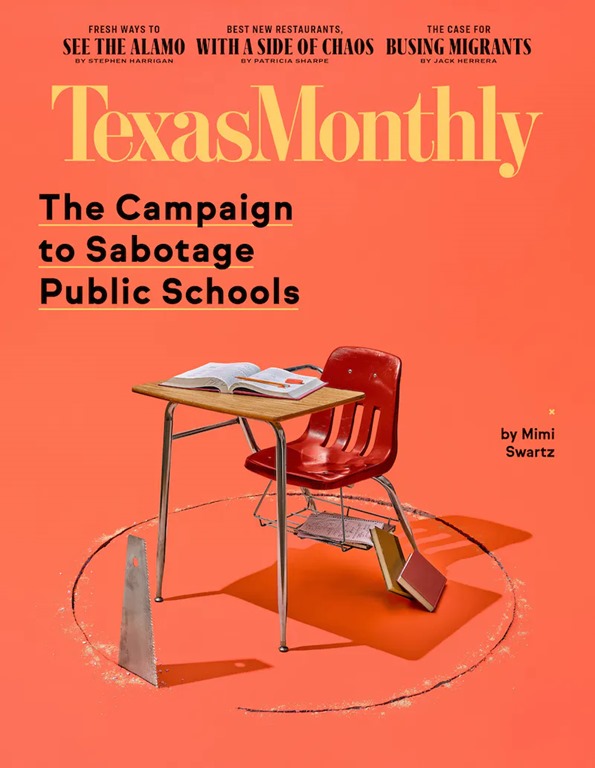
“They” say the depredations of age get each of us eventually, and maybe that’s responsible for what feels like my increasingb530dca6-86c1-4d7b-9fd1-e6ebb1bf3b41 inability to think of just the right word on short notice.  But whatever the cause, I owe a big thanks to whoever wrote and approved the headline on the March cover of Texas Monthly: “The Campaign to Sabotage Public Schools” hit perfectly as the word to describe the effort I’ve witnessed for years as radical evangelical Christians have undermined Texas public schools while insisting they are trying to save them.  Butter wouldn’t melt in their mouths.

For a quick refresher on the history of free public education in the United States, check out this short summary by the Center on Education Policy at The George Washington University.  The effort wasn’t without its shortfalls, but the driving force was the thoughtful insight that the future of America depended on educated Americans.

The Founding Fathers maintained that the success of the fragile American democracy would depend on the competency of its citizens. They believed strongly that preserving democracy would require an educated population that could understand political and social issues and would participate in civic life, vote wisely, protect their rights and freedoms, and resist tyrants and demagogues. Character and virtue were also considered essential to good citizenship, and education was seen as a means to provide moral instruction and build character. While voters were limited to white males, many leaders of the early nation also supported educating girls on the grounds that mothers were responsible for educating their own children, were partners on family farms, and set a tone for the virtues of the nation. The nations’ founders recognized that educating people for citizenship would be difficult to accomplish without a more systematic approach to schooling. Soon after the American Revolution, Thomas Jefferson, John Adams, and other early leaders proposed the creation of a more formal and unified system of publicly funded schools. While some Northeastern communities had already established publicly funded or free schools by the late 1780s, the concept of free public education did not begin to take hold on a wider scale until the 1830s.

It became understood across society that educating all of our children would be a benefit to the nation as a whole, and that the tax money needed to fund that effort was one of the responsibilities of citizenship, whether or not you had children and whether or not you sent them to the public school in your town.  Today, that desire and responsibility to promote a societal good is diminishing in some sectors of society; you’ve probably seen these people at work in your community as I have in mine.

The people who believe America is a “Christian nation” and that any effort to respect and accept other beliefs is misguided and unpatriotic.  The people who cannot abide that some people have different beliefs and ideas about what is right and how things should be done, especially when those other people do not share their religious beliefs; for these people, “freedom of religion” as a concept means that all Americans are free to worship as they do.  The people who protested COVID vaccine mandates as another flavor of criticism of established authority outside their “faith tradition.”  The people who now suddenly protest school library books as insufficiently representative of Christian evangelical mores.  The people who demonize the people who are willing to acknowledge the history of racism in this country, and the persistence thereof.  For them, public schools that teach children about math and science and literature and history to prepare them for participation in the secular world at large, and that do not take as their primary responsibility the religious indoctrination of students, are enemies to be defeated.  To be sabotaged, if necessary.

Taken individually, any of these incidents may seem like a grassroots skirmish. But they are, more often than not, part of a well-organized and well-funded campaign executed by out-of-town political operatives and funded by billionaires in Texas and elsewhere. “In various parts of Texas right now, there are meetings taking place in small and large communities led by individuals who are literally providing tutorials—here’s what you say, here’s what you do,” said H. D. Chambers, the recently retired superintendent of Alief ISD, in southwest Harris County. “This divisiveness has been created that is basically telling parents they can’t trust public schools. It’s a systematic erosion of the confidence that people have in their schools.”

The “they” behind this crusade are the current generation of a movement that has been trying to destroy public education for years.

The motivations for these attacks are myriad and sometimes opaque, but many opponents of public education share a common goal: privatizing public schools, in the same way activists have pushed, with varying results, for privatization of public utilities and the prison system. Proponents of school privatization now speak of public schools as “dropout factories” and insist that “school choice” should be available to all. They profess a deep faith in vouchers, which would allow parents to send their children not just to the public schools of their choice but to religious and other private schools, at taxpayers’ expense.

But if privatizing public education is today cloaked in talk of expanded liberty, entrepreneurial competition, and improved schools for those who need them most, its history tells a different story. In 1956, two years after the U.S. Supreme Court handed down its landmark Brown v. Board of Education decision, a group of segregationist legislators in Texas, with support from retiring governor Allan Shivers, began concocting work-arounds for parents appalled by the prospect of racial integration of public schools. One idea: state-subsidized tuition at private schools. That never came to pass, but it was Texas’s first flirtation with vouchers.

The dreaded vouchers.  The current effort in Teas, supported now for the first time by the governor as well as the lieutenant governor, uses the buzzwords “school choice” and “educational excellence” to advocate for a system that will take tax money out of the public schools and hand it over to the private schools, including private religious schools.  Yes: take public tax money and use it to pay for a religious school education for Texas children.

I don’t know that there was ever opposition to parents pulling their children out of the local public school and sending them to private schools—when they do so at their own expense.  My own parents footed the bill to send me to a private high school where they believed I would get a better education than in the Houston public schools.  Maybe they were right about that part.  But they never presumed to think that their public school tax money should be drawn out of the local public school district to pay their son’s private school tuition.  And I don’t want my secular tax dollars today supporting your favored religious institution, regardless of denomination.  And yes, that is exactly what this plan would do.

Pro-voucher people reject the argument that vouchers will only benefit the rich: they say vouchers will help the poor save their children from underperforming public schools.

That hasn’t worked out either. In various experiments across the nation, funding for vouchers hasn’t come close to covering tuition costs at high-quality private schools, and many kids, deprived of the most basic tools, haven’t been able to meet the standards for admission.

(Besides, just think about it: why are the schools “underperforming” in the first place?  Think it has anything to do with the effort over the years to reduce spending on schools or to divert school tax money into private school tuition?)

Voucher programs in Texas have failed at the legislature in the past because of opposition to the diversion of tax money, and due to the pragmatic concern of rural lawmakers who know that public school districts employ significant percentages of their constituents.  Draining the school budgets wasn’t/isn’t in their interests.  The lieutenant governor has favored some form of voucher system for years, but not the governor.

Governor Greg Abbott, knowing all too well the political headwinds that vouchers have faced, has long been wary of publicly supporting them, so he has undermined public schools in other ways. While campaigning early last year, he promised to amend the Texas constitution with a “parental bill of rights,” even though most, if not all, of those rights already existed. By then, “parental rights” had become a dog whistle to animate opponents of public education. (As the Texas Tribune put it: “Gov. Greg Abbott taps into parent anger to fuel reelection campaign.”)

During the recent intensifying crisis on the border, Abbott publicly floated a challenge to the state’s constitutional obligation to give all Texas children, including undocumented ones, a publicly funded education—a step his Republican predecessor, Rick Perry, had denounced years earlier as heartless. Then last spring, Abbott made headlines with his first full-throated public endorsement of a voucher program.

So here we are, with distrust in public schools advancing as fast as the latest COVID-19 variant. The forces behind the spread of this vitriol are no mystery. Those who would destroy public schools have learned to apply three simple stratagems: destabilize, divide, and, if that doesn’t work, open the floodgates of fear.

Here come the foot soldiers of the modern digital offensive: they lie about and harass people they disagree with, and amazingly (at least to me) very many of people who read those lies on Facebook believe them!  Same terrifying principle as with Alex Jones and his acolytes who not only bought what he had to say about the Sandy Hook school shooting being fake, but then took it upon themselves to attack the bereaved parents.  In the TM article, Mimi Swartz’ example of these tactics come from the Central Texas town of Dripping Springs, and she explains the rich and powerful players in the game.

In 2006 [James] Leininger found powerful new allies when [Tim] Dunn, with a major financial assist from the Wilks brothers, formed Empower Texans. Public education became one of its primary targets, in part because the property taxes that funded schools ran counter to their interests as billionaires and in part because they wanted more Texas children exposed to their version of Christian values.

(snip)

What voucher proponents needed most was a powerful champion who was also a gifted salesman. Former sportscaster and right-wing talk-radio host Dan Patrick happily stepped into the role. Elected to the state Senate from Houston’s prosperous, white, northwestern suburbs in 2006, the perpetually youthful but often choleric Patrick was lieutenant governor by 2015. Patrick found school choice and its kissing cousin, property tax reduction, to be winning issues among his right-wing base and his growing cadre of big-money donors, who, along with the backers of TPPF and Empower Texans, also included the billionaire deans of dark money, the Kansas-based brothers Charles and David Koch.

The American Legislative Exchange Council, commonly known as ALEC, is a powerful Koch-supported organization that has devoted much time and money to privatizing public schools nationally. According to a study by the watchdog group Common Cause, Texas has one of the highest concentrations of state lawmakers connected to the organization, at around 32 percent. One of the first bills Patrick introduced in the 2011 legislative session called for eliminating the ceiling on the number of charter schools allowed in the state. It failed, but the relentless Patrick rammed it through two years later. Echoing Republican U.S. senator Ted Cruz, Patrick would also proclaim vouchers to be “the civil rights issue of our time.”

(snip)

The state’s leadership has found other ways to undermine public schools. Texas, according to the latest data, ranks fortieth when it comes to school spending—$10,300 per pupil annually, compared with the national average of $13,500. According to a survey conducted by the Annie E. Casey Foundation, a charitable organization devoted to child welfare, Texas gets what it pays for, ranking thirty-third in the U.S. in the quality of its K–12 education.

Then there is the state’s ongoing loyalty to the STAAR test, the results of which are used to evaluate teacher and school quality. Its efficacy has been widely challenged by educators, parents’ groups, and academic researchers, who have found that the test’s demands are often well above grade level. And because the test is used as a yardstick to grade (and potentially close) schools, test prep has taken over actual teaching in many classrooms.

There’s much more worth your time in the story, which fleshes out the story of the attack on public education, in Texas and elsewhere, in the past couple of generations.  Some of it has been simple, racially-motivated white flight to the suburbs, leaving behind city schools with fewer resources available for the students who remain.  Not satisfied with their parents’ decision to take their ball and go to a new home, the children and grandchildren of those parents of the 50s and 60s are now trying to grab every last nickel they can out of the public school system to “protect” their own children from the real world.  I feel sorry for the children who will have to deal with that world without benefit of a “real world” education.