Recommended election reading, for those inexplicably eager for more election news

This week both The Los Angeles Times and The Washington Post issued the surprise announcement that they will endorse no one in the race for president this year.  Those decisions were made by the owners of the newspapers, who in that capacity have every legal right to make the choice they did.  Just not the moral and ethical rights, not if they want their newspapers to mean anything to the readers they claim to serve.

In the case of the LA Times, as the editorial board prepared a series of editorials leading to an endorsement of California native and former state attorney general and U.S. Senator Kamala Harris, it got a message from owner Dr. Patrick Soon-Shiong, “with scant internal or public explanation, abruptly vetoing the planned endorsement, informing the board through an intermediary that The Los Angeles Times would make no recommendation in the presidential race.”  Through an intermediary?  Dude didn’t have the guts to deliver the news face to face?  The story at the above link has more.

The choice at the Washington Post, which was expected to endorse the Democratic candidate, too, was to cease any endorsements in presidential elections from now on; it was announced by the paper’s publisher and framed as a choice to maintain neutrality.  That choice has been interpreted as an effort by the owner, Jeff Bezos, to avoid antagonizing the former guy; the Post itself has published the very critical reactions of 17 of its own opinion columnists under this declaration:

The Washington Post’s decision not to make an endorsement in the presidential campaign is a terrible mistake. It represents an abandonment of the fundamental editorial convictions of the newspaper that we love. This is a moment for the institution to be making clear its commitment to democratic values, the rule of law and international alliances, and the threat that Donald Trump poses to them — the precise points The Post made in endorsing Trump’s opponents in 2016 and 2020. There is no contradiction between The Post’s important role as an independent newspaper and its practice of making political endorsements, both as a matter of guidance to readers and as a statement of core beliefs. That has never been more true than in the current campaign. An independent newspaper might someday choose to back away from making presidential endorsements. But this isn’t the right moment, when one candidate is advocating positions that directly threaten freedom of the press and the values of the Constitution. [emphasis added]

Plenty of other papers are making endorsements, of course, including my hometown Houston Chronicle and my birthtown New York Times, both of whom are encouraging a vote for Harris.  And here are a few other recommended readings:

The Washington Post’s Eugene Robinson with a vivid reminder of the double standard we’ve developed for covering the two major party candidates: high scrutiny for the woman candidate, and a kind of same-old same-old attitude when the former guy “spews nonstop lies, ominous threats, impossible promises and utter gibberish.”

In Slate, Steven Greenhouse with the consideration that the unfathomable (to some) closeness of this contest can be blamed on the richest of the rich Americans who are prioritizing their personal financial well being over the betterment of our country.

At The Bulwark, Will Saletan’s tight summation of just what – specifically – Trump is doing that warrants him being labelled – accurately – as a fascist.

And a lively reminder from The Daily Show’s Jon Stewart of the it-would-be-amusing-if-it-weren’t-so-dangerous reality that the former president is, in point of fact, demonstrably not many the things that his loyal army of supporters say are their reasons for voting for him.  He is, in fact, the opposite of what they say he is, but they can’t/won’t see that.  Sad.

The truth shall set you free

One nice thing about Joe Biden’s decision to drop out of the race for president and to endorse Vice President Kamala Harris for the job – and then her enthusiasm for the task as she began to gather more support among Democrats nationwide, plus the wall to wall coverage of those efforts – has been the brief respite we’ve enjoyed from hearing TFG’s constant attacks and whining complaints about…well, everything.  Even The New York Times has noticed, and immediately sought to give the Republican nominee something of a make-good by doing a story about the fact that he wasn’t getting stories done about him.

It’s an unfamiliar experience for Mr. Trump, who has monopolized America’s televisions, newspapers and smartphones for more than 12 months through indictments, primary victories, 34 felony convictions, an assassination attempt and a Republican National Convention at which he was celebrated as a quasi-religious figure.

In the three days since President Biden announced he was quitting the 2024 race, Mr. Trump has entered foreign territory. He has been largely crowded out from “earned media,” or organic news coverage that spreads rapidly among voters and costs campaigns nothing to produce. And his message has been, for the moment, scrambled as Democrats have replaced an old, frail white man with a younger Black woman who is campaigning energetically and giving new life to the Democratic base.

(snip)

The Trump team was not unprepared. They had planned for the possibility of Mr. Biden’s dropping out, produced anti-Harris videos and tested her vulnerabilities in private polls. But they were still somewhat surprised when Mr. Biden actually did it. Some of Mr. Trump’s advisers thought he seemed too stubborn — “too Irish,” one aide said — to buckle to the pressure to quit a race against a man he viscerally hated and believed he was best positioned to defeat.

And they were caught off guard by the speed and ruthless efficiency of the replacement. They figured that if he did quit, Democrats would have to stumble through at least a few weeks of turmoil as ambitious Democrats jostled for their shot at the national stage.

(snip)

Mr. Trump was furious about the switch. He complained it was unfair that Democrats were forcing him to start over with a new opponent after he had spent all that time and money fighting Mr. Biden.

Boo-hoo.  What are you, five years old?  “They’re not being fair to me, they’re not being nice.”  Try to act like an adult instead of an entitled narcissist who doesn’t want to play the game unless it’s rigged…who keeps telling the same disproved lies over and over because you’ve got nothing else to say.

Which reminds me, I have a suggestion for anyone who finds themselves trying to argue some point or other with a Trump-ish opponent primed with the standard firehose of falsehoods: don’t think you have to fully refute every single specious argument they make.  You can take the trouble to point out the error, but they aren’t going to accept your argument – they will respond with another lie.  Trump does this all the time.  Instead, use forensic judo on them: respond to their torrent of lies with truths: fill the air with the good facts and let the leaden falsehoods from the MAGA mouths thud to the floor.

If you’re a supporter of Kamala Harris, deny the false attack on her and proudly reply with her true position on the issue.  No candidate for office, ever, has had a position on each issue that satisfies all potential voters.  On some things, we just disagree; that’s OK.  She is not running for God, and she doesn’t have to agree with you on every single topic to be a good president.  She starts with one insurmountable advantage: her election as president keeps Trump out of office and stymies efforts to implement the Project 2025 goals that the criminal Trump denies knowing anything about.  Which is, of course, another Trump lie.  (Add that to the more than 30,000 documented lies he told while he was president, or the 30 more “false claims” he managed to squeeze in during less than 90 minutes on stage in last month’s debate.)

If you feel you must knock down the stupid argument, here is a new, handy, fact-check sheet with to-the-point refutations for the usual false claims about job creation, inflation, tax cuts, government debt, tariffs, Ukraine, immigration, crime, and who is the worst president of all time.  (I think you know where that one is going.)

Stewart to the rescue

“The basis of our governments being the opinion of the people, the very first object should be to keep that right; and were it left to me to decide whether we should have a government without newspapers, or newspapers without a government, I should not hesitate a moment to prefer the latter.”  Thomas Jefferson, in a letter to Edward Carrington, January 16, 1787

If I may be so bold as to raise a point with Mr. Jefferson, I wonder if he would still prefer journalism to government if he knew something of the state of the former in the 21st century. Generally speaking, the Founders’ confidence in the American people to govern themselves fairly and justly was based on a presumption that the people would be honestly informed about the issues of their day, and they had faith that a free press would do that.  Even the free press of their day, which was unabashedly partisan.  American journalism evolved, and not always to the good: in an effort to be, and to appear to be, non-partisan, there are elements of today’s journalism that won’t defend objective truth for fear of being labelled everything from unfair to slanted to (gasp!) liberal.

But there is hope: journalists could be in practice what they aspire to be in theory, finders and defenders of truth based on verifiable evidence.  Like the courts have done, in admirably turning so many lion-like defenders of a certain 34-times-convicted felon into cowering pussy cats because courts prioritize truth, while television prioritizes likeable personalities and access.

Yes you, the eager young fellow in front:

Fingers crossed, hoping for the best

A few thoughts while waiting for the New York jury to return a verdict in the business fraud/election interference trial of you know who:

I hate it every time a news report refers to Donald Trump’s “Hush Money Trial.”  Not only is it inaccurate and lazy, but it plays into his overheated claim that he’s being persecuted, that there was no crime committed.

  • It is NOT against the law to have sex with a porn actor.  Of the many things it may be (and you have your own list of the things that it is), “against the law” is not one of them.  I pray we don’t return to an age in this country where it is against the law for consenting adults to engage in some non-hurtful behaviors.
  • It is NOT against the law to pay hush money.  Blackmail is a crime, for the person committing it; it’s not illegal for you to pay money to keep someone from telling a secret about you.
  • It is NOT even a crime to use your private company’s funds to pay that hush money, provided your paper trail does not lie about the use of the money.  Your investors or directors probably won’t like it much and may take action against you, but it’s not business fraud.  (And if Trump is SOOO rich, as he claims, why didn’t he just write a check himself and not get the company money involved?  I know, hindsight is 20/20.)

BUT, if you doctor your company’s books to falsify the record about why the money was spent – like, saying it was “legal fees” when it was really reimbursing an employee for fronting you the hush money to conceal a private matter – that IS a crime.  It is business fraud in New York, and that is the crime the Manhattan district attorney is prosecuting.  It became a major felony when, in this case, the fraud was committed to advance another crime: improperly interfering with the 2016 presidential election by covering up information that could harm Trump’s chances.  (Man, isn’t it hard to get your head around the idea that it was Trump and Republicans who actually were committing the election fraud, not the liberals and the illegals?)

Lately I’ve been running across many clever, funny, and to-the-point posts that take the varnish off of efforts to obscure what Trump has done, and what he promises to do if elected.  On ABC’s This Week George Stephanopoulos had a terrific summary as the current trial began.

GOnN-WNXcAAD5my

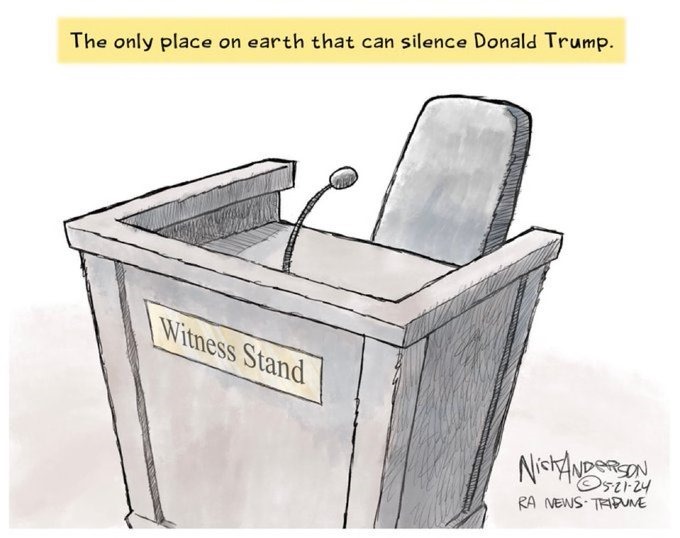
Last week Jennifer Rubin had a good roundup of Trump’s pratfall-filled week leading up to the trial’s closing arguments, including his not-unexpected cop-out when it came to fulfilling his repeated promise to testify in his own defense (something that I know no defense lawyer wants a client with a total lack of self-control and a well-documented history of serial lying to do).

Finally, Trump predictably chickened out of testifying. He repeatedly boasted he would testify, but like so many other attempts to look tough, this one fizzled into the ether. The episode underscored his cowardice and fragility. At some level, he likely knew that if he had taken the stand, he would have wound up either perjuring himself, digging his own legal grave or both.

What explains these serial debacles? This is who Trump is. He cozies up to neo-Nazis and white nationalists, so naturally he attracts aides with the mind-set to borrow material from fascists. He has contempt for women and tries to please his white Christian nationalist base at every turn; unsurprisingly, he has no idea where to stop and how far is too far. And he bullies his lawyers, insisting on making dumb arguments and calling witnesses he thinks are swell but who implode under examination. (And because he surrounds himself with disreputable charlatans and yes-men, one can hardly be surprised when they reveal their true character.)

For all Trump’s braggadocio, it may be that he just isn’t all that bright, cannot think strategically beyond the moment and lacks any common sense. Without aides or family members empowered to stop him from colossal missteps, he racks up the blunders. And perhaps like a good many bullies, he really does fear taking a punch.

GONmYbbWgAAAmpP

GOR52y_X0AA1_J_

Trump’s family, which finally began to trickle in to the courthouse to act like they support him, joined in the family business – lying to our faces – when Eric Trump clearly and cleanly misstated the facts:

And beyond the current trial, the situation has become severe enough to get the historian and documentarian Ken Burns off the political sideline; he had this warning to America during a commencement speech at Brandeis University.

Just a couple more..I can’t resist:

Actual malice, meet demonstrable truth

…not long after Joe Biden had been officially declared the winner of [the 2020 presidential] election, a bunch of disreputable right-wing sore losers—that’s the technical term—began to claim that the Dominion machines had somehow been tampered with, and that votes that had been duly cast for Donald Trump via Dominion machines had been secretly switched over to Biden’s column.

The fact that this thesis was very stupid did not stop it from gaining credence among many Trump voters. These people weren’t just angry that their candidate had lost the election; they were angry that Fox News wasn’t reporting that Trump had actually won the election. In retaliation, many of these Trump fans began to unofficially boycott Fox News, instead tuning in to other right-wing news networks, such as Newsmax, which were much more willing to indulge their conspiratorial fantasies.

Check out more of this nice, fun summary of Dominion Voting systems libel suit against Fox News here.  The libel suit is scheduled to go before a jury in a Delaware court tomorrow, assuming the two sides don’t reach a settlement between now and then.

As a recovering journalist myself, I’ll say it is my belief that it should be hard to get a libel verdict against a journalist, a newspaper or broadcast company.  The U.S. Constitution envisions a free press that facilitates a lively public debate of issues, and in the decision that set today’s judicial standard on libel law, New York Times v. Sullivan, Justice William Brennan wrote for a unanimous court that “debate on public issues should be uninhibited, robust, and wide‐open, and that it may well include vehement, caustic, and sometimes unpleasantly sharp attacks on government and public officials.”  The threat of litigation is often used to by people who come out on the bad end of those debates to try to scare a paper or a station into not running tough stories (see: Trump, Donald J.; litigation; threats of).

But that doesn’t mean that those who publish on paper, who broadcast through the air, or who post online, should have a free hand to say anything they want at any time with impunity; those who have truly been libeled do have recourse.  But keep in mind, reputable publications can make a strong defense by proving the truth of what they published: if a published statement is true, it is not libelous or slanderous. (It was not ever thus: courts no longer automatically consider statements that damage the reputation as obviously libelous.)  If what was published is factually true, it is not libelous and you cannot win a lawsuit alleging libel.

In a case where the plaintiff is a public figure or a public official, Times v. Sullivan set a high bar for proving you were libeled by a publication: you must prove that the defendant published a story “with knowledge that it was false or with reckless disregard of whether it was false or not.”  (A term you’ll often hear that is used to describe that state is to say the publication acted with “actual malice.”)  While publication of an erroneous story is bad and hurts the reputation of the publication, it is not a case of libel against a public figure or institution (which Dominion is) if the publication believed the story was true and had done the required work to gather the facts to come to believe it was true.

In Dominion Voting Systems v. Fox, the voting machine company claims Fox defamed the company by “spreading false claims that the company rigged the 2020 presidential election to prevent former President Donald Trump’s reelection.”

As noted in a New York Times story last week,

While legal experts have said Dominion’s case is unusually strong, defamation suits are extremely difficult to win because the law essentially requires proof of the defendants’ state of mind. Dominion’s burden will be to convince a jury that people inside Fox acted with actual malice, meaning either that they knew the allegations they broadcast were false but did so anyway, or that they acted so recklessly they overlooked facts that would have proved them wrong.

During standard pre-trial discovery in this case, Dominion uncovered information from inside Fox that Fox News Channel and its on-air talent and some of its management leaders knew that the claims against Dominion were not true (“with knowledge that it was false”) but published the stories anyway—over and over again—to keep from offending their viewers who believed the claims from Trump and his lawyers and other sycophants of a rigged election (“with reckless disregard of whether it was false or not”).

As it often does, Fox defends itself by wearing the mantle of mainstream responsible journalism operating in the public interest; it argues it reported the claims made by Trump and others because they were newsworthy.

Fox has argued that while it understood many of the claims made by its guests about Dominion were false, they were still worth covering as inherently newsworthy. Fox’s lawyers have taken the position that there is nothing more newsworthy than claims by a former president of the United States that an election wasn’t credible.

But Judge [Eric] Davis disagreed.

“Just because someone is newsworthy doesn’t mean you can defame someone,” he said, referring to pro-Trump lawyers like Sidney Powell and Rudolph W. Giuliani, who appeared repeatedly on Fox News and Fox Business in the weeks after the 2020 election and linked Dominion to various conspiracy theories.

The judge admonished Fox’s lawyers, saying they cannot make the argument that the false statements about Dominion came from guests like Ms. Powell and not from Fox hosts. That argument is irrelevant, he said, because the fact remains that Fox is responsible as the broadcaster.

“It’s a publication issue, not a who-said-it issue,” he said.

There’s no guarantee to the outcome of a jury trial, of course…but if I may presume to summarize a closing argument for Dominion:

  • Fox lied about Dominion rigging its election machines to steal the 2020 presidential election from Crybaby He-Man
  • Dominion made every effort to inform Fox that what its guests and its hosts were saying on the air was incorrect
  • Fox knew that the accusations against Dominion that were being made on its programs were lies, but permitted them to continue
  • Dominion suffered monetary losses and losses to its reputation as a result of Fox’s broadcasts, and asks for money damages

Nice and neat, and not confusing.

Fox has been lying on the air to its audience for years, telling them (1) what they want to hear, regardless of whether it is true, and (2) what certain politicians have agreed to parrot, to build political consensus and power.  But this time, it lied about a company that was willing to call them out in a court of law, and the case has landed before a judge who has demonstrated his loyalty to demonstrable truth and facts.  For Fox, that is a whole new kind of audience.