One small step

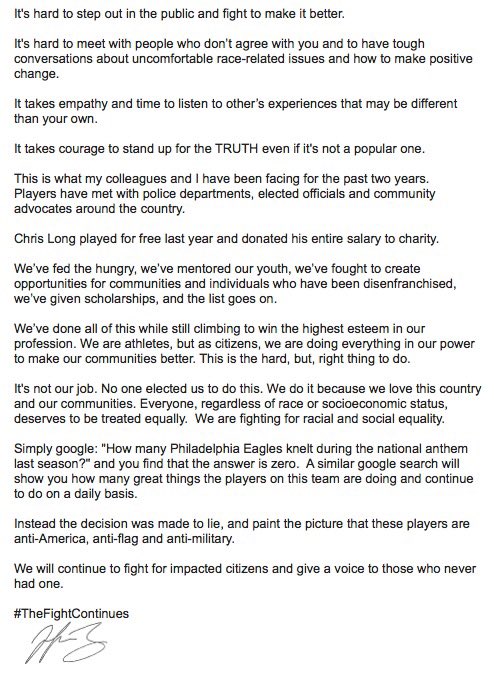
Because I believe our current president has a tenuous, hit-and-miss relationship (at best) with truth, I tend to just shake my head when he opens his piehole or his Tweeting machine: there’s no reason to think any of it is accurate or honest, and it shouldn’t be taken seriously (or literally)…by anyone.  But his current delusional outburst about the Philadelphia Eagles’ visit to the White House should not go unrefuted; one of the best responses I’ve seen was Eagles player Malcolm Jenkins today on Twitter.

De8Zs7_UYAAMD5AMaintaining a functioning civil society takes work from all of us, starting with just calling bullshit when appropriate.  It really is the least we can do.  (And never let it be said that I didn’t do the least I could do ~~ Hawkeye Pierce)

Turns out the twain shall meet after all

Doonesbury, or Shania Twain?  Tough call…but I can has both on the InterWebs.

Most interesting read of my morning was this story in Slate about the Canadian singer who got burned by touching on American politics, a story I missed over the weekend because I went to a wedding and played golf both days.  She sparked something of an uproar by saying that if she could have voted in the U.S. presidential election, she would have voted for Donald Trump because “even though he was offensive, he seemed honest.”  As the story notes, “Twain was furiously starting to backpedal before the weekend was out.  ‘I am passionately against discrimination of any kind and hope it’s clear from the choices I have made, and the people I stand with, that I do not hold any common moral beliefs with the current President,’ she tweeted on Sunday night.”

The author uses the Twain story to start a discussion of a peer-reviewed article in last August’s American Sociological Review:

How, the authors of the recent study set out to understand, do populists like Trump get away with such obvious lies? And why is it that, in the words of Shania Twain, many voters even perceive them to be especially honest?

(snip)

Even though most Trump supporters were willing to admit that Trump lies, they also rated him as extremely “authentic.” In fact, Trump was rated as being much more authentic by his supporters than Hillary Clinton was by hers.

This, the paper suggests, is the key to understanding Trump’s success.

When the political system is widely seen as doing its job, somebody like Trump, who violates its basic norms, is seen as illegitimate. A politician who blatantly lies doesn’t stand a chance. But this changes when more and more people come to believe that the system is rigged and that most politicians don’t have their best interests in mind. Amid such a “crisis of legitimacy,” voters don’t particularly care whether a politician plays by the rules of the game. Instead, they long for somebody who bluntly states how rotten the system really is.

I take from this that people are unhappy with the current system (check) and want to elect people who will do a better job on behalf of regular Americans than the people who are currently in office (check); and so they deduce that people who seem and sound different than the current crop of politicians are therefore the people who are going to do good things (wait what?!)?  This feels like this goes along with all the wondering about how come evangelicals are such strong supporters of Trump’s.  I mean, they’ve spent the time since the 1980 election campaign proudly showing off their holier-than-thou bona fides and making it clear that, to them, there is nothing more important when voting for an officer of our secular government than that man’s (preferably a man) belief in, and adherence to, their particular flavor of religion.  Until now, in the face of a candidate/president who is demonstrably everything they’ve claimed to oppose.

db180422

Thanks GoComics.com

There’s one more thing I just an across and want to share, and it kinda fits here—a quote from John Kenneth Galbraith in an interview in the Toronto Globe and Mail, July 6, 2002: “The modern conservative is engaged in one of man’s oldest exercises in moral philosophy; that is, the search for a superior moral justification for selfishness.”

It’s been a hell of a year

If you want to try to narrow down the chaos that is Trump’s America,  try for a moment to put aside the things the president has done, and those you fear he might do, which you feel threaten the security of our country, or maybe even the safety of the entire world (there are some things!), and just focus on corruption.  There’s too much, right?  Well, not if you’re CREW, Citizens for Responsibility and Ethics in Washington.  Earlier this month it published its cumulative list of actions that it considers to be personal conflicts of interest for President Trump…things he has done to financially benefit himself and his family, things that no previous president has ever done (at least not so blatantly and openly).

CREW researchers spent a year tracking every known interaction between the Trump administration and the Trump Organization in a daily timeline. Here’s what they found:

  • President Trump spent a full third of his first year in office—122 days—visiting his commercial properties.

  • Seventy executive branch officials, more than 30 members of Congress and more than a dozen state officials visited Trump Organization properties during the first year of the Trump administration.

  • President Trump and his White House staff promoted the Trump brand by mentioning or referring to one of the president’s private businesses on at least 35 different occasions during the president’s first year in office.

  • There have been more than 40 instances of special interest groups holding events at Trump properties since January 20, 2017.

  • At least eleven foreign governments paid Trump-owned entities during the president’s first year in office, and at least six foreign government officials have made appearances at Trump Organization properties.

  • Political groups spent more than $1.2 million at Trump properties during the president’s first year in office. Prior to President Trump’s 2016 campaign, annual spending by political committees at Trump properties had never exceeded $100,000 in any given year going back to at least 2002.

Are you OK with all of that?  I’m not.  But a thing that is in some ways even worse—although frankly I’m having trouble deciding what thing is worse than the next thing anymore—is the revelation of the heart and soul of the national Republican Party in this first year of the Trump Administration.  (Yes, it’s only been one year.)  Conservative columnist Jennifer Rubin gives a stark but honest reading in the Washington Post:

The sight of conservative Republicans cheering President Trump as a great success in his first year in office tells us much about the state of conservatism and the future of the GOP. There are two components to the reverential treatment of Trump: first, praise for allegedly conservative wins, and second, a willingness to tolerate falsehoods and attacks upon democratic norms and the American creed, as though these are matters of style.

As to the first, “conservatism” these days has become (both in the eyes of liberals who think conservatism is interchangeable with “right-wing extremism” and those claiming the conservative mantle) a cartoon version of itself. A tax cut that grows the deficit and gives disproportionate benefits to the rich is a “win” and “conservative” because, because … why? Because conservatism demands that whatever the needs of the moment and whatever the politics, the first order of business is to starve the government of revenue? Tax cuts unmoored from reasonable ends (e.g. fiscal sobriety, focused help for the working and middle class) are not “conservative”; deficits and widening of income inequality should not be cause for celebration.

Likewise, denying climate change or calling all regulatory repeal “conservative” (is it conservative to allow restaurants to take away employees’ tips?) doesn’t strike us as evidence of truth-based, modest government. In sum, much of the cheering for “conservative” ends skips over the details, disregards the substance and ignores context — none of which are indices of conservative thought. It is not conservative to favor reversing everything President Barack Obama did without regard to changed circumstances or alternatives. That doesn’t make Obama’s political legacy wonderful; it makes those advocating blind destruction without reasoned alternatives anything but conservative.

(snip)

The “shithole” episode vividly illustrates this. The sentiment underlying Trump’s attack on African immigrants entails a repudiation of the “all men are created equal” creed, a disregard of facts (e.g., education levels of African immigrants) and a rejection of economic reality verging on illiteracy. (We do need skilled and unskilled workers, we do not have a finite number of jobs, etc.) Put on top of that the willingness to prevaricate (Well, if we say it was “shithouse” and not “shithole,” we can say Sen. Dick Durbin was lying!) and you have an assault on principles that are the foundation for our democracy and for conservatism (or what it used to be). It’s not a minor episode. It’s in many ways a defining episode, not only for Trump but, worse, for his defenders.

OK, just one more today.  As bad as I feel this has been, I am persuaded by Leonard Pitts, Jr., in a column entitled “Trump’s definitely not the brains of the operation—and that’s a good thing” that it could be worse:

But what if Trump were smart?

More to the point, what if there arose some future demagogue who combined Trump’s new media savvy with a toxic ideology? It’s not far-fetched to wonder if Trump is not simply writing that individual’s playbook, showing her or him how easily a stable democracy can be subverted.

So even as we grapple with the daily outrages of this presidency, it would be smart to begin inoculating future generations against one that could be worse. Now, then, would be an excellent time to push even harder for Internet giants like Facebook and Twitter to find better ways of purging their platforms of false news and hate.

Now would also be an excellent time for schools to beef up their teaching of philosophy, history, civics, social studies. Teach those things as a means of helping people to think critically, value truth and internalize the ideals that are supposed to make America America.

All I can hear in my head right now is Whitney Houston: 

I believe the children are our future
Teach them well and let them lead the way

This is not the president you’re looking for

I get tired of feeling like I have to write about Donald Trump, and about what he has done and is doing to our country and our society.  I get tired of reading about the topic, too: it’s unhappy, repetitive, disillusioning news for anyone who believes in the American ideals of justice and tolerance and fair treatment and service to others.

The thing is, we can’t stop reading and writing about it because it’s too important.  None of us should just let what Trump and the Trumpettes are doing become background noise, or just blindly trust that someone somewhere will take care of it all eventually and things can go back to the way they were.  (First of all, things the way they were weren’t all that grand, but still…)  The least we can do is keep reminding ourselves and others of what is really happening—to recognize reality, to see the truth—and remind ourselves and others that things are not supposed to be like this.  We have to stand up for ourselves, and for our country.

David Brooks of the New York Times did a good job of that last week, sadly reminding the Republican Party and those who claim loyalty to its beliefs that they’ve betrayed their own ideals and are letting their party rot away.  He told Republicans who believed “…You didn’t have to tie yourself hip to hip with Donald Trump…You could sort of float along in the middle, and keep your head down until this whole Trump thing passed…it’s clear that middle ground doesn’t exist.”

First, [Trump] asked the party to swallow the idea of a narcissistic sexual harasser and a routine liar as its party leader. Then he asked the party to accept his comprehensive ignorance and his politics of racial division. Now he asks the party to give up its reputation for fiscal conservatism. At the same time he asks the party to become the party of Roy Moore, the party of bigotry, alleged sexual harassment and child assault.

There is no end to what Trump will ask of his party. He is defined by shamelessness, and so there is no bottom. And apparently there is no end to what regular Republicans are willing to give him. Trump may soon ask them to accept his firing of Robert Mueller, and yes, after some sighing, they will accept that, too.

That’s the way these corrupt bargains always work. You think you’re only giving your tormentor a little piece of yourself, but he keeps asking and asking, and before long he owns your entire soul.

The Republican Party is doing harm to every cause it purports to serve. If Republicans accept Roy Moore as a United States senator, they may, for a couple years, have one more vote for a justice or a tax cut, but they will have made their party loathsome for an entire generation. The pro-life cause will be forever associated with moral hypocrisy on an epic scale. The word “evangelical” is already being discredited for an entire generation. Young people and people of color look at the Trump-Moore G.O.P. and they are repulsed, maybe forever.

You don’t help your cause by wrapping your arms around an alleged sexual predator and a patriarchic bigot. You don’t help your cause by putting the pursuit of power above character, by worshiping at the feet of some loutish man or another, by claiming the ends justify any means. You don’t successfully rationalize your own tawdriness by claiming your opponents are satanic. You don’t save Christianity by betraying its message.

(snip)

The Republican Party I grew up with admired excellence. It admired intellectual excellence (Milton Friedman, William F. Buckley), moral excellence (John Paul II, Natan Sharansky) and excellent leaders (James Baker, Jeane Kirkpatrick). Populism abandoned all that — and had to by its very nature. Excellence is hierarchical. Excellence requires work, time, experience and talent. Populism doesn’t believe in hierarchy. Populism doesn’t demand the effort required to understand the best that has been thought and said. Populism celebrates the quick slogan, the impulsive slash, the easy ignorant assertion. Populism is blind to mastery and embraces mediocrity.

(snip)

[Unlike the tax cuts of 30 to 40 years ago] Today’s tax cuts have no bipartisan support. They have no intellectual grounding, no body of supporting evidence. They do not respond to the central crisis of our time. They have no vision of the common good, except that Republican donors should get more money and Democratic donors should have less.

The rot afflicting the G.O.P. is comprehensive — moral, intellectual, political and reputational. More and more former Republicans wake up every day and realize: “I’m homeless. I’m politically homeless.”

We don’t have to end up that way; we don’t have to let it happen.  Start with this Jedi-mind-trick chant: this is not the president you’re looking for…

Donald the Dog Whistler

It’s not the fact that there are throwbacks like the people who marched in support of a Robert E. Lee statue in a park in Charlottesville, Virginia, yesterday that surprises me.  Saddens me, yes, but doesn’t surprise.  The only part about all that happened yesterday that did surprise was the response to it all from the president of the United States: I don’t know if he was excrutiatingly selective about his words, or just tone deaf, but he couldn’t find the words, or even the Tweets, to condemn white supremacists.

https://twitter.com/MerryRey/status/827416649582125056

https://twitter.com/RicoGagliano/status/896476997031014400

https://twitter.com/benjaminwittes/status/896489642266157057

He didn’t/wouldn’t take sides in a fight over basic human rights, or even pretend to take sides and be seen as part of the mainstream.

https://twitter.com/tribelaw/status/896570074076766209

What he did do yesterday was dog-whistle a message to some of his supporters, the people who knew he was an ignorant, truth-impaired, narcissistic megalomaniac with the attention span of a two year old but voted for him anyway, because when he promised to “make America great again” they heard “take our country back.”  If we didn’t realize a long time ago what that means to those people, we know now:

The turmoil in Charlottesville began with a march Friday night by white nationalists on the campus of the University of Virginia and escalated Saturday morning as demonstrators from both sides gathered in and around the park. Waving Confederate flags, chanting Nazi-era slogans, wearing helmets and carrying shields, the white nationalists converged on the Lee statue inside the park and began chanting phrases like “You will not replace us” and “Jews will not replace us.”

(snip)

“We’re going to fulfill the promises of Donald Trump” to “take our country back,” said Mr. [David] Duke, a former imperial wizard of the Ku Klux Klan. Many of the white nationalist protesters carried campaign signs for Mr. Trump.

The White House is trying to cover his ass about it today, but what the president said yesterday—when it happened; when it mattered—was “We condemn in the strongest possible terms this egregious display of hatred, bigotry, and violence.  On many sides; on many sides.”

Meaning what, exactly?

Yesterday in Slate, Josh Levin had a great answer to that question:

He then said those three words again—“On many sides”—as if to emphasize that this throwaway phrase was in fact the only bit of his short speech that he truly believed in. He did not talk about white supremacy, and he did not note the prevalence of racist chants. The troubles in Charlottesville, the president said, were everyone’s fault. Or, to put it another way, nobody in particular was more responsible than anyone else for what happened in Virginia this weekend. Not the president. Not the party that enabled him. Not even those who idolize Adolf Hitler.

Trump’s refusal to condemn white supremacist violence, coming on the heels of his silence in the aftermath of last week’s mosque bombing in Minnesota, is just the latest affirmation of his fundamental immorality. The president’s racist, anti-Semitic, Muslim-hating acolytes heard the words Trump didn’t say on Saturday. They know they have an ally in the White House, a man who will abet anyone who abets his own hold on power.

Don’t think that it’s only the liberal mainstream media that thinks Trump is favoring the white supremacists—the white supremacists noticed, and cheered, the fact that he did not attack them and their ideology!

Trump comments were good. He didn’t attack us. He just said the nation should come together. Nothing specific against us.

He said that we need to study why people are so angry, and implied that there was hate… on both sides!

So he implied the antifa are haters.

There was virtually no counter-signaling of us at all.

He said he loves us all.

Also refused to answer a question about White Nationalists supporting him.

No condemnation at all.

When asked to condemn, he just walked out of the room.

Really, really good.

God bless him.

He’s had another 24 hours to think about it, to articulate his beliefs, to try to make clear to people how he feels on the subject.  As of post time, he has not.  [UPDATE 8/14: Here‘s what he had to say today; it does not seem to me that his heart was in it.] [ANOTHER UPDATE 8/15: Never mind, he took it back.]

https://twitter.com/jk_rowling/status/896406206901833729

Josh Levin:

On a day that called for the president to take a stand, he instead made a perverse call for unity. “I love the people of our country,” Trump said at the end of his Bedminster Address. “I love all of the people of our country. We’re going to make America great again. But we’re going to make it great for all of the people of the United States of America.”

The neo-Nazis in Charlottesville heard that call, and so did the posters on the Daily Stormer. “On many sides,” Trump said. These are not anodyne words. They are dangerous ones. On Saturday, the president had the chance to tell the nation what it is he does and doesn’t believe in. That’s exactly what he did.

https://twitter.com/Mike_Eagle/status/896514685201035264

You could also check out this fine Twitter thread from yesterday, if you want to have a think about the gist of the protest from the white supremacists:

https://twitter.com/JuliusGoat/status/896326301832925184