
Considering “American exceptionalism”

Two hundred thirty-six years!  Wow…amazing to think that this country has not just survived, but prospered for that long, given all that it and its people have faced over those seven or eight generations.  Some attribute that to the hand of God, some to the nature of Americans, some to a combination of the two.

If you’ve led a sheltered life, like me, then the concept of “American exceptionalism” is a relatively recent revelation.  Come to find out, today it’s a dog whistle blown by social conservatives amid the political battle, and wielded like a heavy club against those of us who “just don’t get it.”  And so I was very interested to run across a thoughtful series of essays at CNN.com that shed a lot of light on the topic.

The first installment, on the site’s Belief Blog, looks into the history of the idea and makes it pretty clear that it began as a religious concept among the Puritans who fled England almost 500 years ago.  Those people established a theocracy and their descendants were big believers in Manifest Destiny, but the concept evolved along with beliefs about democracy and egalitarianism.  Very interesting reading.

So is the second part, which will bother some “exceptionalists” no end: it looks at the evidence which proves that in some respects America is not the best country in the world, and wonders why some people think that even considering the evidence is a sign of weakness, or treason.

The third rail of American politics is acknowledging we may not be the greatest country in the world.

(snip)

It’s not like acknowledging flaws is the same as acknowledging failure. The business sector seldom rests on its laurels. Successful companies assume there’s room for improvement, and they’ll put themselves through ISO 9000, Six Sigma, benchmarking, best practices and any number of other assessment programs to get there.

(snip)

If businesses don’t evolve, they end up like Atari, Pan Am and Woolworth’s, onetime industry leaders that crashed against the rocks of strategy, innovation and competition. So the successful ones aren’t shy about borrowing good ideas from others.

Then why is it so hard for the United States to admit its shortcomings and do the same?

(Read the piece for the answer.)

And in today’s third installment, CNN political analyst (and longtime Republican political adviser) David Gergen, and his researcher Michael Zuckerman, try to answer the question “What makes America special?” and conclude that exceptionalism, like beauty and more, is in the eye of the beholder, and that the heart of our contemporary on-going political pie fight is a conflict over which of our “core values” is core-est.

…Americans espouse five core values, stemming from key historical experiences, that distinguish us from other Western nations: liberty, egalitarianism, individualism, populism and laissez-faire.

(snip)

…these values can be in serious tension with each other. Those who believe foremost in egalitarianism, for example, run in very different directions from stout defenders of laissez-faire.

In politics, nowhere does this tension between core values play out more starkly than in debates over liberty versus equality. Republicans have traditionally argued that a free society allows everyone to do better, while Democrats have objected that without basic fairness, society as a whole is held back. In that spirit, Romney ardently defends liberty and just as ardently, Obama defends social equity.

So, why should we care about this right now, while we’re preparing to ditch work and fill our faces and gawk at politically-hued ballistics displays in the middle of the week?

On this July Fourth, then, we have an America where many, including our leading politicians, disagree on what makes the country special — and on what values should take precedence. There is nothing inherently wrong with such disagreements: Indeed, a competition of ideas is healthy for the republic. But, as has become painfully obvious, the differences in perspective have become so sharp and deep that we are tearing ourselves apart.

That’s why this July Fourth should not only be an occasion for wondering what makes America special, but also for pondering how we can build bridges across the divide.

(snip)

For our money, the winner of the 2012 election won’t be the one who makes a stronger argument for egalitarianism over liberty or liberty over egalitarianism, but the candidate who joins the two, persuading voters he is best equipped to lift floors as well as ceilings, ensuring every American has an honest shot in life.

Happy birthday, America!
Health insurance law ruling will refocus fall campaign–away from the most important issues!

Let the predictable caterwauling begin: today the Supreme Court upheld the constitutionality of President Obama’s signature domestic policy achievement, the Patient Protection and Affordable Care Act, with Chief Justice John Roberts leading the majority on the 5-4 decision.

The heart of the disagreement over the law is its requirement that each of us Americans purchase health insurance, and the court has now ruled that the requirement does not violate the Constitution.

During oral arguments in March, conservative justices indicated they were skeptical about the individual mandate, the provision in the 2,700-page health-care law that requires nearly all Americans to obtain health insurance by 2014 or pay a financial penalty.

Arguing the case for the Obama administration, Solicitor General Donald B. Verrilli Jr. defended the law as a constitutional exercise of congressional power under the charter’s commerce clause to regulate interstate commerce. He said lawmakers were regulating health insurance to deal with the problem of millions of people who lack coverage and therefore shift costs to the insured when they cannot pay for their medical care.

Paul D. Clement, representing Florida and 25 other states objecting to the health-care law, argued that Congress exceeded its power in passing the law, which he said compels people to buy a product.

The court rejected Obama administration’s commerce-clause argument, but ruled 5-4 that Congress nevertheless “has the power to impose” the individual mandate under its taxing authority. The provision “need not be read to do more than impose a tax,” the opinion said. “This is sufficient to sustain it.”

Neither the plaintiffs in the case nor the Obama administration had argued before the court that the individual mandate was a tax.

(In fact, that is the point made—the only point made—in the story I saw when I clicked on the lead headline on FoxNews.comthis afternoon.)

The decision means that implementation of the new law should proceed, with the aim to get health insurance coverage for tens of millions of currently uninsured Americans; these are the people who currently access the most expensive health care around through emergency rooms and charity care, medical care that those of us who pay taxes are already footing the bill for anyway.

So, that’s settled.  Or not.  Arguably, the real heart of the disagreement is that this is Obama’s plan, and people who had supported similar health care insurance law revisions in the past (like the conservative Heritage Foundation and many Republicans; like the Commonwealth of Massachusetts, W. Mitt Romney, Gov.) opposed this one because it was Obama’s plan.  People like Mitch McConnell, and others who have proudly and publicly asserted that they will do whatever is required to make Barack Obama a one-term president (for whatever reason).

The dissent in the case will only fuel their fire: it argues that the Obamacare mandate that individuals purchase a product—health insurance—and its threatened denial of some Medicaid funding to states for non-compliance both unconstitutionally exceed government authority, and that since those provisions are crucial to making the system work, the entire statute should be tossed out…hmm, not much room for compromise here, I guess.

It’s unfortunate that the divide on the court was (except for Roberts) by perceived political ideology—for many people that’s going to reinforce the idea that the justices make their decisions based on politics rather than the law, and that will reinforce the left/right division in politics.  But it could have been worse: as David Franklin from DePaul University’s College of Law argues in Slate, Roberts found a way to uphold ACA in order to save the integrity of the Supreme Court.

A 5-4 decision to strike down Obamacare along party lines, whatever its reasoning, would have been received by the general public as yet more proof that the court is merely an extension of the nation’s polarized politics. Add the fact that the legal challenges to the individual mandate were at best novel and at worst frivolous, and suddenly a one-vote takedown of the ACA looks like it might undermine the court’s very legitimacy.

And, of course, health care is now likely to become the distraction center for a presidential campaign that I’d hoped would hold its focus on employment and the federal budget.

(We don’t need to spend time discussing how, in their rush to be first with the news, CNN and Fox both got the story completely wrong, do we?  Fish in a barrel…)

Here’s a smattering of the early reports on the court ruling, for your edification and delight:

Look at who else must be a socialist, too

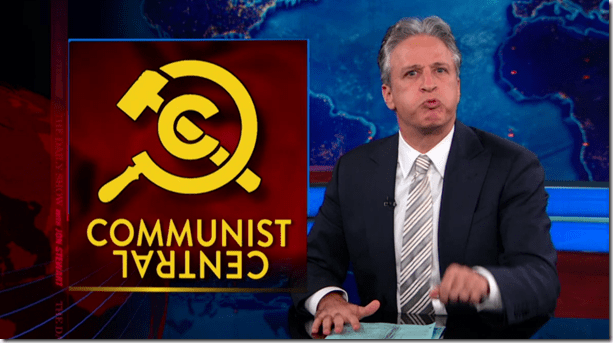
Last week Fox News CEO Roger Ailes said in a speech at Ohio University that “The Daily Show” host Jon Stewart had told him some years ago that he (Stewart) was a socialist; Stewart was on vacation and didn’t offer any response/defense/denial. ; It seems that no one got too terribly worked up about this “accusation” against an entertainer, although I’d half expected the Fox News Commentariat to hyperventilate into unconsciousness over the revelation. ; (They may have; I don’t watch, so I don’t know what they did (or didn’t) do.)

Now Stewart’s back from vacation and last night he did respond, staking out what it is that he does believe in, absent the simplistic and obfuscatory labeling that supplies so much of what passes for political analysis today…and, naturally, he found a way to use that explanation to (1) point out the hypocrisy among the conservative extremists considered among the leaders of today’s Republican Party, and (2) make me laugh. ; What more do you need? (Click the pic)

image

Thank you, Comedy Central.

A little good news: scientists stand up to politicians

And by politicians, I mean the knuckleheaded, blindered-by-the-right-wing nitwits who refuse to believe anything that doesn’t support their political beliefs…or, the beliefs they profess to believe, in order to maintain their political support (there, I believe that’s clear now).  You know, the ones who don’t get Daniel Patrick Moynihan’s epigram that people are entitled to their own opinions but not to their own facts, and who don’t get the irony that they don’t get it.

Today I ran across this NPR story about scientists in Tennessee fighting a state law that was promoted as an open-minded effort to allow “teachers to question accepted theories on evolution and climate change,” but which the scientists argued was just another attempt to get creationism taught as a theory on a scientific par with evolution.  The story refers to similar efforts in other states where scientists are fighting other efforts to distort science fact into political fiction.

Allow it?  Questioning theories and explaining how hypotheses are proved and become accepted scientific fact is the basis of science.  Teachers don’t need state lawmakers’ permission to break down and explain the parts of any scientific theory, or they shouldn’t.  Not knowing that, while trying to sneak a little religion into the secular science, the grandstanding pols peel back another layer of their own ignorance…or is it another layer of toadiness?

Slamming your eyes shut and screaming “no no no no no no no I can’t hear you” in the face of inconvenient facts is not the reassuring response I want out of my elected representatives.  I agree with Rice University professor Ken Whitney, who thinks that a candidate’s refusal to acknowledge scientific fact as fact ought to be a deal-killer when we go to the ballot box:

I would have an extremely hard time voting for someone who actively argued that evolution should not be taught, or alternately that intelligent design is a valid concept that we should be teaching our kids in public school science classes.

Note, he said we shouldn’t be teaching it in science classes, and that’s because it’s not scientifically valid.  We have to be open-minded enough not to confuse science with religion if we want to get the most value out of each of them.

In the spring a young man’s fancy also turns to baseball and cars; politics is getting in the way

Yep, another great day: sunny skies and highs in the low 80s in southeast Texas, got a ticket for my first game of the new baseball season tonight, made some good progress with a new swing thought out on the driving range yesterday, and I’m about a week away from trading in a serviceable but boxy and uninspiring VW for a very low mileage Honda two-seater—just the kind I’ve always loved and used to drive—while lowering my costs in the process!  With Rick Santorum’s exit from the GOP presidential primary, I’m hoping we can all enjoy a period of relative campaign quiet, too, but here’s something to roll around in your head before Mitt Romney and Barack Obama, and the permanent political class, use up all the oxygen.

It has looked like, from the vantage point of today, that come November we voters would face a choice between the radicalism that defines today’s Republican Party or another four years of divided government and damn little constructive effort on crucial economic issues.  Even the most moderate-seeming Republican candidate, Romney, was disavowing anything in own past that smelled of reasonableness and compromise, to appeal to the extremists who make up most of the GOP primary voters.  But the need for that should be over now, absent a mind-boggling resurgence from Newt Gingrich or Ron Paul or a last gasp charge to the convention from Sarah Palin or someone of that ilk to rally the “true conservatives.”

But even as Romney starts to redefine himself to appeal to the less ideological among us, Republicans will have a quite a slog in front of them if they wish to broaden their appeal beyond those who’ve already drunk the Kool-Aid.  Former White House speechwriter and senior policy adviser Michael Gerson says it’s not just a matter of trying to counter the Democrats’ “war on women” meme: “The GOP’s main problem is not the contraceptive issue; it is the perception that it has become too ideological on many issues.”

Women and independent voters have seen a party enthusiastically confirming its most damaging stereotypes. The composite Republican candidate—reflecting the party’s ideological mean—has been harsh on immigration, confrontational on social issues, simplistic in condemning government and silent on the struggles of the poor. How many women would find this profile appealing on eHarmony?

This is the hidden curse of the Republican congressional triumph of 2010. Republican activists came to believe that purity is all that is necessary for victory. But a presidential candidate, it turns out, requires a broader ideological attraction than your average tea party House freshman.

From an academic standpoint it will be interesting to see if and how Romney and the more traditional Republican elements work to sand the scary edges off of their primary campaign messages, to widen their appeal and entice the plurality of American voters who don’t ritualistically identify with the Republican or Democratic parties; those are the people who will decide this election.  (The Obama campaign isn’t going to make it easy, already working to reinforce Romney’s “severe” conservatism and other primary campaign highlights.)  Gerson argues that “Mainly, women and independents want some reassurance that Republicans give a damn about someone other than Republican primary voters. It is not a high bar. But Romney needs to start somewhere…”.  I’ll check back in after Memorial Day to see how he’s doing.