A journey of a thousand miles begins with…

“Change is sure slow” I wrote last week; I was wrong, and couldn’t be more pleased about it.

I wrote that in a post based on a New York Times story about the growing practice of government and campaign officials demanding pre-publication approval of any direct quotes attributed to them in published news stories.  The big news media outlets that sheepishly admitted to giving “quote approval” to the subjects of their stories reacted as though they were helpless infants: if they refused they would lose access to the sources and not have the story at all…there was nothing they could do.

Nothing, except stand up to the bullies.  And prove the value of reporting a story, of shining the light of publicity on a corrupt practice.

The day after the Times story ran the Associated Press raised its hand to say it did not permit quote approval.  Soon after that Dan Rather and others weighed in; today it’s McClatchy and the National Journal stepping up to reclaim some of journalism’s tarnished heritage.  I feel confident this growing cascade of recognition of who journalists really work for isn’t going to dry up with the testimony of these disciples.  (Well done, Jeremy Peters and the Times.)

The point was true last week and remains true today: “No news publication can cede the responsibility to write its own story as its writers and editors see fit; to give up that authority to the people who are the subjects of the story is to erase any reason for you or me to believe anything they print.”  If more of them are coming around to the point of view that there is something they can do, that they can stand up to the bully, it’s just sad that they had to be embarrassed into doing the right thing.

The powers that be control the message—even more than you know

Here is another depressing argument that the reality you and I inhabit, and feel comfortable most days saying we have some control over, has been sanitized for our protection.

The New York Times reports that “quote approval” is a common practice with the Obama and Romney campaigns, but also among most of the government bureaucracy.  Campaign or government officials agree to an interview with the proviso that they get pre-publication approval as to “what statements can be quoted and attributed by name.”

The chutzpah is galling, yes?  But here’s the worst part: the reporters agree to the condition!

It’s nothing new for politicians to go to extraordinary lengths to manage the impressions we get of them, and that’s not all bad: I’d rather have leaders who take time to consider what they’re doing and how their actions will be perceived than leaders who don’t take a moment to think about alternative courses of action and their potential outcomes.  And remember, there is no requirement anywhere that any politician or candidate for office need ever consent to be interviewed; that’s just the way, historically, that they have communicated with the people who put them in power.  They’re free to ask for any condition at all in return for an interview.

But, the role of the journalist in our system is to report—to dig, to uncover, to reason, to relate, to provide context—so the rest of us can hold leaders to account for the actions that they do take.  It’s not the job of the journalist to help the leaders fabricate a version of reality that puts them in a more positive light, and letting them clean up their quotes is doing just that.  (This system doesn’t work for an interview that is broadcast live on television or radio or the Web…yea, TV and radio.)

The politicians themselves betray a little self-consciousness on the issue—“The Obama campaign declined to make Mr. Plouffe or Mr. Messina available to explain their media practices. ‘We are not putting anyone on the record for this story,’ said Katie Hogan, an Obama spokeswoman, without a hint of irony.”—and the Times story says reporters “grudgingly agree” to this restriction.

I would argue that they should not agree at all.  Giving in to the bully is not the way to get him to stop stealing your lunch money.

Politicians should have the fortitude to stand by whatever they say when they agree to an on-the-record interview, whether it’s broadcast on television or reported in a printed publication, and I’m disappointed to learn about some of those who demand the final rewrite as if they were negotiating a movie deal.  But journalists mustuphold a higher standard, and that means no more cooperating with the cover-up.  Today’s story in the Times is a good start, because now the rest of us have a better idea of what’s going on.  Shining a light on this stupid practice is the first step toward bringing it to an end.

I’d love to see a story that informed me “candidate so-and-so would only agree to an interview if The Daily Disappointment gave him authority to decide which quotes would be included in the story.”  No news publication can cede the responsibility to write its own story as its writers and editors see fit; to give up that authority to the people who are the subjects of the story is to erase any reason for you or me to believe anything they print.

The author and critic Louis Kronenberger wrote that “The trouble with us in America isn’t that the poetry of life has been turned to prose, but that it has been turned to advertising copy.”  He wrote that in 1954…change is sure slow.

→UPDATE 7/17:  Turns out that not all the reporters give “quote approval”–congratulations, Associated Press!

Rhetoric doesn’t match the facts, and Roberts may not be a traitor to conservatism after all

A follow-up on Thursday’s Supreme Court Obamacare ruling:

The campaign for president hasn’t taken a time out since the court issued its ruling on the health care insurance reform last week; Barack Obama and Mitt Romney are all over it, but it turns out they’re getting a good bit of it wrong—both of them.  Check out the AP fact checker on the rhetoric since last Thursday: the law does not guarantee everyone can keep the insurance they have now indefinitely, 20 million people losing their insurance is a worst-case scenario estimate, there’s no evidence the law will add trillions to the budget deficit or raise taxes on the American people by half a trillion dollars, and very few of us should be counting on rebate checks from our insurance companies.

A healthy portion of the American people had some level of surprise or disgust at the action of Chief Justice John Roberts in this case: surprise that he found the law was constitutional, disgust at his seeming abandonment of conservative principles to come up with a way to find that the law was constitutional.  Today, CBS News quotes sources inside the court who say Roberts changed his mind on this ruling and worked to find a way to save the law, which angered his conservative colleagues.  Meanwhile, two more top conservative columnists, George Will and Charles Krauthammer, have joined the ranks of those who see a silver lining in the ruling: Roberts found a way to strike a blow for limited government while at the same time protect the integrity of the court itself!

Will:

If the mandate had been upheld under the Commerce Clause, the Supreme Court would have decisively construed this clause so permissively as to give Congress an essentially unlimited police power — the power to mandate, proscribe and regulate behavior for whatever Congress deems a public benefit. Instead, the court rejected the Obama administration’s Commerce Clause doctrine. The court remains clearly committed to this previous holding: “Under our written Constitution . . . the limitation of congressional authority is not solely a matter of legislative grace.”

Krauthammer:

More recently, however, few decisions have occasioned more bitterness and rancor than Bush v. Gore, a 5 to 4 decision split along ideological lines. It was seen by many (principally, of course, on the left) as a political act disguised as jurisprudence and designed to alter the course of the single most consequential political act of a democracy — the election of a president.

Whatever one thinks of the substance of Bush v. Gore, it did affect the reputation of the court. Roberts seems determined that there be no recurrence with Obamacare. Hence his straining in his Obamacare ruling to avoid a similar result — a 5 to 4 decision split along ideological lines that might be perceived as partisan and political.

Last week I said that it would have been unfortunate for the law to be rejected by a single vote, in what would have amounted to a “party line” vote.  Will and Krauthammer and others think the chief justice of the United States was thinking the same as me…although he was thinking it sooner, I’m sure, and with much greater legal clarity.  But still, he was on the right track…

Health insurance law ruling will refocus fall campaign–away from the most important issues!

Let the predictable caterwauling begin: today the Supreme Court upheld the constitutionality of President Obama’s signature domestic policy achievement, the Patient Protection and Affordable Care Act, with Chief Justice John Roberts leading the majority on the 5-4 decision.

The heart of the disagreement over the law is its requirement that each of us Americans purchase health insurance, and the court has now ruled that the requirement does not violate the Constitution.

During oral arguments in March, conservative justices indicated they were skeptical about the individual mandate, the provision in the 2,700-page health-care law that requires nearly all Americans to obtain health insurance by 2014 or pay a financial penalty.

Arguing the case for the Obama administration, Solicitor General Donald B. Verrilli Jr. defended the law as a constitutional exercise of congressional power under the charter’s commerce clause to regulate interstate commerce. He said lawmakers were regulating health insurance to deal with the problem of millions of people who lack coverage and therefore shift costs to the insured when they cannot pay for their medical care.

Paul D. Clement, representing Florida and 25 other states objecting to the health-care law, argued that Congress exceeded its power in passing the law, which he said compels people to buy a product.

The court rejected Obama administration’s commerce-clause argument, but ruled 5-4 that Congress nevertheless “has the power to impose” the individual mandate under its taxing authority. The provision “need not be read to do more than impose a tax,” the opinion said. “This is sufficient to sustain it.”

Neither the plaintiffs in the case nor the Obama administration had argued before the court that the individual mandate was a tax.

(In fact, that is the point made—the only point made—in the story I saw when I clicked on the lead headline on FoxNews.comthis afternoon.)

The decision means that implementation of the new law should proceed, with the aim to get health insurance coverage for tens of millions of currently uninsured Americans; these are the people who currently access the most expensive health care around through emergency rooms and charity care, medical care that those of us who pay taxes are already footing the bill for anyway.

So, that’s settled.  Or not.  Arguably, the real heart of the disagreement is that this is Obama’s plan, and people who had supported similar health care insurance law revisions in the past (like the conservative Heritage Foundation and many Republicans; like the Commonwealth of Massachusetts, W. Mitt Romney, Gov.) opposed this one because it was Obama’s plan.  People like Mitch McConnell, and others who have proudly and publicly asserted that they will do whatever is required to make Barack Obama a one-term president (for whatever reason).

The dissent in the case will only fuel their fire: it argues that the Obamacare mandate that individuals purchase a product—health insurance—and its threatened denial of some Medicaid funding to states for non-compliance both unconstitutionally exceed government authority, and that since those provisions are crucial to making the system work, the entire statute should be tossed out…hmm, not much room for compromise here, I guess.

It’s unfortunate that the divide on the court was (except for Roberts) by perceived political ideology—for many people that’s going to reinforce the idea that the justices make their decisions based on politics rather than the law, and that will reinforce the left/right division in politics.  But it could have been worse: as David Franklin from DePaul University’s College of Law argues in Slate, Roberts found a way to uphold ACA in order to save the integrity of the Supreme Court.

A 5-4 decision to strike down Obamacare along party lines, whatever its reasoning, would have been received by the general public as yet more proof that the court is merely an extension of the nation’s polarized politics. Add the fact that the legal challenges to the individual mandate were at best novel and at worst frivolous, and suddenly a one-vote takedown of the ACA looks like it might undermine the court’s very legitimacy.

And, of course, health care is now likely to become the distraction center for a presidential campaign that I’d hoped would hold its focus on employment and the federal budget.

(We don’t need to spend time discussing how, in their rush to be first with the news, CNN and Fox both got the story completely wrong, do we?  Fish in a barrel…)

Here’s a smattering of the early reports on the court ruling, for your edification and delight:

Look at who else must be a socialist, too

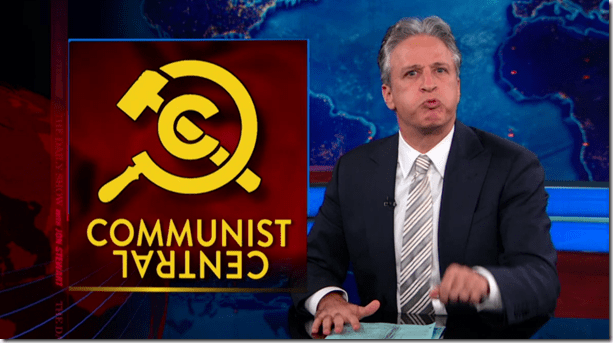
Last week Fox News CEO Roger Ailes said in a speech at Ohio University that “The Daily Show” host Jon Stewart had told him some years ago that he (Stewart) was a socialist; Stewart was on vacation and didn’t offer any response/defense/denial. ; It seems that no one got too terribly worked up about this “accusation” against an entertainer, although I’d half expected the Fox News Commentariat to hyperventilate into unconsciousness over the revelation. ; (They may have; I don’t watch, so I don’t know what they did (or didn’t) do.)

Now Stewart’s back from vacation and last night he did respond, staking out what it is that he does believe in, absent the simplistic and obfuscatory labeling that supplies so much of what passes for political analysis today…and, naturally, he found a way to use that explanation to (1) point out the hypocrisy among the conservative extremists considered among the leaders of today’s Republican Party, and (2) make me laugh. ; What more do you need? (Click the pic)

image

Thank you, Comedy Central.