Same song, next verse

When I was a college student in the capital city of Texas, the mayor once held his regular weekly news conference and was asked to comment on the fact that the state legislature was about to begin another biennial session under the big pink dome.  His immediate reaction was to say “Lock up the kids and dogs.”

America, your legislature is back in business: the House of Representatives has selected Mike Johnson of Louisiana as its new speaker.  Who is that, you ask, and what does he believe in?  Among other things, he

So, we got that going for us…which is not nice.  Ruth Marcus writes in the Washington Post that any sense of relief you might be feeling that a well-known extremist like Jim Jordan was not elected by Republicans in Congress is misplaced.

For Jordan’s shirt sleeves demeanor and wrestler’s pugnacity, substitute a bespectacled, low-key presentation, a law degree and an unswerving commitment to conservative dogma and former president Donald Trump.

This is not an upgrade. It is Jordan in a more palatable package — evidently smoother, seemingly smarter and, therefore, potentially more effective.

Johnson, now serving his fourth term in Congress, was the moving force behind aSpeaker Johnson Supreme Court brief that helped lay the shoddy intellectual groundwork for Jan. 6, 2021. In December 2020, he rallied fellow Republican lawmakers to support Texas’s brazen bid to overturn the election results. In a lawsuit that fizzled almost as soon as it was filed, Texas Attorney General Ken Paxton sought to have the Supreme Court intervene in the election by blocking the certification of electoral college votes in four swing states — Pennsylvania, Georgia, Michigan and Wisconsin — where voting rules had been changed in the course of the election and voters, not coincidentally, had favored Joe Biden. The justices swiftly rejected the case, tartly noting that, “Texas has not demonstrated a judicially cognizable interest in the manner in which another State conducts its elections.”

(snip)

The Johnson brief was a full-throated endorsement of the “independent state legislature” theory, ultimately rejected by the Supreme Court in 2023’s Moore v. Harper. The brief asserted that under the terms of the Constitution, only state legislatures — without any review by state courts or involvement of other state parties — have power to set rules for choosing presidential electors. “The clear authority of those state legislatures to determine the rules for appointing electors was usurped at various times by governors, secretaries of state, election officials, state courts, federal courts, and private parties,” the brief argued.

(snip)

The Texas episode was of a piece with Johnson’s conservative worldview. Before being elected to Congress, he was a senior lawyer and national spokesman for the Alliance Defending Freedom, a conservative group that opposes abortion, same-sex marriage and LGBTQ+ rights.

Running for Congress in 2016, he described himself as “a Christian, a husband, a father, a lifelong conservative, constitutional law attorney and a small business owner in that order, and I think that order is important.” Johnson said he had been “called to legal ministry and I’ve been out on the front lines of the ‘culture war’ defending religious freedom, the sanctity of human life, and biblical values, including the defense of traditional marriage, and other ideals like these when they’ve been under assault.”

We shall see how well Johnson does in leading the House, or at least its too-small-for-comfort Republican majority, in handling upcoming issues like a possible government shutdown in three weeks, or requests for more aid to Israel and Ukraine, or any of the other normal kinds of business which members of Congress are supposed to take care of on our behalf.  But given his still-declared support of Trump, it’s unlikely Johnson will be much of a leader when it comes to the reality of the need to work with Democrats to get things done: as David Frum wrote in The Atlantic earlier this month, “The rules of contemporary Republican politics make it had to accept reality.  Reality is just too awkward.”

In reality, Trump has been a big vote loser for Republicans. He fluked into the presidency with a Dukakis-like share of the vote in 2016, then lost his party its majority in the House in 2018. Trump got decisively booted from the presidency in 2020; rampaged illegally on January 6, 2021; and then cost his party its Senate majority in the January 2021 runoff elections. His election-denier message damaged his party further in the elections of 2022. His demand for a Biden investigation and impeachment in 2023 is producing an embarrassing fiasco. But no Republican leader dares say these things out loud.

Most taboo of all is working with Democrats, on any terms other than total, one-sided domination: We win, you lose. So [then-Speaker Kevin] McCarthy just had to press ahead, acting as if he commanded a majority when he did not; insulting and demeaning the minority, even though he had to know that he might need their help at any minute.

That minute came. McCarthy sought Democratic votes to save him from his own refractory members, and in return he offered nothing. Not even politeness.

That proposition did not produce the desired results, and so here we are.

Where we are is a country with a solid anti-Trump majority confronting a pro-Trump minority that believes it has a right to rule without concession or compromise.

The only way to produce a stable majority in the House is for the next Republican leader to reach a working agreement with the Democrats to bypass the nihilists in the GOP caucus. But that agreement will have to be unspoken and even denied—because making agreements that show any respect for the other side will be seen by Republican partisans as betrayal. The price of GOP leadership is delivering delusions and fantasies: the delusion and fantasy that Trump won in 2020, the delusion and fantasy that the Republicans did not lose in 2022.

“Delusion and fantasy” might well stand as a new motto for the remnants of a once proud GOP: in the Public Religion Research Institute’s annual American Values Survey, one-third of Republicans believe that “because things have gotten so far off track, true American patriots may have to resort to violence in order to save our country,” almost half think we need a strong leader who is willing to break some rules to get things done, and 29% are strong believers in the QAnon conspiracy movement. In the Washington Post, Jennifer Rubin writes:

Most frightening is how many Republicans buy into white Christian nationalism, a racist ideology that rejects the basic premise of our democracy: “All men are created equal.” One-third of Americans but 52 percent of Republicans agree that “God intended America to be a new promised land where European Christians could create a society that could be an example to the rest of the world.” The number is even higher among White evangelical Protestants (54 percent). Americans who subscribe to white Christian nationalism are more than twice as likely as other Americans to say true patriots might have to resort to violence to save the country.

In a related question, 75 percent of Republicans think the Founders wanted America to be a Christian nation with Western European values.

Rubin also identifies a “positive sign of public sanity” across the ideological spectrum.

Overwhelming majorities of Americans today support teaching the good and the bad of American history, trust public school teachers to select appropriate curriculum, and strongly oppose the banning of books that discuss slavery or the banning of Advanced Placement (AP) African American History.” Moreover, “A solid majority of Americans also oppose banning social and emotional learning programs in public schools.” Though some Republicans have made “anti-wokeism” a key requirement of their political identity, their message is deeply unpopular. “Fewer than one in ten Americans favor the banning of books that include depictions of slavery from being taught in public schools (7%), compared with 88% who oppose such bans.”

Sixty percent say abortion should be legal in most or all cases, compared with 37 percent who say it should be illegal in most or all cases. In a political reversal, “Democrats are now significantly more likely than Republicans to say their support for a candidate hinges on the candidate’s position on abortion,” 50 percent vs. 38 percent.

(snip)

Taking a step back, the overall picture here is a country that is inclusive, respectful of religious differences, pro-democracy and supportive of women’s rights — except when it comes to the largely Republican, mostly White evangelical Christians who reject these fundamental ideas.

When a sizable portion of one of the major political parties, aided by a right-wing propaganda machine and infused with religious fervor, rejects the basis for multiracial, multicultural democracy, we face a severe crisis. Even if Trump does not return to the White House, this radicalized segment will not disappear. How we reintegrate millions of Americans into reality-based, pro-democracy politics in a diverse country remains the great challenge of our time.

The real RINOs

Today’s Republican Party claims to be the only truly patriotic, fully America-loving and God-fearing political party in the country, the one that will protect regular America-loving and God-fearing citizens from the perfidies of big gummint and make the country, well, you-know-what again.  So, how are they doing with that today?

Well, as I write this we are just hours away from the gummint shutting down much of its operations because Congress cannot pass the legislation needed to pay the bills.  But not because the Congress and the president haven’t been able to come to a compromise: this past May President Biden and House Speaker McCarthy did agree on total spending levels through 2024.  It’s that some Republicans in the House refuse to accept the deal.  If there is no agreement by the deadline we can all look forward to enjoying life with only “essential services” from Washington.  If you are a government worker (as I was) who is deemed essential (as I was not), you get to keep working but not be paid for it; non-essential workers just get furloughed.

So much for Republicans looking out for the average, America-loving, God-fearing citizen.

What Republicans are doing instead of keeping the government running smoothly is kicking off an impeachment inquiry into President Biden.  Against whom they have no evidence – zero – of his commission of an impeachable offense.  Who brought witnesses who say they don’t see it, either:  Jonathan Turley, George Washington University law professor and Fox News contributor, said “In fact, I do not believe that the current evidence would support articles of impeachment.”  The same Republicans who screeched that Democrats were weaponizing impeachment against the former guy (who was as innocent as the day is long during his presidency, they insisted, and who is just being victimized by 91 criminal and civil indictments (so far) in his post-presidency) are only doing the Lord’s work in rooting out corruption in government.

The weird thing is, the same Republicans who are trying to use the mechanisms of government to impeach a president of the other party (albeit one who faces no substantiated allegations of any wrongdoing) are the same ones who by obstinately refusing to compromise on a spending plan will force much of that same government to close up shop for an indefinite period.  (Although, not Congress or their investigation.)  This is not, historically, what the Republican Party has been about.

The Grand Old Party was organized in the early 1850s as a coalition opposed to the expansion of slavery into new states and territories, and after the Civil War its majority in Congress –- the Radical Republicans -– passed laws to, among other things, protect the rights of freed slaves.  While Democrats in the South worked to chip away at the Reconstruction reforms, Republicans became more and more associated with the interests of business; some also supported (gasp!) progressive efforts for social reforms.

The growth of the federal government through the New Deal period and World War II encouraged more and more Southern Democrats who opposed civil rights for blacks (and other non-whites) and most expanded government programs to move to the Republican Party, where they joined up with conservative Christians stirred to action by opposition to “culture issues” that they were persuaded were threatening the “Christian nation” that God had intended America to be.  These elements came to control the party…or at least they did until they handed over the keys to a circus clown from New York.

Today those Republicans who are part of “MAGA nation” – polls say they are less than 25% of the nation as a whole — seem ever so pleased with themselves any time they get the opportunity to act-out as childish name-callers; one of their favorites is to brand a fellow Republican with whom they have some disagreement on a point of policy, no matter how trivial, as being a Republican In Name Only.  (How clever.)  But they are the real RINOs, who have succeeded in taking control of a once-respected political organization and philosophy and turned it into a vehicle (a clown car?) for instituting their warped social views into law.  It’d be a lot funnier if they weren’t so successful.

Saboteurs in sheep’s clothing

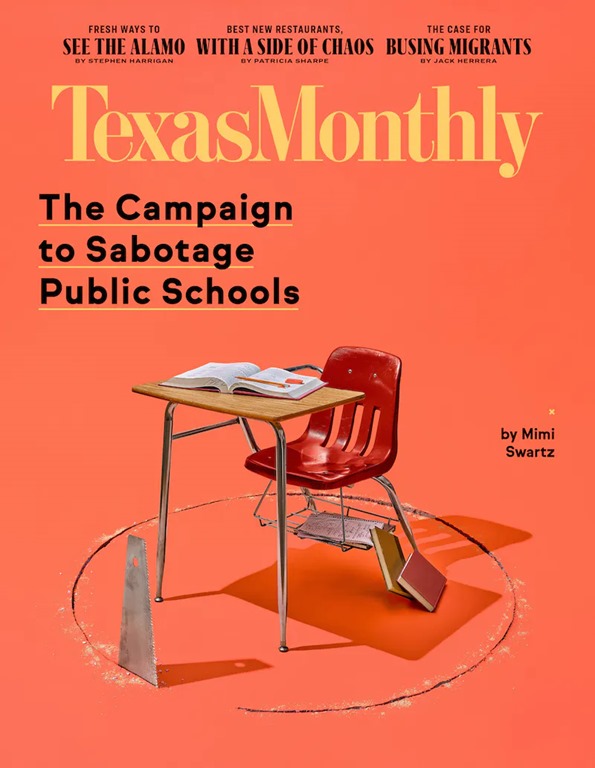
“They” say the depredations of age get each of us eventually, and maybe that’s responsible for what feels like my increasingb530dca6-86c1-4d7b-9fd1-e6ebb1bf3b41 inability to think of just the right word on short notice.  But whatever the cause, I owe a big thanks to whoever wrote and approved the headline on the March cover of Texas Monthly: “The Campaign to Sabotage Public Schools” hit perfectly as the word to describe the effort I’ve witnessed for years as radical evangelical Christians have undermined Texas public schools while insisting they are trying to save them.  Butter wouldn’t melt in their mouths.

For a quick refresher on the history of free public education in the United States, check out this short summary by the Center on Education Policy at The George Washington University.  The effort wasn’t without its shortfalls, but the driving force was the thoughtful insight that the future of America depended on educated Americans.

The Founding Fathers maintained that the success of the fragile American democracy would depend on the competency of its citizens. They believed strongly that preserving democracy would require an educated population that could understand political and social issues and would participate in civic life, vote wisely, protect their rights and freedoms, and resist tyrants and demagogues. Character and virtue were also considered essential to good citizenship, and education was seen as a means to provide moral instruction and build character. While voters were limited to white males, many leaders of the early nation also supported educating girls on the grounds that mothers were responsible for educating their own children, were partners on family farms, and set a tone for the virtues of the nation. The nations’ founders recognized that educating people for citizenship would be difficult to accomplish without a more systematic approach to schooling. Soon after the American Revolution, Thomas Jefferson, John Adams, and other early leaders proposed the creation of a more formal and unified system of publicly funded schools. While some Northeastern communities had already established publicly funded or free schools by the late 1780s, the concept of free public education did not begin to take hold on a wider scale until the 1830s.

It became understood across society that educating all of our children would be a benefit to the nation as a whole, and that the tax money needed to fund that effort was one of the responsibilities of citizenship, whether or not you had children and whether or not you sent them to the public school in your town.  Today, that desire and responsibility to promote a societal good is diminishing in some sectors of society; you’ve probably seen these people at work in your community as I have in mine.

The people who believe America is a “Christian nation” and that any effort to respect and accept other beliefs is misguided and unpatriotic.  The people who cannot abide that some people have different beliefs and ideas about what is right and how things should be done, especially when those other people do not share their religious beliefs; for these people, “freedom of religion” as a concept means that all Americans are free to worship as they do.  The people who protested COVID vaccine mandates as another flavor of criticism of established authority outside their “faith tradition.”  The people who now suddenly protest school library books as insufficiently representative of Christian evangelical mores.  The people who demonize the people who are willing to acknowledge the history of racism in this country, and the persistence thereof.  For them, public schools that teach children about math and science and literature and history to prepare them for participation in the secular world at large, and that do not take as their primary responsibility the religious indoctrination of students, are enemies to be defeated.  To be sabotaged, if necessary.

Taken individually, any of these incidents may seem like a grassroots skirmish. But they are, more often than not, part of a well-organized and well-funded campaign executed by out-of-town political operatives and funded by billionaires in Texas and elsewhere. “In various parts of Texas right now, there are meetings taking place in small and large communities led by individuals who are literally providing tutorials—here’s what you say, here’s what you do,” said H. D. Chambers, the recently retired superintendent of Alief ISD, in southwest Harris County. “This divisiveness has been created that is basically telling parents they can’t trust public schools. It’s a systematic erosion of the confidence that people have in their schools.”

The “they” behind this crusade are the current generation of a movement that has been trying to destroy public education for years.

The motivations for these attacks are myriad and sometimes opaque, but many opponents of public education share a common goal: privatizing public schools, in the same way activists have pushed, with varying results, for privatization of public utilities and the prison system. Proponents of school privatization now speak of public schools as “dropout factories” and insist that “school choice” should be available to all. They profess a deep faith in vouchers, which would allow parents to send their children not just to the public schools of their choice but to religious and other private schools, at taxpayers’ expense.

But if privatizing public education is today cloaked in talk of expanded liberty, entrepreneurial competition, and improved schools for those who need them most, its history tells a different story. In 1956, two years after the U.S. Supreme Court handed down its landmark Brown v. Board of Education decision, a group of segregationist legislators in Texas, with support from retiring governor Allan Shivers, began concocting work-arounds for parents appalled by the prospect of racial integration of public schools. One idea: state-subsidized tuition at private schools. That never came to pass, but it was Texas’s first flirtation with vouchers.

The dreaded vouchers.  The current effort in Teas, supported now for the first time by the governor as well as the lieutenant governor, uses the buzzwords “school choice” and “educational excellence” to advocate for a system that will take tax money out of the public schools and hand it over to the private schools, including private religious schools.  Yes: take public tax money and use it to pay for a religious school education for Texas children.

I don’t know that there was ever opposition to parents pulling their children out of the local public school and sending them to private schools—when they do so at their own expense.  My own parents footed the bill to send me to a private high school where they believed I would get a better education than in the Houston public schools.  Maybe they were right about that part.  But they never presumed to think that their public school tax money should be drawn out of the local public school district to pay their son’s private school tuition.  And I don’t want my secular tax dollars today supporting your favored religious institution, regardless of denomination.  And yes, that is exactly what this plan would do.

Pro-voucher people reject the argument that vouchers will only benefit the rich: they say vouchers will help the poor save their children from underperforming public schools.

That hasn’t worked out either. In various experiments across the nation, funding for vouchers hasn’t come close to covering tuition costs at high-quality private schools, and many kids, deprived of the most basic tools, haven’t been able to meet the standards for admission.

(Besides, just think about it: why are the schools “underperforming” in the first place?  Think it has anything to do with the effort over the years to reduce spending on schools or to divert school tax money into private school tuition?)

Voucher programs in Texas have failed at the legislature in the past because of opposition to the diversion of tax money, and due to the pragmatic concern of rural lawmakers who know that public school districts employ significant percentages of their constituents.  Draining the school budgets wasn’t/isn’t in their interests.  The lieutenant governor has favored some form of voucher system for years, but not the governor.

Governor Greg Abbott, knowing all too well the political headwinds that vouchers have faced, has long been wary of publicly supporting them, so he has undermined public schools in other ways. While campaigning early last year, he promised to amend the Texas constitution with a “parental bill of rights,” even though most, if not all, of those rights already existed. By then, “parental rights” had become a dog whistle to animate opponents of public education. (As the Texas Tribune put it: “Gov. Greg Abbott taps into parent anger to fuel reelection campaign.”)

During the recent intensifying crisis on the border, Abbott publicly floated a challenge to the state’s constitutional obligation to give all Texas children, including undocumented ones, a publicly funded education—a step his Republican predecessor, Rick Perry, had denounced years earlier as heartless. Then last spring, Abbott made headlines with his first full-throated public endorsement of a voucher program.

So here we are, with distrust in public schools advancing as fast as the latest COVID-19 variant. The forces behind the spread of this vitriol are no mystery. Those who would destroy public schools have learned to apply three simple stratagems: destabilize, divide, and, if that doesn’t work, open the floodgates of fear.

Here come the foot soldiers of the modern digital offensive: they lie about and harass people they disagree with, and amazingly (at least to me) very many of people who read those lies on Facebook believe them!  Same terrifying principle as with Alex Jones and his acolytes who not only bought what he had to say about the Sandy Hook school shooting being fake, but then took it upon themselves to attack the bereaved parents.  In the TM article, Mimi Swartz’ example of these tactics come from the Central Texas town of Dripping Springs, and she explains the rich and powerful players in the game.

In 2006 [James] Leininger found powerful new allies when [Tim] Dunn, with a major financial assist from the Wilks brothers, formed Empower Texans. Public education became one of its primary targets, in part because the property taxes that funded schools ran counter to their interests as billionaires and in part because they wanted more Texas children exposed to their version of Christian values.

(snip)

What voucher proponents needed most was a powerful champion who was also a gifted salesman. Former sportscaster and right-wing talk-radio host Dan Patrick happily stepped into the role. Elected to the state Senate from Houston’s prosperous, white, northwestern suburbs in 2006, the perpetually youthful but often choleric Patrick was lieutenant governor by 2015. Patrick found school choice and its kissing cousin, property tax reduction, to be winning issues among his right-wing base and his growing cadre of big-money donors, who, along with the backers of TPPF and Empower Texans, also included the billionaire deans of dark money, the Kansas-based brothers Charles and David Koch.

The American Legislative Exchange Council, commonly known as ALEC, is a powerful Koch-supported organization that has devoted much time and money to privatizing public schools nationally. According to a study by the watchdog group Common Cause, Texas has one of the highest concentrations of state lawmakers connected to the organization, at around 32 percent. One of the first bills Patrick introduced in the 2011 legislative session called for eliminating the ceiling on the number of charter schools allowed in the state. It failed, but the relentless Patrick rammed it through two years later. Echoing Republican U.S. senator Ted Cruz, Patrick would also proclaim vouchers to be “the civil rights issue of our time.”

(snip)

The state’s leadership has found other ways to undermine public schools. Texas, according to the latest data, ranks fortieth when it comes to school spending—$10,300 per pupil annually, compared with the national average of $13,500. According to a survey conducted by the Annie E. Casey Foundation, a charitable organization devoted to child welfare, Texas gets what it pays for, ranking thirty-third in the U.S. in the quality of its K–12 education.

Then there is the state’s ongoing loyalty to the STAAR test, the results of which are used to evaluate teacher and school quality. Its efficacy has been widely challenged by educators, parents’ groups, and academic researchers, who have found that the test’s demands are often well above grade level. And because the test is used as a yardstick to grade (and potentially close) schools, test prep has taken over actual teaching in many classrooms.

There’s much more worth your time in the story, which fleshes out the story of the attack on public education, in Texas and elsewhere, in the past couple of generations.  Some of it has been simple, racially-motivated white flight to the suburbs, leaving behind city schools with fewer resources available for the students who remain.  Not satisfied with their parents’ decision to take their ball and go to a new home, the children and grandchildren of those parents of the 50s and 60s are now trying to grab every last nickel they can out of the public school system to “protect” their own children from the real world.  I feel sorry for the children who will have to deal with that world without benefit of a “real world” education.


Fundamental dishonesty

It wasn’t a “driveway moment” because I wasn’t in my driveway, I wasn’t sitting in the car listening to the radio to hear the end of a story that had sucked me in.  No, I was still on the road headed home from the grocery store when I heard two words that broke through and provided some clarity of mind, finally, amid the onslaught of distressing rulings from the Supreme Court of the United States.

Just a week ago, the court’s six “conservative” justices ruled that a program in Maine that subsidizes tuition for certain private schools in rural areas of the state cannot exclude religious private schools from the program.  Two days later the same six found that a New York law placing strict limits on carrying guns in public violates the Second Amendment.  And the day after that, those same six members not only found that a Mississippi ban on abortions after just 15 weeks was constitutional, they went the extra step and overturned the nearly 50-year old precedent of their own court that established a woman’s right to an abortion.

The separation of church and state.  The rights to privacy, and to safety, individual liberty, and self-determination.  The targets of this Supreme Court and the “conservative” movement in general couldn’t be clearer.  With each new Republican-appointed justice on the court, and each new ruling by the new majority, they demonstrate their mission to remake America as a paradigm of Christian nationalism.  It seems clear that the decades-long mission to destroy the secular society that has grown up since World War II just can’t be denied, not even when the inconvenience of the facts gets in the way.

It was Nina Totenberg on the radio reporting on the ruling in favor of the high school coach who insisted on holding a prayer circle at midfield after football games, and Justice Neil Gorsuch’s opinion scolded the school district:

“Here, a government entity sought to punish an individual for engaging in a personal religious observance, based on a mistaken view that it has a duty to suppress religious observances even as it allows comparable secular speech. The Constitution neither mandates nor tolerates that kind of discrimination. Mr. Kennedy is entitled to summary judgment on his religious exercise and free speech claims,” Gorsuch wrote.

The three dissenters said that account of the facts blinkered reality (emphasis added). Writing for the three liberals, Justice Sonia Sotomayor said that Kennedy’s prayer was neither private speech, nor benign. She pointed to the fact that the coach conducted a media blitz leading ultimately to the field being stormed and students being knocked down. And she said “schools face a higher risk of unconstitutionally ‘coerc[ing] … support or participat[ion] in religion or its exercise’ than other government entities.”

“This decision does a disservice to schools and the young citizens they serve, as well as to our Nation’s longstanding commitment to the separation of church and state,” Sotomayor wrote. “Today’s decision elevates the rights of a school coach who voluntarily accepted public employment, over the rights of students required to attend public schools and who may feel obligated to join in prayer.” In doing so, Sotomayor claims, the court gives “short shrift” to the constitutions ban on state entanglement with religion.

University of Virginia law professor Douglas Laycock usually files briefs siding with religion advocates. But not in this case. He called Monday’s ruling, “fundamentally dishonest” and pointed to the third sentence of the Gorsuch opinion, which characterizes coach Kennedy’s conduct as “quiet isolated prayers,” stating, “They weren’t quiet and they weren’t isolated. They were leading the students in prayer, and to say that’s okay undermines all the school prayer cases.” By that he means Supreme Court decisions barring teacher- or student-led prayers in public school classrooms, and ceremonies like graduation.

It was like a fire alarm went off inside my head: “fundamentally dishonest.”

Yes—the fundamental dishonesty of these justices, and of the Christian religious extremists who have been fighting the secularization of American society for generations!  They have had a winking understanding with a certain segment of America: anything is permissible—the end justifies the means—when it comes to returning America to be the Christian country we all “know” it should be, including lying under oath in order to gain positions of power.  Don’t believe me?  Look at the video of the confirmation hearings over the years of the “conservative” justices now on the court: is it just a coincidence that when the Senate Judiciary Committees asked these nominees about Roe v. Wade, these individuals had the same answer, in virtually the same words, words meant to leave the impression that they believed in the doctrine of stare decisis in general and specifically for this case?  I think not.

In a concurring opinion on Dobbs, Justice Clarence Thomas says the quiet part out loud about using the wedge they perfected in overturning Roe to take aim at other precedents that guarantee other rights to Americans.

“In future cases, we should reconsider all of this Court’s substantive due process precedents, including Griswold, Lawrence, and Obergefell,” Thomas wrote on Page 119 of the opinion in Dobbs v. Jackson Women’s Health, also referring to the rulings that legalized same-sex relationships and marriage equality, respectively.Because any substantive due process decision is ‘demonstrably erroneous’ … we have a duty to ‘correct the error’ established in those precedents.”

Just coincidence, right, that the other cases on his mind are the ones that guaranteed the rights to same-sex marriage, and same-sex sex, and the use of birth control.  BIRTH CONTROL!?  He wants to return to a time when the use of birth control by married couples in the privacy of their own home could be and was prohibited by states?  Who can even imagine such a thing?

I know who…so do you.  And I don’t take any comfort—at all—in the protestation from the other five “conservative” justices that “[n]othing in this opinion should be understood to cast doubt on precedents that do not concern abortion.”  When there is fundamental dishonesty, I have doubts.

Know your enemy

On Friday morning, after a night of insomnia fueled by worries about raising children in a collapsing society, I opened my eyes, started reading about efforts by Wisconsin Republicans to seize control of the state’s elections, then paused to let my tachycardiac heartbeat subside. Marinating in the news is part of my job, but doing so lately is a source of full-body horror. If this were simply my problem, I’d write about it in a journal instead of in The New York Times. But political despair is an issue for the entire Democratic Party.

It’s predictable that, with Donald Trump out of the White House, Democrats would pull back from constant, frenetic political engagement. But there’s a withdrawal happening right now — from news consumption, activism and, in some places, voting — that seems less a product of relief than of avoidance. Part of this is simply burnout and lingering trauma from Covid. But I suspect that part of it is about growing hopelessness born of a sense that dislodging Trump has bought American democracy only a brief reprieve.

One redeeming feature of Trump’s presidency, in retrospect, was that it was possible to look forward to the date when Americans could finish it. Covid, too, once seemed like something we’d be able to largely put behind us when we got vaccinated. Sure, Trumpism, like the virus, would linger, but it was easy to imagine a much better world after the election, the inauguration and the wide availability of shots.

Now we’re past all that, and American life is still comprehensively awful. Dystopia no longer has an expiration date.

Last week in the New York Times, Michelle Goldberg worried about the future of our American democracy.  Like thousands/millions of others, I share her concern, and so should you.

The problem isn’t just that polls show that, at least right now, voters want to hand over Congress to a party that largely treats the Jan. 6 insurrectionists as heroes.

(snip)

What’s terrifying is that even if Democrats win back public confidence, they can win more votes than Republicans and still lose. Gerrymandering alone is enough to tip the balance in the House.

(snip)

Meanwhile, Republicans are purging local officials who protected the integrity of the 2020 election, replacing them with apparatchiks. It will be hard for Republicans to steal the 2024 election outright, since they don’t control the current administration, but they can throw it into the sort of chaos that will cause widespread civil unrest. And if they win, it’s hard to imagine them ever consenting to the peaceful transfer of power again.

(snip)

I look at the future and I see rule without recourse by people who either approve of terrorizing liberals or welcome those who do. Such an outcome isn’t inevitable; unforeseen events can reshape political coalitions. Something could happen to forestall the catastrophe bearing down on us.

Here’s a hopeful sign: two long-time contributors to Fox News giving a thorough and public explanation of why they just can’t take it any more.

…there are still responsible conservatives [at Fox News] providing valuable opinion and analysis. But the voices of the responsible are being drowned out by the irresponsible.

A case in point: Patriot Purge, a three-part series hosted by Tucker Carlson.

The special—which ran on Fox’s subscription streaming service earlier this month and was promoted on Fox News—is presented in the style of an exposé, a hard-hitting piece of investigative journalism. In reality, it is a collection of incoherent conspiracy-mongering, riddled with factual inaccuracies, half-truths, deceptive imagery, and damning omissions. And its message is clear: The U.S. government is targeting patriotic Americans in the same manner —and with the same tools—that it used to target al Qaeda.

(snip)

This is not happening. And we think it’s dangerous to pretend it is. If a person with such a platform shares such misinformation loud enough and long enough, there are Americans who will believe—and act upon—it.

This isn’t theoretical. This is what actually happened on January 6, 2021.

Over the past five years, some of Fox’s top opinion hosts amplified the false claims and bizarre narratives of Donald Trump or offered up their own in his service. In this sense, the release of Patriot Purge wasn’t an isolated incident, it was merely the most egregious example of a longstanding trend. Patriot Purge creates an alternative history of January 6, contradicted not just by common sense, not just by the testimony and on-the-record statements of many participants, but by the reporting of the news division of Fox News itself.

There are still many real conservatives who recognize that the Orange Emperor has no clothes, and who have not drunk the toxic brew that has let so many Republicans (and others) show true feelings they have always keep secret, until now.  Jennifer Rubin is one.

When Donald Trump ran for president in 2016, Never Trumpers (now largely ex-Republicans) warned that he would corrupt the party in every way imaginable. His misogyny would morph in the party’s toxic masculinity and degradation of women, they cautioned. His infatuation with brutality and violence (boasting he would kill terrorists’ families, exhorting his supporters to slug protesters) would metastasize to the party as a whole. Boy, did those predictions pan out.

You only have to look at the vicious imagery showing the murder of Rep. Alexandria Ocasio-Cortez (D-N.Y.) deployed by Rep. Paul A. Gosar (R-Ariz.), the verbal attack on her from Rep. Louie Gohmert (R-Tex.) last year — and Republicans’ defense of both — to understand that their refusal to dump Trump after the “Access Hollywood” tape came to light was merely the prelude to an era of normalizing violence (especially against women), culminating in the Jan. 6 violent insurrection, which many Republicans, including Trump, tried to paint as nonviolent.

Threats and portrayals of violence against women have turned into a badge of honor for a party in which traditional notions about gender (back to the 1950s!) have become a key predictor of Republican support. Casting men (even a Supreme Court nominee) as victims of aggressive, “nasty” or unhinged women accusing them of wrongdoing has become standard fare in the Trump party.

Rubin cites Robert P. Jones, CEO and founder of Public Religion Research Institute, who is willing to lay the blame for the violence we’re seeing now at the core of Republican party voters: White evangelicals.

Today, for an alarming number of white conservative Christians, the mark of Christian faithfulness is not a love that inspires them to lay down their lives for their friends, but a defensiveness that lures them to take the lives of their fellow citizens.

The anti-democratic and white supremacist core of this worldview snaps into focus as soon as we ask just one question: What is the “America” they are saving? This question is at the heart of the MAGA ideology that has now fully overtaken one of our two major political parties.

That second “A,” for “again,” is the hermeneutical key that unlocks the obfuscation.  This nostalgia for a White Christian America has become the weapon of choice in the culture wars. In that vision of the country, white law and order reign, and with refreshments and pats on the back, white vigilantes are informally deputized as partners. And Black people protesting in the streets or even shopping in the local CVS are seen as suspect for not playing their properly deferential roles or staying in their assigned subservient places.

If Trump has done anything for us, he has peeled back a thin veneer of patriotic- and Christian-sounding words to reveal the core claim underneath it all: That God intended America to be a white Christian nation. That claim has literally generated—for those among the chosen— a license to kill anyone who threatens that norm and the confidence that those actions will not only be free of negative consequences, but be rewarded both here on earth and in heaven.

“Christian nationalism” is the threat.  Let’s start by defining the terms, thanks to Paul D. Miller at Christianity Today.

There are many definitions of nationalism and an active debate about how best to define it. I reviewed the standard academic literature on nationalism and found several recurring themes. Most scholars agree that nationalism starts with the belief that humanity is divisible into mutually distinct, internally coherent cultural groups defined by shared traits like language, religion, ethnicity, or culture. From there, scholars say, nationalists believe that these groups should each have their own governments; that governments should promote and protect a nation’s cultural identity; and that sovereign national groups provide meaning and purpose for human beings.

What is Christian nationalism?

Christian nationalism is the belief that the American nation is defined by Christianity, and that the government should take active steps to keep it that way. Popularly, Christian nationalists assert that America is and must remain a “Christian nation”—not merely as an observation about American history, but as a prescriptive program for what America must continue to be in the future. Scholars like Samuel Huntington have made a similar argument: that America is defined by its “Anglo-Protestant” past and that we will lose our identity and our freedom if we do not preserve our cultural inheritance.

Christian nationalists do not reject the First Amendment and do not advocate for theocracy, but they do believe that Christianity should enjoy a privileged position in the public square. The term “Christian nationalism,” is relatively new, and its advocates generally do not use it of themselves, but it accurately describes American nationalists who believe American identity is inextricable from Christianity.

What is the problem with nationalism?

Humanity is not easily divisible into mutually distinct cultural units. Cultures overlap and their borders are fuzzy. Since cultural units are fuzzy, they make a poor fit as the foundation for political order. Cultural identities are fluid and hard to draw boundaries around, but political boundaries are hard and semipermanent. Attempting to found political legitimacy on cultural likeness means political order will constantly be in danger of being felt as illegitimate by some group or other. Cultural pluralism is essentially inevitable in every nation.

Is that really a problem, or just an abstract worry?

It is a serious problem. When nationalists go about constructing their nation, they have to define who is, and who is not, part of the nation. But there are always dissidents and minorities who do not or cannot conform to the nationalists’ preferred cultural template. In the absence of moral authority, nationalists can only establish themselves by force. Scholars are almost unanimous that nationalist governments tend to become authoritarian and oppressive in practice. For example, in past generations, to the extent that the United States had a quasi-established official religion of Protestantism, it did not respect true religious freedom. Worse, the United States and many individual states used Christianity as a prop to support slavery and segregation.

There is much more here you should read.  Know your enemy, while there is still time to win the fight.

This is not about all Christians, or even all Christian evangelicals.  But those who think “freedom of religion” means everyone is free to practice their particular strain of Christian faith in their houses of worship and through the imposition of their religious beliefs in secular law, those who harbor a “nostalgia for White Christian America,” and who have been succeeding politically at achieving their goals since at least the days of the Moral Majority, those are the political enemies we need to get serious about defeating.  Right now, political despair be damned.