By turns, this video is remarkable, unbelievable, inspiring, comical, and by the end very very sad, as the object of our attention first comes face to face with its new home, something that looks for all the world like a gigantic aluminum garden shed. From the Los Angeles Times, click the pic for an outstanding time-lapse view of space shuttle Endeavour being moved from Los Angeles International Airport through the city streets to the California Science Center, where it goes on permanent display.
Category Space Exploration
Neil Armstrong
Today his family held a private memorial service for Neil Armstrong, who died last week at the age of 82. I’ve read a lot of the tributes to the first man to walk on the moon that have been published in the past week, and have a little to add.
I never met Neil Armstrong, but I’ve always looked up to him. As a kid I paid a lot of attention to the space program, and when my dad was transferred to Houston in mid-1966 I started to feel like I was a part of it since I lived where the astronauts lived, but I really don’t remember Armstrong’s name sticking in my mind until it came time for Apollo 11. I was 12 years old that night in 1969: I was on the floor at home in front of our family’s first color television, straining to comprehend through the static-y images and voices just what was happening as the Eagle landed, and then as Armstrong and Buzz Aldrin stepped out onto the moon. Although that summer I was laser-focused on making the Little League all-star team (I didn’t), as I sat on the floor that night I really felt like I had done something great, had somehow helped make that moon landing possible.
When the ticker tape parades I saw on television were over, Armstrong faded from view; it turns out, that’s what he wanted. And that’s a big part of why I’ve respected him over the years. I realize now that Neil Armstrong probably wasn’t any braver than any of the other astronauts for making that flight—every other astronaut wanted the assignment, and many lobbied for it to have the chance for a prominent place in history. Although he’s been highly praised as being among the finest pilots at NASA, his colleagues weren’t slouches at the stick. But Armstrong wasn’t after glory or recognition: he wanted to fly, to do new things; he wanted to do his job, and he didn’t want to become the center of attention.
He personified the American ideal of the strong, silent type: the guy who was the best at what he did and loved doing it, who wanted to make a contribution to society, who didn’t want to brag about it later or feel like he was taking too much credit. Highly talented, well educated, capable and confident, with a sense of adventure and a sense of humor, and not an overinflated sense of himself. I have always been proud that it was that kind of man, that kind of American, who took the symbolic step into the future on behalf of the rest of us, from all the scientists and engineers who made it happen to all the 12-year-olds who felt like they were making that first step themselves.
So today—ironically, the day of an actual Blue Moon—on the day his family says farewell to him, I want to say thank you to Neil Armstrong for his part in opening up the future for our species, and for being the kind of man and leader in whom our country can take quiet pride. And I plan to follow his family’s honest and good-humored suggestion about how to honor him:
For those who may ask what they can do to honor Neil, we have a simple request. Honor his example of service, accomplishment and modesty, and the next time you walk outside on a clear night and see the moon smiling down at you, think of Neil Armstrong and give him a wink.
The gentleman from Pearland yields…
…for some great insight on yesterday’s topic. First, Wayne Hale, a former NASA flight director and, among other things, a one-time manager of America’s Space Shuttle Program (the big boss!), who has retired from government service, is also a wonderful writer. And he has a great post today on why Houston didn’t get a space shuttle—because Houston takes having the space program here for granted, and assumed it was in the bag.
…with the level of interest that our citizens and leaders have in JSC, I soon expect to see that facility in the hands of a different federal agency. Soon the National Park Service will be leading tours through the historic – and empty – halls of the Johnson Space Center National Historic Site.
I have a suspicion Wayne is trying to stir the troops to action; good for Wayne.
Those same troops got a different message today from Kyle Herring, a NASA public affairs officer for more than 20 years. He sent along a reminder that not having a shuttle come to live in Houston shouldn’t be the end of our love affair with the program.
These space shuttles will have ended their flying careers, but not their inspirational ones. That career will live on forever in places where so many people will see what we have lived for much of our adult lives and our careers. We now can allow those who aren’t really sure what we did to see what miracles of spaceflight the space shuttle orbiters really are.
(snip)
As we travel around the country in a year, two years, five, 10, 20, our paths will take us to these museums.
We’ll pass through the doors of a hangar, or round the corner of a cavernous hall and suddenly look up and see Enterprise, Discovery, Atlantis and Endeavour representing our work, our commitment, our dedication. Our forearms will sprout bumps knowing that these spaceships are there because we protected them through years of flight in an environment not friendly to Earth-built machines.
(snip)
…when we are standing in one of the four locations each orbiter finds home, we can watch the visitors stand in awe of these remarkable spacecraft and tell them about the Space Shuttle Program. We can tell them about what it meant to support such a great vehicle. We can spread the meaning of space – and the space shuttle in particular – to them.
April 12
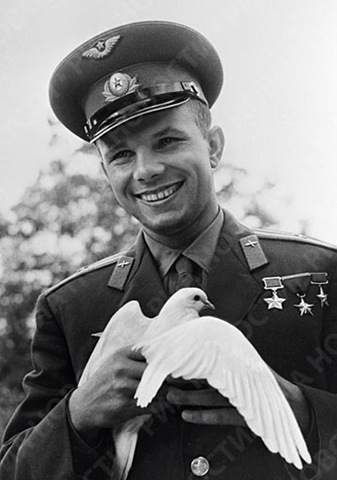
1633, Galileo convicted of heresy; 1777, Henry Clay born; 1861, America’s Civil War began; 1878, Boss Tweed died; 1947, David Letterman born; 1954, Bill Haley and the Comets recorded “Rock Around the Clock”; 1961, Douglas MacArthur declined an invitation to become baseball commissioner. Oh yeah, and a man flew in space.
I’ve never felt the significance of that. I understand the significance, but I can’t feel just how earthshaking that must have been to anyone who was more than, let’s say, 20, at the time: people old enough to have an understanding of how things are, who lived in a world where people didn’t leave the planet except in flights of fancy.
Fifty years ago I was four years old, the oldest of three kids living in Birmingham, Alabama. I knew nothing about Yuri Gagarin or the Soviet Union, or the Redstone Arsenal just 50 miles away in Huntsville, where Wernher von Braun and his team were developing the heavy lift rocket that would make the moon landing possible. (You had three TV stations to choose from (not counting educational television), if you were lucky, telephones had dials and many lived in booths, cars as well as fish had fins, the prestigious post-season college basketball tournament was the NIT, and there were only 16 big league baseball teams.)
Today I’m 50 years older; I live outside of Houston, and I work in the American space program, for the public affairs office at the Johnson Space Center. Today I interviewed the astronaut who will command the last flight of the space shuttle, which is planned for this summer. Just a regular work day.
If I can’t imagine the amazement that people felt 50 years ago, can I imagine what the world would be like if we had never left the planet, even for brief periods? Would we have had any incentive to create semiconductors (and then faster semiconductors), to miniaturize computers, to put geostationary satellites in orbit? Would we still have put a powerful telescope in orbit that would revolutionize astronomy, or have figured out a way to fix it once it got there? Would Gene Roddenberry and George Lucas still have been inspired to create other worlds that in some ways have come true in ours? Would the Colt .45s still be in the National League?
1965, first National League game at the Astrodome (Phillies 2, Astros 0; oh well). Less than two months later Houston became the Mission Control Center for U.S. manned spaceflight on Gemini 4, the flight that featured the first American spacewalk. Then we went to the moon—for that, I was old enough to feel the amazement. Then we stopped going to the moon, or anywhere else in space.
1981, first space shuttle flight. It was amazing to watch that launch—it was so much different than other rockets we’d seen—and I remember being very skeptical about that thing making a soft landing when it came down. Then it started pulling off missions that the Mercury 7 only ever dreamed about: retrieving and repairing satellites, supporting all kinds of advanced and (to the layman) esoteric science research, staying in space for weeks at a time—weeks, I tell you! Then docking to a Russian space station, then building one of our very own in a successful partnership with most of the Western world. Now that’s amazing!
2011: the 50th anniversary of Gagarin’s flight, the 30th anniversary of the first shuttle mission, and NASA announces where Enterprise, Discovery, Atlantis and Endeavour will spend their retirement.
April 12, 2061: Boy, I wish I knew…