#JeSuisCharlie

What happened in Paris this morning?  Well, for starters, it’s not about cartoons:

…this isn’t about Charlie Hebdo’s cartoons, any more than a rape is about what the victim is wearing, or a murder is about where the victim was walking.

What happened today, according to current reports, is that two men went on a killing spree. Their killing spree, like most killing sprees, will have some thin rationale. Even the worst villains believe themselves to be heroes. But in truth, it was unprovoked slaughter. The fault lies with no one but them and their accomplices. Their crime isn’t explained by cartoons or religion. Plenty of people read Charlie Hebdo’s cartoons and managed to avoid responding with mass murder. Plenty of people follow all sorts of religions and somehow get through the day without racking up a body count.

Read Ezra Klein’s essay.  And this one by Joe Randazzo, a former editor of The Onion.

If it turns out that members of Al Qaeda or some other radical “Islamic” sect carried out this attack, the saddest, most profoundly ironic thing about it will have been that the satire worked. It did its job. It so threatened its target, cut so deeply at the truth, that it resorted to the most cowardly, most offensive and despicable form of lashing out.

Satire must always accompany any free society. It is an absolute necessity. Even in the most repressive medieval kingdoms, they understood the need for the court jester, the one soul allowed to tell the truth through laughter. It is, in many ways, the most powerful form of free speech because it is aimed at those in power, or those whose ideas would spread hate. It is the canary in the coalmine, a cultural thermometer, and it always has to push, push, push the boundaries of society to see how much it’s grown.

It’s about freedom—of speech and of religion.  Yes, I know that the people who committed the murders in Paris today probably aren’t Americans with an American’s sense of those freedoms—more the reason why people who do have an American’s sense of freedom should be spreading the message.

You don’t give Mrs. O’Leary a forum to bad-mouth the firefighters, or let Capt. Hazelwood criticize how they clean up the oil spill

So extreme that they even scare Al Qaeda?  OK, you’ve got my attention.

What the hell is The Islamic State of Iraq and Syria, and how is it able to take over major Iraqi cities apart from the luck of only encountering feeble resistance from American-trained Iraqi government forces?  I don’t know, and it’s a little unsettling to read and hear the stories of these religious extremists blowing through city after city summarily executing those who don’t worship properly—as Sunni Muslims—and setting up their own governing authority.  The Iraqi government has asked the U.S. for help and our government is thinking it over.

In the meantime, because news networks have lots and lots of air time to fill, the punditocracy has cranked into gear to do what it does best: blow hot air.  Well, that’s just fine, I suppose, but…why, why, why, in the wide wide world of sports are they asking the opinions of the men who got us into the quagmire of Iraq in the first place for their opinions on what President Obama should do now?

Sargent Iraq arson

Thanks Ben Sargent and GoComics.com

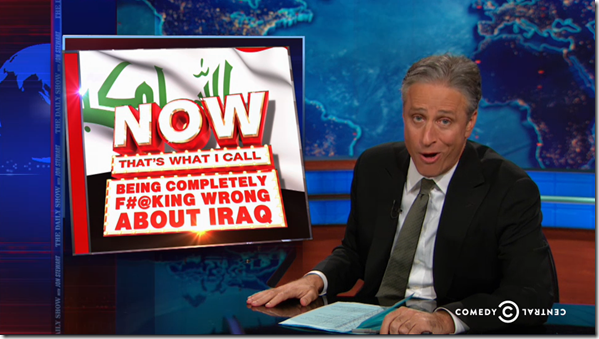
Want to read some more—try here and here and here and here and here.  But as one might imagine, some of the best remember-what-these-nutballs-said-and-did-and-what-happened-because-of-it recollection has come from Jon Stewart on The Daily Show.  (click the pic to see what I mean)

wrong about iraq

Hey, talk show bookers and assignment editors: think, just for a minute, before you make your next move.  Looking for a good summary of what happened way back when–here’s one.

The totality of the Bush administration’s failure in Iraq is stunning. It is not simply that they failed to build the liberal democracy they wanted. It’s that they ended up strengthening theocracies they feared.

And it’s not simply that they failed to find the weapons of mass destruction that they worried could one day be passed onto terrorists. It’s that a terrorist organization now controls a territory about the size of Belgium, raising the possibility that America’s invasion and occupation inadvertently trained the fighters and created the vacuum that will lead to al Qaeda’s successor organization.

And all this cost us trillions of dollars and thousands of American lives.

(UPDATE: Yes, I did change the headline once I realized the error…I figure it’s never too late to get it right–PR)

Furlough Journal: We don’t negotiate with terrorists

There has been a small amount of entertainment value so far from the “partial government shutdown,” and I don’t just mean the fun I’ve had during the time away from the office.  On top of watching my bosses devise legitimate projects we can all work on outside of our government-provided offices and away from our government-provided equipment so no one will miss a check or a part of one, and taking care of my own projects both at home and on the driving range, I’ve had time to consider the silliness that our members of Congress have been reduced to while simultaneously trying to end the “crisis” they created and make sure they won’t be blamed for it once it’s over.

Today, after a failed series of attempts to pass laws to fund small slivers of government operations which proponents argued “everyone was for,” the House passed a bill to guarantee that furloughed workers will get full back pay for the furlough period, whenever it finally ends.  The Senate and the president have also expressed sympathy for the poor, innocent government workers who could be facing serious financial trouble if they start missing paychecks as a result of a standoff that they had no part in starting (or ending, apparently).  But this approach raises an interesting point.

…even as Congress and the White House rallied around the bill, one outside group said it “demonstrates the stupidity of the shutdown.”

Making the shutdown less painful for 800,000 federal employees will encourage Congress and the White House to extend it even longer, driving up the cost, said Steve Ellis of Taxpayers for Common Sense.

Ellis said “essential” federal workers who stayed on the job “will feel like suckers because they’ve been working while the others essentially are getting paid vacations.”

Whatever the negative effects of this partial government shutdown are, all of the victims are innocent ones.  Those responsible for the shutdown weren’t aiming at World War II veterans and their memorial in Washington any more than they meant to harm children or poor people or the space program or home loans or anything else.  Regrettably, they don’t care about any of that, because they are hysterically blind to everything but their true goal: the only target of the intransigence on the part of the extremist Republicans in the House is President Obama.  They want to prevent him from implementing his plans, and they don’t care that he’s already won on the health care reform issue three times: in Congress when it was approved, by the people when he was re-elected, and at the Supreme Court when the law was ruled to be constitutional.

One important difference about this Washington pissing contest as compared to those of the past few years (remember “the fiscal cliff”?) is that Democrats are not taking the bait: so far they haven’t given in to any urge to negotiate with the terrorists, and they should be commended for that.  As Dave Weigel reports in Slate, the Democrats have learned a few things lately about how to hold the line.

“Dealing with terrorists has taught us some things,” said Washington Rep. Jim McDermott after voting no on one of Thursday’s GOP bills. “You can’t deal with ’em. This mess was created by the Republicans for one purpose, and they lost. People in my district are calling in for Obamacare—affordable health care—in large numbers. These guys have lost, and they can’t figure out how to admit it.” Why would House Democrats give away what the Supreme Court and the 2012 electorate didn’t? “You can’t say, OK, you get half of Obamacare—this isn’t a Solomonic decision,” McDermott said. “So we sit here until they figure out they fuckin’ lost.”

UPDATE OCT. 6: But Pat, some may say, surely this whole partial government shutdown thingy isn’t as simple as just the conservatives still fighting with the president, there must be more to it than that.  No, there isn’t: they’ve been planning a government shutdown aimed at Obamacare for months and months, and this morning The New York Times laid it all out, including quotes from the proud perpetrators:

To many Americans, the shutdown came out of nowhere. But interviews with a wide array of conservatives show that the confrontation that precipitated the crisis was the outgrowth of a long-running effort to undo the law, the Affordable Care Act, since its passage in 2010 — waged by a galaxy of conservative groups with more money, organized tactics and interconnections than is commonly known.

(snip)

The current budget brinkmanship is just the latest development in a well-financed, broad-based assault on the health law, Mr. Obama’s signature legislative initiative. Groups like Tea Party Patriots, Americans for Prosperity and FreedomWorks are all immersed in the fight, as is Club for Growth, a business-backed nonprofit organization. Some, like Generation Opportunity and Young Americans for Liberty, both aimed at young adults, are upstarts. Heritage Action is new, too, founded in 2010 to advance the policy prescriptions of its sister group, the Heritage Foundation.

(snip)

On Capitol Hill, the advocates found willing partners in Tea Party conservatives, who have repeatedly threatened to shut down the government if they do not get their way on spending issues. This time they said they were so alarmed by the health law that they were willing to risk a shutdown over it.

(snip)

In the three years since Mr. Obama signed the health measure, Tea Party-inspired groups have mobilized, aided by a financing network that continues to grow, both in its complexity and the sheer amount of money that flows through it.

A review of tax records, campaign finance reports and corporate filings shows that hundreds of millions of dollars have been raised and spent since 2012 by organizations, many of them loosely connected, leading opposition to the measure.

The story is full of details about the groups and people behind the effort, and the enormous sums of money they’re spending to stick it to the president.  Check it out for yourself.

The ACLU explains why even non-terrorists should care about NSA spying on Americans

Since the news broke last month about the domestic spying programs laid out in the secret documents Edward Snowden leaked I’ve tried to make the case why all of us should be angry that our government is spying on us. Some have argued, “but I’ve done nothing wrong so I don’t have anything to worry about.”  Well, you may not have done anything illegal…but do you really want the government knowing and storing information about everything you do?  The folks at Upworthy tweeted a link to this ACLU video that has an answer for those people.

Civil disobedience + free press = privacy + freedom

On a lazy Sunday reading the paper and following Ed Snowden around the world on Twitter, I came across a couple of gems…

It is my hope that the revelations of the extent of U.S. government spying on its citizens that were sparked by Snowden’s leaks lead us to really talk about it, not just repeat talking points: are we prepared to surrender so much of our privacy and our freedom without a fight?  Do we have any reason to trust the government when it say it’s only looking for bad guys and foreigners and is protecting us?  A Guardian story I came across in Jack Shafer’s Twitter feed makes the point:

At every point in this unfolding story, government ministers and officials on both sides of the Atlantic have been at pains to point out that everything that is done by the NSA and GCHQ is lawful because there is “legal oversight”. The problem is that citizens have to take their word for it because every substantive aspect of that oversight is secret. 

(snip)

The conversation between the state and the citizen has been reduced to a dialogue that the writer would have recognised. It goes like this.

State Although intrusive surveillance does infringe a few liberties, it’s necessary if you are to be protected from terrible things.

Citizen (anxiously) What terrible things?

State Can’t tell you, I’m afraid, but believe us they are truly terrible. And, by the way, surveillance has already prevented some terrible things.

Citizen Such as?

State Sorry, can’t go into details about those either.

Citizen So how do I know that this surveillance racket isn’t just bureaucratic empire building?

State You don’t need to worry about that because it’s all done under legal authority.

Citizen So how does that work?

State Regrettably, we can’t go into details because if we did so then the bad guys might get some ideas.

What it comes down to, in the end, is: “Trust us.” And the trouble with that is that in recent decades our political elites have done precious little to deserve our trust.

Need more proof?  How about the news that the Obama Administration is pushing all federal departments and agencies—not just those concerned with national security—to have employees watch their colleagues but also to “pursue unauthorized disclosures of any information, not just classified material.”

The program could make it easier for the government to stifle the flow of unclassified and potentially vital information to the public, while creating toxic work environments poisoned by unfounded suspicions and spurious investigations of loyal Americans, according to these current and former officials and experts. Some non-intelligence agencies already are urging employees to watch their co-workers for “indicators” that include stress, divorce and financial problems.

“It was just a matter of time before the Department of Agriculture or the FDA (Food and Drug Administration) started implementing, ‘Hey, let’s get people to snitch on their friends.’ The only thing they haven’t done here is reward it,” said Kel McClanahan, a Washington lawyer who specializes in national security law. “I’m waiting for the time when you turn in a friend and you get a $50 reward.”

I concede that there are areas of government operations where the need to protect sensitive information is legitimate, but not every area of government meets that standard.  That’s why it’s important that there are people who leak government secrets, and that we have news publications of every medium that investigate and publish that information.  The leakers don’t have to be saints for us to be thankful they are there, as Ben Smith writes in BuzzFeed today.

There is now a heated debate over the moral status of Edward Snowden — who fled Hong Kong for Moscow en route, reportedly, to Ecuador Sunday — and over whether his decision to flee almost certain conviction and imprisonment in the United States means that his actions can’t be considered “civil disobedience.” These seem like good questions for a philosophy class. They are terrible, boring, ones for reporters, and have more to do with the confusing new news environment than with the actual news.

Snowden is what used to be known as a source. And reporters don’t, and shouldn’t, spend too much time thinking about the moral status of their sources. Sources sometimes act from the best of motives — a belief that readers should know something is amiss, or a simple desire to see a good story told. They also often act from motives far more straightforwardly venal than anything than has been suggested of Snowden: They want to screw someone who is in their way professionally; they want to score an ideological point by revealing a personal misdeed; they are acting on an old grudge, and serving revenge cold; they are collecting chits with the press to be cashed in later.

(snip)

…the new media ecosystem has moved sources to the foreground. They make their cases directly on Twitter or in web videos; in Snowden’s case, he also chose to protect himself by going and staying public in a way that would never before have been fully possible. “Big news will now carve its own route to the ocean, and no one feels the need to work with the traditional power players to make it happen,” David Carr wrote recently. The fact that the public must now meet our sources, with their complex motives and personalities, is part of that deal.

Snowden’s flight is a great, classic international story. It is, as Glenn Greenwald tweeted today, a kind of global White Bronco moment. His roots in web culture; his ideology; his decision-making; these are all great stories. He’s a much more interesting figure than Mark Felt because, at least, he’s a new figure, not a familiar one.

(snip)

Snowden’s flight and its surrounding geopolitics are a good story; what he made public is a better one. I’m not sure why reporters should care all that much about his personal moral status, the meaning of the phrase “civil disobedience,” or the fate of his eternal soul. And the public who used to be known as “readers” are going to have to get used to making that distinction.

It should come as no surprise to anyone that Tom The Dancing Bug has something to say on this subject:

td130607

Thanks to TDB and GoComics.com.