Hang down your head, Hearst Newspapers

There’s been a running argument over the last 20 years or so about whether or not newspapers should run ads on their front pages.  The front page is sacred, the old school guys insist: all news and only news, because this is how we show the reader that they’ve come to a serious source of news.  Yes, of course we need to sell ads to stay in business, but we don’t run them on the front page.  We just don’t.

This is one of those fights that the old school guys have been losing, slowly, one paper after another.  A few years back the American Journalism Review ran a good, short history of the issue and outlined reasons for and against.

Gene Patterson, former chairman of the Poynter Institute and former editor of the St. Petersburg Times, sees the page-one ad as a sign of painful economic times for newspapers. “I find the section-front ads to be acceptable; I find the page-one ads repugnant,” he says. “But if they are done tastefully and held down in size, I think perhaps we have to accept them… We have to police it and monitor it and be guided by taste, but I don’t think the advertisers want to ruin us. We are their vehicle, after all, and I think we can work with them to achieve compromises.”

Others want to hold the line. Gene Roberts, a former managing editor of the New York Times and executive editor of the Philadelphia Inquirer, says front-page ads are just another in a series of industry mistakes triggered by short-term thinking. “It’s one more in this kind of death by a thousand cuts that the newspaper business seems to be administering to itself,” says Roberts, a journalism professor at the University of Maryland, which houses AJR. “In the long run, the big necessity is to get and maintain readers, and I think without question that front-page ads work against readership.”

(snip)

Page-one placement can spark visceral reactions not only from journalists but also from readers. Take the case in March of the fluorescent advertising stickers (for a motor oil company and a carpet-and-flooring company) pasted atop the front page of the Hartford Courant. Reader Representative Karen Hunter received several indignant comments on her blog. “That is disgusting to have advertising on the front page of my newspaper,” wrote one woman. Said another: “This has got to stop.” One reader took it further, accusing the Tribune Co., the Courant’s parent, of “absolutely whoring for advertising… It screams, ‘We’re desperate!’ It screams, ‘Ethics be damned!'”

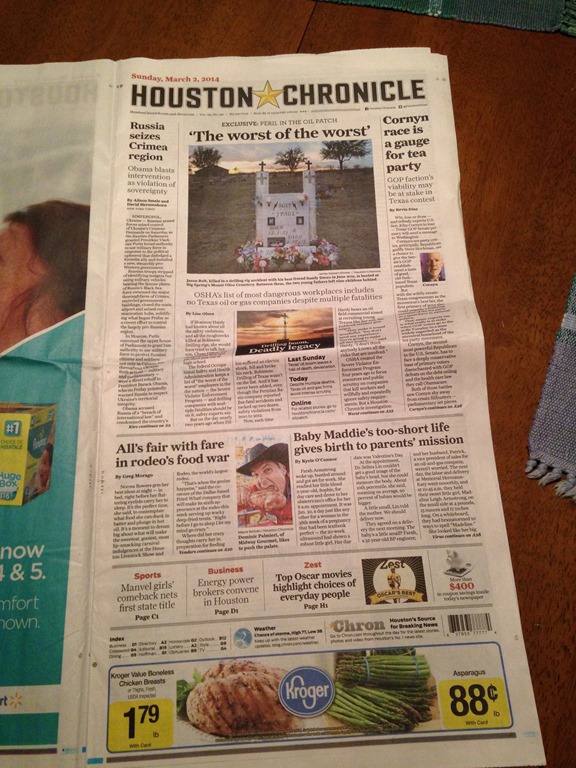
Imagine what they would say if they got a look at this Sunday’s edition in my hometown.  Today, over at Houston’s Leading Information Source, they threw in the towel on this argument.  Not only do we now run ads on the front page, we run two pages of ads in front of the front page!
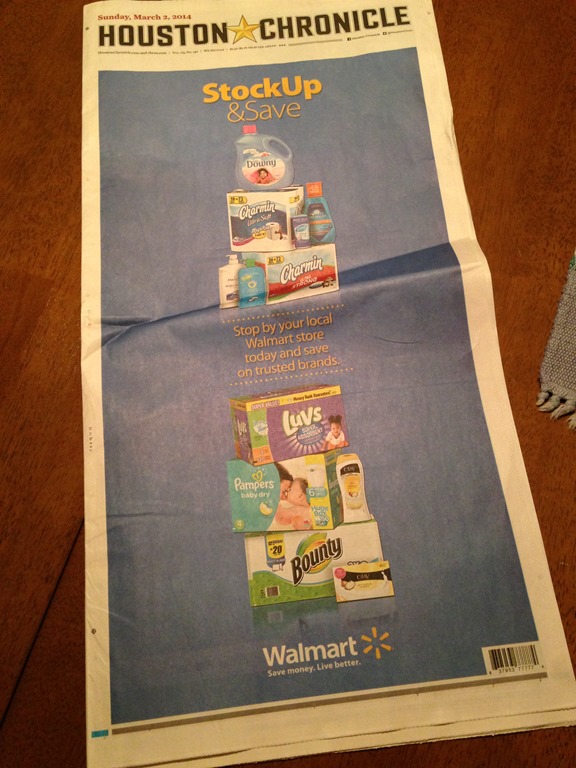
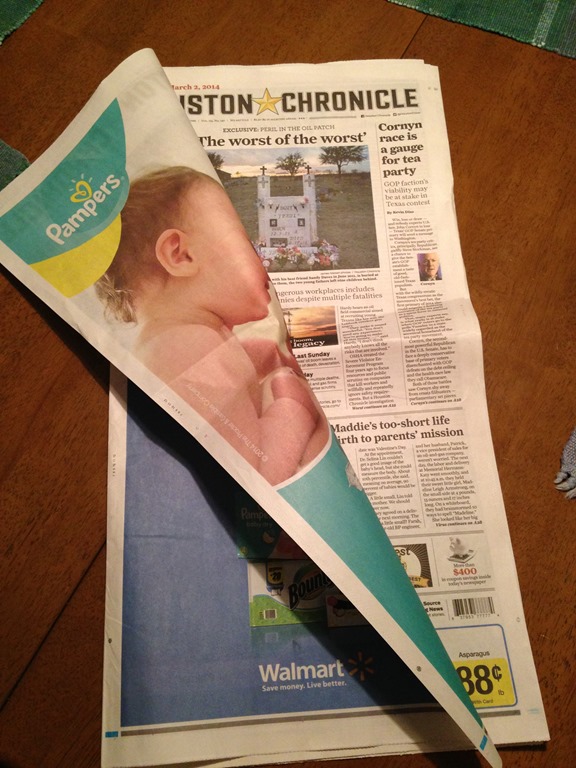
IMG_0116IMG_0118IMG_0117

After the initial shock, I decided I’m not really surprised.  More’s the pity.

Just a little something something from me to you for the holiday

Two little somethings, in fact, which I hope you will find useful and entertaining.

First off, in regard to Pilgrim Fun Facts: what would you say if I told you that some of the core plot points we were taught back in elementary school about the religious freedom-seekers in the big-buckle hats were wrong?  Well, what would you say if the chairman of the history department at Wheaton College told you?  Starting with, the Pilgrims probably didn’t land at Plymouth Rock:

We “know” the location of the Pilgrims’ landing because in 1741 —121 years after they arrived — a young boy overheard 95-year-old Thomas Faunce relate that his father, who came to Plymouth three years after the Mayflower, told him he’d heard from unnamed persons that the landing occurred there.

(snip)

If a longing for religious freedom had compelled them, they probably never would have left. But while they cherished the freedom of conscience they enjoyed in Leiden, the Pilgrims had two major complaints: They found it a hard place to maintain their English identity and an even harder place to make a living. In America, they hoped to live by themselves, enjoy the same degree of religious liberty and earn a “better and easier” living.

Now, to add to your holiday joy, some important tips to guide your behavior at the big feast…John Cook’s suggestions for the right way to start the family fight!

1) Select Your Target. Obviously, you need to find someone who disagrees with you politically. But not just anyone: Close relatives present perilous risks. Your parents or siblings can drag all sorts of emotional baggage into the fight, muddying the waters and making it more about how your veganism ruined that family vacation to Yellowstone in 1999 than whether “job-killer” is a racist code word.

(snip)

2) Getting Started. First off, you should wait until everyone’s seated at the table before you try to get things started. That way you have a captive audience that has to watch the fireworks, and everyone is settled in for a nice long time. Getting the topic of conversation to politics shouldn’t be too hard. Stick to short, sarcastic, tendentious remarks to get things going. “I’m thankful for all that free stuff Obama gave me.”

Read them all and commit them to memory for a truly if you want to provide your loved ones with a truly inspired Thanksgiving blowout they’ll talk about for years.

You’re welcome.

Everything in the news is interrelated to everything else

And who better to prove the point than Tom the Dancing Bug

td131101

Thanks to TtheDB and GoComics.com

Heralding the Classic with a clash of the brass

Are you like me, are you looking forward to what ought to be a pretty good World Series between Boston and St. Louis starting tonight?  Of course you are.  And this may just be me not paying attention, but I’m pleased not to have had to hear about the usual stupid bets between mayors and governors when a series like this comes around; on the other hand, I was very pleased to learn, from NPR, about this unusual throwdown between the orchestras of the two towns!

I’ll take the Cardinals in 6…

Furlough Journal: The end of an error

Uh, that’s it?

After more than two weeks of a partial government shutdown and right up to the brink of a government default on its bills, all forced by extremist Republicans trying to coerce Democrats and the president to give up their wins on health care reform, the Republicans waved the white flag.  Unable to come up with a plan that was agreeable even within the group of Republicans in the House, the House threw up its collective hands and punted, agreeing to approve a compromise originated in the Senate that funds the government and raises the debt ceiling—that is, it kicks this can down the road a few months.  And as far as the Affordable Care Act goes, this bill does not defund a damn thing but it does “strengthen income verification requirements for those who sign up for insurance under Obamacare.”  Well, isn’t that special.

The extremist Republicans got exactly none of what they claimed to have been after, the entire Republican Party has taken a black eye in public approval, 800,000 civil servants and an uncounted number of contractors who do not do “essential jobs” missed work and maybe paying some bills.  And what did I learn, back here in my little corner of the partial government shutdown?

  • I enjoy not going to the office, and going instead to the golf course
  • I don’t respond to a few consecutive days of exercise like I used to
  • Working from home on a short term basis is hard because there are too many potential distractions
  • I hate getting calls from telemarketers

Now I wait for instructions.  My contract management tells me and my colleagues we must wait until our contract gets official notification before we can step foot back at our government offices, and that hasn’t come yet, but the civil servants we work directly for are already calling 9:00 o’clock meetings for tomorrow morning.  That’s right: some things never change.