
This is EXACTLY what the First Amendment protects us from

In the dark reality of the second Trump Administration and its near-daily attacks on the legal and Constitutional protections of the American way of life, I’ve resolved not to be that guy with the kneejerk rapid response to every “outrageous” action dreamed up by the Christian nationalist lawyers who plan and execute TFG’s official agenda.  Because if I did, there wouldn’t be enough time left in the day for sleeping late or watching TV, for playing golf or doing any of the things I like to do; sounding the warning about you know who is a thing I am increasingly uninspired about.  I figure, those who know the threat already know; those who know and don’t care aren’t listening anyway; the rest can’t read, I guess.

But our government blatantly violated the First Amendment to the Constitution yesterday, and I felt the need to say something even though others have and will say this, but I want to say it too.

Since the Bill of Rights was ratified December 15, 1791, my favorite Constitutional amendment has protected our basic freedoms: “Congress shall make no law respecting an establishment of religion, or prohibiting the free exercise thereof; or abridging the freedom of speech, or of the press; or the right of the people peaceably to assemble, and to petition the Government for a redress of grievances.”  When it comes to free speech, what it means is that we can say we want (within some limits) without censorship by the government.  It doesn’t mean that your boss or your church or your spouse can’t punish you for what you say, or that your friends can’t ostracize you from the group chat or not invite you to the neighborhood barbecue; it means you have “the right to articulate opinions and ideas without interference, retaliation or punishment from the government.”  As explained in an article by the Ronald Reagan Presidential Library, freedom of speech

…has long since been interpreted by the Supreme Court to mean that all American speech can not be infringed upon by any branch or section of the federal, state, or local governments. Private organizations however, such as businesses, colleges, and religious groups, are not bound by the same Constitutional obligation. The First Amendment experienced a surge in support and expansion in the 20th century, as Gitlow v. New York (1925) determined that the freedoms promised in it are applicable to local, state, and the federal governments. Further, subsequent Supreme Court decisions from the 20th century to the early-21st century have determined that the First Amendment protects more recent and advanced forms of art and communication, including radio, film, television, video games, and the Internet. Presently, the few forms of expression that have little to no First Amendment protection include commercial advertising, defamation, obscenity, and interpersonal threats to life and limb.

Yesterday we all learned that the ABC television network, a division of the Walt Disney Company, announced an indefinite suspension of “Jimmy Kimmel Live!”  That decision was announced after Nexstar Media Group announced it would preempt Kimmel on the 23 ABC-affiliated stations it owns due to comments Kimmel made “concerning the killing of Charlie Kirk”.  Nexstar owns and/or operates more than 200 local TV stations across the country, and it has every right to decide which programs it will air and which it will not.  As the possessor of a government license to operate a broadcast outlet, it actually has a responsibility to do that.  Whether or not you or I agree with Nexstar’s stated reason for deciding to pull Kimmel, that decision is entirely within the law and does not violate anyone’s First Amendment rights.  And if ABC pulled the show from the network as a means to try to placate a large business partner, that’s perfectly legal, too.  A little cowardly, maybe, but not illegal.

Now, just as background, be aware that both Nexstar and Disney are in line to get government approval for separate planned deals: Disney’s ESPN is trying to acquire the NFL Network, and Nexstar still needs final approval to buy Tegna, which owns 64 stations in 51 markets across the country.  Hmm, seems familiar: Paramount, which owns CBS, was awaiting government approval on a merger…then it settled a meritless $20 BILLION suit filed against it by Trump (for $16 million) and that led to the “big fat bribe” comment on “The Late Show with Stephen Colbert,” and then CBS cancelled Colbert (ten months in the future).  Paramount received the merger approval three weeks later.  But back to our current story.

You see, before Nexstar made its announcement yesterday and before ABC then followed up with its announcement, the chairman of the Federal Communications Commission appeared on a podcast and criticized Kimmel’s comments.  That’s cool.   Brendan Carr said the FCC “has a strong case for holding Kimmel, ABC and network parent Walt Disney Co. accountable for spreading misinformation.”  Uh, I guess that’s OK if he means the agency responsible for regulating the use of public airwaves won’t permit the misuse of that shared resource.  But then Carr said “We can do this the easy way or the hard way. These companies can find ways to take action on Kimmel or there is going to be additional work for the FCC ahead.”

That doesn’t sound very much like the government threatening a business over its exercise of free speech, does it?  Take care of it…or else. ( Hey, nice network ya got there; be a shame if anything happened to it.)

The point of free speech is that you can say what you want and not face “intimidation, retaliation or punishment” from the government.  Like, say, the FCC chairman (a Trump sycophant) threatening the licenses of ABC affiliates who air Kimmel because he (and Trump) don’t like what Kimmel says.

FCC Commissioner Anna Gomez criticized the administration for “using the weight of government power to suppress lawful expression” in a post on X.

“Another media outlet withered under government pressure, ensuring that the administration will continue to extort and exact retribution on broadcasters and publishers who criticize it,” said Ari Cohn, lead counsel for tech policy at the Foundation for Individual Rights and Expression. “We cannot be a country where late-night talk show hosts serve at the pleasure of the president.”

Like, the president who said “as he flew home on Air Force One on Thursday…networks that give him bad publicity should “maybe” have their licenses taken away. (The FCC regulates local TV station licenses, not networks.)”  Proving beyond all question that he really does not understand the role of the press in America.

Bill Carter, an editor-at-large at LateNighter who has spent 40-plus years covering late-night comedy and the television industry, said “nothing even remotely like it has ever happened before.” Calling the Trump administration’s recent actions an “affront to the Constitution,” Carter stressed the role previous late-night stars like Johnny Carson played in public discourse.

Carson “spoke comedy to power,” Carter said. “And that’s what late-night shows have done ever since.”

Other expressions of shock and anger rolled through the Hollywood Hills and Capitol Hill on Thursday, as concerns mounted about a new era of government censorship.

“This is beyond McCarthyism,” Christopher Anders, director of the Democracy and Technology Division for the American Civil Liberties Union, said in a statement. “Trump officials are repeatedly abusing their power to stop ideas they don’t like, deciding who can speak, write, and even joke. The Trump administration’s actions, paired with ABC’s capitulation, represent a grave threat to our First Amendment freedoms.”

“Jimmy Kimmel has been muzzled and taken off the air,” comedian Marc Maron said in an Instagram video posted early Thursday morning. “This is what authoritarianism looks like right now in this country … This is government censorship.”

“This isn’t right,” actor and director Ben Stiller wrote on X.

Damon Lindelof, the writer-producer of the hit TV show “Lost,” vowed to take action against ABC’s owner, Disney. “I can’t in good conscience work for the company that imposed [Kimmel’s suspension],” he said.

There are many more reactions in this story, including from that fun couple Barack Obama and Roseanne Barr.  Click the (gift) link above to read them all.

My point is, this action – a government official threatening government action against a company over speech he (claims he) finds offensive – is as stark an example as I can imagine of what the First Amendment does not allow.  And, it’s just the latest example of what seems to be a top goal of the thinnest-skinned man ever to be our president: to punish any and all who would dare criticize his any or every action. (Gift article, too)

Billionaires are accelerating their efforts to consolidate control over media platforms and the president is eager to help them do so, provided they shut down his critics. If they don’t, he threatens to use the levers of government — particularly those designed to remain independent — to financially punish them. None of this is secret; the brazenness is, at least partly, the point.

(snip)

The systematic effort to censor American media isn’t exactly subtle. The president has not disguised his intentions or his reasons. He has gone to some trouble to emphasize that he wants to control who’s on television and what they say. (And in newspapers too — in the past two months, he has filed lawsuits against the Wall Street Journal and the New York Times.) When Colbert’s “Late Night (sic) with Stephen Colbert” was canceled in July, Trump posted “It’s really good to see them go,” “and I hope I played a major part in it!”

For some valuable perspective on this big Constitutional issue, and the tiny-fisted tyrant at the center of the storm, I close with this:

David Letterman, the king of a previous generation of late-night TV hosts, spoke about Kimmel’s suspension at the Atlantic Festival in New York on Thursday. He said that as host of “Late Night With David Letterman,” he had mocked presidents across six administrations without fear of retribution.

We “attacked these men mercilessly,” Letterman told Atlantic editor Jeffrey Goldberg. “Beating up on these people, rightly or wrongly, accurately or perhaps inaccurately in the name of comedy, not once were we squeezed by anyone from any governmental agency, let alone the dreaded FCC.”

“The institution of the President of the United States ought to be bigger than a guy doing a talk show. You know, it just really ought to be bigger,” Letterman added. “By the way, I have heard from Jimmy. He was nice enough to text me this morning, and he’s sitting up in bed taking nourishment. He’s going to be fine.”
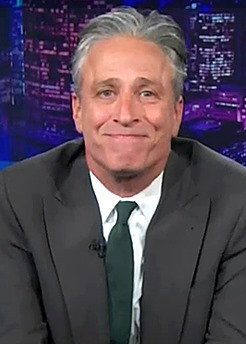
Stewart to the rescue

“The basis of our governments being the opinion of the people, the very first object should be to keep that right; and were it left to me to decide whether we should have a government without newspapers, or newspapers without a government, I should not hesitate a moment to prefer the latter.”  Thomas Jefferson, in a letter to Edward Carrington, January 16, 1787

If I may be so bold as to raise a point with Mr. Jefferson, I wonder if he would still prefer journalism to government if he knew something of the state of the former in the 21st century. Generally speaking, the Founders’ confidence in the American people to govern themselves fairly and justly was based on a presumption that the people would be honestly informed about the issues of their day, and they had faith that a free press would do that.  Even the free press of their day, which was unabashedly partisan.  American journalism evolved, and not always to the good: in an effort to be, and to appear to be, non-partisan, there are elements of today’s journalism that won’t defend objective truth for fear of being labelled everything from unfair to slanted to (gasp!) liberal.

But there is hope: journalists could be in practice what they aspire to be in theory, finders and defenders of truth based on verifiable evidence.  Like the courts have done, in admirably turning so many lion-like defenders of a certain 34-times-convicted felon into cowering pussy cats because courts prioritize truth, while television prioritizes likeable personalities and access.

Yes you, the eager young fellow in front:

Actual malice, meet demonstrable truth

…not long after Joe Biden had been officially declared the winner of [the 2020 presidential] election, a bunch of disreputable right-wing sore losers—that’s the technical term—began to claim that the Dominion machines had somehow been tampered with, and that votes that had been duly cast for Donald Trump via Dominion machines had been secretly switched over to Biden’s column.

The fact that this thesis was very stupid did not stop it from gaining credence among many Trump voters. These people weren’t just angry that their candidate had lost the election; they were angry that Fox News wasn’t reporting that Trump had actually won the election. In retaliation, many of these Trump fans began to unofficially boycott Fox News, instead tuning in to other right-wing news networks, such as Newsmax, which were much more willing to indulge their conspiratorial fantasies.

Check out more of this nice, fun summary of Dominion Voting systems libel suit against Fox News here.  The libel suit is scheduled to go before a jury in a Delaware court tomorrow, assuming the two sides don’t reach a settlement between now and then.

As a recovering journalist myself, I’ll say it is my belief that it should be hard to get a libel verdict against a journalist, a newspaper or broadcast company.  The U.S. Constitution envisions a free press that facilitates a lively public debate of issues, and in the decision that set today’s judicial standard on libel law, New York Times v. Sullivan, Justice William Brennan wrote for a unanimous court that “debate on public issues should be uninhibited, robust, and wide‐open, and that it may well include vehement, caustic, and sometimes unpleasantly sharp attacks on government and public officials.”  The threat of litigation is often used to by people who come out on the bad end of those debates to try to scare a paper or a station into not running tough stories (see: Trump, Donald J.; litigation; threats of).

But that doesn’t mean that those who publish on paper, who broadcast through the air, or who post online, should have a free hand to say anything they want at any time with impunity; those who have truly been libeled do have recourse.  But keep in mind, reputable publications can make a strong defense by proving the truth of what they published: if a published statement is true, it is not libelous or slanderous. (It was not ever thus: courts no longer automatically consider statements that damage the reputation as obviously libelous.)  If what was published is factually true, it is not libelous and you cannot win a lawsuit alleging libel.

In a case where the plaintiff is a public figure or a public official, Times v. Sullivan set a high bar for proving you were libeled by a publication: you must prove that the defendant published a story “with knowledge that it was false or with reckless disregard of whether it was false or not.”  (A term you’ll often hear that is used to describe that state is to say the publication acted with “actual malice.”)  While publication of an erroneous story is bad and hurts the reputation of the publication, it is not a case of libel against a public figure or institution (which Dominion is) if the publication believed the story was true and had done the required work to gather the facts to come to believe it was true.

In Dominion Voting Systems v. Fox, the voting machine company claims Fox defamed the company by “spreading false claims that the company rigged the 2020 presidential election to prevent former President Donald Trump’s reelection.”

As noted in a New York Times story last week,

While legal experts have said Dominion’s case is unusually strong, defamation suits are extremely difficult to win because the law essentially requires proof of the defendants’ state of mind. Dominion’s burden will be to convince a jury that people inside Fox acted with actual malice, meaning either that they knew the allegations they broadcast were false but did so anyway, or that they acted so recklessly they overlooked facts that would have proved them wrong.

During standard pre-trial discovery in this case, Dominion uncovered information from inside Fox that Fox News Channel and its on-air talent and some of its management leaders knew that the claims against Dominion were not true (“with knowledge that it was false”) but published the stories anyway—over and over again—to keep from offending their viewers who believed the claims from Trump and his lawyers and other sycophants of a rigged election (“with reckless disregard of whether it was false or not”).

As it often does, Fox defends itself by wearing the mantle of mainstream responsible journalism operating in the public interest; it argues it reported the claims made by Trump and others because they were newsworthy.

Fox has argued that while it understood many of the claims made by its guests about Dominion were false, they were still worth covering as inherently newsworthy. Fox’s lawyers have taken the position that there is nothing more newsworthy than claims by a former president of the United States that an election wasn’t credible.

But Judge [Eric] Davis disagreed.

“Just because someone is newsworthy doesn’t mean you can defame someone,” he said, referring to pro-Trump lawyers like Sidney Powell and Rudolph W. Giuliani, who appeared repeatedly on Fox News and Fox Business in the weeks after the 2020 election and linked Dominion to various conspiracy theories.

The judge admonished Fox’s lawyers, saying they cannot make the argument that the false statements about Dominion came from guests like Ms. Powell and not from Fox hosts. That argument is irrelevant, he said, because the fact remains that Fox is responsible as the broadcaster.

“It’s a publication issue, not a who-said-it issue,” he said.

There’s no guarantee to the outcome of a jury trial, of course…but if I may presume to summarize a closing argument for Dominion:

  • Fox lied about Dominion rigging its election machines to steal the 2020 presidential election from Crybaby He-Man
  • Dominion made every effort to inform Fox that what its guests and its hosts were saying on the air was incorrect
  • Fox knew that the accusations against Dominion that were being made on its programs were lies, but permitted them to continue
  • Dominion suffered monetary losses and losses to its reputation as a result of Fox’s broadcasts, and asks for money damages

Nice and neat, and not confusing.

Fox has been lying on the air to its audience for years, telling them (1) what they want to hear, regardless of whether it is true, and (2) what certain politicians have agreed to parrot, to build political consensus and power.  But this time, it lied about a company that was willing to call them out in a court of law, and the case has landed before a judge who has demonstrated his loyalty to demonstrable truth and facts.  For Fox, that is a whole new kind of audience.

Dear Jon Stewart,

Thank you…you and the little army of writers and television gypsies that came together for good, at a time when your country, and I, needed you.  When we were lost, trying to rescue truth from the clutches of the radical political conservatives, and the evangelical Christian extremists, and the political organizations they controlled, you went to the front of the column and screamed, “Seriously?”

Journalism was little help in those dark times.  The major outlets were swampedjon_stewart3 by calls that blamed the “liberal media” for always taking sides against good honest conservatives, so they fell back to reporting controversial stories as little more than “he said/she said” exchanges and refused to identify blatant falsity as such.  They were outmaneuvered by the opposition; they were (and are) cowards, willing victims to what David Shaw of the Los Angeles Times beautifully referred to as “the four horsemen of the journalistic apocalypse: superficiality, sensationalism, preoccupation with celebrity, and obsession with the bottom line.”  So it was left to comedy, satire, to ride to our rescue.

The objection to Puritans is not that they try to make us think as they do, but that they try to make us do as they think. – H. L. Mencken

Almost any sect, cult, or religion will legislate its creed into law if it acquires the political power to do so. – Robert A. Heinlein

It didn’t help that the barbarians at the gate, intent on replacing the tolerant democratic civil society we were aspiring to with a theocracy of their own religious beliefs, decided to unlevel the playing field and refuse to acknowledge any truths that didn’t support their worldview.  The “reality-based community” stood dumbfounded, scrambling for the proper reply to “No, the sky is not blue, and you can’t prove that it is.”  But you found a way.

You like to say that you were just a comedian; true enough, but on The Daily Show you were more than just jokes.  You aimed a most potent weapon—sunshine; the light of day; their own words; common sense—at people who were full of shit and assured us all that the smell was coming from somewhere else.  They deserved what they got from you, and we got to laugh.  And in the process—in pointing out that the emperor indeed did not have on any clothes, that what politicians said quite often was at odds with demonstrable truth, that the 24-hour news channels weren’t worth the paper they were printed on—you reassured a lot of us that there was still hope.  For that, thank you.

Fact is, you did a great job of it just this week and I grabbed the link.  So for old time’s sake, just once more, let me suggest—click the pic, ya maroons.

image

This week’s winner of the Internet

Who was it who said there’s a sucker born every minute: P.T. Barnum?*  Roger Ailes?  Well, whoever it was would love this one:

I saw the story on the net Monday—actually I only saw the headline—

President of Argentina adopts Jewish godson to ‘stop him turning into a werewolf’

—and I thought, c’mon…this is the 21st century, right?  No elected national leader in the modern world is believing this, or even going along with it for the sake of his or her people (unlike national leaders who talk man-to-man to Santa Claus or pardon Thanksgiving turkeys for unspecified crimes).  Of course, it’s not true.

The Guardian took a bit of pleasure in popping this balloon:

Evidently, the chance meeting of a Latin American president with a colourful myth too good to fact-check proved irresistible – confirming as it did any number of stereotypes about erratic behaviour from national leaders in the continent of magical realism.

But according to Argentine historian Daniel Balmaceda, there is no link between the two traditions. “The local myth of the lobizón is not in any way connected to the custom that began over 100 years ago by which every seventh son (or seventh daughter) born in Argentina becomes godchild to the president,” he said.

It seems this tradition was born in 1907 when a couple from Russia asked Argentina’s president to be godfather to their seventh son: “The couple wanted to maintain a custom from Czarist Russia, where the Tsar was said to become godfather to seventh sons, and Argentina’s president accepted.”  The tradition in Argentina became law in 1974 and President Isabel Peron extended the benefit to seventh daughters; it was subsequently granted to non-Catholic children beginning in 2009.  The president’s godchildren receive presidential protection, a gold medal, and a scholarship until their 21st birthday.

It was Mark Twain who said, Never let the truth get in the way of a good story.  Many publishers and editors have been making a good living following his advice since long before the Internet came along, but now we can get the full story in fewer news cycles.  So in that sense we all won the Internet this week!

*(Come to fine out it was not P.T. Barnum, it was someone named David Hannum.  Read the interesting backstory here.)