My English is very goodly!

The Southeast Asian character who said that in a television show that’s stuck in a dusty corner of my memory—maybe a “M*A*S*H” episode?—got away with this funny line it because (1) she wasn’t a native English speaker and (2) it was the 1970s, excuses not available to the people who write and edit our newspapers and television newscasts today.

Last week  in The Washington Post Gene Weingarten lamented the death of English at the hands of journalists, the people you might have imagined should know how to properly use the tool that has expedited our exchange of information ever since evolution stole our ability to do that task with a simple sniff.

The end came quietly on Aug. 21 on the letters page of The Washington Post.  A reader castigated the newspaper for having written that Sasha Obama was the “youngest” daughter of the president and first lady, rather than their “younger” daughter.  In so doing, however, the letter writer called the first couple the “Obama’s.”  This, too, was published, constituting an illiterate proofreading of an illiterate criticism of an illiteracy.  Moments later, already severely weakened, English died of shame.

You in the hinterlands, do not take solace imagining that the plague is restricted to Our Nation’s Capital…oh no:

The Lewiston (Maine) Sun-Journal has written of “spading and neutering.”  The Miami Herald reported on someone who “eeks out a living” — alas, not by running an amusement-park haunted house.  The Fredericksburg Free Lance-Star described professional football as a “doggy dog world.”  The Vallejo (Calif.) Times-Herald and the South Bend (Ind.) Tribune were the two most recent papers, out of dozens, to report on the treatment of “prostrate cancer.”

The demise of the language has not happened in a vacuum: readers supplied Weingarten with some of the more irksome examples they have stomached:

7. “loose,” as the opposite of “win.”

8. A mute point.

9. “amount” used to describe countable objects. 

Although regrettable, the slaying of the language by those who (arguably) should know better isn’t that much of a surprise.  These are the same people who, for instance, recently accepted the explanation from golfer Erica Blasberg’s doctor that he removed the suicide note and pill bottle from the scene of her suicide to save her family embarrassment without asking why he didn’t remove the plastic bag that was tied over her head, and who showed “dramatic video” shot from on board a Coast Guard helicopter of a rescue at sea without ever explaining why the boat was still speeding across the surf!

Got an excellent example of egregious and excess execution of English?  Hit the comment button and share with the class.

WARNING: Operator can’t be bothered verifying truth of story

A great idea: warning labels for news stories

warning-7  So many possibilities, so little time…

The Formula

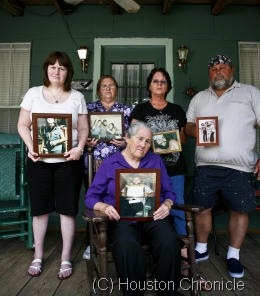
Let me introduce you to the family of Marine Lance Cpl. Shane Martin of Spring, Texas, and ask you to join me in apologizing to them.  It wasn’t enough that they lost a loved one—the 23-year-old Martin was killed in the line of duty in Afghanistan last week—but now they join the ranks of the grieving who’ve been victimized by Houston’s Leading Information Source.

Actually, I commend the paper for running a story about local servicemen and women who are killed in war—it should remind us that our children are fighting a war, something many find all too easy to overlook these days.  But why, why, why does the Houston Chronicle have to keep running The Shot—

Martin family

Yeah, go up there and talk to the family, grab a few heartwarming anecdotes, then ask them to pose for The Shot: get them all lined up on the couch or a line of chairs, looking real sad like, and holding or touching the picture.


We’ve talked about this before—I can presume the family is unhappy about Martin’s death (if not, you’ve got a different story); it doesn’t help me to see them portrayed like victims.  I feel like I’m intruding on their grief.  But the editors run The Shot over and over again, sticking to the formula because then they don’t have to think.

Oh yes, there’s a formula…it’s different for print than it is for TV, or for radio or the Web, but they all have them.  On BBC4, they don’t mind explaining it.

C’mon, Chronicle, don’t let yourself become more of the butt of the joke.

USA 234, HIPRB! 1

Happy 4th of July, all you American patriots…the rest of ya, too.  I’ve got a gift for you, even though you’re not the one turning 234 years old: I invite you to remove your shoes and stroll barefoot among the new tabs at the top of the page, up there under the site title (I gotta get a better title).

For almost a year I’ve been using this page to show off my ideas, but mostly to practice putting one word in front of the other on a regular basis again.  When I discovered that there can be more than one page here, I knew how I wanted to use them.

For years I’ve been saving quotations that appealed to me.  Some I saved just because they were so well written but most of them are ideas I agree with, expressed more ably and eloquently than I am capable (of).  (See.)

Choose from ideas about American law and government and politics, thoughts about my first post-college profession, a section of funnies, and a collection of philosophical takes on life.  I hope you enjoy them, and offer your comments pro and con.  I’ll be adding to the sections as new material is discovered.

So, what did you get me?

What was the point of this?

The photo caught my attention when I read the story in Friday’s Houston Chronicle—as it was meant to.

Cade family

Now, I get it that when you run a story about some people, you want some art.  But do you ask these people each to hold a photo of their murdered relative?  What, like they all carry that around with them all the time?

Read the story, and what do we have: a man disappears, no trace; his family searches and hopes he’ll be found, but authorities identify a body as that of the missing man, who was the victim of a homicide.

The story is at the top of the local news section, and so I’m looking for the news.  It’s not that a man disappeared—that happened in 1988.  It’s not that a body was found—that happened in 1989;  and although the body was found only a few miles from where the man was last seen, the news does not seem to be that authorities couldn’t put two and two together, either.

The news isn’t that the body was just identified—that happened three months ago.  And the news is not that the killer has been found—no one’s been arrested; heck, the cops have no suspects.

The news here is…what?  Thanks, Houston’s Leading Information Source…all too typical performance.  Like the graphic for today’s business section story analyzing the local economy during the first three months of the year:

Chron Quarterly graphic

That’s right: the Q-U-R-R-T-E-R-L-Y.