A thought for the day, every day

“Each time we gather to inaugurate a president, we bear witness to the enduring strength of our Constitution. We affirm the promise of our democracy. We recall that what binds this nation together is not the colors of our skin or the tenets of our faith or the origins of our names. What makes us exceptional – what makes us American – is our allegiance to an idea, articulated in a declaration made more than two centuries ago:

We hold these truths to be self-evident, that all men are created equal, that they are endowed by their Creator with certain unalienable rights, that among these are Life, Liberty, and the pursuit of Happiness.

Today we continue a never-ending journey, to bridge the meaning of those words with the realities of our time.”

–Barack Obama, Second Inaugural Address, January 21, 2013

Recommended reading: an inside story of the loss of space shuttle Columbia

This week, January 16, is the 10th anniversary of the last launch of last launchspace shuttle Columbia. If you’re interested in knowing what happened at NASA leading up to that launch and what happened in Houston during the flight, read Wayne Hale’s Blog. Wayne is retired from NASA now after a 32-year career that saw him rise from flight controller to flight director to posts within the space shuttle program hierarchy and at NASA Headquarters, including Space Shuttle Program Manager after the loss of Columbia and her crew.

Start with his August 14, 2012 entry and read forward in time: he carefully and colorfully sets the stage, introduces the players and fills in shuttle program background; he doesn’t retreat into engineering jargon; he offers his recollections of the most difficult time in the professional lives of many of the people who make up America’s human spaceflight program and doesn’t spare himself from a close look. He writes of “The Tyranny of Requirements” and the warnings that were plainly there in the two previous flights (for any who could see them), of “Counting Down to Disaster” while “Working on the Wrong Problem.”

As someone who worked at Columbia crewNASA then and now, I’ve found his essays both moving and instructive; I don’t know where he’s going with the story exactly, but I’m eager to read each new installment. I can explain to you what happened to that vehicle as it rose to orbit 10 years ago, and what tore it apart and killed its crew as it came home 16 days later, but Wayne’s point of view on what led up to those events—what caused them, what was responsible—is unparalleled in its accessibility and honesty.

In 2002 I thought we were paying the right level of attention to the shuttle. I thought I was paying the right level of attention to the shuttle. I was a Flight Director. I was also a husband and a father and active in my community. I thought I could do it all.

I was wrong.

Later on, I will write about the MLK three day weekend that cost us a crew just because we took three days off. But how can you know in advance where the proper balance is between work and life when you work at extreme risk?


While I can’t cite specific studies, my observation of several major NASA projects that have gotten in trouble over the years shows a high correlation with new, added, late, or poorly defined requirements which caused technical issues, increased the costs, and delayed the schedule. Put simply, a good program manager has got to have the gumption to just say no to changes in requirements – even when they are really good ideas.


In the end, I am convinced that the “relentless budget reduction pressures” were a major cause of the Columbia accident that cost us a crew and an orbiter. Not the only cause, but a major cause.

So where do you draw that line, between prudent and acceptable expenses and extravagance? What do you do when you depend on a vehicle that just flat costs more to fly than you can afford?


The rest of the story is coming soon, but you can get caught up now: the story of space shuttle Columbia on  Wayne Hale’s Blog is worth the effort.

Thoughts on the Baseball Hall of Fame election on the occasion of really caring about the results for the first time

As a kid I thought all the players in the Baseball Hall of Fame, by definition, National_Baseball_Hall_of_Fame_and_Museumwere great players and great guys. It’s not so, but I was just a kid; now that I know better I still want it to be true; I want things to be simple. For the most part, anyone who’s followed baseball for years just knows who’s a Hall of Famer and who’s not, and can make an elevator argument for their guys. And that’s fun, when people who love baseball talk about the shared past from their different perspectives. For what it’s worth, here are the only guidelines handed to the voters as they consider the choices.

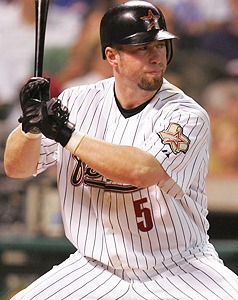
Most of us who grew up in a big league city grew up rooting for the hometown team, and I’ve been in Houston since I was nine. Today is the first time in all those years that players who spent most (or in this case, all) of their Major League careers with the Houston Astros have a real chance (or in this case, two chances) of getting in. So, yeah, it’s exciting to be waiting for the news: will Craig Biggio and Jeff Bagwell make it?

(I don’t know how those of you who didn’t grow up in a big league city picked your favorite team: was it the nearest big league team? The one that had a minor league team in or near your town? The team that had your favorite player? Your dad’s favorite player?)

My guess is, Bagwell won’t make it anmlb_g_bagwell_sy_576d Biggio will. Bagwell’s got the numbers, but I think the doubts about his alleged-but-unproven use of steroids are what’s keeping his vote short. Biggio has no steroid shadow over his career; he’s got more than 3000 hits; he was multiple times an All-Star at two different positions, and a multiple times Gold Glove and Silver Slugger winner; he’s in.

Let’s see if I’m right. (BTW, this is the first time ever that I’ve stopped whatever else I was doing to try to hear the HOF announcement live…always interested before, but never in quite this way.)


OK then, the headline is: NOBODY was elected to the HOF this year! First time that’s happened since 1996, only the eighth time since they started voting for the HOF in 1936.

The subhead: Barry Bonds and Roger Clemens and Sammy Sosa and the other strongly-suspected steroid users didn’t even come close—seven-time Cy Young Award winner Clemens had 37.6% of the vote, all-time home run king Bonds 36.2%.

The sub-subhead: it turns out my feelings weren’t far off the mark. Craig Biggio was the top vote-getter with 68.2%, just 39 votes short of the 75% needed to be elected. And Jeff Bagwell was third at 59.6%. (Jack Morris was second, just behind Biggio at 67.7%.)

My reaction: I’m fine with this.

First, there is no shame—none—for Biggio not to be elected in his first year bw-29-biggio-0627-4_3_r560of eligibility; something like 80% of the players in the Hall weren’t elected in their first year of eligibility. To be the top vote-getter in his first year, and so close to the threshold, means the voters think he’s worthy, and his ultimate election is all but assured. And Bagwell’s vote total improved again: he had 41.7% in his first year, 56% last year and 59.6% this year. He’s going to make it, too.

It would have been great to see either of them, or the two of them together, get this honor, and I’m now even more confident that one day they will. Other HOFers have ties to Houston—Joe Morgan and Nolan Ryan the most prominent—but none of them is wearing an Astros cap on his plaque; Bagwell and Biggio will be the first players from my team to get to the HOF, and I was in the stands to watch them play their entire major league careers, so it will mean something to me when they are recognized as being among the greatest players ever.

The second reason I’m fine with this is, the steroids cheaters were shut out.

Let me start by acknowledging my ambivalence on the subject of steroids. I can accept the scientific evidence that the use of steroids poses a danger to the user, and I’m conformist enough that I have no problem punishing players who broke the rules that prohibited the use of steroids, once those rules were finally put in place. It’s the concept that some performance-enhancing drugs are banned while others are allowed that gives me trouble. Why are antibiotics, protein supplements, vitamins and caffeine OK, but anabolic steroids and amphetamines prohibited? How do we draw the line that says an athlete’s efforts to become the best they can be are to be applauded but only up to this point, and no further?

Second, I think there’s a reasonable argument to be made that baseball writers—the journalists who cover baseball as a news story—shouldn’t be the ones with sole authority over which players get into the Hall of Fame: the people whose job it is to cover the news should not be involved in making the news. (I don’t know who, in the alternative, would select Hall of Famers, but that’s a different question.) In this case, we’re talking about the baseball writers who covered the game in the 1990s and 2000s, who saw the players get freakishly bigger and the old records fall, and decided not to write about the fact that the players breaking the records were taking illegal performance-enhancing drugs.

This Hall of Fame ballot wasn’t the first one to feature prominent players whose careers came during the era of steroid use, but in Bonds and Clemens it had two of the most accomplished players of all time who also happened to be suspected of cheating. Their worthiness to be enshrined in the HOF was judged by the writers who were once complicit with the players and their union and Major League Baseball and its teams in facilitating the use of steroids by players and the subsequent mutilation of the record books that it caused, and who now unapologetically pivot into the role of moral arbiter and protector of the faith to declare that no cheaters shall prosper in Cooperstown. Nice work if you can get it.

The hypocrisy of the writers notwithstanding, the circumstantial evidence of cheating against many of the players, including Bonds and Clemens, is overwhelming, and I’m satisfied at their being rejected this time around; remember, they’ve got 14 more chances, and attitudes are likely to change/soften over the years. Bob Costas suggested that a comparison of next year’s vote totals with today’s for Clemens, Bonds and Sosa will give a real indication of their ultimate chances for getting into the Hall. The vote totals for steroids users like Rafael Palmeiro and Mark McGwire started low and then slipped: Palmeiro (569 homers, 3020 hits) started at 11% in 2011 and was down to 8.8% this year, Mark McGwire (583 homers) got 23.5% in 2007 and this year just under 17%. (And just in case you’re interested, here’s the Mitchell Report on steroids in baseball, with dozens of references to Bonds and Clemens.)

Oh, and one more thing: pitchers and catchers report in just one month!

What the hell just happened here?

For someone who didn’t just go over the fiscal cliff, I’m pretty disappointed with our House and Senate and president. Not surprised, but disappointed…if I can summarize out loud, to help organize my thoughts:

Our elected leaders were faced with some $600 billion worth of automatic tax hikes and spending cuts that might or might not have any real impact in reducing the government’s debt and deficit, but which arguably might push our struggling-to-recover national economy back into a recession; they set a deadline for themselves to act a year and a half ago; then they did nothing, waiting until after the national election to bother to talk about it among themselves so the nasty details of our national fiscal crisis wouldn’t intrude on an otherwise uplifting discussion of the issues of the day; and the best they could come up with—even after the deadline had passed anyway—was a bill that raises marginal income tax rates for some well-to-do folks but not for most of us and kicks the budget cuts can down the road again?! So it’ll have to be taken up at the same time as another increase to the debt ceiling—what could possibly go wrong?!?!

It’s a plan that a majority of Republicans in the House voted against, even though—since the Bush-era tax cuts had just expired at the end of 2012—they were, technically, voting against lowering the tax rate for the bottom 98% or so of Americans.  Because there weren’t enough spending cuts.  Or in this case, any.

Which Barack Obama were Republicans negotiating with—was it the same one that the Conservative Industrial Complex consistently criticizes for being too soft, too dumb to get a good deal for America?

I try to look on the bright side: at least they finally agreed on something, even if it was only that going over the fiscal cliff would be a bad thing. Hooray…take an honorable discharge out of petty cash. (Thanks, Hawkeye.)

(Heavy sigh.)

The fault is not in our stars

Congress is back in Washington—a warning that reminds me of the comment many years ago by then-mayor Jeff Friedman of Austin, Texas, who, when asked for his thoughts about the fact that the state legislature was coming back to town soon, said “Lock up the kids and dogs.”

The legislative branch and the president are back in town, in theory, to deal with the prospect of more than $600 billion worth of budget cuts and tax increases scheduled to go into effect next week. They’re not making much progress, as you might imagine.

Remember, the “fiscal cliff” is a threat the legislative and executive branches imposed on themselves a year and a half ago. To resolve an impasse over extending the debt ceiling so the government could continue to borrow money and pay its bills, our “leaders” set this time bomb of higher taxes and cuts to federal programs to force themselves to come to agreements on taxes and spending and debt ceilings before the “unthinkable” happened. Well, now we’re on the doorstep of the unthinkable, and look what they’re doing. (By the way, the Treasury department says we’re going to hit the debt ceiling next week!)

Perhaps more annoying than our elected leaders’ inability to govern—for that is what it really comes down to, their inability to do what they were sent there to do—is the realization that the focus on the fiscal cliff isn’t what’s really important anyway. Not to say that higher taxes and program cuts don’t matter, but that the real cause of the government’s economic problems—spending more than we take in—still isn’t being addressed.

The fiscal cliff was a crisis of Congress’ own making, brought on by its inability to address many of the same problems last year. The bigger problem, which lawmakers aren’t addressing, is the lack of sustainable fiscal policy.

We are in this mess in part because for decades leaders from both parties have been reading from the same economic playbook. They haggle over the small change while trying to convince Americans that it will make a profound difference in the country’s finances.

Houston Chronicle business columnist Loren Steffy recently offered another on-target analysis that reminds us the real problem isn’t the fiscal cliff, it’s the historic lack of honesty on the part of the political parties.

The budget battle playing out in Washington is nothing more than a giant national temper tantrum. Since 2001, we have been on a spending jag that has ballooned well beyond the costs of inflation and population growth. We’ve funded wars and prescription drug plans, bailed out banks and automakers and stimulated the economy. These programs have spanned both parties’ control of the White House and Congress.

At the same time, we’ve cut taxes. We now have the lowest average tax rate in about 30 years, yet many still complain taxes are too high and protest any threats to cut or curtail entitlement programs.

For more than a decade, we have demanded more while expecting to pay less. No one wants to admit the party’s over.

But they do want to admit—they’re desperate to admit—that the other party is causing the problem. As for the immediate issue, after the House speaker and the president couldn’t come up with a deal last week John Boehner has insisted that the Senate must come up with a plan and then the House will consider it, while the Democratic leadership in the Senate “stands strong” insisting that the House approve a measure it’s already turned down…or else.  (Or else what?) And just while I’ve been writing this, CNN reported that President Obama is about to make a new offer, until it reported that he won’t.

As disheartening as it is to see our national leadership apparently incapable of acting in the nation’s best interests, the situation becomes damn near depressing when you recognize who is really to blame: it’s us. You; me; them; those guys over there, too—we are responsible for the evolution of a system in which ideological extremists representing the view of a minority of citizens are able to reach positions of national power, and we are responsible for not holding our leaders to account for not putting national interests first, and we are responsible for taking more and more from our government but not being willing to pay for what we take.

The solution to our government’s economic problems won’t come out of Congress this week or next; it won’t come from refusing to reduce spending on government programs (which, frankly, no one is doing), nor from refusing to raise taxes and threatening to hold one’s breath until one turns blue (which, candidly, more than one are doing). It will come, when it comes, with the realization by Americans that America can’t keep putting its everyday expenses on a credit card and only make the minimum payments indefinitely and still expect to remain fiscally healthy.  It doesn’t work like that, and we have the national debt and the federal budget deficit to prove it.