
Now, this is what play-by-play is supposed to be

I never heard Ernie Harwell call a whole baseball game on the radio, and from all I can tell I am the poorer for that.

The long-time Detroit Tigers play-by-play man passed away last week, in his 90s and suffering from bile duct cancer.  Google him and you’ll find pages of eloquent tributes to the man, to what he meant to Detroit, and to what he meant to generations of Tiger fans.

As a baseball fan, and a broadcaster, I’ve admired the great radio voices of the game’s past—Red Barber, Mel Allen—through what was written about them and from what brief recordings I’ve heard.  A few of those great voices did some television, and that’s how I got more familiar with the likes of Jack Buck and Jon Miller.  And, of course, Vin Scully.

Scully is from the Bronx, so I have a soft spot.  When Ernie Harwell moved to the Giants in 1950 it was young Vin Scully who took his seat in the Brooklyn radio booth.  Despite his belonging to that hated team, I’ve admired Scully’s easy, relaxed call of a game, how he could bring the sequence of events of a game to life and tell another story, and never let one get in the way of the other.

Here’s the proof: today I found a transcript of Scully’s call the night Harwell passed away; imagine a little crowd noise in the background…I’ll wait.

(waiting)

Now…imagine how it would go if your team’s radio guy tried to do that.
I wish I’d written this

“Religious liberty—the freedom to worship as one chooses, or not to worship—is a central element of the American creed.”  And from there “Newsweek” editor Jon Meacham’s column in this week’s issue lays out the argument—straight down the middle—that the separation of church and state is there for the benefit of both:

The civil and legal cases against religious coercion are well known: human freedom extends to one’s conscience, and by abolishing religious tests for office or mandated observances, Americans have successfully created a climate—a free market, if you will—in which religion can take its stand in the culture and in the country without particular help or harm from the government.

There is a religious case against state involvement with matters of faith, too. Long before Thomas Jefferson, Roger Williams, the founder of Rhode Island, called for a "hedge or wall of separation between the garden of the church and the wilderness of the world," believing, with the Psalmist, that human beings were not to put their trust in princes. The principalities and powers of a fallen world represented and still represent a corrupting threat to religion: too many rulers have used faith to justify and excuse all manner of evil.

Meacham lines up George Washington, John Adams and Thomas Jefferson on the side of the angels in making the case against calling the United States a Christian nation, but a nation where all are free to believe (or not) as they choose.  I know this irks many who see it their duty to evangelize or who misunderstand our history, but that makes it no less true.

Yes, many of the Founders were believing, observant Christians. But to think of them as apostles in knee breeches or as passionate evangelicals is a profound misreading of the past. In many ways their most wondrous legacy was creating the foundations of a culture of religious diversity in which the secular and the religious could live in harmony

As Americans we each have the right to practice a faith of our choosing; why isn’t that good enough?

What was the point of this?

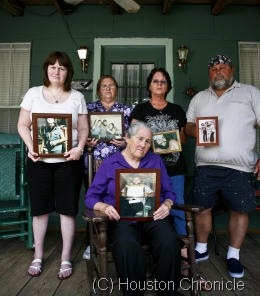
The photo caught my attention when I read the story in Friday’s Houston Chronicle—as it was meant to.

Cade family

Now, I get it that when you run a story about some people, you want some art.  But do you ask these people each to hold a photo of their murdered relative?  What, like they all carry that around with them all the time?

Read the story, and what do we have: a man disappears, no trace; his family searches and hopes he’ll be found, but authorities identify a body as that of the missing man, who was the victim of a homicide.

The story is at the top of the local news section, and so I’m looking for the news.  It’s not that a man disappeared—that happened in 1988.  It’s not that a body was found—that happened in 1989;  and although the body was found only a few miles from where the man was last seen, the news does not seem to be that authorities couldn’t put two and two together, either.

The news isn’t that the body was just identified—that happened three months ago.  And the news is not that the killer has been found—no one’s been arrested; heck, the cops have no suspects.

The news here is…what?  Thanks, Houston’s Leading Information Source…all too typical performance.  Like the graphic for today’s business section story analyzing the local economy during the first three months of the year:

Chron Quarterly graphic

That’s right: the Q-U-R-R-T-E-R-L-Y.

The future of journalism…yesterday

I stumbled across this yesterday and haven’t stopped giggling.  This is a real book, circa 1965:

yourcareerjournalismcover2

“The journalist enjoys good standing in his community. He is even likely to be held in awe.”

“The story that a reporter worried and sweated over will be read by thousands and perhaps millions of people who will be informed, enlightened or amused. … He has prestige and influence that most persons can never hope to attain.”

“The day may not be far off when a city editor will say to a reporter, ‘Check your space gear. You’re going to the moon.'”

This is about a half-a-generation before my time; the journalism I went into in the 1970s was kind of “All the President’s Men” with a touch of “The Front Page,” and then I added a radio station to it.  I wouldn’t have been intrigued by “Ward Cleaver covers the school board,” especially if that had been a true characterization, and I’m having a hard time imagining who would have been.

Just how innocent was this country 45 years ago?  Was it common practice to lie give kids such a sterilized view of the world they were moving into?

More frightening: do we still do it?  (Hey, you parents: whaddya say?)

Don’t believe me? Listen to the faithful

Not to harp on this, but read today’s Maureen Dowd column: after a pointed observation about how the Roman Catholic Church treats its female members, her religiously devout and politically conservative brother eloquently makes the point I was trudging toward a few days ago (“Desperation in a brown cassock,” 4/2/2010):

The church is dying from a thousand cuts. Its cover-up has cost a fortune and been a betrayal worthy of Judas. The money spent came from social programs, Catholic schools and the poor. This should be a sin that cries to heaven for vengeance.

(snip)

The storm within the church strikes at what every Catholic fears most. We take our religion on faith. How can we maintain that faith when our leaders are unworthy of it?