Actual malice, meet demonstrable truth

…not long after Joe Biden had been officially declared the winner of [the 2020 presidential] election, a bunch of disreputable right-wing sore losers—that’s the technical term—began to claim that the Dominion machines had somehow been tampered with, and that votes that had been duly cast for Donald Trump via Dominion machines had been secretly switched over to Biden’s column.

The fact that this thesis was very stupid did not stop it from gaining credence among many Trump voters. These people weren’t just angry that their candidate had lost the election; they were angry that Fox News wasn’t reporting that Trump had actually won the election. In retaliation, many of these Trump fans began to unofficially boycott Fox News, instead tuning in to other right-wing news networks, such as Newsmax, which were much more willing to indulge their conspiratorial fantasies.

Check out more of this nice, fun summary of Dominion Voting systems libel suit against Fox News here.  The libel suit is scheduled to go before a jury in a Delaware court tomorrow, assuming the two sides don’t reach a settlement between now and then.

As a recovering journalist myself, I’ll say it is my belief that it should be hard to get a libel verdict against a journalist, a newspaper or broadcast company.  The U.S. Constitution envisions a free press that facilitates a lively public debate of issues, and in the decision that set today’s judicial standard on libel law, New York Times v. Sullivan, Justice William Brennan wrote for a unanimous court that “debate on public issues should be uninhibited, robust, and wide‐open, and that it may well include vehement, caustic, and sometimes unpleasantly sharp attacks on government and public officials.”  The threat of litigation is often used to by people who come out on the bad end of those debates to try to scare a paper or a station into not running tough stories (see: Trump, Donald J.; litigation; threats of).

But that doesn’t mean that those who publish on paper, who broadcast through the air, or who post online, should have a free hand to say anything they want at any time with impunity; those who have truly been libeled do have recourse.  But keep in mind, reputable publications can make a strong defense by proving the truth of what they published: if a published statement is true, it is not libelous or slanderous. (It was not ever thus: courts no longer automatically consider statements that damage the reputation as obviously libelous.)  If what was published is factually true, it is not libelous and you cannot win a lawsuit alleging libel.

In a case where the plaintiff is a public figure or a public official, Times v. Sullivan set a high bar for proving you were libeled by a publication: you must prove that the defendant published a story “with knowledge that it was false or with reckless disregard of whether it was false or not.”  (A term you’ll often hear that is used to describe that state is to say the publication acted with “actual malice.”)  While publication of an erroneous story is bad and hurts the reputation of the publication, it is not a case of libel against a public figure or institution (which Dominion is) if the publication believed the story was true and had done the required work to gather the facts to come to believe it was true.

In Dominion Voting Systems v. Fox, the voting machine company claims Fox defamed the company by “spreading false claims that the company rigged the 2020 presidential election to prevent former President Donald Trump’s reelection.”

As noted in a New York Times story last week,

While legal experts have said Dominion’s case is unusually strong, defamation suits are extremely difficult to win because the law essentially requires proof of the defendants’ state of mind. Dominion’s burden will be to convince a jury that people inside Fox acted with actual malice, meaning either that they knew the allegations they broadcast were false but did so anyway, or that they acted so recklessly they overlooked facts that would have proved them wrong.

During standard pre-trial discovery in this case, Dominion uncovered information from inside Fox that Fox News Channel and its on-air talent and some of its management leaders knew that the claims against Dominion were not true (“with knowledge that it was false”) but published the stories anyway—over and over again—to keep from offending their viewers who believed the claims from Trump and his lawyers and other sycophants of a rigged election (“with reckless disregard of whether it was false or not”).

As it often does, Fox defends itself by wearing the mantle of mainstream responsible journalism operating in the public interest; it argues it reported the claims made by Trump and others because they were newsworthy.

Fox has argued that while it understood many of the claims made by its guests about Dominion were false, they were still worth covering as inherently newsworthy. Fox’s lawyers have taken the position that there is nothing more newsworthy than claims by a former president of the United States that an election wasn’t credible.

But Judge [Eric] Davis disagreed.

“Just because someone is newsworthy doesn’t mean you can defame someone,” he said, referring to pro-Trump lawyers like Sidney Powell and Rudolph W. Giuliani, who appeared repeatedly on Fox News and Fox Business in the weeks after the 2020 election and linked Dominion to various conspiracy theories.

The judge admonished Fox’s lawyers, saying they cannot make the argument that the false statements about Dominion came from guests like Ms. Powell and not from Fox hosts. That argument is irrelevant, he said, because the fact remains that Fox is responsible as the broadcaster.

“It’s a publication issue, not a who-said-it issue,” he said.

There’s no guarantee to the outcome of a jury trial, of course…but if I may presume to summarize a closing argument for Dominion:

  • Fox lied about Dominion rigging its election machines to steal the 2020 presidential election from Crybaby He-Man
  • Dominion made every effort to inform Fox that what its guests and its hosts were saying on the air was incorrect
  • Fox knew that the accusations against Dominion that were being made on its programs were lies, but permitted them to continue
  • Dominion suffered monetary losses and losses to its reputation as a result of Fox’s broadcasts, and asks for money damages

Nice and neat, and not confusing.

Fox has been lying on the air to its audience for years, telling them (1) what they want to hear, regardless of whether it is true, and (2) what certain politicians have agreed to parrot, to build political consensus and power.  But this time, it lied about a company that was willing to call them out in a court of law, and the case has landed before a judge who has demonstrated his loyalty to demonstrable truth and facts.  For Fox, that is a whole new kind of audience.
The most crucial lesson

Seated at my desk at work with CNN playing numbingly in the background, it was just another autumn Tuesday morning in Houston.  Finally, it soaked in that they were saying a commercial jetliner had crashed into the World Trade Center in New York—where we had been on a vacation weekend just 15 months earlier—and my reaction was to think, that’s crazy: those buildings are near the flight paths to the New York City-area airports, sure, but the pilots are too good at what they do to make that kind of mistake on a bright, cloudless morning.  Must have been a small private plane, with an amateur pilot who got confused.

It never occurred to me that someone would fly a plane into the building on purpose, until I saw what was clearly a passenger jet get lined up and plow right into the middle of the other tower.

We were sent home from work soon after that, so I sat in front of my TV for the rest of the day watching the history.  Riveted.  Fascinated.  Helpless.


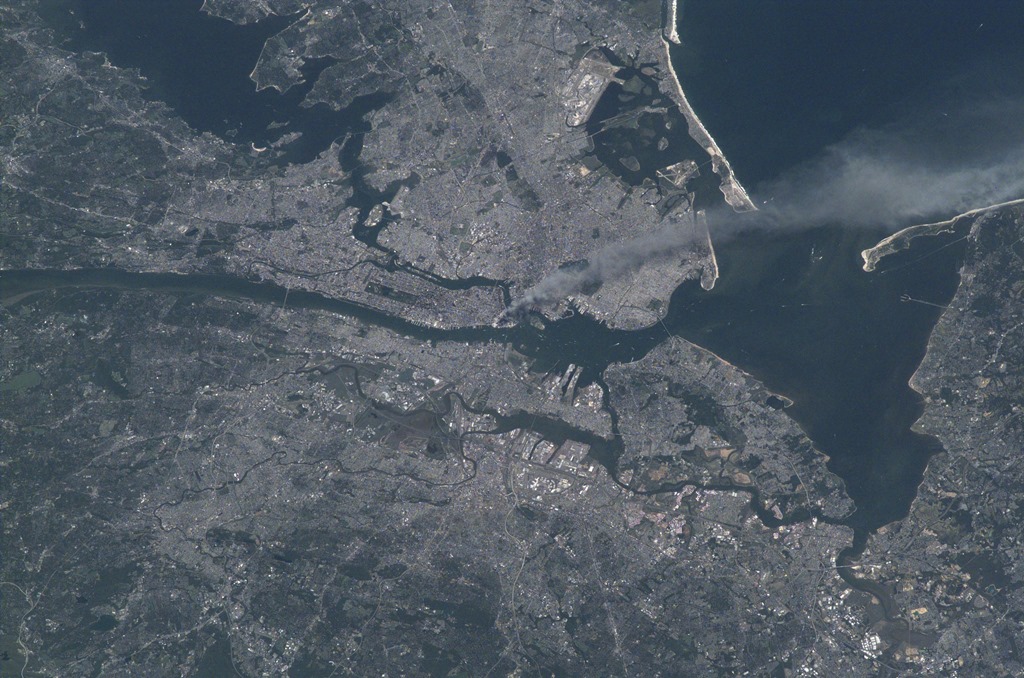
We love anniversaries that come in numbers ending in zero and five, ascribe to them some extra significance, and today is just that way.  There’s no shortage of think pieces out there taking a stab at explaining what we’ve learned about ourselves in the last 20 years, or what we have failed to learn in that time.  There are the first-person memories of being in New York and seeing it happen…or of being inside the towers as they were struck, and shook, and caught fire, and what it was like to save your own life as you joined thousands of others trying to get outside before it was too late.   And then seeing what was out there.  And ultimately, seeing those buildings collapse on themselves.  NASA astronaut Frank Culbertson was the commander of the International Space Station on that day, and he took this picture as they flew above Lower Manhattan just about the time the second tower fell.

iss003e5387_full

Ironically, Culbertson was a Naval Academy classmate, and friend, of Chic Burlingame, who was the captain of the flight that was hijacked that day and crashed into the Pentagon.


America’s war in Afghanistan started as a direct response to the attacks that happened 20 years ago today.  We went after Al Qaeda and its leader Osama bin Laden, and the whole world was on our side: no one questioned the righteousness of the U.S. decision to retaliate against the people behind these unprovoked attacks.  Hell, the rest of the world helped: it was the only time in its existence that NATO invoked the collective defense clause of the treaty.  It took nearly ten full years before Navy SEALs located the Al Qaeda leader in Pakistan and took him out, and ten more years after that before the last American military forces were withdrawn from Afghanistan.

We took our revenge, as we should.  But it still doesn’t feel like we made the best use of the 20 years to understand why the terrorists attacked us in the first place, or to learn how to treat the rest of the world in a way that would make the most dangerous people out there hate us less and be less inclined to attack us.  And meanwhile, America has become a more dangerous place.

Instead of a new order, 9/11…gave rise to the angry, aggrieved, self-proclaimed patriot, and heightened surveillance and suspicion in the name of common defense.

(snip)

In shock from the assault, a swath of American society embraced the us vs. them binary outlook articulated by [President George W.] Bush — “Either you are with us, or you are with the terrorists” — and has never let go of it.

You could hear it in the country songs and talk radio, and during presidential campaigns, offering the balm of a bloodlust cry for revenge. “We’ll put a boot in your ass, it’s the American way,” Toby Keith promised America’s enemies in one of the most popular of those songs in 2002.

Americans stuck flags in yards and on the back of trucks. Factionalism hardened inside America, in school board fights, on Facebook posts, and in national politics, so that opposing views were treated as propaganda from mortal enemies. The concept of enemy also evolved, from not simply the terrorist but also to the immigrant, or the conflation of the terrorist as immigrant trying to cross the border.

The patriot under threat became a personal and political identity in the United States. Fifteen years later, [Donald] Trump harnessed it to help him win the presidency.

In the week after the attacks, Bush demanded of Americans that they know “Islam is peace” and that the attacks were a perversion of that religion. He told the country that American Muslims are us, not them, even as mosques came under surveillance and Arabs coming to the U.S. to take their kids to Disneyland or go to school risked being detained for questioning.

For Trump, in contrast, everything was always about them, the outsiders.

In the birther lie Trump promoted before his presidency, Barack Obama was an outsider. In Trump’s campaigns and administration, Muslims and immigrants were outsiders. The “China virus” was a foreign interloper, too.

(snip)

The legacies of 9/11 ripple both in obvious and unusual ways.

Most directly, millions of people in the U.S. and Europe go about their public business under the constant gaze of security cameras while other surveillance tools scoop up private communications. The government layered post-9/11 bureaucracies on to law enforcement to support the expansive security apparatus.

Militarization is more evident now, from large cities to small towns that now own military vehicles and weapons that seem well out of proportion to any terrorist threat. Government offices have become fortifications and airports a security maze.

But as profound an event as 9/11 was, its immediate effect on how the world has been ordered was temporary and largely undone by domestic political forces, a global economic downturn and now a lethal pandemic.


Journalist, author and filmmaker Chris Tomlinson is an Army veteran and former AP reporter and editor.  In his column in the Houston Chronicle today he provides a background based on what he’s seen and learned fighting and covering wars from back into the 1980s, including the post-September 11 conflicts in the Middle East and Asia, and offers a thoughtful summary of where we ought to turn our attention to prevent another September 11, and probably improve our lives.

In debating the last 20 years, we can talk about the limits of military power, the futility of nation-building, and the inevitable failure of occupations. We can chatter about politics, diplomacy and negotiation. But the most crucial and ignored lesson is one taught to all the children of Abraham.

Do unto others as you would have them do unto you.

Respect is the foundation of peace. We must treat all people with fairness and justice. We must recognize that other nations are not failed attempts to become the United States. Most foreigners do not want to be us; they are proud of the cultures and traditions they spent millennia creating.

We can exchange insights. We should support each other’s progress. We may learn from one another. But we must limit ourselves to setting an example, lending a hand, and sharing knowledge. We must defend ourselves but cannot rely on invading armies, economic sanctions, and cultural imperialism to change the world to look more like us.

Such coercion has triggered a global rise in nationalism and authoritarianism. Tolerance is ebbing. Justifications for injustice are everywhere. Hate is overpowering love in the quest for power. We are not any safer.

Despite the last 20 years, we still value competition over cooperation and war over peace. Some day we may become a nation of philosopher-kings rather than warrior-kings, but for now, we still choose to live by the sword.

A U.S. sailor’s bullet silenced Bin Laden’s voice, but millions more bullets did not bring peace or justice to the world. I no longer report from war zones, instead I write about commerce because the surest path to peace is prosperity for all. Perhaps we can give that a try.

Wheels up

Twenty years fighting a war in Afghanistan, and what did we come away with?  The head of Osama bin Laden…and we threw that in the ocean.

The start of this war was clear cut.  America was attacked by Al Qaeda and we went to Afghanistan to get the people who were responsible.  Twenty years and four presidents ago.  It took almost ten years to finally kill bin Laden (Mission Accomplished!) but we did it.  And then…we didn’t come home.  We had pushed out the Taliban and installed a new government, and we tried to train the people to govern themselves and to defend themselves.  But the killing never stopped, the government never worked, and the Afghan army was a sad joke.  Twenty years later the Taliban is back in charge, and look what we’ve left behind in weapons they now control, even after all the deaths we’ve sustained and the trillions of dollars we spent.

“Tonight’s withdrawal signifies both the end of the military component of the evacuation, but also the end of the nearly 20-year mission that began in Afghanistan shortly after Sept. 11, 2001,” said Gen. Kenneth F. McKenzie Jr., the head of the military’s Central Command. “No words from me could possibly capture the full measure of sacrifices and accomplishments of those who served.”

More than 2,400 U.S. military personnel and nearly 50,000 Afghan civilians died in the 20-year war, in addition to tens of thousands of casualties among U.S. contractors, the Afghan military and national police, insurgents and others, according to the Costs of War Project at Brown University.

The U.S. military succeeded in evacuating more than 120,000 people from Afghanistan in recent weeks, American citizens and others who feared staying under Taliban rule.  Quite an achievement, really; unfortunately, there are another few hundred they couldn’t get out before the deadline.  Let’s wish them all luck in finally escaping.

I’ve got no issue with why we went to war in Afghanistan, nor with the decision to end the war despite the messy nature of things.  I give President Biden credit for closing this down, despite the complaints.

He is under heavy criticism, particularly from Republicans, for his handling of the evacuation. But he said it was inevitable that the final departure from two decades of war, first negotiated with the Taliban for May 1 by former President Donald Trump, would have been difficult with likely violence, no matter when it was planned and conducted.

“To those asking for a third decade of war in Afghanistan, I ask, ‘What is the vital national interest?’” Biden said. He added, “I simply do not believe that the safety and security of America is enhanced by continuing to deploy thousands of American troops and spending billions of dollars in Afghanistan.”

If only our government had learned that lesson ten years ago, after we made good on the real reason we went there in the first place.

The winter of my discontent has spilled over into the spring

You’d have thought that two months would have been plenty of time.  Time for Americans to take a calming breath, relax a bit, and let the radicalization of thought and action spurred by “the former guy” just naturally subside.  Time for passions to cool.  Time for the recognition of fact versus fiction.

Nope.

Four years of cognitive dissonance generated by the primary source of fake news in our lives reached its crescendo in early January when thousands of people claiming to hold an unwavering belief in law and order ignored the provable facts and attacked the seat of government of the country they swore they loved.  Hundreds of law enforcement officers were injured by the “patriots” who took the law into their own hands that day and tried to overturn the results of a free and fair election because they didn’t like the result.

The man impeached for inspiring that assault has left office, but the “the crazy” is still in the house.  He wasn’t the cause, it turns out; just a catalyst.

I daresay we all know at least a few of these people.  The stone cold racists.  The Christian Nationalists trying to make the United States a “Christian nation” even though the Constitution prohibits that.  The self-styled “conservatives” for whom anything can be said if it annoys their political opponents and inspires their own supporters, with adherence to actual accuracy or consistency with their own past statements not required.

They took advantage of having a mainstream leader—it don’t get any mainstreamer than the White House—who was willing to support their radical beliefs to force a massive change in the course of American society.  For four years, it was working.  They didn’t count on Dear Leader being so thoroughly self-absorbed and delusional that he refused to lead the country against the ravages of a global pandemic, a failure which generated enough antagonism that it inspired the record voter turnout that caused his defeat.

MAGA nation has always been there; it came out of the shadows in 2016, and it’s not done.

For those with no self-esteem and no affinity for truth, the blatant and self-serving lying is still going strong.  (Recent examples here and here.)  The flow of ludicrous conspiracy theories and disinformation is unrestrained—such as Wisconsin’s Ron Johnson, “an all-access purveyor of misinformation on serious issues such as the pandemic and the legitimacy of American democracy, as well as invoking the etymology of Greenland as a way to downplay the effects of climate change.”  The absence of any need for intellectual consistency has never been more apparent: a lawyer who is being sued for defamation by a voting machine company she trashed for weeks is defending herself by claiming that “no reasonable person” would have believed the things she claimed in an actual legal filing were actually true!

Many Republicans across the country acknowledge that they have a problem: there are too many Americans who have not drunk the kool-aid and are not voting for Republicans. So they are taking action to make it harder for those people to vote at all.

More than 250 bills have been introduced in 43 states that would change how Americans vote, according to a tally by the Brennan Center for Justice, which backs expanded voting access. That includes measures that would limit mail voting, cut hours that polling places are open and impose restrictions that Democrats argue amount to the greatest assault on voting rights since Jim Crow.

First across the finish line is the great state of Georgia.  In the state where a Republican secretary of state effectively told a sitting president soliciting his cooperation in voting fraud to shove it, the Republican legislature passed and the Republican governor signed an “overhaul of state elections that includes new restrictions on voting by mail and gives the legislature greater control over how elections are run.”

Among other things, the law requires a photo ID in order to vote absentee by mail, after more than 1.3 million Georgia voters used that option during the COVID-19 pandemic. It also cuts the time people have to request an absentee ballot and limits where ballot drop boxes can be placed and when they can be accessed.

Democrats and voting rights groups say the law will disproportionately disenfranchise voters of color. It is part of a wave of GOP-backed election bills introduced in states around the nation after former President Trump stoked false claims that fraud led to his 2020 election defeat.

The effort in Georgia and elsewhere—including my state of Texas, sad to say—are marketed as laws designed to provide greater ballot security and give voters reassurance about the integrity of election outcomes.  This presupposes your belief in the old GOP chestnut that elections now are not secure and that the outcomes are not legitimate.  Which, of course, is untrue—look at the literally dozens of lawsuits pursued across the country by Republicans trying to change the outcome of the presidential race last year, which could not prove voter fraud sufficient to have changed any results.  No one can reasonably argue that there is no election fraud, ever, anywhere, but there has never been evidence of the kind of massive voter fraud—ever, anywhere—that Republicans falsely assert as reason to make voting harder.  Even to the extent, in Georgia, of making it illegal to give a bottle of water to anyone waiting in line to vote.

Republicans who recognize actual truth understand this: their party controls the legislatures in 30 of the 50 states, and thus the redistricting process in those states, which goes a long way to perpetuate their electoral strength in legislative and congressional elections despite their national weakness.  (Democrats redistrict to their own benefit, of course, but they don’t have as many opportunities.)  In the 2020 election for president, 84.1 million Americans voted for someone other than the Republican incumbent, and another 80.8 million Americans didn’t vote at all, so nearly 70% of Americans who are eligible to vote turned thumbs down at another four years of Republican control of the White House.  In an election where more Americans voted than ever voted before, less than one-third of Americans voted Republican at the top of the ballot.  If Republicans want to hold on to power, they know they had better use their majorities while they still have them.

So must the Democrats in Congress.  The For the People Act, passed by the House of Representatives and awaiting action in the Senate, is an effort to negate the Republican attempts to make voting more difficult: it would expand voting rights, and limit gerrymandering, and take precedence in these areas over any laws passed in the states.  We’ll see.

Meanwhile, Republicans and conservatives seem intent on amusing us with their crying and whining.  The party that used to be all about personal responsibility can’t shut up about being the victims of cancel culture when they get caught doing the very things for which they criticize others.

https://twitter.com/richardmarx/status/1376031116868509697

https://twitter.com/RealRBHJr/status/1376201570925359110

https://twitter.com/CollierForTexas/status/1375828780980314113

https://twitter.com/BetteMidler/status/1376040337823518721

E pluribus unity

After two days of consideration, and some moping, I’ve determined that I am disappointed with the final vote by the Senate in Donald Trump’s second impeachment trial, especially since they were so close to calling witnesses who might have provided evidence that could have won over enough votes to convict him of the charges.

I got up early (for a Saturday) to watch the closing arguments, and even though Mitch McConnell had emailed that he would vote to acquit I was happy to learn that there was a chance that witnesses would be called to testify.  As someone who believes Trump’s illegal and un-American behavior deserves whatever punishment is available, I began dreaming—calling witnesses was going to increase the chances that something would happen that would persuade more senators to convict Trump.  It might be the only way to get Republicans who were hell bent on protecting Trump—or who at least wanted to look like they were protecting Trump, in order to insulate themselves from the anger of Trump nation—into a position in which they could vote their real conscience.  Deep down, where everyone knows that Trump is a menace.  Even Lindsey Graham and Ted Cruz.

https://twitter.com/Eric_Alterman/status/1360998689448357888

Although disappointed in the verdict, I am not surprised by it.  Because this is not a movie.  In fiction, without a doubt, there would have been a surprise speech from some Republican senator that clearly and persuasively and emotionally laid the blame for inciting the attack on Congress on Trump, not just for his speech on the Ellipse that day but for the months of blatant lies inflaming his supporters into thinking a nefarious force was stealing the election.  Something like this, right up until the “but…”

Of course, there was a nefarious force at work…it was Trump.

I can’t comprehend how or why people believed Trump’s warning that an election that had not yet happened had already been rigged.  Not that Trump doesn’t have a high enough opinion of himself to make the claim that the only way he could lose would be through theft, but I still don’t get how so many Americans would accept this transparently self-serving claim as true—before the first vote was even cast, and with no offer of proof for how it would happen.  After all the opposition to Trump’s policies and his actions that had developed over the years, why was it hard to believe that a lot of people wouldn’t want him to be president any more?  You didn’t have to agree with those people to be honest enough with yourself to see that they were there, and they were going to vote for someone else.

The election came, and he did lose, and he bored right in with the lie.  There was no evidence of widespread fraud.  Court after court after court (after court) rejected literally dozens of legal claims.  Right through the recounts and the canvasses in state after state, right through the certification of electoral votes in all fifty states, the lying persisted.  These men and women who believed themselves patriots—the only real Americans left—convinced themselves that Trump was right, that taking up arms against their own government was the patriotic thing to do.  They were so entrenched in the delusion that they even photo-documented themselves committing the crime, unburdened by any concern for their own legal culpability.  Hundreds of them are now aware of just what a mistake that was.

The case against Trump presented by the House managers left any honest audience little wiggle room in concluding that Trump committed an impeachable offense: encouraging an armed assault against the United States Capitol and its defenders, the members of the legislative branch of government, and his own vice president.  The smoking gun was right there in Trump’s tiny hand: even if you accept the argument that he meant it when told his supporters that day to make a peaceful protest, you have to explain why, for hours after the violence began, he did nothing to try to stop it.  Didn’t get on TV and call on them to stop.  Didn’t Tweet at them, telling them to stop.  Didn’t call in the National Guard, or any other law enforcement to assist the Capitol police.  Did nothing to restore law and order. *

A majority of the U.S. Senate voted that Trump is guilty of the charge, but not the two-thirds of members present that the Constitution requires.  Today the Houston Chronicle editorial board praised those seven Republicans senators who braved the backlash sure to come by voting to convict based on the compelling evidence presented in the trial.  As for the others:

Their colleagues who voted to acquit either averted their eyes from the glaring evidence or cowered behind strained legal arguments. History will judge them, but the American people need not wait. We bore witness to the assault on our nation’s Capitol and the evidence presented in trial.

We will not forget Trump’s crimes or the failure of most in his party to hold him accountable. Senators failed to show the same kind of courage that Republican state officials did as they resisted the former president’s pressure to overturn an election.

They failed to put their duty to safeguard democracy above partisan allegiance. They took no strength from former Vice President Mike Pence, who rebuffed calls to interfere in the Electoral College certification process, or from former Attorney General Bill Barr, who investigated allegations of voter fraud and, finding no evidence, chose to resign rather than perpetuate Trump’s false claims.

They failed to honor the bravery of the officers who risked their lives to prevent further carnage, including Capitol officer Brian D. Sicknick who was killed and the almost 140 officers who were bruised, bloodied and bashed by a mob wielding bats and flag poles.

Perhaps the starkest profile in cowardice belongs to Senate Minority Leader Mitch McConnell for voting to acquit and then delivering a damning speech proving he knew better. McConnell declared Trump “practically and morally” responsible for the Capitol riot but relied on a questionable legal interpretation to claim the Senate lacked the power to hold a former president accountable. Then he tried to pass blame on the House for delays when he himself blocked the Senate from starting the trial while Trump was still in office.

Such excuses, including Texas Sen. John Cornyn’s claim that Democrats were being “unnecessarily vindictive” in pursuing impeachment, aren’t fooling anybody who’s been paying attention.

So, disappointed…but not discouraged.  Not yet.  The verdict of the U.S. Senate does not protect Trump from the criminal justice system, which can still prosecute him for his actions in regard to the attack on the Capitol just as it can for his attempts in Georgia and elsewhere to pressure local officials to commit election fraud.  Not to mention the civil and criminal investigations in New York and elsewhere, which get the feel of being too much to remember, so thanks to George Conway for bothering to write it down.

In the meantime I intend to try to follow the advice offered by E.J. Dionne yesterday: think about how the good that came out of this trial can be the foundation for the future:

…a diverse and able group of prosecutors laid out an indelible record not only of what happened on Jan. 6 and why, but also Trump’s irresponsibility throughout his term of office: his courting of the violent far right; his celebration of violence; his habit of privileging himself and his own interests over everything and everyone else, including his unrequitedly loyal vice president.

This record matters. We often like to pretend that we can move on and forget the past. But our judgments about the past inevitably shape our future. Every political era is, in part, a reaction to the failures — perceived and real — of the previous one. The Hoover-Coolidge Republicans loomed large for two generations of Democrats. Ronald Reagan built a thriving movement by calling out what he successfully cast as the sins of liberalism.

By tying themselves to Trump with their votes, most House and Senate Republicans made themselves complicit in his behavior. And Trump will prove to be even more of an albatross than Hoover, who, after all, had a moral core.

(snip)

It’s a sign of how far and how fast the ex-president has fallen that opponents of impeachment rationalized their votes by saying, as McConnell did, that Trump must still confront the “criminal justice system” and “civil litigation.” You’re in trouble when your would-be friends are saying you should be prosecuted rather than impeached.

All of which strengthens the hand of a president whose central campaign theme was a warning against the threat that Trump posed to democracy itself. A bipartisan majority of 57 senators and 232 House members has now declared that Joe Biden was right.

Here’s some of what Joe Biden had to say, standing in front of the Capitol two weeks after Trump’s mob tried to steal an election and subvert our system of government.

Few periods in our nation’s history have been more challenging or difficult than the one we’re in now.  A once-in-a-century virus silently stalks the country.  It’s taken as many lives in one year as America lost in all of World War II.  Millions of jobs have been lost.  Hundreds of thousands of businesses closed.  A cry for racial justice some 400 years in the making moves us.  The dream of justice for all will be deferred no longer.  A cry for survival comes from the planet itself.  A cry that can’t be any more desperate or any more clear.  And now, a rise in political extremism, white supremacy, domestic terrorism that we must confront and we will defeat.

To overcome these challenges – to restore the soul and to secure the future of America – requires more than words.  It requires that most elusive of things in a democracy:  Unity.

(snip)

I ask every American to join me in this cause.

Uniting to fight the common foes we face: Anger, resentment, hatred.  Extremism, lawlessness, violence.  Disease, joblessness, hopelessness.  With unity we can do great things.  Important things.  We can right wrongs.  We can put people to work in good jobs.  We can teach our children in safe schools.  We can overcome this deadly virus.  We can reward work, rebuild the middle class, and make health care secure for all.  We can deliver racial justice.  We can make America, once again, the leading force for good in the world.

(snip)

Our history has been a constant struggle between the American ideal that we are all created equal and the harsh, ugly reality that racism, nativism, fear, and demonization have long torn us apart.  The battle is perennial.  Victory is never assured.

Through the Civil War, the Great Depression, World War, 9/11, through struggle, sacrifice, and setbacks, our “better angels” have always prevailed.  In each of these moments, enough of us came together to carry all of us forward.  And, we can do so now.  History, faith, and reason show the way, the way of unity.

(snip)

And so today, at this time and in this place, let us start afresh.  All of us.  Let us listen to one another.  Hear one another.  See one another.  Show respect to one another.  Politics need not be a raging fire destroying everything in its path.  Every disagreement doesn’t have to be a cause for total war.  And, we must reject a culture in which facts themselves are manipulated and even manufactured.

My fellow Americans, we have to be different than this.  America has to be better than this.  And, I believe America is better than this.

(snip)

This is a time of testing.  We face an attack on democracy and on truth.  A raging virus.  Growing inequity.  The sting of systemic racism.  A climate in crisis.  America’s role in the world.  Any one of these would be enough to challenge us in profound ways.  But the fact is we face them all at once, presenting this nation with the gravest of responsibilities.  Now we must step up.  All of us.

* EDITOR’S NOTE: This post has been updated to remove a referenced Tweet which claimed Trump and his family watched the attack on the Capitol from a party tent on the White House lawn.  That was not correct; the Poynter Tweet below explains the error.  HIPRB regrets the error.