
It’s still the economy, stupid

Any system that tries to make candidates for public office come together in one place to talk about what they intend to do if elected is a positive for civic discourse. This week the two major party candidates for president of the United States met on a stage in Denver to talk about domestic issues and that meant, mostly, our country’s economy. They kinda sorta agreed that the fiscal situation is bad and something should be done, and yet the only thing we clearly remember out of the exchange is a lame crack about Big Bird? This is why we have a problem.

Our government’s fiscal affairs are a mess, but the only talk that gains any traction is about something that doesn’t really make a difference. Business columnist Loren Steffy calls it the Big Bird Syndrome, “when politicians imply they will fix the country’s massive fiscal problems by eliminating what amounts to chicken feed in federal spending.” Even though we all agree that a federal deficit exceeding $1 trillion must be reduced—for our own good—the people sucking around for our votes are too afraid of losing support to be serious and specific about how they propose to solve the problem. So they tentatively nibble around the edges:

Perhaps we need to cut these programs because they’re inefficient or we don’t believe government should fund them or we simply don’t like them. But as a deficit reducer, it’s like throwing a few grains of sand over the rim of Grand Canyon and saying you’re fighting erosion.

There are thousands of variables in this equation—spending programs, entitlements, tax rates, deductions, exemptions—and the Simpson-Bowles Commission did a great job envisioning how they might all be leveraged to make progress in reducing the deficit. That framework is still over there on the shelf waiting to be tried if anyone is interested…in Denver both candidates “praised the deficit-cutting framework” without “embrac[ing] the politically unpopular choices” it offered. (What, were the politically popular choices already taken?)

The U.S. government budget works the same as your personal budget and mine; it’s on an entirely different scale, but the basic principles are consistent. From time to time your family and mine spend more than we make, just like Washington, and it’s not always a bad thing: that’s how we pay for houses and cars and educations for our children, for disaster relief and war mobilization. But when we do it as a matter of course, as a way to pay for the “nice to haves” in our lives, and do it over and over for a long enough time, it pushes us into a pit that is damn hard to climb out of.

In that pit, we spend more and more of whatever money we make to repay the interest on the money we borrowed to buy the things we couldn’t afford but thought would be nice to have as well as the borrowed money itself. As the percentage of our income required to pay for the borrowing gets larger, the percentage available to pay for today’s needs gets smaller, and if we don’t reduce our spending to match the available income we have to borrow more to keep up. If there’s no increase in income, or no reduction in expenses, the process repeats and repeats and we spin further and further into debt. This is how banks and credit card companies and loan sharks get rich.

Paying back the loans is hard. Assuming you have no lottery windfall, it probably means doing without or with less for a while (but after you pay back the loan you have more money to spend on what you need or what you want or to save for future spending). That’s not to advocate for trying to pay off the entire national debt right away, but we can’t keep having such a high percentage of our income committed to paying interest—that keeps us from paying for other things that we decide are worth doing, or from reducing the tax burden (hey, how about that concept!). We can’t keep borrowing forever. Growth in the economy will contribute to more revenue without raising tax rates, but the economy isn’t growing fast enough today to make a dent.

This is still the most important issue facing the president and Congress, without exception. But I didn’t hear anyone on that stage in Denver suggest that you or me need to act like responsible adults and do the hard work that’s required: they have plans with lower tax rates (yeah!) and shrinking deficits (wowser!), with milk and cookies served all along the primrose path to solvency!!

They’re telling us what they think we want to hear. They believe we won’t vote for them if they tell us the truth: the economy is a sand castle near the water’s edge, and the tide is coming in…we all have to pitch in, sacrifice some, to protect and strengthen its foundation before the damn thing collapses of its own weight. And, they vaguely promise they have the road map to a solution, and drop only subtle hints about the condition of the road we’ll have to take to get there.

The next two “debates” between the candidates for president and vice president offer another opportunity for some straight talk on this subject. We, and the people who’ll actually be doing the asking in Danville and Hempstead, should be insisting that they give it to us.
The president better Hope he can Change this!

Gallup Poll: Rural Whites Prefer Ahmadinejad To Obama

(I did not see this coming…)

The 47% fallout at Fox, as told by Jon Stewart

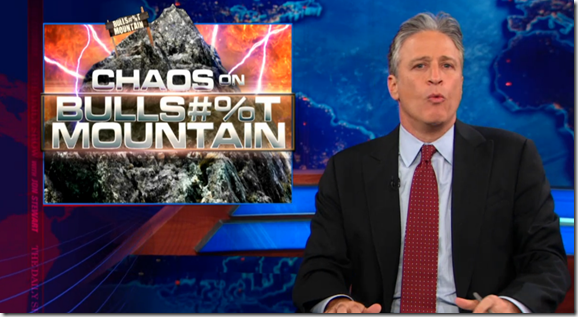
It has been great fun to watch the political circus play out around last week’s revelation of Mitt Romney’s campaign gaffe—or to put it another way, that chance for the rest of us to hear the truth Romney tells his supporters behind closed doors.  The good folks at The Daily Show even took a good-natured little poke at their friends at Fox News Channel for their contortionally-magnificent defense of the Republican Party nominee: “Let me sum up the message from Bullshit Mountain, if I may: this inartfully-stated dirty liberal smear is a truthful expression of Mitt Romney’s political philosophy and it is a winner.”  Click the pic for the whole beautiful report.

image

This is the core of Bullshit Mountain: the 49% entitlement society Obama enables.  That is the core of the Bullshit Nation fiction, that somehow only since Obama, the half of Americans who love this country and work hard and are good have had the fruits of their labor seized and handed over to the half of this nation that is lazy and dependent and the opposite of good—I’m sure there’s a better term for that.  Now, in that 49% [Sean] Hannity is including those on Social Security and Medicare, or as I like to call them, his audience.

Thanks to Mashed Potato Bulletin for the heads up.

Mitt: Did I say that out loud?

Years ago I was a political junkie, but I kicked it. Turned out it was pretty easy to get the political process monkey off my back when the campaign content and tactics got so distasteful that I couldn’t bear to listen. But some things come back easily, in the right circumstances.

The “hidden video” news revealing Mitt Romney in an unguarded moment in his native environment—among the wealthy—expressing his apparently-honest feelings about a large portion of his fellow citizens left me shaking my head and imagining the effect on voters. Even if what he said was right—and mostly it’s not—demonstrating that contempt for the poor and the elderly, who make up most of those who owe no federal income tax but still pay plenty of other taxes, isn’t going to help Romney with his likeability problem. Today’s revelation of another video clip from that same fundraiser—in which Romney asserts that Palestinians (apparently, all of them) “have no interest whatsoever in establishing peace” with Israel—and the promise of the full video still to come, makes you grateful to live in a time when everyone with a phone is a potential hidden camera.

Romney is right about the fact that most people, on both sides, have made up their minds, and the outcome depends on the choices of a small portion of voters. The experts haven’t had time yet to gather data on how Romney’s truth outbursts in a Florida fundraiser will affect those undecided voters, but that data will get put into the mix along with this very interesting analysis of the polling up to this point which concludes that “Given where the election is being contested, however, the most likely outcome is that Obama wins enough tipping-point states to eke out a victory.” I can hardly wait for the debates!

Just like a little love, campaign truth is hard to find

You hold your breath…you make a wish…and you’re disappointed when it doesn’t come true.  And then you remember that things don’t happen just because you wish them to.  Such is the case, not very surprisingly, with the level of discussion this week in the race for president.

Mitt Romney’s selection of Wisconsin congressman Paul Ryan (no relation) as his running mate last Saturday was greeted as good news by some people positioned all along the political spectrum, from those tea party members and fiscal conservatives who love his budget plans to those more liberal folks who believed his serious interest in issues would spark a real debate.  How long did that last?

Until Tuesday.

If we can all agree that Joe Biden is to oratory what Spam is to steak, we can agree that his inelegant comment to a mixed-race audience in Virginia was not meant to invoke the specter of slavery.  Yet that was all Romney and Ryan had to say—that the Democrats were running a campaign of hate—even before that evening’s newscasts hit the air.  (I do give them credit, though, for how well they can operate with the threshold set so low on such a finely-tuned sense of outrage.)

Tuesday also featured some well-prepared interviewers catching Romney surrogates on their indefensible claim about Medicare cuts under Obamacare.  This piece on Mediate has all the links to both occasions: CNN’s Soledad O’Brien with John Sununu, and Fox News Channel’s Brit Hume with Ryan himself, as each of them tried to pass off the latest Republican mischaracterization (to be kind) of the impact to Medicare funding under the Affordable Care Act.  Just nailed them, which was amusing; watch the clips.  The partisan noisemakers can’t really slough this off with the standard allegation of liberal media bias—we’re talking BRIT HUME here!  If FOX NEWS was schooling your VP, you got to make allowances that just maybe CNN was playing it down the middle, too.

But the best thing I saw on Tuesday, from the perspective of trying to keep the facts straight, was an interview on Slate with the author of The New New Deal.  Journalist Michael Grunwald went looking for the truth about the impact of The American Recovery and Reinvestment Act—President Obama’s $800 billion stimulus bill passed by Congress in early 2009, designed to help get the country’s economy rolling again.  His conclusion: the stimulus bill worked.

Not that everything in it worked, or worked perfectly, not that there weren’t problems or some waste and fraud.  But mostly, the stimulus bill did what it was designed to do; it can be argued that the economy hasn’t done better because the stimulus was too small, although Obama could never have gotten Congress to go for more.

…the stimulus was supposed to create jobs at a time when jobs were vanishing at a terrifying rate. Nonpartisan economists agree that it helped stop the free fall; job losses peaked the month before it passed, and the economy dramatically improved once it kicked into gear. But even after the dramatic improvements, the unemployment rate was still sky-high and rising; an economy can do a lot better than losing 800,000 jobs a month without doing well. Ultimately, the stimulus was a 2.5 million-job solution to an 8 million-job problem.

To the extent that Obama’s opponents will argue that Grunwald’s story is biased, he replies:

I don’t think my book portrays the Republicans as “vicious,” but I do show—thanks to a lot of in-depth interviews with GOP sources—how they plotted to obstruct Obama before he even took office. I show how the stimulus was chock full of stuff they claimed to support until Jan. 20, 2009—not just things like health IT and the smart grid and energy efficiency and scientific research, but the very idea of Keynesian stimulus. Every presidential candidate in 2008 proposed a stimulus package, and Mitt Romney’s was the largest. So I do spend a fair amount of time chronicling Republican stimulus hypocrisies. (Readers might enjoy the backstory of Sen. Judd Gregg’s short-lived nomination to be Obama’s commerce secretary.) In general, I’d have to say my reporting backs up the Norm Ornstein-Thomas Mann thesis that the Republicans have gone off the policy deep end—denying global warming, denying Keynesian economics (except when it comes to business tax cuts and defense spending!), trashing Obama’s government takeover of health care and also his Medicare cuts, drumming stimulus supporters like Crist and Specter out of the party.

Read the interview; the book is just coming out this week.  I want to hear this story—we should all want to hear this story, and other stories—from someone who hasn’t already sold out to one party or one candidate.

We’ve debated a bizarro-world stimulus that does not exist. And I think that’s true about Obama, too. I don’t think he comes across as “brilliant.” I think he comes across as a pragmatic left-of-center technocrat who wasn’t interested in pursuing lost causes, but basically tried to do what he said he would do during the campaign. He wasn’t a policy entrepreneur with new policy ideas, but he did his best to get 60 votes for old policy ideas that made sense, and then pushed his administration to put them into action as cleanly and competently as possible. And I did a lot of reporting in the bowels of the bureaucracy and around the country to show how change has been playing out.

I tried to tell the story as fairly and honestly as I could. But I didn’t try to be balanced for the sake of balance. When politicians were full of shit, I tried to point that out.

That’s what we need more of from reporters.  Dutifully transcribing the opinion of the spokeshuman from one party and then the opinion of the spokeshuman from a second party doesn’t get us the truth; what the political parties have to say is designed to benefit the parties, not to promote truth.