
Same song, next verse

When I was a college student in the capital city of Texas, the mayor once held his regular weekly news conference and was asked to comment on the fact that the state legislature was about to begin another biennial session under the big pink dome.  His immediate reaction was to say “Lock up the kids and dogs.”

America, your legislature is back in business: the House of Representatives has selected Mike Johnson of Louisiana as its new speaker.  Who is that, you ask, and what does he believe in?  Among other things, he

So, we got that going for us…which is not nice.  Ruth Marcus writes in the Washington Post that any sense of relief you might be feeling that a well-known extremist like Jim Jordan was not elected by Republicans in Congress is misplaced.

For Jordan’s shirt sleeves demeanor and wrestler’s pugnacity, substitute a bespectacled, low-key presentation, a law degree and an unswerving commitment to conservative dogma and former president Donald Trump.

This is not an upgrade. It is Jordan in a more palatable package — evidently smoother, seemingly smarter and, therefore, potentially more effective.

Johnson, now serving his fourth term in Congress, was the moving force behind aSpeaker Johnson Supreme Court brief that helped lay the shoddy intellectual groundwork for Jan. 6, 2021. In December 2020, he rallied fellow Republican lawmakers to support Texas’s brazen bid to overturn the election results. In a lawsuit that fizzled almost as soon as it was filed, Texas Attorney General Ken Paxton sought to have the Supreme Court intervene in the election by blocking the certification of electoral college votes in four swing states — Pennsylvania, Georgia, Michigan and Wisconsin — where voting rules had been changed in the course of the election and voters, not coincidentally, had favored Joe Biden. The justices swiftly rejected the case, tartly noting that, “Texas has not demonstrated a judicially cognizable interest in the manner in which another State conducts its elections.”

(snip)

The Johnson brief was a full-throated endorsement of the “independent state legislature” theory, ultimately rejected by the Supreme Court in 2023’s Moore v. Harper. The brief asserted that under the terms of the Constitution, only state legislatures — without any review by state courts or involvement of other state parties — have power to set rules for choosing presidential electors. “The clear authority of those state legislatures to determine the rules for appointing electors was usurped at various times by governors, secretaries of state, election officials, state courts, federal courts, and private parties,” the brief argued.

(snip)

The Texas episode was of a piece with Johnson’s conservative worldview. Before being elected to Congress, he was a senior lawyer and national spokesman for the Alliance Defending Freedom, a conservative group that opposes abortion, same-sex marriage and LGBTQ+ rights.

Running for Congress in 2016, he described himself as “a Christian, a husband, a father, a lifelong conservative, constitutional law attorney and a small business owner in that order, and I think that order is important.” Johnson said he had been “called to legal ministry and I’ve been out on the front lines of the ‘culture war’ defending religious freedom, the sanctity of human life, and biblical values, including the defense of traditional marriage, and other ideals like these when they’ve been under assault.”
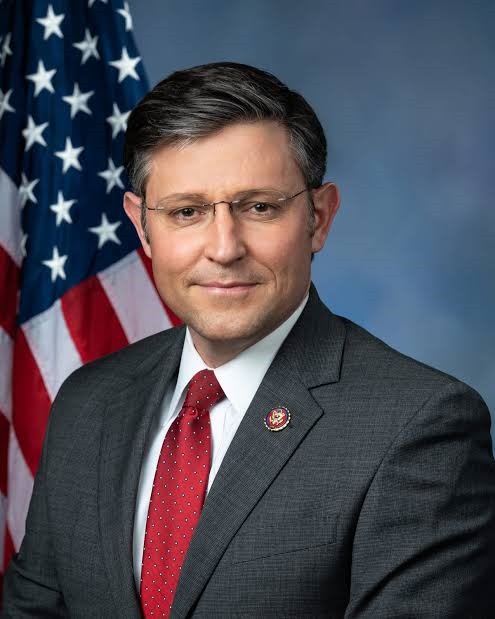
We shall see how well Johnson does in leading the House, or at least its too-small-for-comfort Republican majority, in handling upcoming issues like a possible government shutdown in three weeks, or requests for more aid to Israel and Ukraine, or any of the other normal kinds of business which members of Congress are supposed to take care of on our behalf.  But given his still-declared support of Trump, it’s unlikely Johnson will be much of a leader when it comes to the reality of the need to work with Democrats to get things done: as David Frum wrote in The Atlantic earlier this month, “The rules of contemporary Republican politics make it had to accept reality.  Reality is just too awkward.”

In reality, Trump has been a big vote loser for Republicans. He fluked into the presidency with a Dukakis-like share of the vote in 2016, then lost his party its majority in the House in 2018. Trump got decisively booted from the presidency in 2020; rampaged illegally on January 6, 2021; and then cost his party its Senate majority in the January 2021 runoff elections. His election-denier message damaged his party further in the elections of 2022. His demand for a Biden investigation and impeachment in 2023 is producing an embarrassing fiasco. But no Republican leader dares say these things out loud.

Most taboo of all is working with Democrats, on any terms other than total, one-sided domination: We win, you lose. So [then-Speaker Kevin] McCarthy just had to press ahead, acting as if he commanded a majority when he did not; insulting and demeaning the minority, even though he had to know that he might need their help at any minute.

That minute came. McCarthy sought Democratic votes to save him from his own refractory members, and in return he offered nothing. Not even politeness.

That proposition did not produce the desired results, and so here we are.

Where we are is a country with a solid anti-Trump majority confronting a pro-Trump minority that believes it has a right to rule without concession or compromise.

The only way to produce a stable majority in the House is for the next Republican leader to reach a working agreement with the Democrats to bypass the nihilists in the GOP caucus. But that agreement will have to be unspoken and even denied—because making agreements that show any respect for the other side will be seen by Republican partisans as betrayal. The price of GOP leadership is delivering delusions and fantasies: the delusion and fantasy that Trump won in 2020, the delusion and fantasy that the Republicans did not lose in 2022.

“Delusion and fantasy” might well stand as a new motto for the remnants of a once proud GOP: in the Public Religion Research Institute’s annual American Values Survey, one-third of Republicans believe that “because things have gotten so far off track, true American patriots may have to resort to violence in order to save our country,” almost half think we need a strong leader who is willing to break some rules to get things done, and 29% are strong believers in the QAnon conspiracy movement. In the Washington Post, Jennifer Rubin writes:

Most frightening is how many Republicans buy into white Christian nationalism, a racist ideology that rejects the basic premise of our democracy: “All men are created equal.” One-third of Americans but 52 percent of Republicans agree that “God intended America to be a new promised land where European Christians could create a society that could be an example to the rest of the world.” The number is even higher among White evangelical Protestants (54 percent). Americans who subscribe to white Christian nationalism are more than twice as likely as other Americans to say true patriots might have to resort to violence to save the country.

In a related question, 75 percent of Republicans think the Founders wanted America to be a Christian nation with Western European values.

Rubin also identifies a “positive sign of public sanity” across the ideological spectrum.

Overwhelming majorities of Americans today support teaching the good and the bad of American history, trust public school teachers to select appropriate curriculum, and strongly oppose the banning of books that discuss slavery or the banning of Advanced Placement (AP) African American History.” Moreover, “A solid majority of Americans also oppose banning social and emotional learning programs in public schools.” Though some Republicans have made “anti-wokeism” a key requirement of their political identity, their message is deeply unpopular. “Fewer than one in ten Americans favor the banning of books that include depictions of slavery from being taught in public schools (7%), compared with 88% who oppose such bans.”

Sixty percent say abortion should be legal in most or all cases, compared with 37 percent who say it should be illegal in most or all cases. In a political reversal, “Democrats are now significantly more likely than Republicans to say their support for a candidate hinges on the candidate’s position on abortion,” 50 percent vs. 38 percent.

(snip)

Taking a step back, the overall picture here is a country that is inclusive, respectful of religious differences, pro-democracy and supportive of women’s rights — except when it comes to the largely Republican, mostly White evangelical Christians who reject these fundamental ideas.

When a sizable portion of one of the major political parties, aided by a right-wing propaganda machine and infused with religious fervor, rejects the basis for multiracial, multicultural democracy, we face a severe crisis. Even if Trump does not return to the White House, this radicalized segment will not disappear. How we reintegrate millions of Americans into reality-based, pro-democracy politics in a diverse country remains the great challenge of our time.

E pluribus unity

After two days of consideration, and some moping, I’ve determined that I am disappointed with the final vote by the Senate in Donald Trump’s second impeachment trial, especially since they were so close to calling witnesses who might have provided evidence that could have won over enough votes to convict him of the charges.

I got up early (for a Saturday) to watch the closing arguments, and even though Mitch McConnell had emailed that he would vote to acquit I was happy to learn that there was a chance that witnesses would be called to testify.  As someone who believes Trump’s illegal and un-American behavior deserves whatever punishment is available, I began dreaming—calling witnesses was going to increase the chances that something would happen that would persuade more senators to convict Trump.  It might be the only way to get Republicans who were hell bent on protecting Trump—or who at least wanted to look like they were protecting Trump, in order to insulate themselves from the anger of Trump nation—into a position in which they could vote their real conscience.  Deep down, where everyone knows that Trump is a menace.  Even Lindsey Graham and Ted Cruz.

https://twitter.com/Eric_Alterman/status/1360998689448357888

Although disappointed in the verdict, I am not surprised by it.  Because this is not a movie.  In fiction, without a doubt, there would have been a surprise speech from some Republican senator that clearly and persuasively and emotionally laid the blame for inciting the attack on Congress on Trump, not just for his speech on the Ellipse that day but for the months of blatant lies inflaming his supporters into thinking a nefarious force was stealing the election.  Something like this, right up until the “but…”

Of course, there was a nefarious force at work…it was Trump.

I can’t comprehend how or why people believed Trump’s warning that an election that had not yet happened had already been rigged.  Not that Trump doesn’t have a high enough opinion of himself to make the claim that the only way he could lose would be through theft, but I still don’t get how so many Americans would accept this transparently self-serving claim as true—before the first vote was even cast, and with no offer of proof for how it would happen.  After all the opposition to Trump’s policies and his actions that had developed over the years, why was it hard to believe that a lot of people wouldn’t want him to be president any more?  You didn’t have to agree with those people to be honest enough with yourself to see that they were there, and they were going to vote for someone else.

The election came, and he did lose, and he bored right in with the lie.  There was no evidence of widespread fraud.  Court after court after court (after court) rejected literally dozens of legal claims.  Right through the recounts and the canvasses in state after state, right through the certification of electoral votes in all fifty states, the lying persisted.  These men and women who believed themselves patriots—the only real Americans left—convinced themselves that Trump was right, that taking up arms against their own government was the patriotic thing to do.  They were so entrenched in the delusion that they even photo-documented themselves committing the crime, unburdened by any concern for their own legal culpability.  Hundreds of them are now aware of just what a mistake that was.

The case against Trump presented by the House managers left any honest audience little wiggle room in concluding that Trump committed an impeachable offense: encouraging an armed assault against the United States Capitol and its defenders, the members of the legislative branch of government, and his own vice president.  The smoking gun was right there in Trump’s tiny hand: even if you accept the argument that he meant it when told his supporters that day to make a peaceful protest, you have to explain why, for hours after the violence began, he did nothing to try to stop it.  Didn’t get on TV and call on them to stop.  Didn’t Tweet at them, telling them to stop.  Didn’t call in the National Guard, or any other law enforcement to assist the Capitol police.  Did nothing to restore law and order. *

A majority of the U.S. Senate voted that Trump is guilty of the charge, but not the two-thirds of members present that the Constitution requires.  Today the Houston Chronicle editorial board praised those seven Republicans senators who braved the backlash sure to come by voting to convict based on the compelling evidence presented in the trial.  As for the others:

Their colleagues who voted to acquit either averted their eyes from the glaring evidence or cowered behind strained legal arguments. History will judge them, but the American people need not wait. We bore witness to the assault on our nation’s Capitol and the evidence presented in trial.

We will not forget Trump’s crimes or the failure of most in his party to hold him accountable. Senators failed to show the same kind of courage that Republican state officials did as they resisted the former president’s pressure to overturn an election.

They failed to put their duty to safeguard democracy above partisan allegiance. They took no strength from former Vice President Mike Pence, who rebuffed calls to interfere in the Electoral College certification process, or from former Attorney General Bill Barr, who investigated allegations of voter fraud and, finding no evidence, chose to resign rather than perpetuate Trump’s false claims.

They failed to honor the bravery of the officers who risked their lives to prevent further carnage, including Capitol officer Brian D. Sicknick who was killed and the almost 140 officers who were bruised, bloodied and bashed by a mob wielding bats and flag poles.

Perhaps the starkest profile in cowardice belongs to Senate Minority Leader Mitch McConnell for voting to acquit and then delivering a damning speech proving he knew better. McConnell declared Trump “practically and morally” responsible for the Capitol riot but relied on a questionable legal interpretation to claim the Senate lacked the power to hold a former president accountable. Then he tried to pass blame on the House for delays when he himself blocked the Senate from starting the trial while Trump was still in office.

Such excuses, including Texas Sen. John Cornyn’s claim that Democrats were being “unnecessarily vindictive” in pursuing impeachment, aren’t fooling anybody who’s been paying attention.

So, disappointed…but not discouraged.  Not yet.  The verdict of the U.S. Senate does not protect Trump from the criminal justice system, which can still prosecute him for his actions in regard to the attack on the Capitol just as it can for his attempts in Georgia and elsewhere to pressure local officials to commit election fraud.  Not to mention the civil and criminal investigations in New York and elsewhere, which get the feel of being too much to remember, so thanks to George Conway for bothering to write it down.

In the meantime I intend to try to follow the advice offered by E.J. Dionne yesterday: think about how the good that came out of this trial can be the foundation for the future:

…a diverse and able group of prosecutors laid out an indelible record not only of what happened on Jan. 6 and why, but also Trump’s irresponsibility throughout his term of office: his courting of the violent far right; his celebration of violence; his habit of privileging himself and his own interests over everything and everyone else, including his unrequitedly loyal vice president.

This record matters. We often like to pretend that we can move on and forget the past. But our judgments about the past inevitably shape our future. Every political era is, in part, a reaction to the failures — perceived and real — of the previous one. The Hoover-Coolidge Republicans loomed large for two generations of Democrats. Ronald Reagan built a thriving movement by calling out what he successfully cast as the sins of liberalism.

By tying themselves to Trump with their votes, most House and Senate Republicans made themselves complicit in his behavior. And Trump will prove to be even more of an albatross than Hoover, who, after all, had a moral core.

(snip)

It’s a sign of how far and how fast the ex-president has fallen that opponents of impeachment rationalized their votes by saying, as McConnell did, that Trump must still confront the “criminal justice system” and “civil litigation.” You’re in trouble when your would-be friends are saying you should be prosecuted rather than impeached.

All of which strengthens the hand of a president whose central campaign theme was a warning against the threat that Trump posed to democracy itself. A bipartisan majority of 57 senators and 232 House members has now declared that Joe Biden was right.

Here’s some of what Joe Biden had to say, standing in front of the Capitol two weeks after Trump’s mob tried to steal an election and subvert our system of government.

Few periods in our nation’s history have been more challenging or difficult than the one we’re in now.  A once-in-a-century virus silently stalks the country.  It’s taken as many lives in one year as America lost in all of World War II.  Millions of jobs have been lost.  Hundreds of thousands of businesses closed.  A cry for racial justice some 400 years in the making moves us.  The dream of justice for all will be deferred no longer.  A cry for survival comes from the planet itself.  A cry that can’t be any more desperate or any more clear.  And now, a rise in political extremism, white supremacy, domestic terrorism that we must confront and we will defeat.

To overcome these challenges – to restore the soul and to secure the future of America – requires more than words.  It requires that most elusive of things in a democracy:  Unity.

(snip)

I ask every American to join me in this cause.

Uniting to fight the common foes we face: Anger, resentment, hatred.  Extremism, lawlessness, violence.  Disease, joblessness, hopelessness.  With unity we can do great things.  Important things.  We can right wrongs.  We can put people to work in good jobs.  We can teach our children in safe schools.  We can overcome this deadly virus.  We can reward work, rebuild the middle class, and make health care secure for all.  We can deliver racial justice.  We can make America, once again, the leading force for good in the world.

(snip)

Our history has been a constant struggle between the American ideal that we are all created equal and the harsh, ugly reality that racism, nativism, fear, and demonization have long torn us apart.  The battle is perennial.  Victory is never assured.

Through the Civil War, the Great Depression, World War, 9/11, through struggle, sacrifice, and setbacks, our “better angels” have always prevailed.  In each of these moments, enough of us came together to carry all of us forward.  And, we can do so now.  History, faith, and reason show the way, the way of unity.

(snip)

And so today, at this time and in this place, let us start afresh.  All of us.  Let us listen to one another.  Hear one another.  See one another.  Show respect to one another.  Politics need not be a raging fire destroying everything in its path.  Every disagreement doesn’t have to be a cause for total war.  And, we must reject a culture in which facts themselves are manipulated and even manufactured.

My fellow Americans, we have to be different than this.  America has to be better than this.  And, I believe America is better than this.

(snip)

This is a time of testing.  We face an attack on democracy and on truth.  A raging virus.  Growing inequity.  The sting of systemic racism.  A climate in crisis.  America’s role in the world.  Any one of these would be enough to challenge us in profound ways.  But the fact is we face them all at once, presenting this nation with the gravest of responsibilities.  Now we must step up.  All of us.

* EDITOR’S NOTE: This post has been updated to remove a referenced Tweet which claimed Trump and his family watched the attack on the Capitol from a party tent on the White House lawn.  That was not correct; the Poynter Tweet below explains the error.  HIPRB regrets the error.

Telework Journal: What we have learned

Whether out of productive curiosity or an early onset of ennui bureaucratique, the people leading teleconferences and remote-by-video meetings I’ve been on in the past week are kicking the responsibility for meeting content over to the crowd.  The most common kick-off lately, as we finished our first four weeks of special circumstances, has been the question, “what have you learned so far from teleworking” that could conceivably be of value to others.

If that’s value to others who are teleworking, I don’t have too much to offer besides “get a comfortable chair.”  I think my biggest problem with teleworking is figuring out a new routine for how and when things are to be done, and that routine is going to be particular to me.  Whatever I finally figure out for myself is unlikely to be of too much help to you…I’m kinda quirky in how I work, and I don’t want to visit that on you.

The great philosopher Lawrence P. Berra once noted (or probably, more than once), “You can observe a lot by just watching.”  What I’ve been watching in the past week seems to be something of a steadying of our reaction to this great disruption in our lives.  Not that Americans are happy about being asked to put their lives on hold and stay inside; I think we get why that’s necessary, and we’ve started to look to the next level and the one after that, to try to make sense of this whole situation.  It appears that what more and more people are coming to realize is that America’s handling of the novel coronavirus outbreak could have been so much better.  And to identify those responsible.

That the pandemic occurred is not [Donald] Trump’s fault. The utter unpreparedness of the United States for a pandemic is Trump’s fault. The loss of stockpiled respirators to breakage because the federal government let maintenance contracts lapse in 2018 is Trump’s fault. The failure to store sufficient protective medical gear in the national arsenal is Trump’s fault. That states are bidding against other states for equipment, paying many multiples of the precrisis price for ventilators, is Trump’s fault. Air travelers summoned home and forced to stand for hours in dense airport crowds alongside infected people? That was Trump’s fault too. Ten weeks of insisting that the coronavirus is a harmless flu that would miraculously go away on its own? Trump’s fault again. The refusal of red-state governors to act promptly, the failure to close Florida and Gulf Coast beaches until late March? That fault is more widely shared, but again, responsibility rests with Trump: He could have stopped it, and he did not.

The lying about the coronavirus by hosts on Fox News and conservative talk radio is Trump’s fault: They did it to protect him. The false hope of instant cures and nonexistent vaccines is Trump’s fault, because he told those lies to cover up his failure to act in time. The severity of the economic crisis is Trump’s fault; things would have been less bad if he had acted faster instead of sending out his chief economic adviser and his son Eric to assure Americans that the first stock-market dips were buying opportunities. The firing of a Navy captain for speaking truthfully about the virus’s threat to his crew? Trump’s fault. The fact that so many key government jobs were either empty or filled by mediocrities? Trump’s fault. The insertion of Trump’s arrogant and incompetent son-in-law as commander in chief of the national medical supply chain? Trump’s fault.

For three years, Trump has blathered and bluffed and bullied his way through an office for which he is utterly inadequate. But sooner or later, every president must face a supreme test, a test that cannot be evaded by blather and bluff and bullying. That test has overwhelmed Trump.

Trump failed. He is failing. He will continue to fail. And Americans are paying for his failures.

If you’re sitting at home trying to get smarter about how we got here—more cases of COVID-19 and more deaths from the disease than any other country in the world, still not enough testing capability to truly get a handle on how and where the virus is spreading so we can marshal our efforts to fight it more effectively, sending our first-line medical care providers into the fight without enough of the right weapons—David Frum’s article is a very good place to start.   David Remnick’s story in The New Yorker is another.

And here we are, playing a tragic game of catch-up against a virus that has killed thousands and left millions unemployed. At Trump’s State of the Union address on February 4th, he pledged, “My Administration will take all necessary steps to safeguard our citizens from this threat.” Three weeks later, Kayleigh McEnany, a loud promoter of birtherism and of Trump talking points during the 2016 campaign, cheerfully told the Fox Business audience, “We will not see diseases like the coronavirus come here, we will not see terrorism come here, and isn’t that refreshing when contrasting it with the awful Presidency of President Obama?” Now McEnany is the President’s press secretary.

The coronavirus has inflicted a level of pain that is deep and global. And yet many nations, from South Korea to Germany, have done far better at responding to it than the United States has. The reasons for the American failing include a lack of preparation, delayed mobilization, insufficient testing, and a reluctance to halt travel. The Administration, from its start, has waged war on science and expertise and on what Trump’s former adviser Steve Bannon called “the administrative state.” The results are all around us. Trump has made sure that a great nation is peculiarly vulnerable to a foreseeable public-health calamity.

https://twitter.com/SangerNYT/status/1249016654761205760

Just how deeply and profoundly does Trump not get it?  His smug response to criticism that he’s not doing all he could is to point out that the TV ratings of the daily White House briefings—the ones he commandeered from his vice president after seeing that people were paying attention but not to him—are so very high.  Even a lot of Trump’s loyal defenders can’t sit still for that level off ignorance.

https://twitter.com/brithume/status/1248340683544543233

https://twitter.com/brett_mcgurk/status/1249068388921442305

As for his insistence that the blame lies with the way things were left for him by the Obama Administration…

https://twitter.com/smithstreet1969/status/1248582343830405121

…or the hearty chestnut that the whole thing is a hoax:

https://twitter.com/patryan12/status/1248621603518173184

What have we learned after four weeks of national semi-lockdown?  Doctors and nurses in a pandemic, and the people who keep their hospitals and offices running including the people who keep them supplied with the vital materials that make me better when I’m sick, are as brave or braver than anyone.  TV broadcasts that traffic in easy emotional manipulation and call it “news” should always be shunned.  Those who insist that human activity is not impacting global climate should have a quick look at the images taken from space that show dramatic changes on the planet—changes for the better—after just a few weeks of reduced driving and factory operations.  When working from home it takes longer to do things than it does when we’re at the office, at least until we figure out how to do things when we’re working from home.

And, we’ve done a sufficient job of coming to grips with a very necessary and dramatic change in our way of life, in a comparatively short period of just weeks, that we’re starting to be able to shift focus from our individual needs and see the bigger picture.  To assess the reasons why we are where we are.  To make rational choices about what we should do next.

The story of the film so far

The top level news from Special Counsel Robert Mueller’s report to the attorney general on his investigation of Russian interference in the 2016 presidential election is important confirmation: the Russians did try to influence the outcome of our 2016 presidential election.  Based on Bill Barr’s summary of the report sent to Congress last Sunday, the only currently available report on the report’s contents (a source I choose to trust, as I trust the effort of Mueller’s team), we should now have no reasonable disagreement that Vladimir Putin’s government committed cyber war on our country, and that we should be doing something about it.  I know our president has belittled that notion in the past (disagreeing with the findings of our country’s intelligence community; not clear why), but if he’s going to accept the other conclusions from the Mueller investigation he’ll have a hard time disagreeing with this one by blaming the messenger.  (I say that despite Trump’s demonstrated disdain for anything approaching intellectual consistency, but still…)

Next up: Mueller does not find evidence to indicate that Trump or any of the people in his campaign intentionally or unintentionally worked with the Russians to influence the outcome of the election: “The investigation did not establish that members of the Trump campaign conspired or coordinated with the Russian government in its election interference activities.”  I find I agree with the analysis that this is good news…for everybody.  For Trump, certainly, in that it seems to clear him from being pursued criminally in that respect, reduces the chance of impeachment proceedings, and provides a political boost for his 2020 campaign.  But also for our country, in that we can take some solace in knowing that our president and his people did not conspire with a foreign government to seize power.  This was never a given, sadly, so it’s good to know now.

https://twitter.com/RealRBHJr/status/1109961534069981184

I also agree with the many who argue for the public release of Mueller’s complete report.  A shorthand argument: if the report “completely exonerates” Trump, as he insists it does, then we should all get to share the happy details.  A good longer version comes from David French in Sunday’s National Review:

The American people need full disclosure — and not just of the Mueller report itself. We need to see relevant FISA applications, supporting documents, classified testimony, and any other evidence relevant to not just the Mueller investigation itself but also to the inception of the Trump–Russia investigation. This conclusion is rendered even more urgent by two important political realities.

The first relates to the obstruction of justice. As Barr explains in his letter, the Mueller report neither accuses Trump of committing obstruction of justice in the course of the investigation, nor does it exonerate him [emphasis added]. Instead, the attorney general and deputy attorney general (both Trump appointees) examined the evidence and concluded that the evidence was “not sufficient” to conclude that the president obstructed justice. Democrats will trust this conclusion exactly as much as Republicans would trust a Democratic attorney general to evaluate the actions of a Democratic president.

(snip)

…nothing in Barr’s letter excuses the fact that Trump hired and surrounded himself with some of the worst people in politics — felons and liars who sometimes committed crimes in the ham-handed attempt to cover up their own contacts or attempted contacts with Russian assets or operatives. The president’s personal lawyer, his campaign chair, his longtime friend and adviser, and his first national-security adviser (among others) each engaged in patterns of deception that were not only criminal, they created real and genuine alarm in fair-minded Americans that at least some people in the president’s inner circle were more than willing to work with our enemies abroad to gain financial or political advantage here at home.

But these facts notwithstanding, there are still grounds for immense relief that America’s most recent presidential election has been (further) legitimized and that years of speculation about President Trump’s ties to the Russian government have proven unfounded. These last 30 months of investigations — beginning well before Mueller’s appointment — are among the most divisive and contentious events in modern political history. As we wait to read the full report and move into the inevitable battles over its contents, we can be sure that more division and contention await. Yet today, at least, we can be grateful for the good news we have, and it is good news indeed.

Mark Joseph Stern echoes French’s argument in the sense that full disclosure of the Mueller report is also necessary for analysts to determine if Barr’s quick assessment and summary of the results of the 22-month investigation were an improper effort to head off further action against the president who appointed him to the job.

Barr outlined one key finding unambiguously: The Trump campaign, he wrote, did not coordinate with the Russian government to influence the 2016 election. That conclusion will come as a great relief to the president and his supporters, if Mueller’s report is as clear-cut as Barr indicates. But the attorney general’s summary includes a second finding that is confusing and equivocal. Mueller, Barr wrote, left “unresolved” the question of whether Trump obstructed justice. He instead laid out “evidence of both sides” and allowed Barr, along with Deputy Attorney General Rod Rosenstein, to use those findings to determine whether the president committed obstruction. On the basis of this evidence and analysis—which we cannot yet evaluate—Barr and Rosenstein decided that Trump did not commit such an offense.

This portion of the summary will remain a puzzle until Mueller’s report is released to the public. But Barr provided a clue to his reasoning, by suggesting that he did not see evidence Trump hampered the Russia probe with “corrupt intent.” As former Acting Solicitor General Neal Katyal has noted, it is hard to understand how Barr, or Mueller, or anyone, could gauge Trump’s intent, because the president has not been interviewed about his intentions. Why not? We know at least one person vigorously opposed to compelling Trump to submit to an interview: Bill Barr, whose 2018 memo declared that Mueller could not legally do so.

The full report will be beneficial to Congressional committees, too, to the extent that they are resolved to pull their heads out of their asses and start providing checks and balances of the executive branch rather than being the president’s cheering section and public defender.

https://twitter.com/TheAtlantic/status/1109921343653531650

So we wait, for…who knows how long.  Barr has said he’s all about the transparency, the president says he doesn’t mind at all if the report is made public, but there’s no requirement in law that it ever be released to anyone other than the AG nor any mention of a time limit for so doing.  That’s given Dahlia Lithwick time to bemoan the fact that facts don’t, in fact, seem to matter…that this issue has already devolved into political posturing and stupidity without most of us ever seeing what Mueller did, in fact, report.

Someday, when we’re sitting around the electronic campfires we’ve lit to pretend-warm the huts in our Mars colonies, we will tell our grandchildren about whatever vestigial memories we have of facts. Perhaps we will be able to date their demise to the 46-ish hours between the announcement on Friday, March 22, 2019, that Robert Mueller had submitted his final report to Attorney General William Barr, and the letter Barr released on Sunday, March 24, 2019, which purported to summarize its contents and legal conclusions entirely.

In those 46 hours, there were exactly two facts known: that nobody else had been indicted by Mueller, and that Barr did not find any proposed action by Mueller to be “inappropriate or unwarranted.” That was, quite literally, all we knew. And into that void—that absence of facts—swept the spin. On Fox News, the declamation came forth that there had been an actual finding, of, what else, “no collusion.” Indeed, as Justin Peters noted, the television news station that exists exclusively to protect and defend the president’s preferred narrative declared, without basis in any publicly known or knowable fact, that it was “No Collusion Day!” While every other network was trying to parse out scenarios and future outcomes, and carefully explaining that nothing definitive had been shared with the public, conservative media and congressional Republicans were already claiming that the facts had been amassed, and assessed and released, and supported their cause. Were they clairvoyant? Did they have some insider information? No, they just had the special feeling they get at Fox: The facts are not material to the claim. In the absence of any knowable facts, Republicans declare victory and invent their own. In the absence of any knowable facts, Democrats declare defeat.

Still, you kinda feel like there’s so much more to know, so much more you want to know.  We need to know…

https://twitter.com/colbertlateshow/status/1110357198427713536

Resist, America!

Happy Birthday, you big ol’ wonderful U S of A, you!

db180701

Doonesbury Archive/Washington Post

More of the same, Mike.  It just keeps coming and coming, crazy outburst after incomprehensible decision.  An unprovoked trade war here, a cruel immigration enforcement policy there…how can we be expected to even keep up, much less resist?  It’s too hard, right?

Yes, it’s hard, but not too hard.  This isn’t over unless we let it be over.  (“Was it over when the Germans bombed Pearl Harbor?”)

America can’t throw up its hands and quit because our president lies to us, unconstitutionally profits off of holding the office, threatens our alliances all over the world, and shows no signs of changing his behavior.  There’s more and more of it every day, and it feels like we have no time to rest up from the onslaught from the White House, even a sliver of which would have been unimaginable before January 2017.  In Slate, Dahlia Lithwick used the occasion of the separation of immigrant families at the border last month to encourage us all to speak up and not let Trump’s treatment of America become normal.

That we are finding ourselves unable to process or act or organize because the large-scale daily horrors are escalating and the news is overpowering is perfectly understandable. But we need to understand that and acknowledge it and then refuse it any purchase. Because to be overwhelmed and to do nothing are a choice.

It’s a choice, and it’s also a luxury, because the asylum-seekers at the borders cannot afford to go numb. Female victims of domestic abuse who are coming to the United States to save their own lives cannot afford to go numb. Teen girls denied access to reproductive care do not have the luxury of going numb.

(snip)

There isn’t a lot we can control in the present time, but as any good counselor will tell you, we can absolutely control how we react to what’s going on around us. And this is the scene in the movie where even though you want to fall asleep in the snowdrift, you need to get up and walk around. If you decide to stop swimming and just drift for a while, you’re apt to wake up in a land you don’t recognize. Because “going numb” is the gateway drug to acceptance.

As David Frum wrote in January, reflecting back on the first year of Trump, “the unacceptable does not become more acceptable if it is accepted by increments.” It’s only easier to swallow and more apt to wear down our defenses. Don’t let other people tell you what to focus on. Choose for yourself. Sure, tune out that which makes you feel hopeless. But hold on to what motivates you to act. Find all the humans you can find who agree with you and make calls and register voters. Because if things continue on this way for people without funds, or with brown skin, or for women and children and the sick, there will come a time when we all have fewer choices. This is not yet that time. Get out of the snow bank, find the St. Bernard with the tiny flask of hope, and stomp around like democracy depends on it

You don’t have to be a member of Congress to fight back, although it sure might help if members of Congress started holding the president to account—that is part of their damn job.  We can all start by being careful in the language we use in talking and writing about what’s going on, and not lazily repeating the words Trump uses that make him seem stronger and more rational than he really is.  This is a spot where we all have to make an extra effort because the president has an advantage: our brains just naturally keep track of what is true and what is not, what makes sense and what’s just crazy talk, but he’s just spewing whatever he wants to be true at the moment he says it or Tweets it, with no effort at accuracy, or consistency, or even sensibility.  Lili Loofourow calls it a “linguistic emergency” and urges us to stop reinforcing his defenses.

Sidestep every attempt he and his allies make to equate treating people badly with being strong, because their efforts to link those concepts are working. Neutral outlets are defaulting to his language for what he does—he’s “cracking down” on unions! He’s taking a “hard line“ on the G-7! Driving “hard bargains”! These all position him as powerful, which he loves. The trouble is, it’s wrong. In practice, Trump’s positions slip and slide all over the place. He never got that “hard bargain” he allegedly drove (though he sure got credit for driving it). His deals fall through, his policy shifts depending on whomever he spoke to last. It would be the height of irony if the weakest president on record managed to rebrand himself as the strongman he so badly wants to be.

(snip)

A president’s lack of basic competence is worth accurately reporting on. And it must be reported on when there is nothing else of value worth reporting.

So why doesn’t this happen more? Two reasons: For one, I sense in much of the reporting on Trump a secret fear that maybe we’re missing something. He won, after all. And he keeps insisting that he’s strong despite all the evidence, so maybe there’s something we’re not seeing. This, as many have pointed out, is gaslighting. It’s why he always says he has a plan he won’t describe.

The second reason is that many news organizations still confuse neutrality with accuracy. Better to just report what he says and let the people decide, the thinking goes.

But that’s wrong. And that’s due to the power of language: Simply repeating his fantastical claims makes them seem less fantastical. What a president says usually matters a great deal. But because what Trump says usually bears no relation to the truth (or to what his own policies end up being) it therefore fails to inform the public, and is not worth repeating. He wants to propagate the story of a power he doesn’t have. We shouldn’t help him.

Jon Stewart made the same point, along with some others, when he visited his pal Stephen Colbert last week:

And remember, along with still having our votes to use this November, we in the resistance have one other advantage: unlike Trump, we have a sense of humor and can see the ridiculousness for what it is…all he has is a mirror.  Sad.

Tom the Dancing Bug for Jun 15, 2018 Comic Strip

 Tom the Dancing Bug at go.comics.com