Recommended election reading, for those inexplicably eager for more election news

This week both The Los Angeles Times and The Washington Post issued the surprise announcement that they will endorse no one in the race for president this year.  Those decisions were made by the owners of the newspapers, who in that capacity have every legal right to make the choice they did.  Just not the moral and ethical rights, not if they want their newspapers to mean anything to the readers they claim to serve.

In the case of the LA Times, as the editorial board prepared a series of editorials leading to an endorsement of California native and former state attorney general and U.S. Senator Kamala Harris, it got a message from owner Dr. Patrick Soon-Shiong, “with scant internal or public explanation, abruptly vetoing the planned endorsement, informing the board through an intermediary that The Los Angeles Times would make no recommendation in the presidential race.”  Through an intermediary?  Dude didn’t have the guts to deliver the news face to face?  The story at the above link has more.

The choice at the Washington Post, which was expected to endorse the Democratic candidate, too, was to cease any endorsements in presidential elections from now on; it was announced by the paper’s publisher and framed as a choice to maintain neutrality.  That choice has been interpreted as an effort by the owner, Jeff Bezos, to avoid antagonizing the former guy; the Post itself has published the very critical reactions of 17 of its own opinion columnists under this declaration:

The Washington Post’s decision not to make an endorsement in the presidential campaign is a terrible mistake. It represents an abandonment of the fundamental editorial convictions of the newspaper that we love. This is a moment for the institution to be making clear its commitment to democratic values, the rule of law and international alliances, and the threat that Donald Trump poses to them — the precise points The Post made in endorsing Trump’s opponents in 2016 and 2020. There is no contradiction between The Post’s important role as an independent newspaper and its practice of making political endorsements, both as a matter of guidance to readers and as a statement of core beliefs. That has never been more true than in the current campaign. An independent newspaper might someday choose to back away from making presidential endorsements. But this isn’t the right moment, when one candidate is advocating positions that directly threaten freedom of the press and the values of the Constitution. [emphasis added]

Plenty of other papers are making endorsements, of course, including my hometown Houston Chronicle and my birthtown New York Times, both of whom are encouraging a vote for Harris.  And here are a few other recommended readings:

The Washington Post’s Eugene Robinson with a vivid reminder of the double standard we’ve developed for covering the two major party candidates: high scrutiny for the woman candidate, and a kind of same-old same-old attitude when the former guy “spews nonstop lies, ominous threats, impossible promises and utter gibberish.”

In Slate, Steven Greenhouse with the consideration that the unfathomable (to some) closeness of this contest can be blamed on the richest of the rich Americans who are prioritizing their personal financial well being over the betterment of our country.

At The Bulwark, Will Saletan’s tight summation of just what – specifically – Trump is doing that warrants him being labelled – accurately – as a fascist.

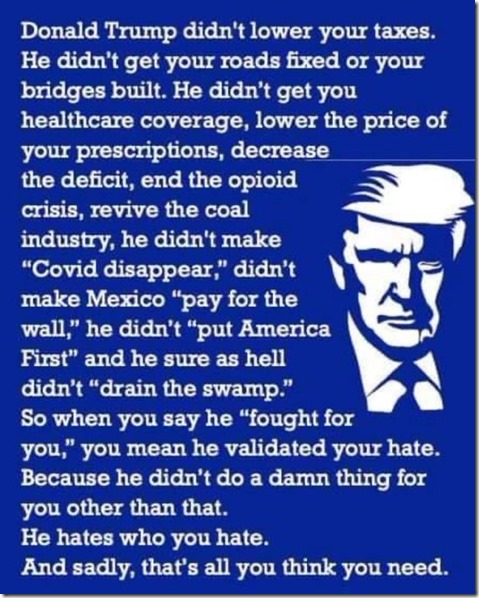
And a lively reminder from The Daily Show’s Jon Stewart of the it-would-be-amusing-if-it-weren’t-so-dangerous reality that the former president is, in point of fact, demonstrably not many the things that his loyal army of supporters say are their reasons for voting for him.  He is, in fact, the opposite of what they say he is, but they can’t/won’t see that.  Sad.

A little something from me for the holiday

It’s as predictable as the local TV Breaking News!  alert about an apartment fire that was put out hours ago: reporters are about to tell us that Labor Day is the traditional start of the presidential campaign season.  Oh yeah?  And all that “presidential campaigning” and adjacent nonsense I’ve been so unsuccessful in avoiding for the last 20 months, what was that – a fever dream?  I wish this was just the start, but mostly I wish it was the end.

The Founding Fathers were pretty smart guys, and I don’t think they set presidential elections four years apart so we could spend half or more of the time in between laser-focused on the next election.  There is nothing I can think of that is more non-productive, unless you are one of those people who make their living from the political-industrial complex.  We can’t (probably shouldn’t) make it against the law to campaign non-stop if you wish to, but we don’t have to encourage it the way we do.  And by “we,” I mean American journalism.

I understand why the national media has to cover the campaign every day: in case something newsworthy happens.  Something actually “new,” or something tragic, or yes, even something weird.  But when Kamala Harris again expresses her joy as she seems to do most days, or Donald Trump again tells the same lies he tells every day, I can do without you – every day – trying to make it seem like that’s the most important thing that happened.  You have to have someone there every day, just in case, but you don’t have to tell me about it every day even when the story doesn’t change.

This is especially applicable to all-news television (and radio), broadcast and cable, which has tons and tons of space to fill and only just so much news every day with which to fill it.  (This I know from experience, having been an editor and newscaster at Houston’s top-rated news/talk radio station when it changed to all-news: it didn’t take even an hour before we were repeating ourselves, and then repeating the repeats.  Within a few years, the talk shows were back.)  Opening up a live camera at some event and then just letting it run is an efficient way to fill time (or is it kill time?), but a lazy way to do it and an ineffective way to inform people about what’s really going on.  (See: CNN at every Trump rally in 2015 and 2016.)

And please, when you do a story on the campaign, make an effort to try to put things in perspective, and stop being so damn petrified by the threat that “someone” will say you’re biased; just answer the accusation plainly and directly.  For instance:

“No, we are not biased against the former president and his campaign.  We are reporting facts and providing context for our readers, listeners and viewers so they can clearly understand what happened Monday at Arlington National Cemetery, including (1) the irony of the man who called American soldiers and sailors who gave their lives for their country “suckers” and “losers” because “there was nothing in it for them” now using the nation’s largest veterans cemetery as a prop for a campaign ad, in violation of service regulations/federal law (not to mention good taste and good manners), and (2) the chutzpah of the whole Trump campaign, which (a) ignored the law against political use of the grounds, (b) when confronted with the violation, slandered the person who had the temerity to do her job by saying that “an unnamed individual, clearly suffering from a mental health episode, decided to physically block members of President Trump’s team during a very solemn ceremony,” [emphasis added] and (c) then posted the video anyway.”  [I’m not linking to the TikTok video, but it’s easy to find.]  “We understand that in some cases, a presentation of the facts and the context can seem biased against the subject of a story; our stories are not meant to be puff pieces on behalf of anyone.”

And when it comes to reporting on TFG, allow me to pass along these suggestions from a New York Times review of campaign rhetoric during just one week earlier this year.  I think we all know by now that Trump lies.  A lot.  More than 30,000 times just during his presidency, the Washington Post calculated, about 21 times per day on average.  And that doesn’t include his golf scores.  The Times analysis of the deluge of deceit, the overflow of fibbery, the mountain of misrepresentation, found that “Though his penchant for bending the truth, sometimes to the breaking point, has been well documented, a close study of how he does so reveals a kind of technique to his dishonesty: a set of recurring rhetorical moves with which Mr. Trump fuels his popularity among his supporters.”  “His words focused heavily on attacking his political rivals, self-aggrandizing and stoking fear to make his case for 2024. In doing so, Mr. Trump often relied on repeated falsehoods and half-truths. He has yet to deviate from this approach in the general election.”  Check it out.


I also recommend checking out Eugene Robinson’s column in the Washington Post for getting into the details about the “dishonorable” actions of the former president at Arlington this week:

Just because we are accustomed to this kind of behavior from Trump does not mean we should accept it. Just because he has no sense of honor or appreciation of sacrifice does not mean we have to pretend honor and sacrifice no longer exist. Just because “Trump is an awful person” is an old story does not mean we should yawn at this latest demonstration and quickly move on.

(snip)

“Federal law prohibits political campaign or election-related activities within Army National Military Cemeteries, to include photographers, content creators or any other persons attending for purposes, or in direct support of a partisan political candidate’s campaign,” Arlington Cemetery officials said this week in a statement. This was made clear to Trump’s team as the visit was being planned, officials said — including the strict enforcement of the rule at Section 60, where grief and loss are still raw.

“What was abundantly clear-cut was: Section 60, no photos and no video,” a defense official told The Post.

(snip)

No one can dismiss the incident as a misunderstanding by Trump and his aides, since their official position is that Trump is infallible. The campaign’s response, as usual, was a lie — a false and gratuitously cruel statement from spokesman Steven Cheung…

(snip)

Arlington National Cemetery is a place of honor. Donald Trump thinks honor is for suckers and losers — and values sacrifice only if it might help him win an election. Do not become numb to his nature.

“What happened happened”

Permit me to ignore my own advice just this once and call attention to current and dangerous behavior by some candidates for the Republican nomination to be president of the United States: their efforts to rewrite history.  Not to alter the timeline by winning the election and creating a future that would be recounted by historians as-yet unborn, but to reach a hand into the past and “revise” the record of what actually happened.  Like the un-impeachment of Donald Trump.  Both of them.

In a recent Salon article Austin Sarat and Dennis Aftergut ridicule the current fever dream among House Republicans to impeach President Biden, and remind us that these same geniuses want the House to change its mind on the historic impeachments of the former guy.

…many of these same MAGA acolytes want to rewrite history by taking the unprecedented and fanciful step of expunging the record of Trump’s two impeachments. Last month, Speaker Kevin McCarthy, desperate to hold onto his slender majority, gave in to those demands when he announced his support for that effort.

That calls to mind a Russian saying from Stalinist times, when rewriting history to suit and flatter a totalitarian leader was de rigueur: “Russia is a country with a certain future; it is only the past that is unpredictable.”

Constitutional experts say there is no mechanism to undo an impeachment; intelligent observers see the effort as a transparent attempt to (choose your own turn of phrase here; I’ll go with) “curry favor” with the former president and MAGA nation.  It’s an effort totally consistent with their modus operandi of ignoring verifiable truth and saying whatever they need to be true in the moment.

Consider the effort in Florida to sanitize the school curriculum on Black history – the whole “slaves learned skills they could benefit from later in life” eyewash.  Florida isn’t alone in this effort to fight attempts to teach a more complete view of the history of Black people in America, but Eugene Robinson says it has the spotlight now because its governor is trying to become president.

It was Gov. Ron DeSantis, running for the GOP presidential nomination as an “anti-wokeness” Savonarola, who inspired this latest effort to both-sides slavery. (Months ago, the state rejected an Advanced Placement course on African American studies, saying it “significantly lacks educational value.”) On Friday, DeSantis blamed the state Department of Education — “I wasn’t involved,” he claimed — but also defended the abomination: “They’re probably going to show that some of the folks that eventually parlayed, you know, being a blacksmith into doing things later in life.”

Where to begin? I’ll start with my own family history. One of my great-great-grandfathers, enslaved in Charleston, S.C., was indeed compelled to learn to be a blacksmith. But he had no ability to “parlay” anything, because his time and labor were not his own. They belonged to his enslaver. He belonged to his enslaver.

To pretend my ancestor was done some sort of favor by being taught a trade ignores the reality of race-based, chattel slavery as practiced in the United States. He was sold like a piece of livestock at least twice that I know of. To say he “developed skills,” as if he had signed up for some sort of apprenticeship program, is appallingly ahistorical. As was true for the millions of other enslaved African Americans, anything he achieved was in spite of his bondage.

(snip)

The problem with all of this is that it seeks to contextualize American slavery as something other than what it was: a unique historical crime, perpetuated over 2½ centuries. Slavery was practiced here on an industrial scale, based on race and the belief in white supremacy, with not just individuals but also their descendants consigned to lifelong servitude.

The Florida curriculum does a similar trick in interpreting the Jim Crow period. It calls for studying “acts of violence perpetrated against and by African Americans” — blaming both sides — but then mentions the “1906 Atlanta Race Riot, 1919 Washington, D.C. Race Riot, 1920 Ocoee Massacre, 1921 Tulsa Massacre and the 1923 Rosewood Massacre.” All of those atrocities, and many more, were White riots against innocent Black victims.

What happened happened. We will not move forward until we truthfully acknowledge where we’ve been.

That acknowledgement is apparently a high hill to climb (a tough pill to swallow?) for many Americans. Some say those people are just racists and that’s why they won’t admit that the demonstrable facts of history are true; Paul Waldman has an alternative explanation:

When you see some of the positions taken by the Republicans running for president on issues that touch upon race, it can be hard to ascribe to them anything but the ugliest motives.

Why, for instance, would Florida Gov. Ron DeSantis and former vice president Mike Pence each announce their intention to change the name of an Army post to honor a Confederate general? Why would DeSantis advocate for new school standards in his state that appear to present slavery as a brief and salutary job training program?

Some will simply answer, “Racism.” But there’s a more complicated answer that better explains what’s happening on the right. The true commitment of today’s Republican Party is not to racism (though there are plenty of genuine racists who thrill to what the GOP offers, and especially to former president Donald Trump). It is to what is best described as anti-antiracism.

In a sense, anti-antiracism is its own ideology. It holds that racism directed at minorities is largely a thing of the past; that whatever racism does exist is a product only of individual hearts and not of institutions and systems; that efforts to ameliorate racism and promote diversity are both counterproductive and morally abhorrent; and, most critically, that those efforts must not only be stopped but also rolled back.

Listen to conservative rhetoric on book banning, affirmative action, teaching history or any of the ways race touches their war on “wokeness,” and you hear this theme repeated: We must stop talking and thinking about racism, and most of all we must stop trying to do anything about racism.

(snip)

Adherence to these kind of anti-antiracist ideas has become “a matter of partisan identity,” going to the core of “what it means to be a Republican,” [political scientist Rachel] Wetts told me. “More than 80 percent of White Republicans endorse these views at very high levels.” In fact, in Wetts and [Robb] Willer’s analysis, the only variable that predicted support for Trump more strongly than anti-antiracism was whether you identified as a Republican.

That helps explain why Republican candidates are so determined to call attention to their efforts to dictate what can be said about race in classrooms, to punish companies for promoting diversity, equity and inclusion (DEI), or even to undo attempts to stop honoring the Confederacy.

(snip)

For some people, “opposition to antiracism is a way of expressing racial animus without explicitly endorsing it,” Wetts said. For others it’s about “distaste, anger and frustration with antiracists themselves,” an expression of revulsion against liberals and everything they want to do. Anti-antiracism is one more way to own the libs.

Feelings have become central to the way conservatives think about race; it’s no accident that many of the laws regarding critical race theory passed in conservative states explicitly outlaw discussions in schools that could make students feel “guilt” or “discomfort.” Anti-antiracism is fueled by White people’s unease with the growing diversity of American society, the knowledge that they’ve lost their dominant position — and to boot, liberals keep trying to make them feel bad.

(snip)

It is easy to see why Republican politicians think anti-antiracism is so potent. It allows people to claim a commitment to equality while opposing policies meant to achieve actual equality. It enables them to proclaim their own victimhood, which has become absolutely central to the conservative worldview.

The lies about history, the Big Lie about the 2020 election: they all fit right in with the the endless stream of lies that have been such an effective campaign message wooing MAGA nation.  And maybe, like most advertising, connecting with the audience at a subliminal level.
F0l4dkcXsAEA4bF