
The TV news is an ass, the sequel

I failed to give credit where it was due when I wrote early yesterday about how television “news” ignored the dramatic events at the Texas state capitol.  There was a filibuster-to-adjournment over a bill that would drastically reduce the availability of abortions in Texas and that caused citizens to fill the galleries, and later to express their anger when they saw, plain as day, the lieutenant governor and his supporters try to railroad the process, and at one point saw that an official record of a vote had been changed.  I was annoyed that I couldn’t follow the story on television–it was not being covered on any of my local stations in Houston nor on any of the national cable “news” channels.  I was keeping up on Twitter.

What I neglected to do was to consult other avenues available on the Inter-Webs, and I was reminded of that today by Time and by Rachel Sklar.  The state senate was live-streaming itself, and the big show was available on other live streams, too, with some great work done by the Austin American-Statesman.  Congratulations to them all for recognizing a newsworthy event when they saw one and doing something to let the rest of us keep up.

Time: “As protesters massed in the gallery, the GOP majority attempted to close debate and bring a vote, and Democrats maneuvered to stall after their rivals forced [Senator Wendy] Davis to stop speaking on procedural grounds, well over 100,000 YouTube viewers were tuned to the channel–closer to 200,000 as zero hour approached. That’s a six-figure viewership, after primetime in most time zones, watching legislators argue over Robert’s Rules of Order and who properly held the floor.”

Sklar: “The clock struck midnight. Victory! They had run out the clock! The chants continued. Twitter exploded. But that was weird, it seemed like that vague roll call was still going on. What, exactly, was going on in that huddle by the Chair?

This is what was going on: They were taking the vote. It was after midnight, and suddenly that strict adherence to rules didn’t seem so strict anymore. Whispers were trickling out, confirmed by the AP: SB5 had passed, 17-12.

Twitter was going bananas. I checked the networks again. CNN was re-running Anderson Cooper. MSNBC was re-running Lawrence O’Donnell. Fox was re-running Greta van Susteren. Journalist Lizzie O’Leary tweeted, ‘Interesting choice you made tonight, cable news executives.'”

By now you’ve heard how it turned out: the good old boys intent on changing a law that most Texans thought didn’t need changing (and despite having failed in their effort to change the law during the regular session, by the way) were gobsmacked at the reaction of the crowd, yet tried to push ahead and took a vote on the bill after the deadline and declared victory, only to be confronted with not only the evidence of their failure to act within the rules of the chamber but evidence that someone messed with the records (Anthony De Rosa posted screenshots of the evidence, here and then here) and ultimately conceded defeat of the bill on other technical grounds.  And just as expected, Governor Haircut issued a call for another special session starting next week so legislators can have a third bite at the apple.

Yeah, but we didn’t need to see any of that live as it happened, did we…

UPDATE 6/28 8:00 am CT: Patti Kilday Hart at Houston’s Leading Information Source solves the mystery over the conflicting reports of when the Texas Senate voted on the abortion restriction bill, and it turns out there was no hanky-panky.  The respected secretary of the Senate Patsy Spaw explains that the vote started before the special session ended at midnight–she knows because it’s her job to check the clock before starting the roll call–and the rules allow such a vote to count; because of the noise in the chamber the staffer charged with recording the vote had to leave her desk to hear the result, and it was past midnight when she returned to her workstation to enter the result; someone later manually changed the date in the system to reflect the correct date of passage.  But the bill ultimately was not passed legally because, as Lt. Gov. Dewhurst said at the time, it hadn’t been signed by the presiding officer “in the presence of the Senate” as required by the state constitution: all official action of the special session ended the moment the senators left the chamber (because of the noise) after midnight, and could not resume when they returned some time later Wednesday morning.
SCOTUS dumps DOMA: fair, simple, American

Brown v. Board of Education; United States v. Windsor: do they belong together?  Yes they do: today’s U.S. Supreme Court ruling in the Windsor case is just that historic.  In a very specific and non-technical way Justice Anthony Kennedy’s opinion makes clear what the 5-4 court ruling says the Constitution requires: the “[Defense of Marriage Act] is unconstitutional as a deprivation of the equal liberty of persons that is protected by the Fifth Amendment.”  You can read the professional reports on the decisions announced today here and here, and elsewhere, but here’s my take:

All people deserve equal treatment under the law.  If the federal government grants certain legal privileges to dual-sex couples who are legally married under the laws of their state, the same privileges must be available to single-sex couples who are legally married under the laws of their state.  Equal treatment; fairness.  The court did not rule on the constitutionality of gay marriage today; it ruled on an issue of equality before the law.  In refusing to rule on the Hollingsworth case regarding California’s Proposition 8, which outlawed gay marriage in the state, it sidestepped ruling one way or another on the constitutionality of gay marriage…perhaps another day.  But that decision does have the effect of re-legalizing gay marriage in California, making it state #13.

In practical terms the Windsor ruling means same-sex couples should be treated the same way as opposite-sex couples when it comes to federal tax law and Social Security and insurance and immigration, all that federal stuff.  In fact there are more than a thousand benefits coming into play here, and McClatchy does a good job summarizing that here.  And for fun, TV Guide summarizes the celebrity reaction to the rulings here.

This is not about what one religion or another teaches about homosexuality; this is about how the civil law treats American citizens regardless of their religious belief, or their gender or their race or national origin.  A religion is free to believe and teach what it wants about the morality of homosexual behavior or same-sex marriage, and its teachings and laws are important to the members in good standing of that particular faith.  But those teachings are not binding on Americans who are not members of that denomination.  The civil law, which orders how we all deal with one another in the secular society outside the confines of our many private clubs, is blind to such moral questions.  States have the right to decide who can “marry” and who can’t, and the federal government has to treat all “married” couples in the same way, regardless of the gender of the spouses.  Simple, really.  Fair.  American.  Congratulations, U.S.A., on another successful day at the office.

The 47% fallout at Fox, as told by Jon Stewart

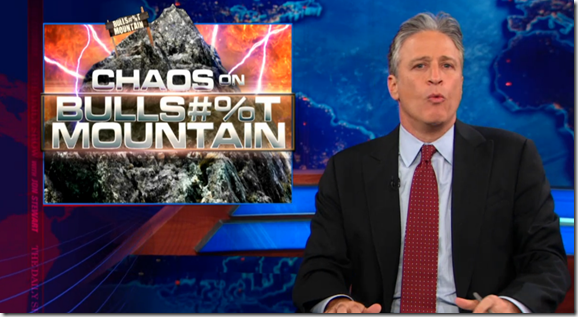
It has been great fun to watch the political circus play out around last week’s revelation of Mitt Romney’s campaign gaffe—or to put it another way, that chance for the rest of us to hear the truth Romney tells his supporters behind closed doors.  The good folks at The Daily Show even took a good-natured little poke at their friends at Fox News Channel for their contortionally-magnificent defense of the Republican Party nominee: “Let me sum up the message from Bullshit Mountain, if I may: this inartfully-stated dirty liberal smear is a truthful expression of Mitt Romney’s political philosophy and it is a winner.”  Click the pic for the whole beautiful report.

image

This is the core of Bullshit Mountain: the 49% entitlement society Obama enables.  That is the core of the Bullshit Nation fiction, that somehow only since Obama, the half of Americans who love this country and work hard and are good have had the fruits of their labor seized and handed over to the half of this nation that is lazy and dependent and the opposite of good—I’m sure there’s a better term for that.  Now, in that 49% [Sean] Hannity is including those on Social Security and Medicare, or as I like to call them, his audience.

Thanks to Mashed Potato Bulletin for the heads up.

Just like a little love, campaign truth is hard to find

You hold your breath…you make a wish…and you’re disappointed when it doesn’t come true.  And then you remember that things don’t happen just because you wish them to.  Such is the case, not very surprisingly, with the level of discussion this week in the race for president.

Mitt Romney’s selection of Wisconsin congressman Paul Ryan (no relation) as his running mate last Saturday was greeted as good news by some people positioned all along the political spectrum, from those tea party members and fiscal conservatives who love his budget plans to those more liberal folks who believed his serious interest in issues would spark a real debate.  How long did that last?

Until Tuesday.

If we can all agree that Joe Biden is to oratory what Spam is to steak, we can agree that his inelegant comment to a mixed-race audience in Virginia was not meant to invoke the specter of slavery.  Yet that was all Romney and Ryan had to say—that the Democrats were running a campaign of hate—even before that evening’s newscasts hit the air.  (I do give them credit, though, for how well they can operate with the threshold set so low on such a finely-tuned sense of outrage.)

Tuesday also featured some well-prepared interviewers catching Romney surrogates on their indefensible claim about Medicare cuts under Obamacare.  This piece on Mediate has all the links to both occasions: CNN’s Soledad O’Brien with John Sununu, and Fox News Channel’s Brit Hume with Ryan himself, as each of them tried to pass off the latest Republican mischaracterization (to be kind) of the impact to Medicare funding under the Affordable Care Act.  Just nailed them, which was amusing; watch the clips.  The partisan noisemakers can’t really slough this off with the standard allegation of liberal media bias—we’re talking BRIT HUME here!  If FOX NEWS was schooling your VP, you got to make allowances that just maybe CNN was playing it down the middle, too.

But the best thing I saw on Tuesday, from the perspective of trying to keep the facts straight, was an interview on Slate with the author of The New New Deal.  Journalist Michael Grunwald went looking for the truth about the impact of The American Recovery and Reinvestment Act—President Obama’s $800 billion stimulus bill passed by Congress in early 2009, designed to help get the country’s economy rolling again.  His conclusion: the stimulus bill worked.

Not that everything in it worked, or worked perfectly, not that there weren’t problems or some waste and fraud.  But mostly, the stimulus bill did what it was designed to do; it can be argued that the economy hasn’t done better because the stimulus was too small, although Obama could never have gotten Congress to go for more.

…the stimulus was supposed to create jobs at a time when jobs were vanishing at a terrifying rate. Nonpartisan economists agree that it helped stop the free fall; job losses peaked the month before it passed, and the economy dramatically improved once it kicked into gear. But even after the dramatic improvements, the unemployment rate was still sky-high and rising; an economy can do a lot better than losing 800,000 jobs a month without doing well. Ultimately, the stimulus was a 2.5 million-job solution to an 8 million-job problem.

To the extent that Obama’s opponents will argue that Grunwald’s story is biased, he replies:

I don’t think my book portrays the Republicans as “vicious,” but I do show—thanks to a lot of in-depth interviews with GOP sources—how they plotted to obstruct Obama before he even took office. I show how the stimulus was chock full of stuff they claimed to support until Jan. 20, 2009—not just things like health IT and the smart grid and energy efficiency and scientific research, but the very idea of Keynesian stimulus. Every presidential candidate in 2008 proposed a stimulus package, and Mitt Romney’s was the largest. So I do spend a fair amount of time chronicling Republican stimulus hypocrisies. (Readers might enjoy the backstory of Sen. Judd Gregg’s short-lived nomination to be Obama’s commerce secretary.) In general, I’d have to say my reporting backs up the Norm Ornstein-Thomas Mann thesis that the Republicans have gone off the policy deep end—denying global warming, denying Keynesian economics (except when it comes to business tax cuts and defense spending!), trashing Obama’s government takeover of health care and also his Medicare cuts, drumming stimulus supporters like Crist and Specter out of the party.

Read the interview; the book is just coming out this week.  I want to hear this story—we should all want to hear this story, and other stories—from someone who hasn’t already sold out to one party or one candidate.

We’ve debated a bizarro-world stimulus that does not exist. And I think that’s true about Obama, too. I don’t think he comes across as “brilliant.” I think he comes across as a pragmatic left-of-center technocrat who wasn’t interested in pursuing lost causes, but basically tried to do what he said he would do during the campaign. He wasn’t a policy entrepreneur with new policy ideas, but he did his best to get 60 votes for old policy ideas that made sense, and then pushed his administration to put them into action as cleanly and competently as possible. And I did a lot of reporting in the bowels of the bureaucracy and around the country to show how change has been playing out.

I tried to tell the story as fairly and honestly as I could. But I didn’t try to be balanced for the sake of balance. When politicians were full of shit, I tried to point that out.

That’s what we need more of from reporters.  Dutifully transcribing the opinion of the spokeshuman from one party and then the opinion of the spokeshuman from a second party doesn’t get us the truth; what the political parties have to say is designed to benefit the parties, not to promote truth.

First things first–let’s start with the facts

It is said that there are two things you do not want to see being made: sausage, and legislation.  I’m of the opinion that a third thing on that list should be the news—you don’t want to see how a news story comes into being.  But Tom Goldstein, the publisher of SCOTUSblog.com, wants you to see what happened behind the scenes last month in the national reporting of the Supreme Court’s decision on the Affordable Care Act.  In his in-depth post-mortem Goldstein (who has a dog in this fight, to be sure) and his staff pieced together what happened at CNN, Fox News Channel, the White House, and SCOTUSblog.com in the nine minutes between when the court’s decision was handed down and when the error-filled reporting of the decision ended, including how

  • hackers tried to bring down SCOTUSblog
  • the court’s own website failed due to the heavy traffic, so no one outside the court building could access the decision
  • a lack of thoroughness led CNN and Fox to run with incorrect interpretations of the opinion, and
  • people who’d seen those incorrect TV reports refused to believe they were incorrect when confronted with the truth

CNN and Fox News have come in for a lot of deserved criticism for initially reporting the story incorrectly.  Yes, I know they were trying to get it first but so was everyone else, and they waited long enough to understand what the court had ruled before reporting it.  In fact, Bloomberg was first—less than one minute after the chief justice began announcing the decision from the bench—and they got it right!

From what I learned in this piece, I find it disturbing just how much brain power was brought to bear by these two networks that day and still they got it wrong.  Disturbing, but not surprising.  Yes, people make mistakes; but people who care more for flash than for accuracy—for generating heat rather than light—are more likely to make careless mistakes.  Avoiding careless mistakes is—or should be—of paramount importance in this business.

But both CNN and Fox exposed themselves to potential failure by

(a) treating the decision as a breathless “breaking news” event, despite the fact that everyone knew when the opinion was going to be released (and the mandate won’t take effect until 2014), while at the same time

(b) not putting sufficiently sound procedures in place to deal with the potential complications, and

(c) not placing more faith in the consensus view of the wire reports.

To put it another way: read the damn opinion before presuming to tell me what it says.  That shouldn’t be too much to ask, whether reporting a Supreme Court decision or a school board meeting or a fender bender.  Bill Kovach and Tom Rosenstiel suggest that in order “to provide people with the information they need to be free and self-governing,” which is the purpose of journalism, the journalist’s first obligation is to the truth.  Sometimes that can take more than just a few minutes to learn, but we don’t mind waiting.

Other opinions–