Dear John McCain,

Jon Stewart’s pre-shaming wasn’t enough, so—shame on you, John McCain; for shame.  When it came to affirming the civil rights of homosexual Americans by supporting repeal of “don’t ask don’t tell,” you did exactly what you said you would not do

Dammit, it’s not a question of who soldiers are “comfortable serving with” if enforcing that prejudice denies the civil rights of other Americans.  Please tell me you wouldn’t make the same argument for white racists who are “not comfortable” serving with blacks?

This, added to your craven pandering to the worst elements of the body politic in your 2008 and 2010 campaigns, and your well-earned reputation as a man of honor, a man of truth, has at last and forever dissolved into the ether.  Although I haven’t agreed with you on every issue I trusted in your judgment and your integrity; now I can’t.  You’ve become “just another politician.”  How depressing.

Tear down this wall

This was supposed to be the last obstacle, right?  This report was to be the last gasp for members of Congress who imagine themselves, in Buckley’s phrase, standing athwart history yelling Stop, at the unstoppable sunrise of civil liberties for homosexuals in America.  Well, now it’s here; let’s see what they do.

Today the Department of Defense released its own report on the anticipated impact to military readiness if Congress were to repeal the hideously-christened “Don’t Ask, Don’t Tell” law, which prohibits homosexual Americans from being honest about their sexuality if they want to serve their country in the armed forces.  DOD found that, by and large, there’s no problem—you can read the reports from the major outlets:  New York Times, Associated Press, Fox News.

The House of Representatives already voted to repeal the law; some in the Senate resisted, wanting to give the Pentagon a chance to determine if changing the law would weaken our national defense.  To those senators who were betting that, surely, the men and women in uniform would object vehemently to gay men and women serving openly, and thereby provide needed political cover to affirm the ban—shame on you for thinking so little of American soldiers, sailors, Marines and airmen.

The former maverick John McCain was perhaps most prominent about yielding to the military leadership on this question; a couple of weeks ago Jon Stewart bothered to remember what McCain had promised. (click the pic)

imageThe Pentagon report concedes that a world without DADT might experience growing pains, but it assures Congress that some brief discomfort is no reason to wait.  Logically, then, there’s no valid reason not to repeal the law, and any objection that the change should be delayed until it’s not so hard to implement should be answered with a reminder that the same argument was floated when President Truman ordered desegregation of the military.

Yes, this is a civil rights issue; I’ve made my case here before.  There’s no stopping it—the change is coming—and if some lame duck members of Congress who aren’t worried about re-election any more make the difference in changing this law, so be it.

Invasion of the body scanners

I like to think I don’t take a back seat to anyone when it comes to defense of civil liberties—I was against the Big Brother-y Patriot Act before it was cool—but I don’t get all the fuss about body scanners in airports.

I’ve been able to mostly ignore the uproar about the Transportation Security Administration’s airport security measures because, well, I’m pretty good at ignore.  But I couldn’t look away from a series of posts by Padre Steve, a guy I find to be a pretty entertaining read, on the existential threat to liberty from our surrendering freedoms in the name of security.  Admittedly, I was hooked by his extended reference to an episode of “Star Trek: The Next Generation” to illustrate the problem.

With respect to Padre Steve and the others who have suffered indignities at the hands of an idiotic TSA employee, I’m not convinced.  It seems likely to me that when one man pithily proclaimed “don’t touch my junk,” that was all that was necessary for the news media—the people with too little judgment and too much space to fill—to rev up the hysteria generator; Howard Kurtz does a good job surveying the landscape of the freak-out over pat-downs.

I’ll posit that we all agree that commercial air travel is not a right but a public accommodation justifiably subject to regulation in the interests of safety—would you get on a plane today if there was no screening of passengers or baggage?  We can debate the appropriateness of the screening measures that are being used, but that’s just details.  And in the meantime, there’s always the train or the bus.

Most experts believe the full-body scanners do not pose a serious health risk for the vast majority of travelers.  As to the complaint that they’re too invasive, because someone will see a black-and-white x-ray depiction of your naked body—

body scan image

Oh, yeah…verrry sexy.

I don’t think that’s too much to ask for the sake of better collective security, and certainly not when considered against the alternative of an all-over hands-on greeting from the TSA.  All in all, the scan seems a reasonable security tactic in a world where religious fanatics convince poor lemmings to stuff their shoes and underwear with explosives to strike a blow against people they don’t know who’ve never harmed them.

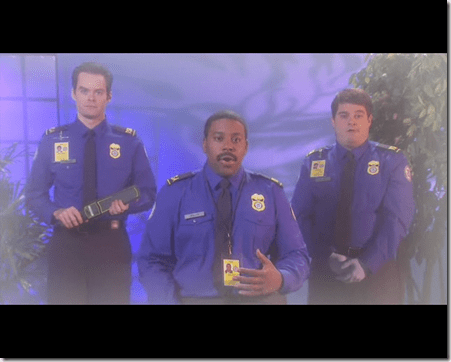
But in the spirit of the holiday, I will say I am thankful for the comedy (click the pic):

image

Judging news judgment

I boarded this train of thought reading  Ted Koppel’s op/ed piece in Sunday’s Washington Post in which he eloquently denounces the cable networks’ proliferation of opinion-as-news programming.  I mostly agree with his complaint that Fox News and MSNBC have given up any pretense of being objective in favor of creating an “idealized reality.”

They show us the world not as it is, but as partisans (and loyal viewers) at either end of the political spectrum would like it to be. This is to journalism what Bernie Madoff was to investment: He told his customers what they wanted to hear, and by the time they learned the truth, their money was gone.

In this essay Koppel seems to put a lot of the blame on the desire to turn a profit; I find that disturbing.  No one in this argument should be against the idea of the Koppel_11_25companies turning a profit, and Koppel himself has proudly noted in the past that Nightline made a pile of money for ABC, although he says they did so with high standards.  I see that Koppel, in the end, is lamenting the death of any effort at real reporting, the loss of any non-partisan effort to uncover facts that can illuminate the truth.

So last night on MSNBC, Keith Olbermann did what he does: protest perhaps a bit too much about being the subject of criticism and spend a lot of valuable minutes proving points that were never called into question.  Mostly though, he gratuitously blasted Koppel for not having done on “Nightline” what Olbermann believes he does on his program—seek for truth, particularly about the war in Iraq.  (Click on the picture to see the whole commentary; runs something over 12:00.)

image

Credit where I think credit is due: Olbermann did his damnedest to get America to see the ugly truth about the Bush Administration and the Iraq war, in the spirit of Murrow’s takedown of Joseph McCarthy.  But as he himself has admitted, in a previous incarnation Olbermann squandered an inordinate amount of precious airtime on the Monica Lewinsky “story.”  Nobody’s perfect.

The important issue here is news judgment.  In Olbermann’s examples of Murrow’s reports from London, and when Cronkite made clear the fiasco of Vietnam and the importance of Watergate, their reports were  the result of a collective decision within their organization about what was news: what was important, what had lasting value, what did the audience need to know about.  In Koppel’s examples of the shouting heads on today’s cable network programs, the reports are the result of a collective decision within those organizations about what will grab attention: what is current, what has flash, what does the audience want to hear.

Koppel’s complaints focus on cable programs, not the broadcast networks and their news programs.  I don’t think those guys have any room to crow when it comes to news judgment when you consider their response to news from London of a wedding within the royal family: leading with the story as “breaking news,” dispatching armies of troops immediately to London, and planning major special reports.

Really?  Is there really anything more pointless, or with less real substance or import to our future, than the wedding of British royalty?  What does it say about our news media when we see them drool on themselves at this news?  Personally, I laughed at the headline Unemployed English girl to wed solider from welfare family, but that’s just me.

I’m not completely pessimistic about the future of journalism; I believe there will always be some place to get an honest recitation of what’s gone on, along with some perspective to help me make sense of my world.  But I know that it will not be from the Tribune Company’s TV station here in Houston.

KIAH-TV is moving ahead with a plan developed by the ousted corporate boss Lee Abrams to do away with traditional newscasts altogether.  They need “preditors” to run this new paradigm, and there’s no pretense: the ad says clearly that they aren’t interested in experience or credentials, they value the ability to make noise and grab attention; heat, not light…flash, not value.

And that’s fine, too—it’s their station and they can put whatever they want on their air.  But when it’s about news judgment, we all need to think about who we want to trust.

(Note: the spell-check dictionary didn’t like the word “Olbermann’s”; it recommended “Doberman’s”…I’m just saying.)

(Would you look at that: a post with Prince William, royal wedding, and Monica Lewinsky tags…I should be ashamed.)

The more things change, the more they stay eerily the same

First of all, don’t believe most of what’s coming out of the mouths of the political pros today, either the candidates or the party officials and consultants, including the ones disguised as Fox News commentators.  The winners of yesterday’s elections are saying every result is due to people rejecting President Obama and big government, while the losers are trying to convince us that they’re not to blame; nothing is that simple.  But make no mistake: the Democrats were beaten up yesterday.  Why?

For starters, the party in power always loses seats in the midterm elections.  Plus, Americans are (generally) not ideological, they’re practical—they want the economy strong and unemployment down, and they are impatient so they voted for someone new.  They didn’t, by and large, vote for mouthy extremists with no realistic plan for solving problems.  It was the independent voters, who supported Democrats in 2008, who drove the results of this election.  And if this election showed the biggest party swing in some 70 years, maybe it was because we’re trying to recover from the worst economic crisis in some 70 years.

The irony?  Unemployment is unacceptably high, but the naysayers aren’t giving the administration any credit for what it did do that, arguably, saved the economy.  But those things didn’t bring back jobs fast enough, and that was all the excuse many needed.

Don’t put too much stock in this big change being permanent.  Just two years ago there was supreme confidence that the Republican Party had one foot in the grave and the other on a banana peel, and that was less than a decade after the Democrats were routed and ostracized following the Clinton presidency, which came after a generation of Republican ascendancy while Democrats wandered in the desert.

Republicans now control the House and should be expected to make an effort to lead, rather than just get in the way as they’ve done the past two years.  Some wise Republicans have said as much today, that the people have given them a “second” chance (this presumes the world began with the election of Ronald Reagan).  Well, the thing Speaker of the House-presumptive John Boehner has touted is the Pledge to America, and I’ve read estimates that achieving that vague set of goals will add $700 billion to the debt.

So don’t be surprised if there’s not much change in Washington.  Promises to lower taxes are vacuous: government can’t afford to take a pay cut any more than you or me, not if it plans to keep programs people want, like Social Security, Medicare, and national defense.  Cutting anything else won’t have the kind of impact on long-term debt that will make a serious difference.  Besides, when it comes to a plan to help the economy recover and generate jobs, what’s your level of confidence that the party largely responsible for the circumstances that led to the economic crisis is the party that can make it all better?

Look for real changes at the state or local level, where enough small changes can add up to real power for Republicans.

One more thing: enough with all the balloon juice about “taking back” the government, unless you’re talking about taking it back from the deep-pocketed interests who’ve been controlling the people in office for years and years now.  On paper, the government is still and always has been in the hands of the people we citizens chose to look out for our interests, just as the Constitution envisioned.  On the ground…well, we all have to understand that the longer those people stay in government—like Boehner, just elected to his 11th two-year term?—the more they depend on the money that greases Washington’s wheels; it’s true for Democrats and Republicans, and they know it, too.

The older I’ve gotten the easier it’s become to keep these things in perspective: if you don’t like the results of this election, remember that there’ll be another one along soon enough.