You never forget your first time

These days a mini-season ticket package for the Houston Astros gets you a seat to 28 games out of the 81-game home schedule, at least one game in every series the team plays at Minute Maid Park over the long baseball season.  My ticket for last Friday night’s game against the Los Angeles Dodgers has been sitting on the shelf in my office since March, drawing no more attention than any of the 27 others on the pre-perforated sheets that I keep in the original mailing envelope.  When a colleague at work asked on Friday morning who that night’s starters would be, I had no idea and had to look it up.

The big news about this interleague series between one-time National League rivals was that Zack Greinke and Clayton Kershaw, the Dodgers’ two best pitchers—two of the best in baseball—were to face the Astros on Saturday and Sunday.  The Dodgers’ Friday starter Brett Anderson was OK but not up to the level of his teammates, and the Astros’ Mike Fiers…well, he’s new here, and hasn’t really shown much so far.  The match-up didn’t generate much enthusiasm.

When I got to my seat the thing that had my full attention was something I’d forgotten.  At the game on Tuesday my friend Paul was wearing an AstrospMLB2-16625621dt blue batting practice jersey with the name and number of a player not on the team any more. He explained that he and other friends had wandered into a store that sells jerseys that were worn by players in real games, and as a joke they decided to treat themselves to the shirts of some players who might be said to have laid the groundwork for the first-place Astros of today.  That is, bad players who aren’t here anymore, or so-so players who’d been traded for better players: Paul was wearing Jarred Cosart’s Number 48, David had Brett Wallace’s Number 29.  He suggested I join the fun.

Sure, why not.  But that night the one store carrying those jerseys closed before I could get there, and Friday night I forgot all about it until I got to our seats and saw Paul.  So, with a giant beer in one hand and a giant soft pretzel in the other, and only fifteen minutes before first pitch, I set off: down from our upper level seats behind home plate to the concourse, around the concourse to a stairwell, down three flights of stairs to the main level, and the rest of the way around to the shop behind center field.  To improve my overall mobility, I stuffed the pretzel in my mouth and swallowed the last of it as I arrived at the Island of Misfit’s Jerseys, and put the can of beer on the ground so I could dig through the racks.  I must have spent four whole minutes grubbing through the hangers until I found a jersey that fit: not only from a player who fit the requirements for inclusion in our little stunt, but a shirt that fit me.  I walked away with the Number 22 of former backup catcher Carlos Corporan, in a size 50.  Jersey sizes run pretty big.

I was feeling it: not content to carry my trophy IMG_0220back upstairs folded up in a plastic bag, I threw it on over the shirt I was wearing, picked up my big beer and retraced my steps back around the concourse to the stairwell, up three flights to the View Deck (no, really, that’s what the upper level is called at Minute Maid Park), back around behind home and back to my section as the national anthem began.  I waited on the stairs, and after “…home of the brave” I bounced up on the front of our section, yelled for Paul’s attention and spun around to show off my prize.  He laughed as I dragged myself up the last six rows and plopped down before the first pitch.

Fiers had a slow start and was throwing a lot of pitches; I was sweating in the air conditioned building, a combination of catching my breath from my impromptu shopping trip and, as mentioned, I was wearing two shirts; before the Dodgers went down in the first I’d unbuttoned the Corporan.  By the end of the second I needed another beer, so that’s another trip down from Row 6, over to the concession stand that sells the cold beer (gotta know these things to be an Astros fan), and then back upstairs; I’d cooled off enough by then that I could button the jersey back up and look presentable.  The Astros’ pitcher had throw to the plate 60 times by the end of the third inning and didn’t look sharp, probably not long for this game.

By that time Paul had adjourned to meet other friends and I was fiddling with my phone, trying to get Twitter to work either with or without the stadium’s wi-fi and not having any luck.  I remember looking up at the scoreboard each inning and seeing that the Dodgers still had no hits, and thinking there was no way Fiers could stay in the game until the end.  But he kept coming back…and back…and back again.  He struck out the side in the 8th.

The Astros did nothing in the 8th, and every eye around me turned to the home team dugout:

Yep, by then I was getting some connection on Twitter and I decided to see if my fat typing thumbs on a tiny virtual keyboard could keep up with the action:

Now wait a minute…

…this could really happen…

(It was Chase Utley’s first game with the Dodgers after the trade, and it took me until the middle of the game to realize: he was back together with Jimmy Rollins, his teammate from the Phillies who’d signed with Los Angeles in the off season.  So much for being aware of what’s going on!)

And that brought up Justin Turner, a Dodger I really had never heard of before…

I think this is going to happen…

Yes, I really think this is about to happen…here comes pitch number 134 of the night:

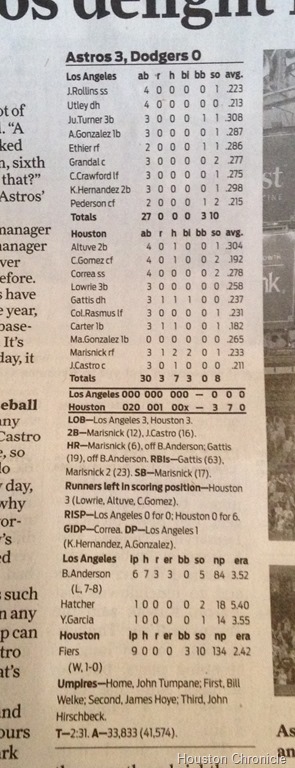
20150821_astrosdodgers_btc_12IMG_0219First no hitter in Mike Fiers’ career, which now totals just 59 starts, only three of them for Houston since he came over in a trade with the Milwaukee Brewers just under the waiver deadline last month.  It’s the first no hitter ever thrown at Minute Maid Park, now in its sixteenth season, and the first one I’ve seen in person in a baseball-watching career that’s significantly longer than sixteen years.  I’m proud to say that I had enough awareness in the moment to turn on the camera on my phone and point it at the players celebrating on the field, and also at the people around me who were a-whoopin’ and a-hollerin’ and jumpin’ ever’ which way at this most unexpected turn of events on a Friday night.  I’m less proud of my skill at operating the smartphone and Twitter:

Yes, there was grumbling from the Dodgers on Friday about the umpiring, and a story today about accusations of a foreign substance seen in Fiers’ glove, but it really did happen: I got a new shirt just in time to see a little baseball history made in this unlikeliest of Houston Astros’ seasons.
Equal protection: it’s what we do here at the ol’ USA

The first time I wrote about gay marriage rights here was more than four and half years ago  (“Equal justice for all: the gay rights tide has turned,” Oct. 15, 2010) and the kernel of the argument was already formed:

We can proclaim not to understand why people are homosexual, or embrace a religious belief that homosexual activity is a sin, but none of that matters in a tolerant, secular, civil society.  The experts can’t say why a person is sexually attracted to one gender or the other.  And it violates the rights of due process and free speech guaranteed to each American in the Constitution to treat someone differently because of their sexual orientation just as it would to treat them differently because of their gender or their ancestry.

(snip)

You don’t have to “understand” gay people any more than you have to “understand” people of a different race or a different religion.  You only have to understand that these people are Americans like you, who believe in American rights like you do, who want to enjoy American freedoms like you do…

This week, history: a 5-4 decision from the Supreme Court of the United States in Obergefell v Hopkins takes its place alongside the great civil rights and civil liberties decisions of American jurisprudence.  The U.S. Constitution guarantees the right of all Americans to civil marriage, and all its advantages and protections, be they heterosexual, homosexual, bisexual, or asexual.  As far as the civil law is concerned this isn’t about sex: it’s about equal treatment under the law.

Homosexual conduct is no longer a civil crime in this country, and thus is no reason to withhold the full rights and exercise of citizenship from homosexuals.  Homosexual conduct is objectionable within many organized religions, to be sure, and virtually all of the opposition to extending the right to marry to gays and lesbians has come on religious grounds.  For the most part I don’t question the sincerity of that religious belief (although it would be prudent to account for the cynical exploiters, primarily from the political realm).

But that’s beside the crucial point, which is that, in this country, civil law is not answerable to religious law.  The First Amendment guarantees that we each and all get the freedom to practice our religions, but also guarantees that none of those religions wields authority directly over civil society.  The Constitution protects us from any majority that would try to force one or another religious doctrine onto everyone—because the Constitution takes religious liberty for all just that seriously—and guarantees that all men and women deserve equal treatment under law.  Despite the nearly hysterical dissenting opinions of some of his colleagues, Justice Anthony Kennedy’s decision didn’t create a new right; it reminded us about a right that’s been there all along…and my friend Mr. Jefferson recognized the rationale by which Kennedy connected the dots (and Peter Foster of the Daily Telegraph reminded via the Twitterverse) long ago:

Obergefell does not mean that First Amendment protections of religious liberties are at risk, despite what you’ve heard.  Some of that reaction is well-intentioned misinformation; most is hot air from right-wing politicians and conservative religious extremists who need a boogieman to scare their supporters into donating money.  (I’m looking at you, Governor Abbott—thanks, Evan Smith for the Tweet-tip.)  In either case, they are wrong.  Religious organizations are exempt from this ruling, as they are exempt from many other laws, like, say, tax laws.  As Lisa Falkenberg put it in this morning’s Houston Chronicle, this ruling has no applicability to individuals in their private lives or to private religious institutions: “It does not keep anyone from judging, or hating, or even just politely refusing to acknowledge gay people.  No court ruling has ever told a pastor whose wedding he or she can bless.  That hasn’t changed.”

It is possible to believe in the religious sacrament of marriage and still accept this court’s decision on civil marriage rights for homosexuals.  Michigan Representative Justin Amash, a Tea Party/Libertarian/Republican, made the point quite nicely this week on Facebook:

Throughout history, different cultures have defined marriage according to their own customs and practices. Christians, Jews, Muslims, Buddhists, Hindus, agnostics, and atheists do not share identical views on marriage. In fact, significant differences regarding marriage exist even within Christianity.

What makes marriage traditional is not its adherence to a universal definition but rather that it is defined by personal faith, not by government. For thousands of years, marriage flourished without a universal definition and without government intervention. Then came licensing of marriage. In recent decades, we’ve seen state legislatures and ballot initiatives define marriage, putting government improperly at the helm of this sacred institution.

Those who care about liberty should not be satisfied with the current situation. Government intervention in marriage presents new threats to religious freedom and provides no advantages, for gay or straight couples, over unlicensed (i.e., traditional) marriage. But we shouldn’t blame the Supreme Court for where things stand.

To the extent that Americans across the political spectrum view government marriage as authoritative and unlicensed marriage as quaint, our laws must treat marriage—and the corresponding legal benefits that attach—as they would any other government institution. So, while today’s Supreme Court opinion rests upon the false premise that government licensure is necessary to validate the intimate relationships of consenting adults, I applaud the important principle enshrined in this opinion: that government may not violate the equal rights of individuals in any area in which it asserts authority. (emphasis added)

The civil right of marriage is open to all Americans.  We must be diligent about making sure that the implementation of this decision protects the First Amendment rights of those with a religious objection to same-sex marriage, keeping in mind that it doesn’t give them the right to ignore the law.  And while we’re at it we should work on getting rid of the laws which still permit discrimination against gay Americans in the areas of housing and hiring and other aspects of day to day life, and any other laws that violate anyone’s right to equal treatment.  Because we’re Americans, and that’s what we do.

Falkenberg snaps the shutout and changes the law

The Houston Chronicle is heckled within these walls as “Houston’s Leading Information Source” for two sarcastic reasons: that’s what it proclaimed itself to be for many years in a local advertising—er, excuse me, branding—campaign , and since the other, better local major daily was bought and smothered—er, excuse me, closed and had its assets acquired—by the Chronicle 20 years ago it’s only had local television and radio stations to compete against, and the less said about their journalism the better.  Yet today I come not to bury the Chron but to praise it, for the first Pulitzer Prize in its 114-year history.

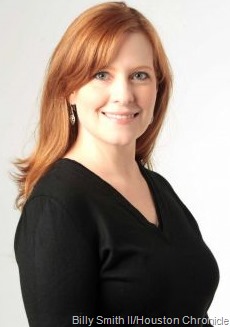
The winner of the 2015 Pulitzer for Commentary is Chronicle Metro columnist Lisa Falkenberg, “for Falkenbergvividly-written, groundbreaking columns about grand jury abuses that led to a wrongful conviction and other egregious problems in the legal and immigration systems.”    In its story on her award today the paper puts Falkenberg’s series in perspective:

Falkenberg was awarded the prize for a series of columns she wrote about Alfred Dewayne Brown, who was condemned for the killing of a Houston police officer, a crime he very likely did not commit.

From documents leaked to her by sources, or obtained through court records and Freedom of Information Act requests, Falkenberg revealed how a witness, Brown’s former girlfriend, who could have provided him with an alibi, was threatened and intimidated by a grand jury into lying on the stand. She provided the key testimony that put Brown on death row.

She pulled back the curtain on the secretive Texas grand jury system, allowing a glimpse into the workings of the panel that indicted Brown. That panel, Falkenberg revealed, was headed by a Houston police officer.

And she documented how phone records placing Brown at his girlfriend’s apartment at the time of the crime which were in the hands of prosecutors were never handed over to his attorneys as required by law.

Ten years after being sentenced to death, Brown was granted a new trial. And as Falkenberg wrote just last Sunday, he is still waiting.

More to the point—albeit one the paper chose not to mention in its own story—Falkenberg’s series on Brown is credited with the push in the current state legislative session to do away with the “pick a pal” grand jury selection system, which she argues is at the heart of the problem that has Browne in jail for a crime he probably did not commit.  Way to go, Leading Information Source.

Congratulations, Lisa.

Hang down your head, Hearst Newspapers

There’s been a running argument over the last 20 years or so about whether or not newspapers should run ads on their front pages.  The front page is sacred, the old school guys insist: all news and only news, because this is how we show the reader that they’ve come to a serious source of news.  Yes, of course we need to sell ads to stay in business, but we don’t run them on the front page.  We just don’t.

This is one of those fights that the old school guys have been losing, slowly, one paper after another.  A few years back the American Journalism Review ran a good, short history of the issue and outlined reasons for and against.

Gene Patterson, former chairman of the Poynter Institute and former editor of the St. Petersburg Times, sees the page-one ad as a sign of painful economic times for newspapers. “I find the section-front ads to be acceptable; I find the page-one ads repugnant,” he says. “But if they are done tastefully and held down in size, I think perhaps we have to accept them… We have to police it and monitor it and be guided by taste, but I don’t think the advertisers want to ruin us. We are their vehicle, after all, and I think we can work with them to achieve compromises.”

Others want to hold the line. Gene Roberts, a former managing editor of the New York Times and executive editor of the Philadelphia Inquirer, says front-page ads are just another in a series of industry mistakes triggered by short-term thinking. “It’s one more in this kind of death by a thousand cuts that the newspaper business seems to be administering to itself,” says Roberts, a journalism professor at the University of Maryland, which houses AJR. “In the long run, the big necessity is to get and maintain readers, and I think without question that front-page ads work against readership.”

(snip)

Page-one placement can spark visceral reactions not only from journalists but also from readers. Take the case in March of the fluorescent advertising stickers (for a motor oil company and a carpet-and-flooring company) pasted atop the front page of the Hartford Courant. Reader Representative Karen Hunter received several indignant comments on her blog. “That is disgusting to have advertising on the front page of my newspaper,” wrote one woman. Said another: “This has got to stop.” One reader took it further, accusing the Tribune Co., the Courant’s parent, of “absolutely whoring for advertising… It screams, ‘We’re desperate!’ It screams, ‘Ethics be damned!'”

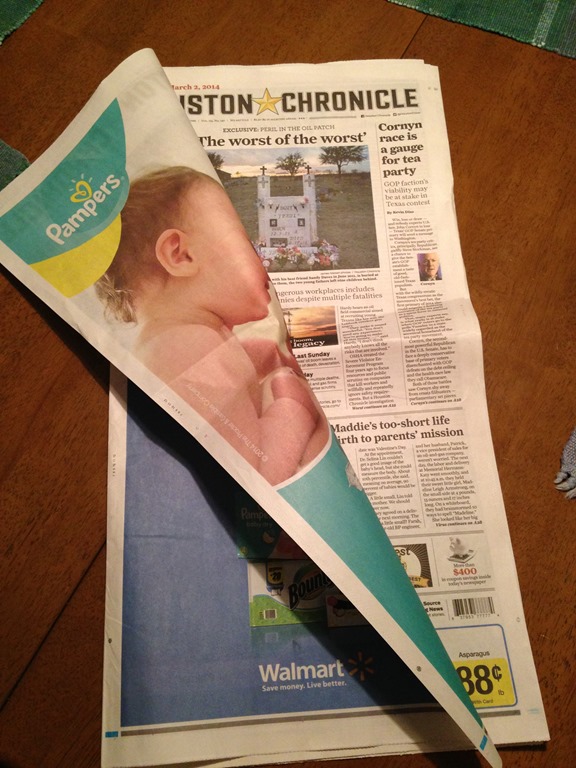
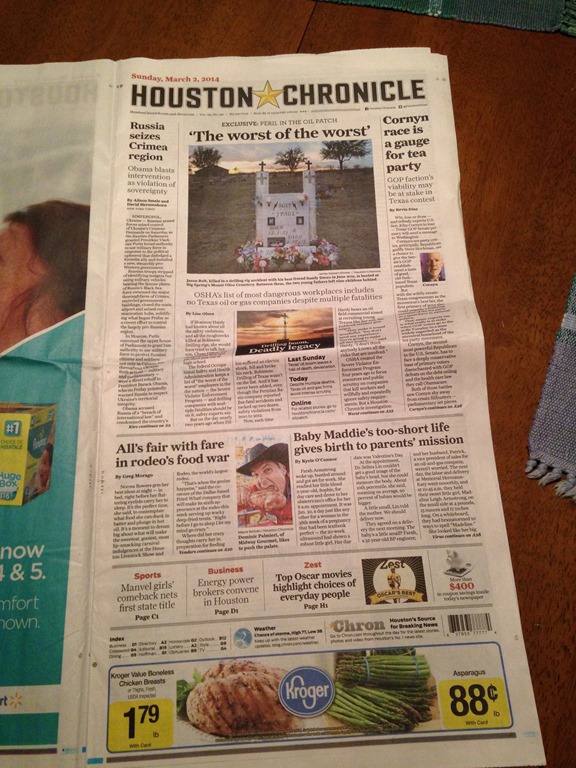
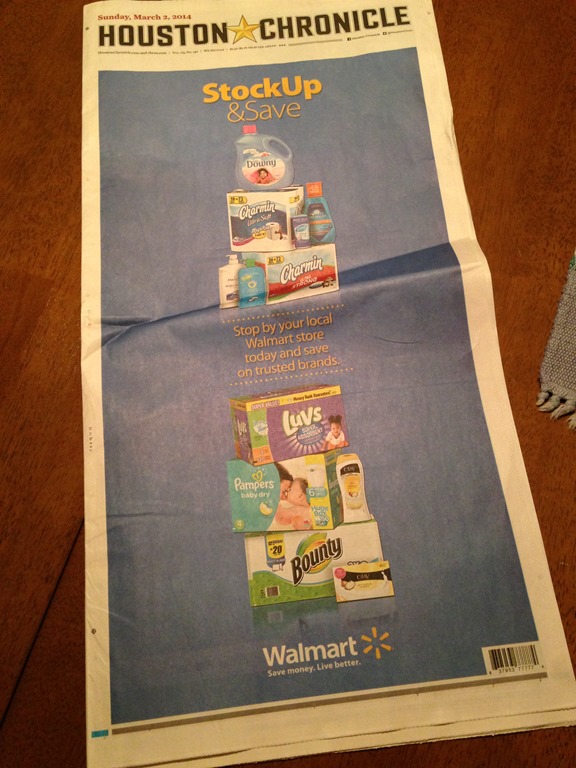
Imagine what they would say if they got a look at this Sunday’s edition in my hometown.  Today, over at Houston’s Leading Information Source, they threw in the towel on this argument.  Not only do we now run ads on the front page, we run two pages of ads in front of the front page!

IMG_0116IMG_0118IMG_0117

After the initial shock, I decided I’m not really surprised.  More’s the pity.

Dammit, Biggio is a sweetheart so elect him to the Hall already!

Craig Biggio did not win election to the Hall of Fame today.  Greg Maddux, Tom Glavine and Frank Thomas did, and they deserve it; congratulations to them.  For the second year in a row, his first two years of eligibility, the Houston Astros icon was the biggest vote-getter without getting the 75% of votes required from members of the Baseball Writers Association of America.  Last year, when the writers elected no one, Biggio was the leading candidate but came up 39 votes short; this time, it was two.  TWO VOTES, out of 571 569 (nope, now they say 571 after all)!  Don’t those people understand that Biggio is a great guy?

I mean, Houston’s Leading Information Source switched into full cheerleader mode last week (as it did this time last year), fulfilling its civic responsibility of promoting Biggio’s candidacy by reminding readers that he is…well, that he is a nice man.  Jose de Jesus Ortiz made the point that Biggio’s teammates think he’s a great guy, and that his agreeing to switch positions showed his further greatness; new guy Evan Drellich has found that even people who knew Biggio as a kid say he’s a lovely fellow.  (To a lesser degree the Chronicle tried to shine the same sweet sunlight on Biggio’s teammate and pal Jeff Bagwell, who carries credentials that match up pretty well with Frank Thomas but who also labors under the suspicion of having used performance-enhancing drugs; he was seventh on today’s list of candidates with more than 54% of the vote.)

But I’ve just discovered that even the local daily doesn’t know it all.  A tweet from Lance Zierlein led me to this eye-opening YouTube video that should convince any remaining skeptics who aren’t sold on Craig Biggio being a member of baseball’s Hall of Fame.  Just take a look for yourself.

What else must this man do?  I mean, really…