
As the coach used to say each Monday, let’s talk a bit about the happenings of last week

It was the best of times, it was the worst of times… (Been done.)

It was the worst night of my entire life… (Take it easy, Princess.)

What in the actual f**k were you people thinking… (Leave that approach to Jon Stewart.  How about this:)

I am very disappointed with the result of the presidential election, and I’m concerned about what’s going to happen starting next year.  (OK…keep going.)

It’s not that I was firmly convinced that Kamala Harris was going to win and am now staring at the returns in disbelief.  I definitely wanted her to win, but wasn’t deluded into thinking there was only one possible outcome.  I am bewildered to think that more than 73 million Americans think the former guy – now the once and future guy, I guess? – is the best person for the job.  Unless they really don’t think that at all.

Now I’m reading (see the reading list below, and thanks to everyone who kept this such a secret until after the whole thing was over) that Trump, as opposed to Harris or Joe Biden or apparently any other Republican, represents a dramatic change from a system that these people do not trust.  Strenuously do not trust.  The theory is that Trump voters don’t really agree with everything that comes out of his mouth; some things, sure, but not everything.  But they do want a major change from the status quo.  They want to throw out the scoundrels of the political establishment, and they trust that anything is better than what we have right now.  Even crazy, lying, fascist Trump is, they think, preferable to more of the same old same old.

While recognizing that all of us only have two real choices in this race by the time we get to November, I’m still surprised that so many people would vote for Trump.  A guy who lies to us so profoundly and so often, who is a convicted criminal, who has shamelessly used public office to enrich himself; who offers a plan to fight inflation and lower prices with tariffs that will undoubtedly raise prices instead, who promises to deport tens of millions of people in a plan that will be enormously expensive and disruptive to the labor force and economy as well as probably inhumane, who promises the unattainable instantly (end the wars in Ukraine and Gaza?  Easy peasy) with no clear plan of action.  Or any plan at all.

I’m worried about what’s going to happen next.  We were surprised in 2017 when he didn’t become more presidential or tone down the rhetoric or act more like what we were used to, but this time no one should be surprised if he does some of the out-there things he promised to do.

–he promised massive tariffs on foreign goods; we’ll all pay higher prices for those goods because the higher prices will be passed along to us by the seller.

–he promised (allegedly) vaccine denier Robert F. Kennedy, Jr. control of our public health agencies; yeah, what could go wrong there.

–he promised to jail his critics; First Amendment, Schmirst Amendment.  Stand by for other protected rights to be ignored.

–he promised the largest mass deportation in American history; waiting now for the (multi-million dollar) plans to construct a new generation of internment camps while he strong-arms our allies to accept repatriation.

–he promised to settle the wars in Gaza and Ukraine; stand by for “America First” plans that will provoke Iran, threaten Ukraine’s sovereignty (to the benefit of Russia), and put the NATO alliance in jeopardy.

You get the picture.  If Republicans end up with control of the House of Representatives as well as the Senate, we’ll also see Trump’s sudden support for Project 2025 and any other effort to push the Christian nationalist agenda to remake America civil society in their image.  And he’ll do it all while, as he did the first time, illegally enriching himself (hello, Emoluments Clause, my old friend).

Oh yeah, there’s this result, too:

image


FOR MORE INFORMATION:

To those thinking, how could Trump possibly win – that’s not who we are: Michelle Goldberg makes the case that maybe it is:

“Trump’s first election felt like a fluke, a sick accident enabled by Democratic complacency. But this year, the forces of liberal pluralism and basic civic decency poured everything they could into the fight, and they lost not just the Electoral College but also quite likely the popular vote. The American electorate, knowing exactly who Trump is, chose him. This is, it turns out, who we are.”

The polls say Trump won big with male voters; Elizabeth Spiers explores just which men they mean: Trump’s appeal to men was

“a regressive idea of masculinity in which power over women is a birthright. That this appealed in particular to white men was not a coincidence — it intersects with other types of entitlement, including the idea that white people are superior to other races and more qualified to hold positions of power, and that any success that women and minorities have has been unfairly conferred to them by D.E.I. programs, affirmative action and government set-asides. For men unhappy with their status, this view offers a group of people to blame, which feels more tangible than blaming systemic problems like rising economic inequality and the difficulty of adapting to technological and cultural changes.”

Bernie Sanders’ take:

“It should come as no great surprise that a Democratic Party which has abandoned working class people would find that the working class has abandoned them…First, it was the white working class, and now it is Latino and Black workers as well. While the Democratic leadership defends the status quo, the American people are angry and want change. And they’re right.”

David French calls the vote a revolt against the ruling class and a faithful effort by those who believe Trump fulfills a prophecy.  (Honest to God)

Democratic mega-donor (and one-time candidate himself) Michael Bloomberg wonders how Democrats could possibly lose to such a bad candidate.

Just for fun, here’s a “deep dive” (as the kids say) on the scary details of Project 2025; Christian nationalists are unlikely to let this opportunity pass.
The most crucial lesson

Seated at my desk at work with CNN playing numbingly in the background, it was just another autumn Tuesday morning in Houston.  Finally, it soaked in that they were saying a commercial jetliner had crashed into the World Trade Center in New York—where we had been on a vacation weekend just 15 months earlier—and my reaction was to think, that’s crazy: those buildings are near the flight paths to the New York City-area airports, sure, but the pilots are too good at what they do to make that kind of mistake on a bright, cloudless morning.  Must have been a small private plane, with an amateur pilot who got confused.

It never occurred to me that someone would fly a plane into the building on purpose, until I saw what was clearly a passenger jet get lined up and plow right into the middle of the other tower.

We were sent home from work soon after that, so I sat in front of my TV for the rest of the day watching the history.  Riveted.  Fascinated.  Helpless.


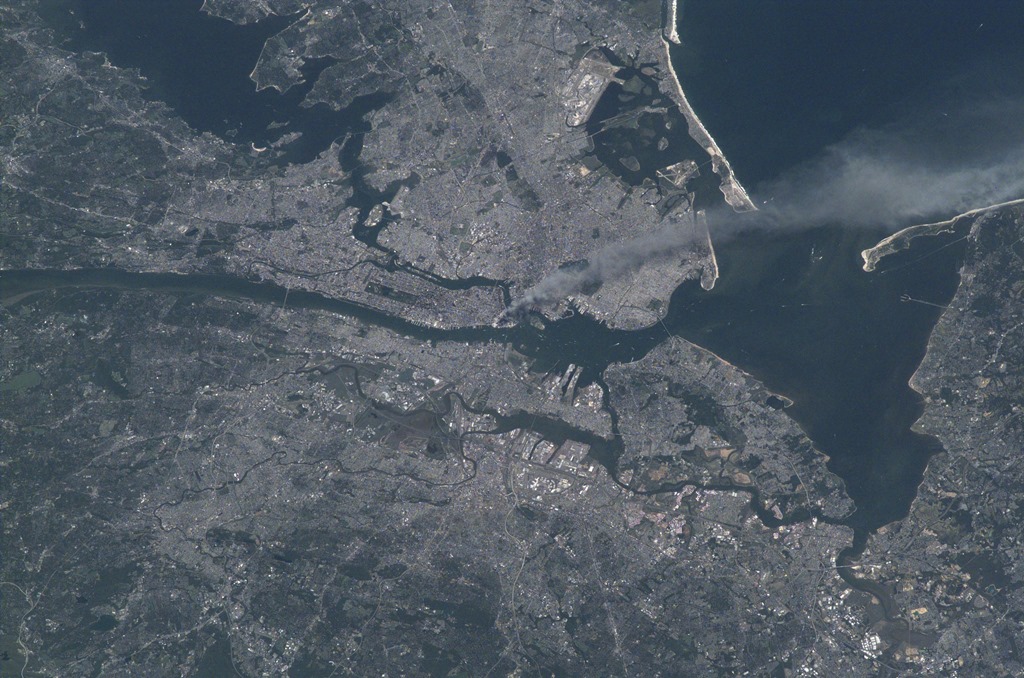
We love anniversaries that come in numbers ending in zero and five, ascribe to them some extra significance, and today is just that way.  There’s no shortage of think pieces out there taking a stab at explaining what we’ve learned about ourselves in the last 20 years, or what we have failed to learn in that time.  There are the first-person memories of being in New York and seeing it happen…or of being inside the towers as they were struck, and shook, and caught fire, and what it was like to save your own life as you joined thousands of others trying to get outside before it was too late.   And then seeing what was out there.  And ultimately, seeing those buildings collapse on themselves.  NASA astronaut Frank Culbertson was the commander of the International Space Station on that day, and he took this picture as they flew above Lower Manhattan just about the time the second tower fell.

iss003e5387_full

Ironically, Culbertson was a Naval Academy classmate, and friend, of Chic Burlingame, who was the captain of the flight that was hijacked that day and crashed into the Pentagon.


America’s war in Afghanistan started as a direct response to the attacks that happened 20 years ago today.  We went after Al Qaeda and its leader Osama bin Laden, and the whole world was on our side: no one questioned the righteousness of the U.S. decision to retaliate against the people behind these unprovoked attacks.  Hell, the rest of the world helped: it was the only time in its existence that NATO invoked the collective defense clause of the treaty.  It took nearly ten full years before Navy SEALs located the Al Qaeda leader in Pakistan and took him out, and ten more years after that before the last American military forces were withdrawn from Afghanistan.

We took our revenge, as we should.  But it still doesn’t feel like we made the best use of the 20 years to understand why the terrorists attacked us in the first place, or to learn how to treat the rest of the world in a way that would make the most dangerous people out there hate us less and be less inclined to attack us.  And meanwhile, America has become a more dangerous place.

Instead of a new order, 9/11…gave rise to the angry, aggrieved, self-proclaimed patriot, and heightened surveillance and suspicion in the name of common defense.

(snip)

In shock from the assault, a swath of American society embraced the us vs. them binary outlook articulated by [President George W.] Bush — “Either you are with us, or you are with the terrorists” — and has never let go of it.

You could hear it in the country songs and talk radio, and during presidential campaigns, offering the balm of a bloodlust cry for revenge. “We’ll put a boot in your ass, it’s the American way,” Toby Keith promised America’s enemies in one of the most popular of those songs in 2002.

Americans stuck flags in yards and on the back of trucks. Factionalism hardened inside America, in school board fights, on Facebook posts, and in national politics, so that opposing views were treated as propaganda from mortal enemies. The concept of enemy also evolved, from not simply the terrorist but also to the immigrant, or the conflation of the terrorist as immigrant trying to cross the border.

The patriot under threat became a personal and political identity in the United States. Fifteen years later, [Donald] Trump harnessed it to help him win the presidency.

In the week after the attacks, Bush demanded of Americans that they know “Islam is peace” and that the attacks were a perversion of that religion. He told the country that American Muslims are us, not them, even as mosques came under surveillance and Arabs coming to the U.S. to take their kids to Disneyland or go to school risked being detained for questioning.

For Trump, in contrast, everything was always about them, the outsiders.

In the birther lie Trump promoted before his presidency, Barack Obama was an outsider. In Trump’s campaigns and administration, Muslims and immigrants were outsiders. The “China virus” was a foreign interloper, too.

(snip)

The legacies of 9/11 ripple both in obvious and unusual ways.

Most directly, millions of people in the U.S. and Europe go about their public business under the constant gaze of security cameras while other surveillance tools scoop up private communications. The government layered post-9/11 bureaucracies on to law enforcement to support the expansive security apparatus.

Militarization is more evident now, from large cities to small towns that now own military vehicles and weapons that seem well out of proportion to any terrorist threat. Government offices have become fortifications and airports a security maze.

But as profound an event as 9/11 was, its immediate effect on how the world has been ordered was temporary and largely undone by domestic political forces, a global economic downturn and now a lethal pandemic.


Journalist, author and filmmaker Chris Tomlinson is an Army veteran and former AP reporter and editor.  In his column in the Houston Chronicle today he provides a background based on what he’s seen and learned fighting and covering wars from back into the 1980s, including the post-September 11 conflicts in the Middle East and Asia, and offers a thoughtful summary of where we ought to turn our attention to prevent another September 11, and probably improve our lives.

In debating the last 20 years, we can talk about the limits of military power, the futility of nation-building, and the inevitable failure of occupations. We can chatter about politics, diplomacy and negotiation. But the most crucial and ignored lesson is one taught to all the children of Abraham.

Do unto others as you would have them do unto you.

Respect is the foundation of peace. We must treat all people with fairness and justice. We must recognize that other nations are not failed attempts to become the United States. Most foreigners do not want to be us; they are proud of the cultures and traditions they spent millennia creating.

We can exchange insights. We should support each other’s progress. We may learn from one another. But we must limit ourselves to setting an example, lending a hand, and sharing knowledge. We must defend ourselves but cannot rely on invading armies, economic sanctions, and cultural imperialism to change the world to look more like us.

Such coercion has triggered a global rise in nationalism and authoritarianism. Tolerance is ebbing. Justifications for injustice are everywhere. Hate is overpowering love in the quest for power. We are not any safer.

Despite the last 20 years, we still value competition over cooperation and war over peace. Some day we may become a nation of philosopher-kings rather than warrior-kings, but for now, we still choose to live by the sword.

A U.S. sailor’s bullet silenced Bin Laden’s voice, but millions more bullets did not bring peace or justice to the world. I no longer report from war zones, instead I write about commerce because the surest path to peace is prosperity for all. Perhaps we can give that a try.