The 47% fallout at Fox, as told by Jon Stewart

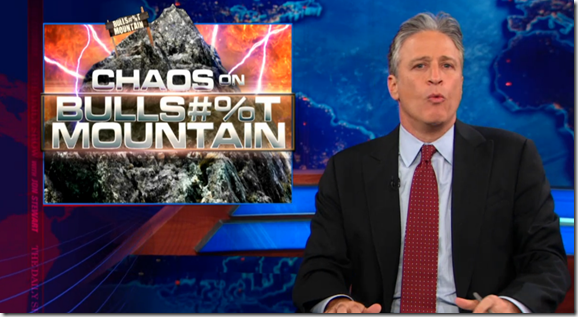
It has been great fun to watch the political circus play out around last week’s revelation of Mitt Romney’s campaign gaffe—or to put it another way, that chance for the rest of us to hear the truth Romney tells his supporters behind closed doors.  The good folks at The Daily Show even took a good-natured little poke at their friends at Fox News Channel for their contortionally-magnificent defense of the Republican Party nominee: “Let me sum up the message from Bullshit Mountain, if I may: this inartfully-stated dirty liberal smear is a truthful expression of Mitt Romney’s political philosophy and it is a winner.”  Click the pic for the whole beautiful report.

image

This is the core of Bullshit Mountain: the 49% entitlement society Obama enables.  That is the core of the Bullshit Nation fiction, that somehow only since Obama, the half of Americans who love this country and work hard and are good have had the fruits of their labor seized and handed over to the half of this nation that is lazy and dependent and the opposite of good—I’m sure there’s a better term for that.  Now, in that 49% [Sean] Hannity is including those on Social Security and Medicare, or as I like to call them, his audience.

Thanks to Mashed Potato Bulletin for the heads up.

Mitt: Did I say that out loud?

Years ago I was a political junkie, but I kicked it. Turned out it was pretty easy to get the political process monkey off my back when the campaign content and tactics got so distasteful that I couldn’t bear to listen. But some things come back easily, in the right circumstances.

The “hidden video” news revealing Mitt Romney in an unguarded moment in his native environment—among the wealthy—expressing his apparently-honest feelings about a large portion of his fellow citizens left me shaking my head and imagining the effect on voters. Even if what he said was right—and mostly it’s not—demonstrating that contempt for the poor and the elderly, who make up most of those who owe no federal income tax but still pay plenty of other taxes, isn’t going to help Romney with his likeability problem. Today’s revelation of another video clip from that same fundraiser—in which Romney asserts that Palestinians (apparently, all of them) “have no interest whatsoever in establishing peace” with Israel—and the promise of the full video still to come, makes you grateful to live in a time when everyone with a phone is a potential hidden camera.

Romney is right about the fact that most people, on both sides, have made up their minds, and the outcome depends on the choices of a small portion of voters. The experts haven’t had time yet to gather data on how Romney’s truth outbursts in a Florida fundraiser will affect those undecided voters, but that data will get put into the mix along with this very interesting analysis of the polling up to this point which concludes that “Given where the election is being contested, however, the most likely outcome is that Obama wins enough tipping-point states to eke out a victory.” I can hardly wait for the debates!

Just like a little love, campaign truth is hard to find

You hold your breath…you make a wish…and you’re disappointed when it doesn’t come true.  And then you remember that things don’t happen just because you wish them to.  Such is the case, not very surprisingly, with the level of discussion this week in the race for president.

Mitt Romney’s selection of Wisconsin congressman Paul Ryan (no relation) as his running mate last Saturday was greeted as good news by some people positioned all along the political spectrum, from those tea party members and fiscal conservatives who love his budget plans to those more liberal folks who believed his serious interest in issues would spark a real debate.  How long did that last?

Until Tuesday.

If we can all agree that Joe Biden is to oratory what Spam is to steak, we can agree that his inelegant comment to a mixed-race audience in Virginia was not meant to invoke the specter of slavery.  Yet that was all Romney and Ryan had to say—that the Democrats were running a campaign of hate—even before that evening’s newscasts hit the air.  (I do give them credit, though, for how well they can operate with the threshold set so low on such a finely-tuned sense of outrage.)

Tuesday also featured some well-prepared interviewers catching Romney surrogates on their indefensible claim about Medicare cuts under Obamacare.  This piece on Mediate has all the links to both occasions: CNN’s Soledad O’Brien with John Sununu, and Fox News Channel’s Brit Hume with Ryan himself, as each of them tried to pass off the latest Republican mischaracterization (to be kind) of the impact to Medicare funding under the Affordable Care Act.  Just nailed them, which was amusing; watch the clips.  The partisan noisemakers can’t really slough this off with the standard allegation of liberal media bias—we’re talking BRIT HUME here!  If FOX NEWS was schooling your VP, you got to make allowances that just maybe CNN was playing it down the middle, too.

But the best thing I saw on Tuesday, from the perspective of trying to keep the facts straight, was an interview on Slate with the author of The New New Deal.  Journalist Michael Grunwald went looking for the truth about the impact of The American Recovery and Reinvestment Act—President Obama’s $800 billion stimulus bill passed by Congress in early 2009, designed to help get the country’s economy rolling again.  His conclusion: the stimulus bill worked.

Not that everything in it worked, or worked perfectly, not that there weren’t problems or some waste and fraud.  But mostly, the stimulus bill did what it was designed to do; it can be argued that the economy hasn’t done better because the stimulus was too small, although Obama could never have gotten Congress to go for more.

…the stimulus was supposed to create jobs at a time when jobs were vanishing at a terrifying rate. Nonpartisan economists agree that it helped stop the free fall; job losses peaked the month before it passed, and the economy dramatically improved once it kicked into gear. But even after the dramatic improvements, the unemployment rate was still sky-high and rising; an economy can do a lot better than losing 800,000 jobs a month without doing well. Ultimately, the stimulus was a 2.5 million-job solution to an 8 million-job problem.

To the extent that Obama’s opponents will argue that Grunwald’s story is biased, he replies:

I don’t think my book portrays the Republicans as “vicious,” but I do show—thanks to a lot of in-depth interviews with GOP sources—how they plotted to obstruct Obama before he even took office. I show how the stimulus was chock full of stuff they claimed to support until Jan. 20, 2009—not just things like health IT and the smart grid and energy efficiency and scientific research, but the very idea of Keynesian stimulus. Every presidential candidate in 2008 proposed a stimulus package, and Mitt Romney’s was the largest. So I do spend a fair amount of time chronicling Republican stimulus hypocrisies. (Readers might enjoy the backstory of Sen. Judd Gregg’s short-lived nomination to be Obama’s commerce secretary.) In general, I’d have to say my reporting backs up the Norm Ornstein-Thomas Mann thesis that the Republicans have gone off the policy deep end—denying global warming, denying Keynesian economics (except when it comes to business tax cuts and defense spending!), trashing Obama’s government takeover of health care and also his Medicare cuts, drumming stimulus supporters like Crist and Specter out of the party.

Read the interview; the book is just coming out this week.  I want to hear this story—we should all want to hear this story, and other stories—from someone who hasn’t already sold out to one party or one candidate.

We’ve debated a bizarro-world stimulus that does not exist. And I think that’s true about Obama, too. I don’t think he comes across as “brilliant.” I think he comes across as a pragmatic left-of-center technocrat who wasn’t interested in pursuing lost causes, but basically tried to do what he said he would do during the campaign. He wasn’t a policy entrepreneur with new policy ideas, but he did his best to get 60 votes for old policy ideas that made sense, and then pushed his administration to put them into action as cleanly and competently as possible. And I did a lot of reporting in the bowels of the bureaucracy and around the country to show how change has been playing out.

I tried to tell the story as fairly and honestly as I could. But I didn’t try to be balanced for the sake of balance. When politicians were full of shit, I tried to point that out.

That’s what we need more of from reporters.  Dutifully transcribing the opinion of the spokeshuman from one party and then the opinion of the spokeshuman from a second party doesn’t get us the truth; what the political parties have to say is designed to benefit the parties, not to promote truth.

In the spring a young man’s fancy also turns to baseball and cars; politics is getting in the way

Yep, another great day: sunny skies and highs in the low 80s in southeast Texas, got a ticket for my first game of the new baseball season tonight, made some good progress with a new swing thought out on the driving range yesterday, and I’m about a week away from trading in a serviceable but boxy and uninspiring VW for a very low mileage Honda two-seater—just the kind I’ve always loved and used to drive—while lowering my costs in the process!  With Rick Santorum’s exit from the GOP presidential primary, I’m hoping we can all enjoy a period of relative campaign quiet, too, but here’s something to roll around in your head before Mitt Romney and Barack Obama, and the permanent political class, use up all the oxygen.

It has looked like, from the vantage point of today, that come November we voters would face a choice between the radicalism that defines today’s Republican Party or another four years of divided government and damn little constructive effort on crucial economic issues.  Even the most moderate-seeming Republican candidate, Romney, was disavowing anything in own past that smelled of reasonableness and compromise, to appeal to the extremists who make up most of the GOP primary voters.  But the need for that should be over now, absent a mind-boggling resurgence from Newt Gingrich or Ron Paul or a last gasp charge to the convention from Sarah Palin or someone of that ilk to rally the “true conservatives.”

But even as Romney starts to redefine himself to appeal to the less ideological among us, Republicans will have a quite a slog in front of them if they wish to broaden their appeal beyond those who’ve already drunk the Kool-Aid.  Former White House speechwriter and senior policy adviser Michael Gerson says it’s not just a matter of trying to counter the Democrats’ “war on women” meme: “The GOP’s main problem is not the contraceptive issue; it is the perception that it has become too ideological on many issues.”

Women and independent voters have seen a party enthusiastically confirming its most damaging stereotypes. The composite Republican candidate—reflecting the party’s ideological mean—has been harsh on immigration, confrontational on social issues, simplistic in condemning government and silent on the struggles of the poor. How many women would find this profile appealing on eHarmony?

This is the hidden curse of the Republican congressional triumph of 2010. Republican activists came to believe that purity is all that is necessary for victory. But a presidential candidate, it turns out, requires a broader ideological attraction than your average tea party House freshman.

From an academic standpoint it will be interesting to see if and how Romney and the more traditional Republican elements work to sand the scary edges off of their primary campaign messages, to widen their appeal and entice the plurality of American voters who don’t ritualistically identify with the Republican or Democratic parties; those are the people who will decide this election.  (The Obama campaign isn’t going to make it easy, already working to reinforce Romney’s “severe” conservatism and other primary campaign highlights.)  Gerson argues that “Mainly, women and independents want some reassurance that Republicans give a damn about someone other than Republican primary voters. It is not a high bar. But Romney needs to start somewhere…”.  I’ll check back in after Memorial Day to see how he’s doing.

This one guy says the evil super PACs are SAVING democracy, others are less charitable

I’m not sure if he’s right or not, but he makes an interesting argument.  Dave Weigel is an excellent political reporter who’s spent a lot of time chronicling the conservative movement.  Today at Slate he makes the provocative argument—it was to me, anyway—that the political action committees fostered by the U. S. Supreme Court’s Citizens United decisionare a good thing, that they have been a force to strengthen democracy and have made this year’s Republican presidential contest fairer.

Huh?  No, no, no, wait a minute: Citizens United is an evil thing, a twisted interpretation of dictionary English by the conservative members of the court so that now the godless, faceless corporations are considered “persons” for the purposes of political participation, and they can secretly donate as much of their giant piles of money as they like to PACs and buy elections and marginalize the little guy like me (I was going to say you and me, but I really shouldn’t presume to speak for you, should I?)…it’s already happened starting in Iowa this year, right?  I mean, that’s what we’ve all been told, right?

But Weigel argues that the super PACs have had a leveling effect: the big money from super PACs is all that’s kept Mitt Romney from outspending his opponents into submission, and essentially buying the GOP nomination.  And despite the concerns about the secretive nature of the super PACs, he notes that we seem to know more about the biggest of the big donors to super PACs than we do about the people making direct donations to the individual candidates’ campaigns. He writes, “The big fear about campaign money is that it corrupts the candidates who have to beg for it.”

But that worry applies better to the shadowy bundler than it does to the megabucks super PAC donor. Corruption can’t grow in the sunlight. The people giving big to super PACs are famous. I didn’t fully understand how famous until I tagged along with [Newt] Gingrich at a speech to Aloma Baptist Church in Florida, when a parishioner asked him to explain why he was taking dirty money from the gambling industry. Gingrich explained that he and [Sheldon] Adelson had a simpatico, guns-a-blazin’ view on Israel. Is it corruption if the candidate tells you what he’ll do for the donor?

(snip)

We know more about those guys than we know about the bundlers, who’ve been passing money under the table for years. So which of those systems is worse for our democracy?

I know what’s good for our democracy: satire and ridicule, and in the case of Citizens United it’s been coming most effectively from Stephen Colbert.  The Comedy Central comedian started his own super PAC and has been using it to expose the ridiculous reality resulting from the court’s ruling.

The line between entertainment and the court blurred even further late last month when Colbert had former Justice John Paul Stevens on his show to discuss his dissent in Citizens United. When a 91-year-old former justice is patiently explaining to a comedian that corporations are not people, it’s clear that everything about the majority opinion has been reduced to a punch line.

The court fights aren’t over, and perhaps the coolest one is in Montana where the state supreme court has told the one in Washington to pound sand.  The court voted 5-2 to uphold the constitutionality of Montana’s ban on corporate campaign contributions, finding justification for the ban that Citizens United does not consider.  Beyond that, Justice James Nelson unloaded: “Corporations are not persons.  Human beings are persons, and it is an affront to the inviolable dignity of our species that courts have created a legal fiction which forces people—human beings—to share fundamental, natural rights with soulless creatures of government.”   And that from one of the two dissenters in the ruling!

More fundamentally, the majority and one dissenter seem to understand perfectly how much the American people resent being lied to about the burning need for courts to step in to protect the oppressed voices of powerless corporate interests. As Judge Nelson wrote in dissent, “the notion that corporations are disadvantaged in the political realm is unbelievable. Indeed, it has astounded most Americans. The truth is that corporations wield enormous power in Congress and in state legislatures. It is hard to tell where government ends and corporate America begins: the transition is seamless and overlapping.”