Recommended election reading, for those inexplicably eager for more election news

This week both The Los Angeles Times and The Washington Post issued the surprise announcement that they will endorse no one in the race for president this year.  Those decisions were made by the owners of the newspapers, who in that capacity have every legal right to make the choice they did.  Just not the moral and ethical rights, not if they want their newspapers to mean anything to the readers they claim to serve.

In the case of the LA Times, as the editorial board prepared a series of editorials leading to an endorsement of California native and former state attorney general and U.S. Senator Kamala Harris, it got a message from owner Dr. Patrick Soon-Shiong, “with scant internal or public explanation, abruptly vetoing the planned endorsement, informing the board through an intermediary that The Los Angeles Times would make no recommendation in the presidential race.”  Through an intermediary?  Dude didn’t have the guts to deliver the news face to face?  The story at the above link has more.

The choice at the Washington Post, which was expected to endorse the Democratic candidate, too, was to cease any endorsements in presidential elections from now on; it was announced by the paper’s publisher and framed as a choice to maintain neutrality.  That choice has been interpreted as an effort by the owner, Jeff Bezos, to avoid antagonizing the former guy; the Post itself has published the very critical reactions of 17 of its own opinion columnists under this declaration:

The Washington Post’s decision not to make an endorsement in the presidential campaign is a terrible mistake. It represents an abandonment of the fundamental editorial convictions of the newspaper that we love. This is a moment for the institution to be making clear its commitment to democratic values, the rule of law and international alliances, and the threat that Donald Trump poses to them — the precise points The Post made in endorsing Trump’s opponents in 2016 and 2020. There is no contradiction between The Post’s important role as an independent newspaper and its practice of making political endorsements, both as a matter of guidance to readers and as a statement of core beliefs. That has never been more true than in the current campaign. An independent newspaper might someday choose to back away from making presidential endorsements. But this isn’t the right moment, when one candidate is advocating positions that directly threaten freedom of the press and the values of the Constitution. [emphasis added]

Plenty of other papers are making endorsements, of course, including my hometown Houston Chronicle and my birthtown New York Times, both of whom are encouraging a vote for Harris.  And here are a few other recommended readings:

The Washington Post’s Eugene Robinson with a vivid reminder of the double standard we’ve developed for covering the two major party candidates: high scrutiny for the woman candidate, and a kind of same-old same-old attitude when the former guy “spews nonstop lies, ominous threats, impossible promises and utter gibberish.”

In Slate, Steven Greenhouse with the consideration that the unfathomable (to some) closeness of this contest can be blamed on the richest of the rich Americans who are prioritizing their personal financial well being over the betterment of our country.

At The Bulwark, Will Saletan’s tight summation of just what – specifically – Trump is doing that warrants him being labelled – accurately – as a fascist.

And a lively reminder from The Daily Show’s Jon Stewart of the it-would-be-amusing-if-it-weren’t-so-dangerous reality that the former president is, in point of fact, demonstrably not many the things that his loyal army of supporters say are their reasons for voting for him.  He is, in fact, the opposite of what they say he is, but they can’t/won’t see that.  Sad.
Stewart to the rescue

“The basis of our governments being the opinion of the people, the very first object should be to keep that right; and were it left to me to decide whether we should have a government without newspapers, or newspapers without a government, I should not hesitate a moment to prefer the latter.”  Thomas Jefferson, in a letter to Edward Carrington, January 16, 1787

If I may be so bold as to raise a point with Mr. Jefferson, I wonder if he would still prefer journalism to government if he knew something of the state of the former in the 21st century. Generally speaking, the Founders’ confidence in the American people to govern themselves fairly and justly was based on a presumption that the people would be honestly informed about the issues of their day, and they had faith that a free press would do that.  Even the free press of their day, which was unabashedly partisan.  American journalism evolved, and not always to the good: in an effort to be, and to appear to be, non-partisan, there are elements of today’s journalism that won’t defend objective truth for fear of being labelled everything from unfair to slanted to (gasp!) liberal.

But there is hope: journalists could be in practice what they aspire to be in theory, finders and defenders of truth based on verifiable evidence.  Like the courts have done, in admirably turning so many lion-like defenders of a certain 34-times-convicted felon into cowering pussy cats because courts prioritize truth, while television prioritizes likeable personalities and access.

Yes you, the eager young fellow in front:

Dear Jon Stewart,

Thank you…you and the little army of writers and television gypsies that came together for good, at a time when your country, and I, needed you.  When we were lost, trying to rescue truth from the clutches of the radical political conservatives, and the evangelical Christian extremists, and the political organizations they controlled, you went to the front of the column and screamed, “Seriously?”

Journalism was little help in those dark times.  The major outlets were swampedjon_stewart3 by calls that blamed the “liberal media” for always taking sides against good honest conservatives, so they fell back to reporting controversial stories as little more than “he said/she said” exchanges and refused to identify blatant falsity as such.  They were outmaneuvered by the opposition; they were (and are) cowards, willing victims to what David Shaw of the Los Angeles Times beautifully referred to as “the four horsemen of the journalistic apocalypse: superficiality, sensationalism, preoccupation with celebrity, and obsession with the bottom line.”  So it was left to comedy, satire, to ride to our rescue.

The objection to Puritans is not that they try to make us think as they do, but that they try to make us do as they think. – H. L. Mencken

Almost any sect, cult, or religion will legislate its creed into law if it acquires the political power to do so. – Robert A. Heinlein

It didn’t help that the barbarians at the gate, intent on replacing the tolerant democratic civil society we were aspiring to with a theocracy of their own religious beliefs, decided to unlevel the playing field and refuse to acknowledge any truths that didn’t support their worldview.  The “reality-based community” stood dumbfounded, scrambling for the proper reply to “No, the sky is not blue, and you can’t prove that it is.”  But you found a way.

You like to say that you were just a comedian; true enough, but on The Daily Show you were more than just jokes.  You aimed a most potent weapon—sunshine; the light of day; their own words; common sense—at people who were full of shit and assured us all that the smell was coming from somewhere else.  They deserved what they got from you, and we got to laugh.  And in the process—in pointing out that the emperor indeed did not have on any clothes, that what politicians said quite often was at odds with demonstrable truth, that the 24-hour news channels weren’t worth the paper they were printed on—you reassured a lot of us that there was still hope.  For that, thank you.

Fact is, you did a great job of it just this week and I grabbed the link.  So for old time’s sake, just once more, let me suggest—click the pic, ya maroons.

image

No kidding

image

…I got nothing for you, in terms of like jokes and sounds, because of what happened in South Carolina…I honestly have nothing, other than just sadness, once again, that we have to peer into the abyss of the depraved violence that we do to each other in the nexus of a, just, gaping racial wound that will not heal, yet we pretend doesn’t exist.  And, I’m confident, though, that by acknowledging it, by staring into that and seeing it for what it is, we still won’t do jackshit.  Yeah; that’s us, and that’s the part that blows my mind.

(clip)

The Confederate flag flies over South Carolina, and the roads are named for Confederate generals, and the white guy is the one who feels like his country is being taken away from him?  We’re bringing it on ourselves, and that’s the thing: Al Qaeda, all those guys, ISIS, they’re not shit compared to the damage that we can apparently do to ourselves on a regular basis.

There are good reasons not to run around shouting “Islamic terrorist”

The whining is so tiresome, and the motivation so transparent, that I usually shake my head and ignore it each time the usual suspects launch a new “Dontcha Just Hate Obama” offensive.   Last week when the president talked about efforts to fight back against recruitment efforts by terrorist groups, we all got to see the righteous indignation of true Americans who were appalled, appalled I say, by the president’s refusal to refer to the terrorists as “Islamic” terrorists or extremists or zealots or whatever.

I gotta wonder, what effing difference does it make if the terrorists are Muslim?  Really.  If they’re terrorists, if they’re waging war on America and Americans, we have the right and the responsibility to fight back.  It doesn’t matter why they’re doing it unless we can use that to persuade them to stop.  (I have a similar feeling about “hate crimes:” murder or assault or whatever the crime is, it’s a crime because it’s against the law, not because of why they did it.)

But, haters gonna hate.  And even though I believe that words can work wonders, I’ve long since given up on the idea that valid, cogent argument grounded in demonstrable fact may ever again be persuasive once one has chugged the Kool-Aid of the radical right.  However, when I came across this terrific unpacking of reasons why it makes absolute sense in a reasonable world for the President of the United States to choose his or her words carefully, I wanted to share.

While [Barack] Obama has not used those words, he has acknowledged Islam plays a role in the Islamic State’s strategy. Obama has said that even though the Islamic State uses religion to justify its extremism, its ideology does not mesh with mainstream, modern Islamic thought.

“They try to portray themselves as religious leaders — holy warriors in defense of Islam.  That’s why ISIL presumes to declare itself the ‘Islamic State.’ And they propagate the notion that America — and the West, generally — is at war with Islam,” Obama said at the White House Summit on Countering Violent Extremism last week. “We are not at war with Islam. We are at war with people who have perverted Islam.”

(snip)

Why such a careful choice of words? Experts we contacted offered a few theories.

For one, the Islamic State is just one of numerous jihadist groups that the United States is fighting in the Middle East and North Africa, including al-Qaida and its affiliates. And the Islamic State has several qualities that set it apart from other jihadi groups, such as their desire to immediately create a caliphate. In that sense, it would be misleading to lump these groups into one singular enemy code-worded Islamic extremism, said James Gelvin, a history professor at the University of California Los Angeles.

Additionally, several countries helping the United States fight the Islamic State and other terrorist groups are Muslim nations, including Jordan and Saudi Arabia. In those cases, it is in the United States’ interest not to be at war with a religion.

(snip)

The Islamic State adheres to strict, literal interpretations of the Koran and Islamic teachings rooted in 18th-century religious philosophy called Wahhabism. This ideology, the dominant faith in Saudi Arabia, is focused on a return to the “truth faith” of the first caliphate established after the death of Mohammed, a time when Islam was not “polluted” by Christianity, paganism or governmental interference, said Richard Brennan, a Middle East expert at the nonpartisan think tank RAND Corporation.

The result is a puritanical practice of Islam that views government as a problem within society, as a man’s allegiance should only be to allah. For some recruits, the Islamic State represents a “fight against the normative world order” of Shia rule, Sunni suppression, and Western colonization and invasion, Mohammed said. “The idea is that after centuries of weakness, some Muslims are fighting back.”

The Islamic State goes even further than traditional Wahhabism by adhering to takfir — which is the belief that some people who say they are Muslim are not truly Muslim, and therefore there is reason to kill them, Gelvin said. The vast majority of the Islamic world tends to believe that if someone professes they are Muslim, then they are, no matter how they specifically practice their faith.

Even al-Qaida and other Islamic extremist groups don’t accept takfir, Gelvin said.

(snip)

Just as Muslims worldwide refused to take up [Osama] bin Laden’s brutal brand of Islam, the vast majority of Muslims are also not heeding the call of the self-proclaimed caliph of the Islamic State, Abu Bakr al-Baghdadi. Tufts University religion professor Kenneth Garden said accepting the terror group’s self-description would amount to “an own-goal” by the United States.

“I am confident that eventually the butchers of ISIS and their like will be roundly rejected and fade away,” Garden said. “But I am afraid this is the work of a generation. There is no quick fix for this, and little role for non-Muslim voices.”

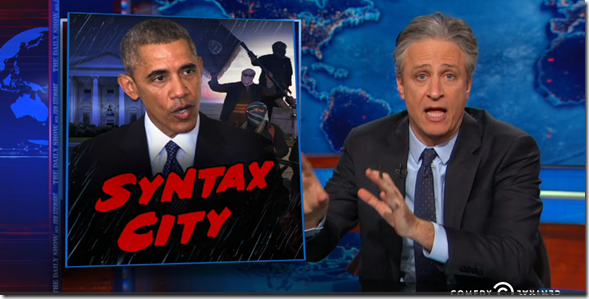
And then, there was Jon Stewart on The Daily Show noticing with exasperation that Obama apparently “still thinks he can persuade us through reasoned argument.”  See for yourself (click the pic):

image