The facts: Trump’s not-so-secret plan “for the most corrupt political party ever” in America to capture the next Congress

Welcome back to the blogosphere’s recently-dedicated home of facts about our president.  In today’s installment we focus on the fact that any time he is confronted with true facts that do not suit him, TFG acts like a four year old who’s been told he can’t have any more ice cream.  Plus, we look at the associated counterfactual statements (the lies) he produces in these instances to salve his ego and (he thinks) to convince us all that he really is our favorite president ever.  That will include, currently most crucially, his lies about the integrity of next month’s elections.

There are very many sources that are independent of this Administration where you and I can check for verification of the truth or falsity of things Donald Trump says.  CNN has a dedicated area, as does the Washington Post, and there are websites that do nothing but fact-check politicians (not just Trump), and I have links to some of them in the far left column of this page under Reference.   (I wish there were a Meghan Trainor song-inspired https://iknowyoulieyourlipsaremovin.com/.)  You can check stupid things, like him ham-handedly altering a National Hurricane Center map to add Alabama to the predicted track of a hurricane, or repeatedly insisting in the face of compelling visual evidence to the contrary that the crowd at his first inauguration was the largest ever.  In these cases he’s much like the brat who stomps his feet and cover his ears screaming “I can’t hear you” when told it’s time to come inside for dinner.

TFG has proven over and over that unlike most mature human beings, he insists that all “truth” not only does not put him in a negative  light, it must be nothing less than the most complimentary light.  Ever since he left military school he has existed in a world where his family’s wealth has allowed him to do pretty much whatever he wants and to ignore any negative consequences.  For example, The University of Pennsylvania couldn’t be forced to give him the good grades he’d need to graduate first in his class, but it couldn’t stop him from lying about it afterward.  If ever there is offered any “truth” which claims Trump is anything less than the sterling and respected character he pretended to be on a television show, then that “truth” is a vicious lie being spread by his enemies.  (Who all “hate Trump,” apparently.)  No matter what he’s talking about, he always sounds like a real estate huckster incessantly selling the biggest and best deal, making you an offer you’d be a fool to refuse.  If he had stayed in that private business world his lies wouldn’t matter to the rest of us, so long as we had the good sense not to do business with him.

But he didn’t.  Now, his lies are about things that really matter.  Every single, solitary accusation of “fake news” directed at a reporter or newspaper or network that doesn’t praise the president for every single, solitary move he makes, facts notwithstanding, does two things. It proves that he does not know how journalism is supposed to work: reporters are not there to promote the president (any president), they are there to report what really happened, as truthfully and as fairly as they can, for the benefit of the American citizens for whom every president works.  No president likes negative coverage and some publicly object to the emphasis reporters put on “bad news” stories, but no other president has so blatantly, transparently and falsely accused the journalists of just making shit up to hurt him.  And, his use of repeated false claims are a political propaganda technique to make people believe outrageous things that are not true.  It was called “the big lie” by that noted political philosopher Adolf Hitler, who wrote that the general population could be manipulated with the use of this tool since they wouldn’t believe that anyone “could have the impudence to distort the truth so infamously.”  Well folks, someone does.

The most dangerous example of Trump’s use of the big lie is his refusal to accept that he lost the 2020 election, to continue to deny it to this very day despite the complete lack of evidence of any fraud significant enough to have changed the outcome, and his continued insistence that all American elections are “rigged.”  Always against him, apparently, even in the two cases where he won.

That claim, which is false – unsupported by any facts – has a very specific goal in mind:

  • to give Americans a reason to believe him when he claims the expected Republican losses in this year’s midterm election are the result of voter fraud,
  • and to get them to agree with his efforts to overturn the results of that election
  • so Republicans maintain control of the House and the Senate
  • where the party will continue to roll over and play dead for Trump’s destructive agenda.

Republicans will smugly respond (as they often do) that it’s not hard to find liberal or even moderate commentators who will shill for this anti-MAGA conspiracy.  They have a harder time arguing the facts when they’re offered by a real Republican, a certified conservative – not a Trump butt boy but a true conservative, like former federal appeals court judge J. Michael Luttig.  He argues in The New Republic that the Trumpist assault on the November midterms is an important next step in their effort to overturn American democracy: fight the results of the expected Democratic victories in House and Senate races, which lays the groundwork for Congress to refuse to seat the Democratic winners  next January and seize control of the government.  Read it yourself and see if you think he’s overstating the case.

…Donald Trump and his Republican congressional allies are even more determined to prosecute the president’s war against American democracy to its catastrophic end than they were on January 6, 2021.

That catastrophic end could well come on January 3, 2027, when Trump and his Republican congressional allies wage the final battle in Trump’s determined war to corrupt America’s democracy and deliver a lasting political victory over the Democrats for his MAGA Republican Party.

Trump and his Republican allies have been preparing for this final battle since January 6, 2021. For the past six years, they have embarrassed themselves and the U.S. with their preposterous, win-at-any-cost denial that Trump lost the 2020 presidential election and their deceitful slander of America’s democracy. Since his return to the White House, Trump’s every unconstitutional act in his effort to seize control over the midterm elections—each hailed by his prostrate Republican Congress—has been toward the end of ensuring that Republicans retain a majority in the 120th Congress.

(snip)

So unalterably subjugated to Trump is today’s Republican House that even a decisive victory for Democrats and a resounding repudiation of Trump and the MAGA Republicans at the polls in November will not guarantee that a Democratic majority-elect will be seated in the 120th Congress on January 3 [emphasis added].

All year long, Trump has been dragooning House Speaker Mike Johnson and the congressional Republicans into prejudging as fraudulent the upcoming November elections of the presumed Democratic majority, as he himself has already prejudged those elections. His dragooning appears to have worked. House Republicans are now poised to claim that the midterm elections were stolen from them when they meet on January 3 to decide which members-elect will be seated in the 120th Congress.

Over the past year and a half since his return to the White House, Trump has exploited every conceivable unlawful means possible to rig the midterm elections in favor of the Republicans, and the federal courts have struck down as unconstitutional every one of these unlawful attempts. He will try every unlawful means over the remaining weeks to ensure that Republicans handily win the midterm elections in November. Those of us who oppose his illegality will look to the courts, but the federal courts will be institutionally incapable of checking his final unlawful rampage.

Trump punctuated his expressed intent to interfere in the midterm elections eight weeks ago in a national prime-time address on “election integrity,” accusing the Democrats and the Chinese in particular of threatening the free and fair elections in November. In that address, he claimed without evidence or support (as usual) that the 2026 midterm elections were being threatened by noncitizen voting, weaknesses in voter registration systems, foreign interference, and vulnerabilities in electronic voting systems.

(snip)

Everyone knows that the greatest threat to the upcoming midterm elections is not the Democrats or the Chinese, noncitizen voting, or electronic voting machines, but the president of the United States and his servile Republican Congress.

(snip)

There was a time not long ago when virtually every member of Congress could be expected to commit to the peaceful transfer of congressional power in advance of an election, just as every president could be expected to commit to the peaceful transfer of presidential power. But those times came to an abrupt end upon Donald Trump’s arrival in January 2017. In a damning indictment of the president and today’s congressional Republicans, it would be hard to find even one congressional Republican with the integrity, sense of duty to country, honor, and courage to put America above the Republican Party, let alone above Donald Trump.

Yet America’s only hope for saving its democracy and avoiding another crippling constitutional crisis on January 3 is for the House Republicans to decide that they are not going to betray their oaths and their country one last time for Donald Trump, and telegraph to Trump and Mike Johnson that any unconstitutional plan they might be contriving to deny Democratic members-elect their rightful seats in the 120th Congress would be dead on arrival January 3.

If there are any such Republicans in the Congress today, they should announce well before November 3 that they will not be party to Trump’s and Johnson’s attempt to steal the midterm elections from the American people.

In fact, Luttig encourages all House members, both parties, to campaign on that point: make sure to loudly highlight any candidate who refuses “to affirm that they will not be complicit in any attempt to steal the midterm elections.”  It will be effective, assuming the issue becomes important to voters to care about and if we can trust the candidates who promise not to steal the election.

He also he lays out – in enough frightening detail to make you realize that some people have actually given this “plan” a lot of thought – the steps the Republicans may take to refuse to allow some or all of the Democrats who win in November to take their seats in the new House in January.  It begins with Speaker Mike Johnson unilaterally, and quite legally, removing current House Clerk Kevin McCumber, “a Republican appointed by former Speaker Kevin McCarthy. He is widely respected for his integrity and faithful adherence to the Constitution and is reputed to be unwilling to carry out orders he considers to be unconstitutional.”  Then Johnson appoints someone more loyal to TFG, who “refuses to list Democrat representatives-elect on the clerk’s roll of representatives-elect that determines who may participate in organizing the new Congress.”  When those who are excluded from that roll object, this whole circus expands into the courts.  And that will take time.  Time during which the country would be in a full-blown constitutional crisis with Congress unable to do any business, including responding to international threats.

It is not difficult to imagine the many possibilities, some of the most critical being entirely realistic. It would be the ideal moment for China to move against Taiwan, by way of military blockade, attack, or even invasion. It would be the perfect moment for Vladimir Putin to complete his conquest of Ukraine, and perhaps even to move militarily against Estonia. Every passing day could bring a deepening economic crisis, worsened by our angry allies around the world who would welcome the opportunity to requite Donald Trump for his belittling mockery of their countries and presidents. Without the Congress, the United States would be powerless to respond to any of these crises.

But we can always count on the Supreme Court to be the voice of reason, to restore a little sanity to the whole process…right?

I don’t intend to be overly sanguine about this Supreme Court. This is the court that shattered the one constitutional truth in the U.S. since 1789 that “no man is above the law” and placed Donald Trump of all presidents above the law in Trump v. United States. This is the court that betrayed the Constitution by refusing even to decide whether Trump was disqualified from the presidency under the Fourteenth Amendment because of his insurrection against the Constitution, which he clearly was. This is also the court that has cynically authorized Trump’s lawlessness for the past two years through its aptly named “shadow docket,” without so much as briefing, argument, or written opinion.

But surely by now this court must understand what it has wrought for the U.S. and the Constitution, and is aghast as we all are, even if it is not penitent. Surely, surely, it will understand the signal moment in American constitutional history that would be presented, and this time understand its supreme obligation to the nation.

Surely indeed.

I hope relying on the Supremes to save America’s bacon is not our only chance to kick Trump in the teeth and defeat his election-stealing plans.  (Note to the people who indicted James Comey in North Carolina: this is not a threat of actual unlawful violence against the person of the president, it is the use of a common metaphor indicating I would like to beat him in this contest.  Er, change that “beat” to “triumph over.”)  I like to think that enough people across this country have sufficient distaste for this Administration and its extralegal antics to turn out in numbers large enough to flip enough House and Senate seats into a Democratic majority that would resuscitate the Congressional checks-and-balances impulse that has gone dormant during Trump II.  And I trust that those same people – and maybe a good portion of the inhabitants of MAGA world, too – won’t stand for a blatant attempt to commit such a fraud.  Luttig hopes the same:

Between now and November 3, congressional Republicans would do well to ponder one last time the fate of their Republican Party were the Supreme Court of the United States to reverse a fraudulent determination by the 120th Republican Congress not to seat Democratic members-elect who would give the Democrats majority control of the House.

Two hundred and fifty years into the greatest experiment in self-government in the history of the world, the Republican Party would finally meet the fate to which it has been destined since January 6, 2021, and cement its place in history as the most corrupt political party ever to emerge in the United States of America for its second attempt in six years to defy the will of the American people on Election Day.

If we Americans are to save our democracy from the forty-seventh president and his MAGA Republican Party, we must disenthrall ourselves from our political bondage to Donald Trump and MAGA, as Abraham Lincoln urged the nation in 1863 to disenthrall itself from its bondage to the ruinous political dogmas of its time. “We must disenthrall ourselves, and then we shall save our country,” the sixteenth president admonished. The Republican Party in particular must finally loose the chains of its political and moral enslavement to Donald Trump and separate itself from the MAGA political party cult.

The writing is already on the wall, Republicans.
Guns spelled backwards is snug, and other thoughts on guns

I’ve been thinking about guns and gun control and the Second Amendment since the school shootings in Newtown, Connecticut, but today I found a guy who’s done a much better job of it than me.

I’m not a gun guy; never have been.  I was born in New York City to parents who’d been born and raised in the city, whose own parents and grandparents had lived their whole lives in New York, or Baltimore or Boston, or in Ireland and Wales in the mid-19th Century and on back…we just weren’t gun people.  What I know about actually shooting guns is what any kid from the Houston suburbs learns at a Central Texas summer camp or from going out to “the country” with his teenaged friends.   Not afraid of guns,  but not interested in them, either; I’ve thought more about guns and gun rights from the perspective of the U.S. Constitution than I ever have from a personal point of view.

My non-legal-scholar’s interpretation of the words of the Second Amendment is that it was plainly the intent of the authors to preserve the right of citizens to bear arms so that they could all participate in the common defense.  (And if you want to hunt for food or shoot for sport, fine.)  I’m aware that this interpretation is not universally accepted.  My non-mental-health-professional’s interpretation of some of the most extreme anti-gun-control arguments of the National Rifle Association and other ”gun rights” groups is that paranoia is a powerful affliction indeed.  This interpretation is not universally accepted, either.

I agree that guns don’t kill people; people using guns do kill people, though, with relative ease, and since the Second Amendment doesn’t identify a right to bear arms only for the clear-headed and law-abiding but not for the crazy or the lawless, we rightly pass laws in an effort to provide some security for all while not violating the basic rights of all.

I think most of the people who own guns are fine with that setup, and aren’t fretting away their days with worrying about having to use their guns to defend themselves from their own government.  I imagine they’re thinking some of the same things that Walter Kirn has written in The New Republic this week:

Growing up around guns and owning them as an adult affords a person memories and experiences that strangers to guns may have trouble understanding. The divide is phenomenological, not political (or not political until it gets to be), like the gulf between those who’ve had sex and those who haven’t or those who smoke and those who’ve never lit up. Pulling a trigger and being prepared to do so cuts patterns in the self. Depending on the nature of your social life, which time around guns can shape and color in ways that I’ll describe, you might forget that these patterns are even there, because you’re surrounded by people who share them—until someone or some event challenges you to answer for your thinking.

(snip)

When the time to lay blame for the [Aurora, Colorado] massacre arrived, it wasn’t Americans’ easy access to firearms that I found myself deploring, but a depraved, unbalanced culture of splatter-fest games and other dark entertainments. I blamed the potential for gruesome fame nurtured by the Internet, as well as a mental health system that’s not a system.

But then, soon enough, another mass shooting occurred, at the Sikh temple in Wisconsin. And then another, at Sandy Hook Elementary. The crimes were no longer discrete abominations but one continuous siege, it seemed, broken only by pauses for reloading. This was a war that warranted wartime thinking; cultural criticism could go to hell. The hour of reckoning had come, particularly for gun owners like me who’d never thought clearly about where we stood, only that it was somewhere between the militants and the innocents—a dangerous spot, since both sides felt attacked.

(snip)

My friend, an Army captain, a tall West Pointer, was just back from Iraq. He’d had a tough time there. We were wrapping Christmas presents. He asked me if I’d ever heard of a law passed under President George W. Bush (he called it a new “order,” actually) that established a formal military command, USNORTHCOM, over the country itself. His tone was dark, insinuating, and I looked at him, concerned. PTSD. We’re all hip to its signs (at least in others), and a moment ago my friend had asked me (oddly, I thought) to turn off a ceiling fan whirling above our heads whose blades kept distracting him as he tied ribbons.

When I asked my friend what bothered him about the Northern Command, his answer, as I half-feared, boiled down to this: Americans beware America. I pressed him. Did he seriously, genuinely believe that soldiers, our soldiers, soldiers much like himself, could possibly be prevailed upon to intimidate or attack their fellow citizens?

Affirmative. If ordered to. They’re soldiers.

(snip)

Statistics on the dangers guns pose to the health of their owners and those who live with them suggest that I’d be safer selling my guns than reserving them for Tombstone II. Trouble is, in an armed showdown, statistics tend to lose. In those who’ve learned to imagine assailants everywhere and may even have faced a real assailant, guns encourage a sense of personal exceptionalism. It’s the essence of their magnetism. Firearms exist to manage situations where rationality has failed, so thinking rationally about them can be hard.

(snip)

Will there be fewer murders with tighter gun laws—the modest laws that might actually materialize rather than the grand ones that probably won’t but will surely rev up the rhetoric and the hoarding—or only fewer or smaller massacres? Can we expect less violence altogether or merely less outrageous acts of violence? And if the answer is fewer catastrophes, fewer Auroras and Sandy Hooks, would that be a worthwhile accomplishment in itself? I think so. Horror and panic themselves are forms of violence, and diminishing them, restricting their dimensions, is itself a civilizing act.

(snip)

Of the five or six guns I’ve gathered over the decades (IF YOU KNOW HOW MANY GUNS YOU HAVE, YOU DON’T HAVE ENOUGH read a t-shirt I saw once) only one is designed to use on human beings: a .38 revolver of the type that burdened policemen’s sagging belts once, before the adoption of sleeker 9mms. The gun is a stodgy old classic, Smithsonian-worthy, that evokes the Made-in-USA age and also speaks of my distance, I like to think, from the cult of maximum firepower that draws harder-boiled folks to stores and gun shows to handle Bushmasters and similar weapons with death-dealing, quasi-military designs. Such ominous firearms hold no allure for me, in part because I doubt they’d do much good against a maniac carrying one or a hypothetical goon squad equipped with their vastly superior big brothers. Ban those guns. Neuter them. I’m fine with it. I can hunt with my shotguns and my deer gun (although I’ve grown tired of hunting), and I can protect myself from miscreants with my trusty .38.

To some in the gun-owning fraternity, this view makes me a traitor. So be it; I think they’re wrong. As they have repeatedly pointed out themselves, and as even Wayne LaPierre might agree, assault rifles are functionally similar to ordinary semi-automatic rifles, differing chiefly in their sinister cosmetics, not in their underlying ballistics. This being the case, what will be lost by giving them up? Nothing but their destabilizing allure for the grandiose, image-obsessed mass killers who favor them—and whose crimes represent a far greater risk to gun rights than does the perceived hostility of certain politicians. By assenting to such a ban, the gun-owning community can demonstrate precisely the sort of reasonable public-mindedness of which some believe it to be incapable. Otherwise, the showdown will go on and we will have only ourselves to blame if our self-destructive intransigence leaves us despised and cornered, with no way out.

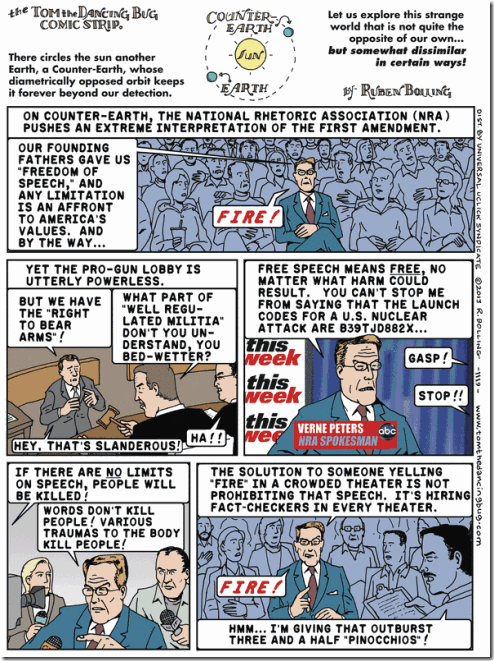
I’ve quoted extensively, but please go read the rest—it’s a great, thoughtful essay that offered me, the non-gun guy,  a valuable perspective on some of what gun guys are thinking.  I already know what Tom the Dancing Bug is thinking…

td130104

(Thanks, TtheDB and GoComics.com)

and what the gun control people are thinking:

So let’s state the plain facts one more time, so that they can’t be mistaken: Gun massacres have happened many times in many countries, and in every other country, gun laws have been tightened to reflect the tragedy and the tragic knowledge of its citizens afterward. In every other country, gun massacres have subsequently become rare. In America alone, gun massacres, most often of children, happen with hideous regularity, and they happen with hideous regularity because guns are hideously and regularly available.

The people who fight and lobby and legislate to make guns regularly available are complicit in the murder of those children. They have made a clear moral choice: that the comfort and emotional reassurance they take from the possession of guns, placed in the balance even against the routine murder of innocent children, is of supreme value. Whatever satisfaction gun owners take from their guns—we know for certain that there is no prudential value in them—is more important than children’s lives. Give them credit: life is making moral choices, and that’s a moral choice, clearly made.

First things first–let’s start with the facts

It is said that there are two things you do not want to see being made: sausage, and legislation.  I’m of the opinion that a third thing on that list should be the news—you don’t want to see how a news story comes into being.  But Tom Goldstein, the publisher of SCOTUSblog.com, wants you to see what happened behind the scenes last month in the national reporting of the Supreme Court’s decision on the Affordable Care Act.  In his in-depth post-mortem Goldstein (who has a dog in this fight, to be sure) and his staff pieced together what happened at CNN, Fox News Channel, the White House, and SCOTUSblog.com in the nine minutes between when the court’s decision was handed down and when the error-filled reporting of the decision ended, including how

  • hackers tried to bring down SCOTUSblog
  • the court’s own website failed due to the heavy traffic, so no one outside the court building could access the decision
  • a lack of thoroughness led CNN and Fox to run with incorrect interpretations of the opinion, and
  • people who’d seen those incorrect TV reports refused to believe they were incorrect when confronted with the truth

CNN and Fox News have come in for a lot of deserved criticism for initially reporting the story incorrectly.  Yes, I know they were trying to get it first but so was everyone else, and they waited long enough to understand what the court had ruled before reporting it.  In fact, Bloomberg was first—less than one minute after the chief justice began announcing the decision from the bench—and they got it right!

From what I learned in this piece, I find it disturbing just how much brain power was brought to bear by these two networks that day and still they got it wrong.  Disturbing, but not surprising.  Yes, people make mistakes; but people who care more for flash than for accuracy—for generating heat rather than light—are more likely to make careless mistakes.  Avoiding careless mistakes is—or should be—of paramount importance in this business.

But both CNN and Fox exposed themselves to potential failure by

(a) treating the decision as a breathless “breaking news” event, despite the fact that everyone knew when the opinion was going to be released (and the mandate won’t take effect until 2014), while at the same time

(b) not putting sufficiently sound procedures in place to deal with the potential complications, and

(c) not placing more faith in the consensus view of the wire reports.

To put it another way: read the damn opinion before presuming to tell me what it says.  That shouldn’t be too much to ask, whether reporting a Supreme Court decision or a school board meeting or a fender bender.  Bill Kovach and Tom Rosenstiel suggest that in order “to provide people with the information they need to be free and self-governing,” which is the purpose of journalism, the journalist’s first obligation is to the truth.  Sometimes that can take more than just a few minutes to learn, but we don’t mind waiting.

Other opinions–

This one guy says the evil super PACs are SAVING democracy, others are less charitable

I’m not sure if he’s right or not, but he makes an interesting argument.  Dave Weigel is an excellent political reporter who’s spent a lot of time chronicling the conservative movement.  Today at Slate he makes the provocative argument—it was to me, anyway—that the political action committees fostered by the U. S. Supreme Court’s Citizens United decisionare a good thing, that they have been a force to strengthen democracy and have made this year’s Republican presidential contest fairer.

Huh?  No, no, no, wait a minute: Citizens United is an evil thing, a twisted interpretation of dictionary English by the conservative members of the court so that now the godless, faceless corporations are considered “persons” for the purposes of political participation, and they can secretly donate as much of their giant piles of money as they like to PACs and buy elections and marginalize the little guy like me (I was going to say you and me, but I really shouldn’t presume to speak for you, should I?)…it’s already happened starting in Iowa this year, right?  I mean, that’s what we’ve all been told, right?

But Weigel argues that the super PACs have had a leveling effect: the big money from super PACs is all that’s kept Mitt Romney from outspending his opponents into submission, and essentially buying the GOP nomination.  And despite the concerns about the secretive nature of the super PACs, he notes that we seem to know more about the biggest of the big donors to super PACs than we do about the people making direct donations to the individual candidates’ campaigns. He writes, “The big fear about campaign money is that it corrupts the candidates who have to beg for it.”

But that worry applies better to the shadowy bundler than it does to the megabucks super PAC donor. Corruption can’t grow in the sunlight. The people giving big to super PACs are famous. I didn’t fully understand how famous until I tagged along with [Newt] Gingrich at a speech to Aloma Baptist Church in Florida, when a parishioner asked him to explain why he was taking dirty money from the gambling industry. Gingrich explained that he and [Sheldon] Adelson had a simpatico, guns-a-blazin’ view on Israel. Is it corruption if the candidate tells you what he’ll do for the donor?

(snip)

We know more about those guys than we know about the bundlers, who’ve been passing money under the table for years. So which of those systems is worse for our democracy?

I know what’s good for our democracy: satire and ridicule, and in the case of Citizens United it’s been coming most effectively from Stephen Colbert.  The Comedy Central comedian started his own super PAC and has been using it to expose the ridiculous reality resulting from the court’s ruling.

The line between entertainment and the court blurred even further late last month when Colbert had former Justice John Paul Stevens on his show to discuss his dissent in Citizens United. When a 91-year-old former justice is patiently explaining to a comedian that corporations are not people, it’s clear that everything about the majority opinion has been reduced to a punch line.

The court fights aren’t over, and perhaps the coolest one is in Montana where the state supreme court has told the one in Washington to pound sand.  The court voted 5-2 to uphold the constitutionality of Montana’s ban on corporate campaign contributions, finding justification for the ban that Citizens United does not consider.  Beyond that, Justice James Nelson unloaded: “Corporations are not persons.  Human beings are persons, and it is an affront to the inviolable dignity of our species that courts have created a legal fiction which forces people—human beings—to share fundamental, natural rights with soulless creatures of government.”   And that from one of the two dissenters in the ruling!

More fundamentally, the majority and one dissenter seem to understand perfectly how much the American people resent being lied to about the burning need for courts to step in to protect the oppressed voices of powerless corporate interests. As Judge Nelson wrote in dissent, “the notion that corporations are disadvantaged in the political realm is unbelievable. Indeed, it has astounded most Americans. The truth is that corporations wield enormous power in Congress and in state legislatures. It is hard to tell where government ends and corporate America begins: the transition is seamless and overlapping.”

Grand Old Party, or Grumpy Old Protesters

President Obama hosts another Big Budget Meeting tomorrow at the White House with a deadline looming for raising the nation’s debt ceiling to keep the country from defaulting on its loan payments, and both political parties are acting as if they’re serious now.  (Now?  Yeah, now…finally, now.)  Republicans, who’ve been spurred in part if not entirely by tea party pressure, have been very tough in the negotiations, demanding that Democrats agree to trillions of dollars in spending cuts and no tax increases in return for the votes to increase the debt ceiling.  Sounds like the Republicans have won this round, doesn’t it?

Columnist David Brooks makes a very good case that the GOP has wrought amazing concessions from Democrats on the economy, spending cuts and debt reduction, and that if it takes what’s been offered it will be good for the country, set a new starting point for future negotiations on more cuts, and be a significant political victory for Republicans to campaign on in 2012.  But he also warns that if they don’t agree soon, people will have good reason to wonder if the GOP has ceased to be a political party capable of governing and turned finally into a mere protest movement that has a “no tax hike” fetish—even when the effective tax rate in this country is now the lowest it’s been since 1950!  The long-time conservative idea man is worried that no-tax-hike-ers threaten the future of his party:

The members of this movement do not accept the logic of compromise, no matter how sweet the terms…The members of this movement do not accept the legitimacy of scholars and intellectual authorities…The members of this movement have no sense of moral decency…The members of this movement have no economic theory worthy of the name.

(snip)

If the debt ceiling talks fail, independents voters will see that Democrats were willing to compromise but Republicans were not. If responsible Republicans don’t take control, independents will conclude that Republican fanaticism caused this default. They will conclude that Republicans are not fit to govern.

And they will be right.

That makes sense to me, and I hope it makes sense to everyone, even the very fanatics that Brooks warns about.  The New Republic’s Jonathan Chait praises Brooks’ column for its emperor-has-no-clothes statement about GOP radicalism, and assigning all of the blame to “Republicans” who would stand in the way of shrinking government, who would cripple the economy and emasculate the recovery, just to make a point.  Something for all of us to keep in mind, as the clock tick-tick-ticks down to possible, and completely avoidable, national default.