There are good reasons not to run around shouting “Islamic terrorist”

The whining is so tiresome, and the motivation so transparent, that I usually shake my head and ignore it each time the usual suspects launch a new “Dontcha Just Hate Obama” offensive.   Last week when the president talked about efforts to fight back against recruitment efforts by terrorist groups, we all got to see the righteous indignation of true Americans who were appalled, appalled I say, by the president’s refusal to refer to the terrorists as “Islamic” terrorists or extremists or zealots or whatever.

I gotta wonder, what effing difference does it make if the terrorists are Muslim?  Really.  If they’re terrorists, if they’re waging war on America and Americans, we have the right and the responsibility to fight back.  It doesn’t matter why they’re doing it unless we can use that to persuade them to stop.  (I have a similar feeling about “hate crimes:” murder or assault or whatever the crime is, it’s a crime because it’s against the law, not because of why they did it.)

But, haters gonna hate.  And even though I believe that words can work wonders, I’ve long since given up on the idea that valid, cogent argument grounded in demonstrable fact may ever again be persuasive once one has chugged the Kool-Aid of the radical right.  However, when I came across this terrific unpacking of reasons why it makes absolute sense in a reasonable world for the President of the United States to choose his or her words carefully, I wanted to share.

While [Barack] Obama has not used those words, he has acknowledged Islam plays a role in the Islamic State’s strategy. Obama has said that even though the Islamic State uses religion to justify its extremism, its ideology does not mesh with mainstream, modern Islamic thought.

“They try to portray themselves as religious leaders — holy warriors in defense of Islam.  That’s why ISIL presumes to declare itself the ‘Islamic State.’ And they propagate the notion that America — and the West, generally — is at war with Islam,” Obama said at the White House Summit on Countering Violent Extremism last week. “We are not at war with Islam. We are at war with people who have perverted Islam.”

(snip)

Why such a careful choice of words? Experts we contacted offered a few theories.

For one, the Islamic State is just one of numerous jihadist groups that the United States is fighting in the Middle East and North Africa, including al-Qaida and its affiliates. And the Islamic State has several qualities that set it apart from other jihadi groups, such as their desire to immediately create a caliphate. In that sense, it would be misleading to lump these groups into one singular enemy code-worded Islamic extremism, said James Gelvin, a history professor at the University of California Los Angeles.

Additionally, several countries helping the United States fight the Islamic State and other terrorist groups are Muslim nations, including Jordan and Saudi Arabia. In those cases, it is in the United States’ interest not to be at war with a religion.

(snip)

The Islamic State adheres to strict, literal interpretations of the Koran and Islamic teachings rooted in 18th-century religious philosophy called Wahhabism. This ideology, the dominant faith in Saudi Arabia, is focused on a return to the “truth faith” of the first caliphate established after the death of Mohammed, a time when Islam was not “polluted” by Christianity, paganism or governmental interference, said Richard Brennan, a Middle East expert at the nonpartisan think tank RAND Corporation.

The result is a puritanical practice of Islam that views government as a problem within society, as a man’s allegiance should only be to allah. For some recruits, the Islamic State represents a “fight against the normative world order” of Shia rule, Sunni suppression, and Western colonization and invasion, Mohammed said. “The idea is that after centuries of weakness, some Muslims are fighting back.”

The Islamic State goes even further than traditional Wahhabism by adhering to takfir — which is the belief that some people who say they are Muslim are not truly Muslim, and therefore there is reason to kill them, Gelvin said. The vast majority of the Islamic world tends to believe that if someone professes they are Muslim, then they are, no matter how they specifically practice their faith.

Even al-Qaida and other Islamic extremist groups don’t accept takfir, Gelvin said.

(snip)

Just as Muslims worldwide refused to take up [Osama] bin Laden’s brutal brand of Islam, the vast majority of Muslims are also not heeding the call of the self-proclaimed caliph of the Islamic State, Abu Bakr al-Baghdadi. Tufts University religion professor Kenneth Garden said accepting the terror group’s self-description would amount to “an own-goal” by the United States.

“I am confident that eventually the butchers of ISIS and their like will be roundly rejected and fade away,” Garden said. “But I am afraid this is the work of a generation. There is no quick fix for this, and little role for non-Muslim voices.”

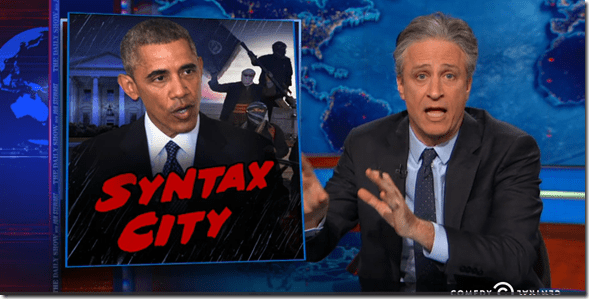
And then, there was Jon Stewart on The Daily Show noticing with exasperation that Obama apparently “still thinks he can persuade us through reasoned argument.”  See for yourself (click the pic):

image

It’s a good news/bad news Friday

The good news comes from the Supreme Court of the United States, which has decided that it will hear arguments on whether or not same-sex couples have a right to marry. This New York Times story summarizes the cases from Ohio, Tennessee, Michigan and Kentucky that are at the heart of an appeal of a decision from the United States Court of Appeals for the Sixth Circuit which the High Nine have now agreed to consider.

The court said it will hear two and a half hours of argument, probably in the last week of April. The first 90 minutes will be devoted to the question of whether the Constitution requires states “to license a marriage between two people of the same sex.”

The last hour will concern a question that will be moot if the answer to the The first one is yes: whether states must “recognize a marriage between two people of the same sex when their marriage was lawfully licensed and performed out of state.”

This is very exciting: within just a few months we’ll have a ruling from the country’s highest court on whether same-sex marriage is to be permitted in all 50 states, not just the 36 states and the District of Columbia where it is legal now.

Now, the bad news: the Southern Education Foundation believes that “For the first time in at least 50 years, a majority of U.S. public school students come from low-income families.”  The Washington Post has a good summary of the report.

Half of all public school students in America are poor?  Half?!  (More than half in 21 states; Mississippi at 71% has the highest percentage.)  I find myself surprised by this confirmation of how far the abandonment of our public schools has gone by those who can afford other options.  (Full disclosure: although most of my education was in public schools, I attended and graduated from a private high school.)  A free public education for all was a great example of America’s commitment to a society where everyone has an opportunity to succeed.  We all paid our share for public schools, even those who sent their kids to private school or whose kids had finished school or who never had any kids at all, because it meant a better-educated society and that was a benefit for all of us.

But more and more, people became unhappy with their public school systems.  When the quality of the education declined people got upset that their kids were being cheated out of their futures; in some cases it was court-ordered desegregation that made people unhappy with their public schools.  Many of those who could afford to moved to suburban school districts and took their tax money with them, leaving the city schools with less and less money to spend on teachers and books and buildings.  Which meant even poorer quality education, which prompted more parents to flee, and the cycle continued.

Today people are trying to get voucher laws passed that will in effect allow their school tax money to pay for their kid’s education in private schools, taking even more money out of the system that is the only resort for the poor, the students whose families can’t afford private schools or charter schools or anything other than the old school down the street.

I understand that parents want the best for their children; I get it that despite recent improvements our economy isn’t as strong as it once was and a lot of people don’t have the jobs and income they want and deserve.  Still, I’m saddened at how many people seem to feel that abandoning the greater good for American society—the education of everyone else’s children—is the best way for them to take care of their own.

The inexorable march of justice

Another one bites the dust…

Another one bites the dust…

A federal judge struck down Pennsylvania’s ban on same-sex marriage Tuesday, handing gay rights advocates their second legal victory in as many days and striking the last remaining ban in the Northeast.

The state’s laws, which ban same-sex marriages, were struck down as unconstitutional by U.S. District Court Judge John Jones III, who ruled in favor of the 23 plaintiffs whose lawsuit was filed by the American Civil Liberties Union and others.

“We are a better people than what these laws represent,” Jones wrote of same-sex marriage bans in his ruling, drawing comparisons between the civil rights movement and the modern gay marriage movement. ”It is time to discard them into the ash heap of history.”

(snip)

The ruling, from US District Judge John Jones, makes Pennsylvania the second state this week and 11th state since the Supreme Court’s 2013 ruling on same-sex marriage to have its ban overturned in court.  But it’s possible the ruling will eventually be put on hold as it works through the appeals process, which would prevent future same-sex couples from marrying. (The American Civil Liberties Union of Pennsylvania is urging Gov. Tom Corbett, a Republican, to not appeal the ruling.)

Jones, like judges in previous same-sex marriage cases, cited the Equal Protection Clause of the US Constitution and deemed Pennsylvania’s statutory ban on same-sex marriages unconstitutional. Unlike many other states, the state constitution in Pennsylvania doesn’t have a provision barring same-sex marriages.

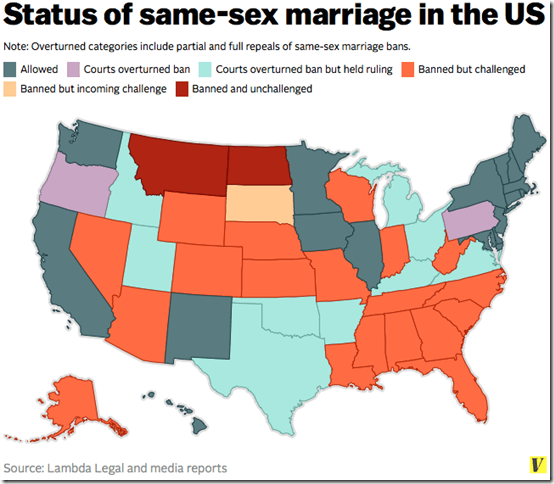
So, where do we stand?

same-sex_marriage_us_map

What’s with Montana and North Dakota?

This just in: Arizona governor vetoes “religious freedom” bill

Good for Gov. Jan Brewer, for taking a stand against hate and discrimination.  Nobody over the age of reason is falling for this “religious freedom” argument.  It’s a sign—a good sign—that the extremists see the writing on the wall, and are getting more desperate.

Hell, even a judge in Texas has struck down the state’s ban on gay marriage!  What more evidence do you need that things really are changing…

Just a little something something from me to you for the holiday

Two little somethings, in fact, which I hope you will find useful and entertaining.

First off, in regard to Pilgrim Fun Facts: what would you say if I told you that some of the core plot points we were taught back in elementary school about the religious freedom-seekers in the big-buckle hats were wrong?  Well, what would you say if the chairman of the history department at Wheaton College told you?  Starting with, the Pilgrims probably didn’t land at Plymouth Rock:

We “know” the location of the Pilgrims’ landing because in 1741 —121 years after they arrived — a young boy overheard 95-year-old Thomas Faunce relate that his father, who came to Plymouth three years after the Mayflower, told him he’d heard from unnamed persons that the landing occurred there.

(snip)

If a longing for religious freedom had compelled them, they probably never would have left. But while they cherished the freedom of conscience they enjoyed in Leiden, the Pilgrims had two major complaints: They found it a hard place to maintain their English identity and an even harder place to make a living. In America, they hoped to live by themselves, enjoy the same degree of religious liberty and earn a “better and easier” living.

Now, to add to your holiday joy, some important tips to guide your behavior at the big feast…John Cook’s suggestions for the right way to start the family fight!

1) Select Your Target. Obviously, you need to find someone who disagrees with you politically. But not just anyone: Close relatives present perilous risks. Your parents or siblings can drag all sorts of emotional baggage into the fight, muddying the waters and making it more about how your veganism ruined that family vacation to Yellowstone in 1999 than whether “job-killer” is a racist code word.

(snip)

2) Getting Started. First off, you should wait until everyone’s seated at the table before you try to get things started. That way you have a captive audience that has to watch the fireworks, and everyone is settled in for a nice long time. Getting the topic of conversation to politics shouldn’t be too hard. Stick to short, sarcastic, tendentious remarks to get things going. “I’m thankful for all that free stuff Obama gave me.”

Read them all and commit them to memory for a truly if you want to provide your loved ones with a truly inspired Thanksgiving blowout they’ll talk about for years.

You’re welcome.