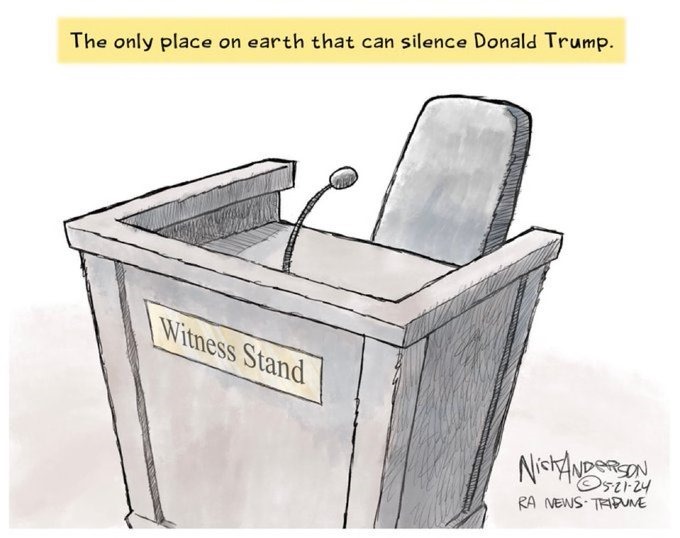
Fingers crossed, hoping for the best

A few thoughts while waiting for the New York jury to return a verdict in the business fraud/election interference trial of you know who:

I hate it every time a news report refers to Donald Trump’s “Hush Money Trial.”  Not only is it inaccurate and lazy, but it plays into his overheated claim that he’s being persecuted, that there was no crime committed.

  • It is NOT against the law to have sex with a porn actor.  Of the many things it may be (and you have your own list of the things that it is), “against the law” is not one of them.  I pray we don’t return to an age in this country where it is against the law for consenting adults to engage in some non-hurtful behaviors.
  • It is NOT against the law to pay hush money.  Blackmail is a crime, for the person committing it; it’s not illegal for you to pay money to keep someone from telling a secret about you.
  • It is NOT even a crime to use your private company’s funds to pay that hush money, provided your paper trail does not lie about the use of the money.  Your investors or directors probably won’t like it much and may take action against you, but it’s not business fraud.  (And if Trump is SOOO rich, as he claims, why didn’t he just write a check himself and not get the company money involved?  I know, hindsight is 20/20.)

BUT, if you doctor your company’s books to falsify the record about why the money was spent – like, saying it was “legal fees” when it was really reimbursing an employee for fronting you the hush money to conceal a private matter – that IS a crime.  It is business fraud in New York, and that is the crime the Manhattan district attorney is prosecuting.  It became a major felony when, in this case, the fraud was committed to advance another crime: improperly interfering with the 2016 presidential election by covering up information that could harm Trump’s chances.  (Man, isn’t it hard to get your head around the idea that it was Trump and Republicans who actually were committing the election fraud, not the liberals and the illegals?)

Lately I’ve been running across many clever, funny, and to-the-point posts that take the varnish off of efforts to obscure what Trump has done, and what he promises to do if elected.  On ABC’s This Week George Stephanopoulos had a terrific summary as the current trial began.

GOnN-WNXcAAD5my

Last week Jennifer Rubin had a good roundup of Trump’s pratfall-filled week leading up to the trial’s closing arguments, including his not-unexpected cop-out when it came to fulfilling his repeated promise to testify in his own defense (something that I know no defense lawyer wants a client with a total lack of self-control and a well-documented history of serial lying to do).

Finally, Trump predictably chickened out of testifying. He repeatedly boasted he would testify, but like so many other attempts to look tough, this one fizzled into the ether. The episode underscored his cowardice and fragility. At some level, he likely knew that if he had taken the stand, he would have wound up either perjuring himself, digging his own legal grave or both.

What explains these serial debacles? This is who Trump is. He cozies up to neo-Nazis and white nationalists, so naturally he attracts aides with the mind-set to borrow material from fascists. He has contempt for women and tries to please his white Christian nationalist base at every turn; unsurprisingly, he has no idea where to stop and how far is too far. And he bullies his lawyers, insisting on making dumb arguments and calling witnesses he thinks are swell but who implode under examination. (And because he surrounds himself with disreputable charlatans and yes-men, one can hardly be surprised when they reveal their true character.)

For all Trump’s braggadocio, it may be that he just isn’t all that bright, cannot think strategically beyond the moment and lacks any common sense. Without aides or family members empowered to stop him from colossal missteps, he racks up the blunders. And perhaps like a good many bullies, he really does fear taking a punch.

GONmYbbWgAAAmpP

GOR52y_X0AA1_J_

Trump’s family, which finally began to trickle in to the courthouse to act like they support him, joined in the family business – lying to our faces – when Eric Trump clearly and cleanly misstated the facts:

And beyond the current trial, the situation has become severe enough to get the historian and documentarian Ken Burns off the political sideline; he had this warning to America during a commencement speech at Brandeis University.

Just a couple more..I can’t resist:

The real majority rules

It only lasted a moment.  An instant, perhaps.  But the spark grew into a happy realization: the U.S. House of Representatives can do something constructive after all, despite the mountain of evidence to the contrary it has piled up since January 2023.  The headline on the email that popped in yesterday afternoon was “House approves $95 billion foreign aid bill” and it turns out that the speaker of the Republican-majority House accomplished it by working with Democrats to outvote the extreme MAGA wing of his own party.

It’s the sort of thing that almost never happens anymore.  Dating back to the mid-1990s, Republican speakers have rarely allowed full floor votes on bills that weren’t already supported by a majority of their own party.  Even in cases where a majority of the full House – Republicans and Democrats and independents – supports a proposal, no final vote is permitted; that keeps the opposition party from looking good by passing legislation with the help of a few renegades from the majority party.  In recent years it has also allowed smaller groups of GOP members with extreme views to prevent more moderate members – in concert with the hated Democrats – from passing legislation that the extremists oppose.  That has prevented a full House vote on, among many other things lately, a bill to send more American military assistance to Ukraine to support its war with Russia.

Part of the story here is what happened to change Speaker Mike Johnson’s mind on helping Ukraine.

When the House passed a $40 billion emergency funding bill for Ukraine in May 2022, support for Ukraine was largely still a bipartisan issue. But a little-known conservative congressman from Louisiana was one of the 57 Republicans to oppose it.

Now, just six months after his unlikely elevation to speaker of the House, Mike Johnson (R-La.) has pushed through a $60 billion effort to bolster’s Ukraine arsenal, along with funding for Israel and the Indo-Pacific.

The move marks a major victory and dramatic turnabout for the speaker who is trying to gain control of a bitterly divided Republican conference. The far right is fiercely against Ukraine aid — 112 Republicans, just over half of the conference, opposed it on the House floor Saturday and he had to rely on unanimous Democratic backing — and Johnson’s decision to greenlight a floor vote could come at great political cost. He could very well lose his job as speaker over it.

(snip)

“Look, history judges us for what we do,” said an emotional Johnson, holding back tears and with a quivering lip at a news conference last week in response to a question from The Washington Post. “This is a critical time right now, critical time on the world stage. I could make a selfish decision and do something that’s different, but I’m doing here what I believe to be the right thing.”

The Washington Post story goes on to explain Johnson’s evolution, which seems to boil down to the fact that he learned more about the situation and the stakes.  Good on him, an extreme conservative and evangelical, for not turning Speaker Johnson (1)his back on real-world, secular evidence that he might have been wrong in May 2022; maybe there’s a bit of accepting the responsibility of being a leader at work here, too.  “One Republican House member recalls: “I’ll never forget Johnson one time said, ‘I’ve gone from representing my district only to representing the entire [House] and the country.’ For someone to go from where he was to where he is now as quickly as he did … is remarkable.”

The other part of the story is the happy realization that brightened my afternoon: the evidence that the MAGA wing can be defeated, that the ignorant and selfish isolationists will not win if the rest of us stand up to them.  When we have leaders who put the best interests of the whole country first, who are serious about supporting America’s role as a leader of the whole world, a rump faction cannot take control.  And I do mean “rump.”

I also take this as an example of what the founders of Axios wrote about recently, the idea that American society and politics are not as irretrievably broken as it seems.

Here’s a wild thought experiment: What if we’ve been deceived into thinking we’re more divided, more dysfunctional and more defeated than we actually are?

Why it matters: Well, there’s compelling evidence we’ve been trapped in a reality distortion bubble — social media, cable TV and tribal political wars — long enough to warp our view of the reality around us.

The big picture: Yes, deep divisions exist on some topics. But on almost every topic of monthly outrage, it’s a fringe view — or example — amplified by the loudest voices on social media and politicians driving it.

  • No, most Christians aren’t white Christian nationalists who see Donald Trump as a God-like figure. Most are ignoring politics and wrestling with their faith.
  • No, most college professors aren’t trying to silence conservatives or turn kids into liberal activists. Most are teaching math, or physics, or biology.
  • No, most kids don’t hate Israel and run around chanting, “From the river to the sea.” On most campuses, most of the time, students are doing what students have always done.
  • No, most Republicans don’t want to ban all abortions starting at conception. No, most Democrats don’t want to allow them until birth.
  • No, immigrants who are here illegally aren’t rushing to vote and commit crimes. Actual data show both rarely happen — even amid a genuine crisis at the border.
  • No, most people aren’t fighting on X. Turns out, the vast majority of Americans never tweet at all.
  • No, most people aren’t cheering insults on Fox News and MSNBC in the evening. Turns out, less than 2 percent of Americans are even watching.

Reality check: But our politics are hopelessly divided, Jim and Mike! You’re naive!

  • Yes, current politics, and particularly the House, seem hopelessly dysfunctional. But this flows in part from majorities so narrow that fringe figures can hijack institutions, again particularly the House, and render them dysfunctional.
  • The actual dysfunction runs much deeper for structural reasons, such as redistricting, low voter turnout in off-year elections and geographic sorting (Democrats in cities, Republicans in rural areas).

(snip)

This new poll by the AP and the NORC Center for Public Affairs Research shows a striking amount of agreement on some very big topics. Roughly 90% or more of Americans — Republicans and Democrats — agree the following rights and freedoms are extremely or very important to a functioning America:

  • Right to vote.
  • Right to equal protection under the law.
  • Right to freedom of religion.
  • Right to freedom of speech.
  • Right to privacy.

Hell, almost 80% think the right to own a gun is important to protect.

The last Republican candidate for president to win a majority of the popular vote was George W. Bush in 2004…barely, at 50.7%.  The last before that was the first George Bush, with more than 53% when he beat Michael Dukakis in 1988.  The guy at the top of the GOP ticket in the last two elections won less than 47% of the popular vote each time; in 2020 one-third of the voting age population didn’t vote at all, and almost 40% blew off the election of 2016.  Which means he was actually voted for by roughly 30% of Americans, at best: less than half of a bit more than half of the country.  Thirty percent is not close to a majority.  The MAGAs are loud and obnoxious, but they are not the voice of America.  It’s time we remember that, and promise to do the thing that they fear the most: vote them out!

No reservations on the crazy train

In the Unofficial Pat Ryan Register of All Things Known and Unknown, there is recent high concern that Donald Trump has dementia.  Or is just batshit crazy.  One or the other is used to explain some of demented and/or hallucinatory things he says at his rallies.  But such concerns aren’t new: in the 2016 campaign it even led to the development of an explanation of a candidate’s speech that you’d never expect to be considered positive: that one should take him seriously but not literally.

At a rally in Ohio earlierGJcwK0kaMAEBJeW this month, in a speech in which he referred to China and automaking, Trump said (amid a typical word salad) there would be a “bloodbath” if he doesn’t win this November; sounds pretty ominous, and the Biden campaign claimed he was threatening actual violence.  But maybe he meant to convey that one result of him losing would be the continuation of Biden policies that would be devastating for the American auto industry.  In February, he told the Black Conservative Federation Gala that Black Americans like him better lately due to the many criminal and civil court cases against him: “I think that’s why the Black people are so much on my side now because they see what’s happening to me happens to them. Does that make sense?”  (No, not really)

One way or another, the listener has to do a lot of work to try to figure out what the speaker really means.  It’s the speaker’s fault if he doesn’t make his message clear enough for the audience to understand it.  (I mean the audience of the general population; his MAGA followers seem to process the dog whistle messages just fine.)

Susan Glasser in The New Yorker: I Listened to Trump’s Rambling, Unhinged, Vituperative Georgia Rally—and So Should You

But there is at least one constant message in Trump speeches lately that doesn’t need much interpretation: his promise to free those convicted of crimes in the January 6 attack on the U.S. Capitol.  Jonathan Chait sets the eerie scene in a great piece in New York Magazine:

At a recent rally in Ohio, Donald Trump stood at formal attention while an announcer instructed the crowd, “Ladies and gentlemen, please rise for the horribly and unfairly treated January 6 hostages.” As Trump saluted, the speakers played a version of the national anthem sung by imprisoned insurrectionists. “They’ve been treated terribly and very unfairly, and you know that, and everybody knows that,” Trump said at the outset of his speech. “And we’re going to be working on that as soon as the first day we get into office. We’re going to save our country, and we’re going to work with the people to treat those unbelievable patriots.”

Over the last year, the insurrection has gradually assumed a more central place in Trump’s campaign. The J6 version of the national anthem has been playing at rallies since March 2023, and Trump has been referring to jailed insurrectionists as “hostages” since November. But the prospect of pardoning them, which he has floated for two years, has in recent days been made his highest priority. Trump’s promise to “save the country,” which before encompassed his array of domestic and international policies, now refers principally to vindicating the militia that tried to illegally install him in power and that more and more has come to resemble a classic paramilitary group in the Trump imaginarium, licensed to carry out extrajudicial violence on his authority alone.

Bad enough that Trump is promising he will ignore/overturn court cases that sent hundreds of domestic terrorists to jail; Chait finds a scarier reason for Trump’s using this new message, one that potentially drives away independents who might vote for him: his desire for a second term in the White House that is unrestrained by conventional politics or judgement.

But there is a perfectly cogent reason why Trump continues to press his most extreme demands, even at the cost of repulsing potential voters. He is no longer willing to accept the alliance of convenience with reluctant partners that held traditional Republicans like Mitch McConnell, Paul Ryan, and Reince Priebus by his side during his first term. Trump has long demanded fealty from his party, which has made it harder to discern the acceleration and intensification of his work in the days since he effectively clinched the Republican nomination on Super Tuesday. Trump’s primary focus is not outward but inward, tightening his control over the GOP to almost unimaginable levels of personal loyalty.

Trump’s elevation of the insurrection to a matter of holy writ within the party is a matter of both conviction and strategy, consistent with his intention to stifle even the quietest forms of dissent. This is why Trump deposed Ronna McDaniel as head of the Republican National Committee in favor of election deniers Michael Whatley and Lara Trump. McDaniel had dutifully jettisoned her maiden name (Romney). She had strongly suggested the 2020 election was stolen, saying the vote tabulations had “problems” that were “concerning” and not “fair,” without quite stating as fact that Trump absolutely won. All her genuflections were not enough.

This is also why Trump is reportedly bringing back Paul Manafort, who served a prison sentence for bank and tax fraud, and witness tampering and obstruction of justice, and whose business partner, Konstantin Kilimnik, was assessed by the FBI to have ties to Russian intelligence. Manafort’s skills are hardly irreplaceable. The point of bringing him back, other than the familiar mob logic of rewarding an underling who took his pinch like a man and refused to rat out the boss, is to signal that loyalty to Trump matters more than any other possible consideration. Normal politicians would distance themselves from staffers who committed crimes, especially crimes on their behalf. Trump regards this as the highest qualification.

(snip)

While Trump touts his first term as a historic success, he and his closest allies view it as largely a failure. Trump, in this view, was manipulated by staffers loyal to the traditional party into letting figures like Robert Mueller and Anthony Fauci undermine him. Mike Pence’s refusal to cooperate in Trump’s plot to steal the election was the ultimate betrayal. Trump’s project is to ensure that a second term faces no sabotage.

An effective Trumpist government has difficulty functioning under the rule of law. If Trump’s staffers and allies believe that carrying out his orders, some of them plainly illegal, will lead to prison or other punishment, they will again hesitate to follow them. That belief is one he has to stamp out, especially as he faces multiple criminal charges for his attempts to steal the election in 2020.

Chait’s conclusion is that Trump’s new focus is meant to shed his movement of all but the true believers; he doesn’t want to build a coalition of various interests and beliefs, he wants only those loyal to the boss, who will support and assist any grift the boss wants.

Among the true-believing Trumpists, there’s no confusion about what Trump’s relentless demands of cultlike submission are trying to accomplish. “The Judas Iscariots of the American Right need to understand that their betrayal comes at a cost,” rails a recent column in American Greatness, one of the new pseudointellectual organs that have sprung up in the Trump era to meet conservative audience demand for sycophantic content. “Excommunication is not enough. Their treachery deserves relentless psychic pain.” It adds that Mike Pence, the New York Times columnist David French, and others “should never be allowed back into respectable conservative company under any circumstances.”

Measured in traditional political terms, January 6 martyrdom may be a disadvantageous message for Trump. The stolen-election lie polls terribly with persuadable voters, and his fixation with it is one reason why Biden’s catastrophic approval ratings have resulted in only a small Trump lead. But by Trumpian logic, it is the perfect campaign theme. It forces his internal critics to swallow their last objection against him. It sends a message to his allies that they can act with impunity. By November, the J6 national anthem will be burned into our brains as deeply as any campaign jingle.

It doesn’t require high-levelGJiBgcnXcAAa-K4 interpretive skills to see the threat posed by a future President Trump in an administration without the likes of John Kelly or Mark Esper around.  They are among 40 of Trump’s 44 one-time Cabinet members who do not support him.  Think about that: of all the people Trump put in positions to lead the government – “the best people” – 10 out of every 11 of them now say no way do they want him in power again.  They haven’t all told us exactly what they saw on the inside of the Trump White House, but it’s enough for them to warn us not to repeat the mistake that was made in 2016.

GIZl3NnXYAAPZwv

Courting trouble for the former guy

Former President I Will Not Be Ignored got a little more of what he’s been begging for yesterday: attention from our nation’s judicial system.  In response to his ridiculous-on-its-face insistence that former presidents enjoy lifelong complete criminal immunity from prosecution for actions taken while in office, lest they be indicted by forces of the opposing party the instant they leave office, a federal appeals court panel ruled – unanimously – that he is off his rocker.  Essentially.  In a legal sense.

At public arguments in January, the three judges expressed concern over the most extreme implications of Trump’s view, with one suggesting it would allow a future president to order the assassination of a political rival. But in their opinion Tuesday, they said it is Trump’s own alleged crimes — “an unprecedented assault on the structure of our government” — that threaten democracy if left beyond the reach of criminal prosecution.

“We cannot accept former President Trump’s claim that a President has unbounded authority to commit crimes that would neutralize the most fundamental check on executive power — the recognition and implementation of election results,” the judges wrote. “Nor can we sanction his apparent contention that the Executive has carte blanche to violate the rights of individual citizens to vote and to have their votes count.”

When he “warns” that all political parties would legally attack former leaders from other parties if those leaders did not enjoy legal protection, it’s a textbook example of the projection associated with his narcissism: in fact, such a thing has never happened in the past, but it is something that he himself has already promised he will do if he becomes president again next year.  This case could still go to the Supreme Court; we will know within weeks.  But we do know that the Supremes will be hearing a Trump case tomorrow, a case over his Constitutional eligibility to ever become president again.

The Supreme Court will hear oral arguments on Thursday in what is shaping up to be the biggest election case since its ruling nearly 25 years ago in Bush v. Gore. At issue is whether former President Donald Trump, who is once again the front runner for the Republican nomination for president, can be excluded from the ballot because of his role in the Jan. 6, 2021, attacks on the U.S. Capitol. 

Although the question comes to the court in a case from Colorado, the impact of the court’s ruling could be much more far-reaching. Maine’s secretary of state ruled in December that Trump should be taken off the primary ballot there, and challenges to Trump’s eligibility are currently pending in 11 other states. Trump warns that the efforts to keep him off the ballot “threaten to disenfranchise tens of millions of Americans” and “promise to unleash chaos and bedlam if other state courts and state officials follow Colorado’s lead.” But the voters challenging Trump’s eligibility counter that “we already saw the ‘bedlam’ Trump unleashed when he was on the ballot and lost.”

At issue is a section of the 14th Amendment to the Constitution, approved in the years following the Civil War to prevent former rebels from entering government and continuing their rebellion.  Paraphrasing here, it prohibits anyone who’d previously been a U.S. government official, and then later “engaged in insurrection or rebellion” against the Constitution, from later serving in government again.  Pretty sensible, right?  In other words, among the requirements to be president, one must be at least 35 years old and not have previously been a traitor.

Trump’s arguments that the 14th Amendment doesn’t apply to him are from the same book as his “presidents need to be able to commit crimes with impunity” arguments in the immunity case he’s currently losing.

Trump’s first, and main, argument is that Section 3 does not apply to him because the president is not an “officer of the United States.” In other provisions of the Constitution where the phrase “officer of the United States” appears, Trump notes, it does not apply to the president – for example, the clause that requires the president to “Commission all the Officers of the United States” and the impeachment clause, which lists the president and vice president separately from “civil Officers of the United States.” Moreover, Trump adds, the Supreme Court in 2010 indicated that the phrase applies only to federal officials who are appointed; it does not extend to elected officials like the president.

The voters dismiss this argument, countering that the president has been called the “chief executive officer of the United States” since long before the 14th Amendment was drafted. As with the phrase “office under the United States,” they say, Section 3 simply uses the phrase “of the United States” to distinguish between federal offices, such as the presidency, and state officers.

The voters also discount Trump’s reliance on other provisions of the Constitution. They note that although the appointments clause requires the president to appoint some “officers of the United States,” it also indicates that the Constitution provides for the appointment of other “officers of the United States” – including the president and vice president – by the electoral college. And the impeachment clause, they reason, provides for the impeachment of the president and vice president separately from “all civil Officers of the United States” because (unlike other officials) the president and vice president play both civil and military roles.

Section 3 also does not apply to him, Trump continues, because when he is sworn in the president pledges to “preserve, protect and defend the Constitution” – rather than “support” it, as Section 3 requires.

The voters contend, however, that “Section 3 is about violation of a sworn duty, not about pedantic wordplay.” The oath that the president takes to “preserve, protect and defend” the Constitution is an oath to support the Constitution, they insist.

The voters add that an interpretation of Section 3 that excludes the president, while still applying to all other officials – including “postmaster or county sheriff” – who took an oath to support the Constitution and then engaged in insurrection would be at odds with the purpose of the provision. Moreover, they suggest, it would be an exception that would apply only to Trump, because “every other President (except, of course, George Washington) had previously sworn a constitutional oath in some other federal or state capacity.”

Trump pushes back against any suggestion that it would be inconsistent with the purpose of Section 3 to hold that the president falls outside its scope. When the 14th Amendment was ratified, he contends, there weren’t any former presidents who had supported the Confederacy, so the drafters would not have had any reason to exclude the president from serving again.

There are a couple of schools of thought among Never Trumpers and other reasonable people: is it better to invoke the Constitution to keep the former guy from being on the ballot for president this year and not take a chance that he wins, or just let the election runs its course and have him suffer electoral defeat?  Of course, we’ve seen what happens when he loses an election fair and square, and we’ve seen what happens when he wins.  I found E.J. Dionne’s argument of how his mind has changed on this question to be persuasive.

Though I agreed that Trump had, indeed, engaged in insurrection, I thought it would be best for the country to have him go down to defeat again in a free and fair election. Keeping him on the ballot so voters could decide was the path to long-term institutional stability and might finally force a reckoning in the Republican Party.

Many people I respect continue to hold versions of this view. But the more I read and listened, the clearer it became that Section 3 was directed against precisely the conduct Trump engaged in. [Emphasis added] Its purpose is to protect the republic from those who would shred the Constitution and destroy our system of self-government. What Trump did in advance of the attack on the Capitol and on Jan. 6, 2021, legally disqualifies him from the presidency.

The record is clear that the legislators who wrote and enacted the amendment in the wake of the Civil War were not just thinking of the Confederacy’s leaders but also of “the leaders of any rebellion hereafter to come.”

Those are the words of John B. Henderson, a Republican senator from Missouri, when he cast his vote for the amendment in 1866. They are recorded in a powerful amicus brief filed with the Supreme Court by a distinguished group of historians of the era: Jill Lepore, David Blight, Drew Gilpin Faust and John Fabian Witt.

The amendment’s authors, they argue, “hoped not only to prevent a resurgence of secessionism but also to protect future generations against insurrectionism.” It was intended “to bar anyone who has betrayed an oath to uphold the Constitution from becoming President of the United States.”

(snip)

And to argue that barring Trump from the ballot is “antidemocratic,” wrote professors Carol Anderson and Ian Farrell in another brief, is “ironic … as he bears by far the most responsibility for attempting to subvert democracy on Jan. 6.” An effort to overthrow constitutional procedures, wrote [Sherrilyn] Ifill, should be distinguished from political protests, even those “accompanied by sporadic acts of violence.” Demonstrators are not the same as a mob trying to hijack the government.

(snip)

Throwing Trump off the ballot would seem, on its face, the opposite of democracy. Yet the whole point of Section 3 is to protect constitutional democracy from anyone who has already tried to destroy it. If its provisions don’t apply to Trump, they don’t apply to anyone. The court would not be disqualifying him. He disqualified himself.

The court convenes at 10 a.m. ET tomorrow; you can listen live to the arguments here or download the clip later.

ALSO: The Washington Post’s Aaron Blake with insight into the damage done to Trump by the loss in his immunity claim case.

We all saw it; we know what happened

“[Today marks] three years since thousands of Americans, lied to by the president of the United States and their elected representatives, perpetrated an assault on the building that has come to symbolize democracy across the globe, and the men and women who work on its grounds.  That’s not an opinion. It’s not an interpretation. It’s not one side of a debate. It is an unequivocal, demonstrable fact.”

Phil Mattingly of CNN stated it plainly, not to be misconstrued.  We all saw it for ourselves, plain as day on our TV screens: there was no doubt that armed protesters were attacking the Capitol.  That’s even what we heard from many members of Congress who were in the building at the time and experienced it first hand.

https://twitter.com/CNNThisMorning/status/1743274757796040901

I’m old enough to remember when it would have been stunning – unthinkable – to see some of those who lived through the attack on the Capitol from the inside completely change their story, now unashamedly insisting that we are being fooled by the evidence provided by our own eyes and ears.  Today, it’s another sad shoulder shrug as we witness a continuing assault on truth.  The Washington Post lays out the numbers from a recent national poll in which “a majority of Americans believe the events of Jan. 6 were an attack on democracy and should never be forgotten,” and yet…

…on the third anniversary of the nation’s first interruption to the peaceful transfer of power since the Civil War era, Republicans’ attitudes about Jan. 6 are increasingly unmoored from other Americans, and Trump holds a commanding lead in the race for the party’s 2024 presidential nomination.

The share of Republicans who said the Jan. 6 protesters who entered the Capitol were “mostly violent” dipped to 18 percent from 26 percent in December 2021, according to a Washington Post-University of Maryland poll. More than half of independents and about three-quarters of Democrats, on the other hand, believe the protesters were “mostly violent,” numbers that have remained largely unchanged over time, the poll found.

That’s good, but even that means almost half of people who consider themselves independents and about one-quarter of self-identified Democrats do not believe the protesters were “mostly violent.”  Why not?  Have they never watched the video?!?  OK, here’s some for you:

I call your attention in particular to the 11:48 mark where we hear the president’s voice describing what he had been watching on television for more than three hours without ever sending help for law enforcement; he says “They were peaceful people, these were great people.  The crowd was unbelievable.  And I mentioned the word ‘love.’  The love, the love in the air, I’ve never seen anything like it.”  There is no better example to prove that just because the president says something doesn’t make it true, and in the case of this president the fact that he said it makes it far more likely that it is not true.

I guess…I guess that the people who can watch that video and not see an assault on the American government are some of the same kinds of people who could have been persuaded that it was their “patriotic duty” to participate in that attack in the first place.  For the rest of us, this fight isn’t over yet.

Editorial: Three years later, beware dangerous revisionism of Jan. 6