Why seizing journalists’ records is the last option, not the first

The latest revelations about the Obama Administration overstepping its moral authority, if not entirely its legal one, in dealing with enemies both real and perceived have left me melancholy.  At best.  While I am buoyed to see that the concept of using the IRS as a blunt instrument  to punish one’s political opponents seems to have won near-unanimous disapproval, the idea that the government shouldn’t be investigating reporters seems not to be getting quite so much support, at least not outside of journalism.

This government is out of bounds—and out of its mind—if it believes that treating journalists as suspected criminals is legally or morally the right way to go.  A government led by a former professor of constitutional law should know better, even if that government has prosecuted more alleged leakers than any previous one.  The things we’re learning about, or which have been alleged, in just a matter of a few days, are stupefying: not just secretly seizing reporters’ phone records and examining their emails, but treating the reporter as though he were a criminal suspect and investigating his associates—even looking at the reporter’s parents’ phone records!

(Look here for links to a number of good stories, editorials and op/eds on government overreach of authority, the attack on civil liberties, and uncomplimentary comparisons to the administrations of George W. Bush and Richard Nixon.  Look here for a first-hand account of the “Kafkaesque” experience of a reporter who had his phone records secretly seized by two government agencies more than 20 years ago.)

Government has a right to protect its secrets; and yes, I think there are circumstances in which government should properly keep information from general distribution.  But unless the information is (1) critical to preserving public safety and security and (2) cannot be obtained in any other way, the government should not be allowed to try to compel journalists to turn over unpublished research or provide testimony or rat out their associates, because that turns those reporters into de facto government investigators and will make people with stories to leak and asses to protect choose their asses over the story. Seizing journalists’ records or compelling testimony is the last option, not the first one, and it’s up a court to decide that, on a case by case basis.

I don’t think journalists have a legal “right” to protect sources; others disagree.  I think they must protect sources if they hope to be effective at their job, but I don’t think the law shields them from any and every effort by the government to uncover information.  (Unless there’s a shield law.)  And I think journalists should be prepared to pay the price under law when they choose to protect their sources, as a good journalist should, while simultaneously refusing to comply with a lawful court order, as a good citizen should.

Yes, Sarah Palin, it’s possible to be a good journalist and a good citizen.  All good citizens are not good journalists, but all good journalists are good citizens when they fulfill a critical role in the functioning of a free society: to tell citizens those things that people in power don’t want us to know; to inform us of what is being done in our name and on our behalf.

I’m not making a case for the purveyors of “news you can use”—things like consumer news, what’s trending on social media, breathless reports on developments on a TV network’s prime time entertainment program as if it was the explosion of the Hindenburg (yes, I’m talking to you, KTRK-TV in Houston); that’s the sissified bullshit kind of “news” we get from outlets that sold their souls when they bought the line of crap peddled by non-journalist consultants whose only real goal is increased profitability.  (I’m not opposed to profit, by the way—I’d like to have been better at it myself—but I am opposed to those organizations for which profit is the only or primary reason for being, and to the people who see journalism as just another product to sell like cook pans or bicycles or bird seed.)

I mean to make the case for the journalism that is there to confront those in power, one citizen to another, and to tell the rest of us what’s going on with the people we’ve authorized to spend our money and operate our governments, from Washington, D.C. to the state capitols and from counties and cities to utility districts and homeowner’s associations.  I mean the journalism that is envisioned in the First Amendment to the U.S. Constitution when it guarantees us the right to a free press right alongside the freedom of religion and freedom of speech and freedom of peaceable assembly and redress of grievances.

How well do American journalists do in living up to that standard?  Each according to his talents, like the rest of us.  The ones Don Henley sang about a generation ago are still around and (still) aren’t even trying, but the ones who are trying to do the job the right way for the right reasons deserve our respect and the respect of our government, regardless of who is president at the moment.

Thoughts on the Baseball Hall of Fame election on the occasion of really caring about the results for the first time

As a kid I thought all the players in the Baseball Hall of Fame, by definition, National_Baseball_Hall_of_Fame_and_Museumwere great players and great guys. It’s not so, but I was just a kid; now that I know better I still want it to be true; I want things to be simple. For the most part, anyone who’s followed baseball for years just knows who’s a Hall of Famer and who’s not, and can make an elevator argument for their guys. And that’s fun, when people who love baseball talk about the shared past from their different perspectives. For what it’s worth, here are the only guidelines handed to the voters as they consider the choices.

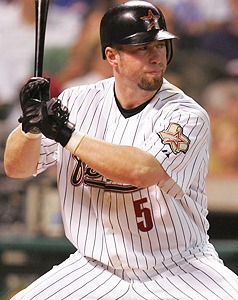
Most of us who grew up in a big league city grew up rooting for the hometown team, and I’ve been in Houston since I was nine. Today is the first time in all those years that players who spent most (or in this case, all) of their Major League careers with the Houston Astros have a real chance (or in this case, two chances) of getting in. So, yeah, it’s exciting to be waiting for the news: will Craig Biggio and Jeff Bagwell make it?

(I don’t know how those of you who didn’t grow up in a big league city picked your favorite team: was it the nearest big league team? The one that had a minor league team in or near your town? The team that had your favorite player? Your dad’s favorite player?)

My guess is, Bagwell won’t make it anmlb_g_bagwell_sy_576d Biggio will. Bagwell’s got the numbers, but I think the doubts about his alleged-but-unproven use of steroids are what’s keeping his vote short. Biggio has no steroid shadow over his career; he’s got more than 3000 hits; he was multiple times an All-Star at two different positions, and a multiple times Gold Glove and Silver Slugger winner; he’s in.

Let’s see if I’m right. (BTW, this is the first time ever that I’ve stopped whatever else I was doing to try to hear the HOF announcement live…always interested before, but never in quite this way.)


OK then, the headline is: NOBODY was elected to the HOF this year! First time that’s happened since 1996, only the eighth time since they started voting for the HOF in 1936.

The subhead: Barry Bonds and Roger Clemens and Sammy Sosa and the other strongly-suspected steroid users didn’t even come close—seven-time Cy Young Award winner Clemens had 37.6% of the vote, all-time home run king Bonds 36.2%.

The sub-subhead: it turns out my feelings weren’t far off the mark. Craig Biggio was the top vote-getter with 68.2%, just 39 votes short of the 75% needed to be elected. And Jeff Bagwell was third at 59.6%. (Jack Morris was second, just behind Biggio at 67.7%.)

My reaction: I’m fine with this.

First, there is no shame—none—for Biggio not to be elected in his first year bw-29-biggio-0627-4_3_r560of eligibility; something like 80% of the players in the Hall weren’t elected in their first year of eligibility. To be the top vote-getter in his first year, and so close to the threshold, means the voters think he’s worthy, and his ultimate election is all but assured. And Bagwell’s vote total improved again: he had 41.7% in his first year, 56% last year and 59.6% this year. He’s going to make it, too.

It would have been great to see either of them, or the two of them together, get this honor, and I’m now even more confident that one day they will. Other HOFers have ties to Houston—Joe Morgan and Nolan Ryan the most prominent—but none of them is wearing an Astros cap on his plaque; Bagwell and Biggio will be the first players from my team to get to the HOF, and I was in the stands to watch them play their entire major league careers, so it will mean something to me when they are recognized as being among the greatest players ever.

The second reason I’m fine with this is, the steroids cheaters were shut out.

Let me start by acknowledging my ambivalence on the subject of steroids. I can accept the scientific evidence that the use of steroids poses a danger to the user, and I’m conformist enough that I have no problem punishing players who broke the rules that prohibited the use of steroids, once those rules were finally put in place. It’s the concept that some performance-enhancing drugs are banned while others are allowed that gives me trouble. Why are antibiotics, protein supplements, vitamins and caffeine OK, but anabolic steroids and amphetamines prohibited? How do we draw the line that says an athlete’s efforts to become the best they can be are to be applauded but only up to this point, and no further?

Second, I think there’s a reasonable argument to be made that baseball writers—the journalists who cover baseball as a news story—shouldn’t be the ones with sole authority over which players get into the Hall of Fame: the people whose job it is to cover the news should not be involved in making the news. (I don’t know who, in the alternative, would select Hall of Famers, but that’s a different question.) In this case, we’re talking about the baseball writers who covered the game in the 1990s and 2000s, who saw the players get freakishly bigger and the old records fall, and decided not to write about the fact that the players breaking the records were taking illegal performance-enhancing drugs.

This Hall of Fame ballot wasn’t the first one to feature prominent players whose careers came during the era of steroid use, but in Bonds and Clemens it had two of the most accomplished players of all time who also happened to be suspected of cheating. Their worthiness to be enshrined in the HOF was judged by the writers who were once complicit with the players and their union and Major League Baseball and its teams in facilitating the use of steroids by players and the subsequent mutilation of the record books that it caused, and who now unapologetically pivot into the role of moral arbiter and protector of the faith to declare that no cheaters shall prosper in Cooperstown. Nice work if you can get it.

The hypocrisy of the writers notwithstanding, the circumstantial evidence of cheating against many of the players, including Bonds and Clemens, is overwhelming, and I’m satisfied at their being rejected this time around; remember, they’ve got 14 more chances, and attitudes are likely to change/soften over the years. Bob Costas suggested that a comparison of next year’s vote totals with today’s for Clemens, Bonds and Sosa will give a real indication of their ultimate chances for getting into the Hall. The vote totals for steroids users like Rafael Palmeiro and Mark McGwire started low and then slipped: Palmeiro (569 homers, 3020 hits) started at 11% in 2011 and was down to 8.8% this year, Mark McGwire (583 homers) got 23.5% in 2007 and this year just under 17%. (And just in case you’re interested, here’s the Mitchell Report on steroids in baseball, with dozens of references to Bonds and Clemens.)

Oh, and one more thing: pitchers and catchers report in just one month!

Gay marriage news, the Anglo-American edition

It was only in passing that I mentioned last month’s election results that put another four states on the side of the angels in the fight to legalize gay marriage. There’s been an important development since then: the U.S. Supreme Court’s decision to hear arguments in two cases on the issue, opening the possibility of a legal precedent that will apply to every state in the union.

Supporters of giving same-sex couples the right to marry are enthused, since this decision comes in relatively close proximity to (1) President Obama announcing his support for gay marriage, (2) another appeals court overturning the Defense of Marriage Act (Windsor v. United States), and (3) people in more states voting in favor of same-sex unions. Emily Bazelon writes in Slate with some great background on the two cases themselves, and offers a warning: don’t assume that because four justices agreed to hear the cases that there are five of them who will rule in favor of gay marriage. Conventional wisdom has it that the court follows the people, but I’m trying not to get overly optimistic: it could be that the justices who said yes to taking up the matter are predisposed to uphold the Defense of Marriage Act or to defer to states on the whole thing…and 39 of them have outlawed gay marriage either by statute or in their constitutions.

I wish we could get some of those states, or Congress, to think about this issue in the way Britain’s government proposes: legalize same-sex marriage in civil law, and make the clear stipulation that religions which object cannot be forced to perform gay weddings.

Face it: most of the objection to same-sex marriage in our country claims a basis in religious teaching. I sympathize with people who are afraid that legalizing a practice condemned by their religion would somehow infringe on their own religious freedom, although I don’t think that would happen in this case. But the core issue as I see it is not one of religious freedom, it’s a question of equal protection under the law. To try to put it simply, it’s not fair that only some citizens can enjoy the benefits of being married under law; if it’s OK for some it must be OK for all, assuming it doesn’t hurt society at large. And let’s don’t get sidetracked on age limits—we already prohibit minors from entering contracts—or possible plural marriages or bigamies, which might be seen to have built-in disincentives and punishments. (Remember the old joke—what’s the penalty for bigamy?  Two wives.)

Think of any given religion as a private club: no one of us is required to join that club but we each have the freedom to do so, and those who do join should be prepared to follow the club’s rules. If one club’s rules prohibit same-sex marriage, that is the club’s prerogative; but the rules of any one club or other are not binding on those of us who didn’t join the club.

The civil law is what’s binding on everyone in the civil arena, and it must be applied equally and fairly to all. The British plan makes it clear that each club/religion retains the right to apply its own rules to its members while inside its clubhouse, but that there is a civil law applicable on the broader scale to the rest of society regardless of the rules inside Club A or Club B.

So, there’s a lot to keep an eye out for on this issue, what with the courts and the lawmakers getting involved. There’s one more front, too, but in this case there’s a possibility that America’s emerging embrace of same-sex marriage, and perhaps of homosexuality in general, could have unintended and disastrous consequences. I refer, of course, to Choire Sicha’s discovery of just how gay marriage could lay waste to the quaint vacation industry:

Yes, America will have to rise up against the menace of bearded gay schoolteacher couples who like to weekend and all those inn-going lesbians with lawyers. With the end of small businesses in America, we’ll just go state-by-state and repeal these gay marriages and everything will be fine. That’s exactly how this will shake out.

Demand more

I’ve been trying like hell to ignore the presidential campaigns, and with a good deal of success: mostly, because I cannot conceive of what a life without respite from politics would be like, no matter how important the office or how laudable the candidate; and, because the modern campaign is so completely full of crap that my intelligence cannot put up with the constant insults.  C’mon, really—there’s no good reason for nearly-continuous presidential campaigns, unless it’s to occupy the attention of the leaches who feed on the blood that runs those campaigns and prevent them from bothering decent people in the off years.

To the second point, I refer you to a column I ran across today at CNN.com that makes the point that we, the vast unseen unwashed American voting public, deserve better campaigns than the ones we get.  David Rothkopf uses the current flap over Harry Reid’s unsubstantiated accusations about Mitt Romney’s tax payments to make his point:

But of course, this is one dust-up that will never end. Because in modern politics it seems the goal is to constantly find ways to smear the opposition, facts and decency be damned. That’s the reason the birther lie endures. That’s the reason that John Kerry, whose military service was distinguished, could be besmirched by the “swift boaters” and a host of political opponents who hadn’t anything like his record of service. And because both sides do it to one another, it is considered to be fair play.

Rothkopf points out a few examples of the bipartisan hypocrisy attendant to campaigns today, and to be candid they are nothing that most people haven’t shaken their heads about before.  But he does something better, more constructive, in offering specific reminders about the things that are not getting proper attention amidst the quadrennial Great American Pie Fight.

America is facing unprecedented challenges. Our economy doesn’t work the way it once did. It is growing more slowly. It is rebounding from crisis more slowly. It is not creating jobs as it has. It is not creating wealth for the population at large the way it used to. Inequality is growing. Our competitiveness is faltering even as competition is growing.

(Wait for it, conservative extremists…he’s making a point here about the things that we “exceptional” Americans can do.)

A new energy mix can free us of dependency on dangerous nations, create jobs and a cleaner environment at home. Our economy is well poised to lead a “Third Industrial Revolution,” driven by high value-added manufacturing in which intellectual capital, the kind we create especially well, is the critical input. We protect that capital better than many of our competitors, too.

We’re in a position to remake our infrastructure, as must be done thanks to very low interest rates, if only we could come to understand the difference between spending and investing. We need to rethink our convoluted tax structure, our broken fiscal system, our corrupt campaign finance system and the way we defend ourselves and project our force worldwide. It is beyond arguing that we need to do something about gun control in this country.

Rothkopf’s lament is that we should be debating these question, not the minutiae that passes for “issues” these days, and I agree.  These are the kinds of things that Americans used to have serious discussions about, used to reason together about and find solutions for, solutions that benefitted society as a whole.  It can be that way again if we really want it to be…if we’ve got the courage and the attention span to make it happen.  Now is as good a time as any to start work on that.

Considering “American exceptionalism”

Two hundred thirty-six years!  Wow…amazing to think that this country has not just survived, but prospered for that long, given all that it and its people have faced over those seven or eight generations.  Some attribute that to the hand of God, some to the nature of Americans, some to a combination of the two.

If you’ve led a sheltered life, like me, then the concept of “American exceptionalism” is a relatively recent revelation.  Come to find out, today it’s a dog whistle blown by social conservatives amid the political battle, and wielded like a heavy club against those of us who “just don’t get it.”  And so I was very interested to run across a thoughtful series of essays at CNN.com that shed a lot of light on the topic.

The first installment, on the site’s Belief Blog, looks into the history of the idea and makes it pretty clear that it began as a religious concept among the Puritans who fled England almost 500 years ago.  Those people established a theocracy and their descendants were big believers in Manifest Destiny, but the concept evolved along with beliefs about democracy and egalitarianism.  Very interesting reading.

So is the second part, which will bother some “exceptionalists” no end: it looks at the evidence which proves that in some respects America is not the best country in the world, and wonders why some people think that even considering the evidence is a sign of weakness, or treason.

The third rail of American politics is acknowledging we may not be the greatest country in the world.

(snip)

It’s not like acknowledging flaws is the same as acknowledging failure. The business sector seldom rests on its laurels. Successful companies assume there’s room for improvement, and they’ll put themselves through ISO 9000, Six Sigma, benchmarking, best practices and any number of other assessment programs to get there.

(snip)

If businesses don’t evolve, they end up like Atari, Pan Am and Woolworth’s, onetime industry leaders that crashed against the rocks of strategy, innovation and competition. So the successful ones aren’t shy about borrowing good ideas from others.

Then why is it so hard for the United States to admit its shortcomings and do the same?

(Read the piece for the answer.)

And in today’s third installment, CNN political analyst (and longtime Republican political adviser) David Gergen, and his researcher Michael Zuckerman, try to answer the question “What makes America special?” and conclude that exceptionalism, like beauty and more, is in the eye of the beholder, and that the heart of our contemporary on-going political pie fight is a conflict over which of our “core values” is core-est.

…Americans espouse five core values, stemming from key historical experiences, that distinguish us from other Western nations: liberty, egalitarianism, individualism, populism and laissez-faire.

(snip)

…these values can be in serious tension with each other. Those who believe foremost in egalitarianism, for example, run in very different directions from stout defenders of laissez-faire.

In politics, nowhere does this tension between core values play out more starkly than in debates over liberty versus equality. Republicans have traditionally argued that a free society allows everyone to do better, while Democrats have objected that without basic fairness, society as a whole is held back. In that spirit, Romney ardently defends liberty and just as ardently, Obama defends social equity.

So, why should we care about this right now, while we’re preparing to ditch work and fill our faces and gawk at politically-hued ballistics displays in the middle of the week?

On this July Fourth, then, we have an America where many, including our leading politicians, disagree on what makes the country special — and on what values should take precedence. There is nothing inherently wrong with such disagreements: Indeed, a competition of ideas is healthy for the republic. But, as has become painfully obvious, the differences in perspective have become so sharp and deep that we are tearing ourselves apart.

That’s why this July Fourth should not only be an occasion for wondering what makes America special, but also for pondering how we can build bridges across the divide.

(snip)

For our money, the winner of the 2012 election won’t be the one who makes a stronger argument for egalitarianism over liberty or liberty over egalitarianism, but the candidate who joins the two, persuading voters he is best equipped to lift floors as well as ceilings, ensuring every American has an honest shot in life.

Happy birthday, America!