You don’t give Mrs. O’Leary a forum to bad-mouth the firefighters, or let Capt. Hazelwood criticize how they clean up the oil spill

So extreme that they even scare Al Qaeda?  OK, you’ve got my attention.

What the hell is The Islamic State of Iraq and Syria, and how is it able to take over major Iraqi cities apart from the luck of only encountering feeble resistance from American-trained Iraqi government forces?  I don’t know, and it’s a little unsettling to read and hear the stories of these religious extremists blowing through city after city summarily executing those who don’t worship properly—as Sunni Muslims—and setting up their own governing authority.  The Iraqi government has asked the U.S. for help and our government is thinking it over.

In the meantime, because news networks have lots and lots of air time to fill, the punditocracy has cranked into gear to do what it does best: blow hot air.  Well, that’s just fine, I suppose, but…why, why, why, in the wide wide world of sports are they asking the opinions of the men who got us into the quagmire of Iraq in the first place for their opinions on what President Obama should do now?

Sargent Iraq arson

Thanks Ben Sargent and GoComics.com

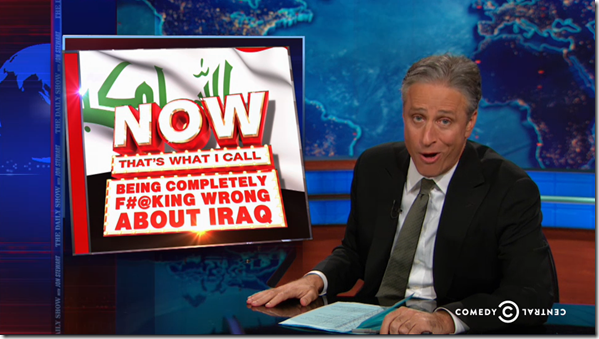
Want to read some more—try here and here and here and here and here.  But as one might imagine, some of the best remember-what-these-nutballs-said-and-did-and-what-happened-because-of-it recollection has come from Jon Stewart on The Daily Show.  (click the pic to see what I mean)

wrong about iraq

Hey, talk show bookers and assignment editors: think, just for a minute, before you make your next move.  Looking for a good summary of what happened way back when–here’s one.

The totality of the Bush administration’s failure in Iraq is stunning. It is not simply that they failed to build the liberal democracy they wanted. It’s that they ended up strengthening theocracies they feared.

And it’s not simply that they failed to find the weapons of mass destruction that they worried could one day be passed onto terrorists. It’s that a terrorist organization now controls a territory about the size of Belgium, raising the possibility that America’s invasion and occupation inadvertently trained the fighters and created the vacuum that will lead to al Qaeda’s successor organization.

And all this cost us trillions of dollars and thousands of American lives.

(UPDATE: Yes, I did change the headline once I realized the error…I figure it’s never too late to get it right–PR)

First the good news, then the better news, then the bad news

The good news is this: Congress has reached a budget deal.  Yes, the U.S. Congress.  And not when facing a deadline.  America’s guests have done a thing that is rare in this day—their jobs.  Here are the details; I’m most enthused at the idea that enough members showed enough maturity and leadership to actually work out some agreement, one which means we and the world can go two years without having to fret about a government shutdown.

Now to the better news, which I would actually classify as a Christmas miracle if I were given to assuming that God takes sides in American politics (or sports): the mainstream Republican Party is showing signs of finally standing up to the conservative extremists.  Speaker of the House John Boehner was the first to publicly, honestly, express his exasperation with the tea partyish crowd that has pushed the GOP so far to the edge of American politics that they have to stand on each other’s shoulders a mile high in order to see the center.  He reportedly got even more “honest” in private:

“They are not fighting for conservative principles,” Mr. Boehner told rank-and-file House Republicans during a private meeting on Wednesday as he seethed and questioned the motives of the groups for piling on against the plan before it was even made public.

“They are not fighting for conservative policy,” he continued, according to accounts of those present. “They are fighting to expand their lists, raise more money and grow their organizations, and they are using you to do it. It’s ridiculous.”

The conservatives of course defended themselves, which is perfectly fine; I hope the center and the far right keep this back-and-forth going ad infinitum (we’re already well past ad nauseum).  For however long they fight with each other—and these things don’t last as long as you might wish them to—it keeps them from concentrating their fire outside the circle; maybe that keeps the extremists from winning more elections and coming into real power to remake America in their own frightening image.

One more politics thing: did you see who was cited by PolitiFact for the Lie of the Year?  Yep, our president.  Selected by a reader poll from among ten finalists, “If you like your health plan, you can keep it” was chosen by 59%, the winner going away and embarassingly ahead of popular favorites like “Congress is exempt from the healthcare law” (Ted Cruz), “No U.S.-trained doctors will accept Obamacare” (Ann Coulter) and “Muslims are exempt from Obamacare” (chain email).  President Obama’s catchy little reassurance actually worked its way up over the years from “half true” to “pants on fire” and now Lie of the Year.  Congratulations, Mr. President, for finding a way to help the self-defeating conservatives survive the circular firing squad.

Furlough Journal: The end of an error

Uh, that’s it?

After more than two weeks of a partial government shutdown and right up to the brink of a government default on its bills, all forced by extremist Republicans trying to coerce Democrats and the president to give up their wins on health care reform, the Republicans waved the white flag.  Unable to come up with a plan that was agreeable even within the group of Republicans in the House, the House threw up its collective hands and punted, agreeing to approve a compromise originated in the Senate that funds the government and raises the debt ceiling—that is, it kicks this can down the road a few months.  And as far as the Affordable Care Act goes, this bill does not defund a damn thing but it does “strengthen income verification requirements for those who sign up for insurance under Obamacare.”  Well, isn’t that special.

The extremist Republicans got exactly none of what they claimed to have been after, the entire Republican Party has taken a black eye in public approval, 800,000 civil servants and an uncounted number of contractors who do not do “essential jobs” missed work and maybe paying some bills.  And what did I learn, back here in my little corner of the partial government shutdown?

  • I enjoy not going to the office, and going instead to the golf course
  • I don’t respond to a few consecutive days of exercise like I used to
  • Working from home on a short term basis is hard because there are too many potential distractions
  • I hate getting calls from telemarketers

Now I wait for instructions.  My contract management tells me and my colleagues we must wait until our contract gets official notification before we can step foot back at our government offices, and that hasn’t come yet, but the civil servants we work directly for are already calling 9:00 o’clock meetings for tomorrow morning.  That’s right: some things never change.

The fault is not in our stars

Congress is back in Washington—a warning that reminds me of the comment many years ago by then-mayor Jeff Friedman of Austin, Texas, who, when asked for his thoughts about the fact that the state legislature was coming back to town soon, said “Lock up the kids and dogs.”

The legislative branch and the president are back in town, in theory, to deal with the prospect of more than $600 billion worth of budget cuts and tax increases scheduled to go into effect next week. They’re not making much progress, as you might imagine.

Remember, the “fiscal cliff” is a threat the legislative and executive branches imposed on themselves a year and a half ago. To resolve an impasse over extending the debt ceiling so the government could continue to borrow money and pay its bills, our “leaders” set this time bomb of higher taxes and cuts to federal programs to force themselves to come to agreements on taxes and spending and debt ceilings before the “unthinkable” happened. Well, now we’re on the doorstep of the unthinkable, and look what they’re doing. (By the way, the Treasury department says we’re going to hit the debt ceiling next week!)

Perhaps more annoying than our elected leaders’ inability to govern—for that is what it really comes down to, their inability to do what they were sent there to do—is the realization that the focus on the fiscal cliff isn’t what’s really important anyway. Not to say that higher taxes and program cuts don’t matter, but that the real cause of the government’s economic problems—spending more than we take in—still isn’t being addressed.

The fiscal cliff was a crisis of Congress’ own making, brought on by its inability to address many of the same problems last year. The bigger problem, which lawmakers aren’t addressing, is the lack of sustainable fiscal policy.

We are in this mess in part because for decades leaders from both parties have been reading from the same economic playbook. They haggle over the small change while trying to convince Americans that it will make a profound difference in the country’s finances.

Houston Chronicle business columnist Loren Steffy recently offered another on-target analysis that reminds us the real problem isn’t the fiscal cliff, it’s the historic lack of honesty on the part of the political parties.

The budget battle playing out in Washington is nothing more than a giant national temper tantrum. Since 2001, we have been on a spending jag that has ballooned well beyond the costs of inflation and population growth. We’ve funded wars and prescription drug plans, bailed out banks and automakers and stimulated the economy. These programs have spanned both parties’ control of the White House and Congress.

At the same time, we’ve cut taxes. We now have the lowest average tax rate in about 30 years, yet many still complain taxes are too high and protest any threats to cut or curtail entitlement programs.

For more than a decade, we have demanded more while expecting to pay less. No one wants to admit the party’s over.

But they do want to admit—they’re desperate to admit—that the other party is causing the problem. As for the immediate issue, after the House speaker and the president couldn’t come up with a deal last week John Boehner has insisted that the Senate must come up with a plan and then the House will consider it, while the Democratic leadership in the Senate “stands strong” insisting that the House approve a measure it’s already turned down…or else.  (Or else what?) And just while I’ve been writing this, CNN reported that President Obama is about to make a new offer, until it reported that he won’t.

As disheartening as it is to see our national leadership apparently incapable of acting in the nation’s best interests, the situation becomes damn near depressing when you recognize who is really to blame: it’s us. You; me; them; those guys over there, too—we are responsible for the evolution of a system in which ideological extremists representing the view of a minority of citizens are able to reach positions of national power, and we are responsible for not holding our leaders to account for not putting national interests first, and we are responsible for taking more and more from our government but not being willing to pay for what we take.

The solution to our government’s economic problems won’t come out of Congress this week or next; it won’t come from refusing to reduce spending on government programs (which, frankly, no one is doing), nor from refusing to raise taxes and threatening to hold one’s breath until one turns blue (which, candidly, more than one are doing). It will come, when it comes, with the realization by Americans that America can’t keep putting its everyday expenses on a credit card and only make the minimum payments indefinitely and still expect to remain fiscally healthy.  It doesn’t work like that, and we have the national debt and the federal budget deficit to prove it.

The Washington kabuki

It’s playing out just as any predictable, poorly-written melodrama might, these “negotiations” to raise the federal debt ceiling and avert a national economic emergency, particularly when the play is performed by such transparent and ham-handed actors.

As expected, yesterday the Senate refused to go along with the House bill to cut government spending and pass a balanced budget amendment to the Constitution (which even National Review’s Rich Lowry is against); it was thought this might provide the cover for enough Republicans to be able to say that they had done their best to comply with Tea Party demands but now had to vote for a debt ceiling hike to avert a crisis, but we haven’t seen that start so far.  Then, Speaker Boehner dramatically announced he was “abandoning” his negotiations with President Obama and laid all the blame on him for not giving in to the no-tax-hike meme…before he announced he would continue negotiating.  Obama says Boehner’s rejected a plan with less tax increases than what the Gang of Six proposed earlier in the week, and he’s called for more negotiations this weekend, while Senate leaders are trying to revive the scheme to let the president raise the debt ceiling without members of Congress having to cast an approving and politically-dicey vote.

Politically dicey?  Yes, for the many Republicans in the House more worried about getting a Tea Party-ish challenger in next year’s primary election than they are about the United States defaulting on its debts.  How’s that for statesmanship?

(Check out the letter Boehner sent to House Republicans on Friday, and expect to see/hear the verbiage again in campaign ads.)

So they talk this weekend, and come out of the talks to stand in front of the microphones and say predictable things.  I feel pretty confident they will come up with some way to beat the deadline and raise the debt ceiling to prevent default, even if they don’t tie it to spending cuts or increased revenue (which isn’t necessary—these are separate albeit related issues).  But I wish they would take advantage of the opportunity now to take some action on spending and revenue, because that’s going to have to be addressed and sooner would be better than later.  David Brooks thinks so, too, arguing that “Standing still is not an option.”

Doing nothing could lead to default and the end of American economic supremacy. The compromise put together by Harry Reid, the Senate majority leader, and Mitch McConnell, the Republican minority leader, that’s been floating around is a ploy to evade responsibility. Punting with some small package would spook the markets and reflect dishonor on yourself.

(snip)

You do it because you know the political climate will be worse for a deal in 2013. If you’re a Republican, you know Obama might win re-election, and even if the G.O.P. swept everything, you know your party wouldn’t have the guts to cut entitlements unilaterally (that’s why the cut, cap and balance bill didn’t mention the specific programs that would face the ax). If you’re a Democrat, you know Obama might lose, and, even if he doesn’t, the Senate will likely tilt rightward.

Mostly you do it because you want to live in a country than can govern itself.

(snip)

…this is the next step in the journey toward economic health.