This just in: Arizona governor vetoes “religious freedom” bill

Good for Gov. Jan Brewer, for taking a stand against hate and discrimination.  Nobody over the age of reason is falling for this “religious freedom” argument.  It’s a sign—a good sign—that the extremists see the writing on the wall, and are getting more desperate.

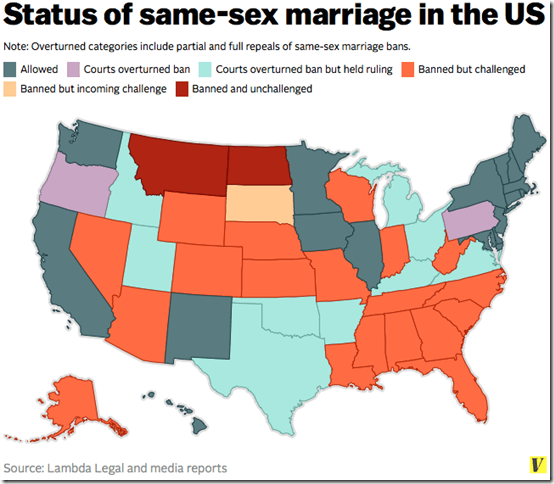
Hell, even a judge in Texas has struck down the state’s ban on gay marriage!  What more evidence do you need that things really are changing…

Happy Olympics Friday, America

Are you like me, did you think that the downhill skiing could be both exciting and dangerous?  Well, we don’t know the half of it: at Sochi 2014, it’s extreme!

After all, it’s all about the kids

It’s not that I don’t like the Olympics, it’s that I am thoroughly disinterested in the Olympics.  Oh, I like athletic competitions just fine, both watching them and taking part in them, and I’m fine with competing on behalf of one’s country.  But there’s something about the Olympics that over the years has left me feeling…who cares?  And the Winter Olympics, even more so.

On top of that I’ve heard nothing but bad things about this Olympics.  The horror stories of the past week about how ill-prepared is Sochi to host the visitors; the waste and corruption in the Russian government and Olympic committee to have spent as much on this event—$51 billion!—as all previous Winter Olympics combined; the Putin government’s transparent lies about its treatment of its gay citizens—none of that would sway me over to watch even a little of the spectacle were I somehow to have had a weak moment when I couldn’t find something to watch on any of the other hundred or so channels that flow freely into my home.

But, that was all before I got the straight dope from the Russians…via Tom the Dancing Bug.  Now that they set me straight on why they’ve done the things they’ve done to be ready to welcome the world to Sochi, I feel a whole lot better.  I’m sure you will, too, once you know what I know.

td140207

Thanks TDB and GoComics.com

Dammit, Biggio is a sweetheart so elect him to the Hall already!

Craig Biggio did not win election to the Hall of Fame today.  Greg Maddux, Tom Glavine and Frank Thomas did, and they deserve it; congratulations to them.  For the second year in a row, his first two years of eligibility, the Houston Astros icon was the biggest vote-getter without getting the 75% of votes required from members of the Baseball Writers Association of America.  Last year, when the writers elected no one, Biggio was the leading candidate but came up 39 votes short; this time, it was two.  TWO VOTES, out of 571 569 (nope, now they say 571 after all)!  Don’t those people understand that Biggio is a great guy?

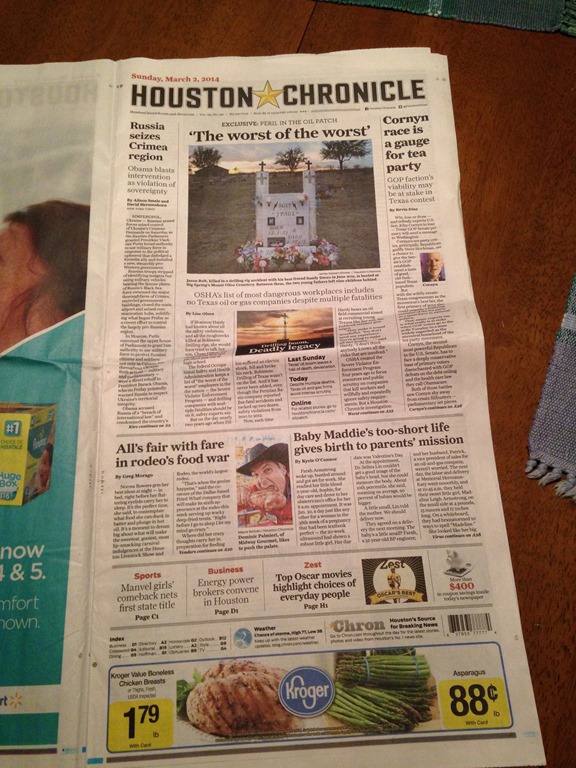
I mean, Houston’s Leading Information Source switched into full cheerleader mode last week (as it did this time last year), fulfilling its civic responsibility of promoting Biggio’s candidacy by reminding readers that he is…well, that he is a nice man.  Jose de Jesus Ortiz made the point that Biggio’s teammates think he’s a great guy, and that his agreeing to switch positions showed his further greatness; new guy Evan Drellich has found that even people who knew Biggio as a kid say he’s a lovely fellow.  (To a lesser degree the Chronicle tried to shine the same sweet sunlight on Biggio’s teammate and pal Jeff Bagwell, who carries credentials that match up pretty well with Frank Thomas but who also labors under the suspicion of having used performance-enhancing drugs; he was seventh on today’s list of candidates with more than 54% of the vote.)

But I’ve just discovered that even the local daily doesn’t know it all.  A tweet from Lance Zierlein led me to this eye-opening YouTube video that should convince any remaining skeptics who aren’t sold on Craig Biggio being a member of baseball’s Hall of Fame.  Just take a look for yourself.

What else must this man do?  I mean, really…


Happy traditional American holiday season observance

OK, you’ve finally convinced me.  Things were never better than when things were the way they were, back in the good old days when everyone believed in the Constitution and Americans weren’t afraid of their religious heritage; you know, back in the generation of the Founding Fathers and after that, when America was the way God meant it to be:

Not a single state in the Union closed its offices for Christmas on December 25 in 1834. [Abraham] Lincoln marked his first Christmas as President, in December 1861, by holding a Cabinet meeting in the morning and a dinner party in the evening. The Lincoln family never had a White House tree and sent no Christmas cards.

Nobody was much shocked by these omissions.

The public Christmas as Americans know it today did not take form until late in the 19th century. George Washington issued a proclamation on Thanksgiving, but he never made any statement about Christmas (or Easter for that matter). The first state to recognize Christmas as a holiday was Alabama, in 1836, but the North and especially New England resisted. Not until 1856 did Massachusetts accept Christmas as a holiday. The federal government took until 1870 to follow.

David Frum writes that the American attitude about Christmas “back in the day” was one that I think we should learn from.  First, he argues that Americans back then absolutely insisted on keeping church separated from state because of how much they cared about their religions, because they didn’t want government favoring one religion over another: “Better to deliver the mail on Sunday than debate who was right about the Sabbath. Better to issue no religious proclamations than let presidents pick and choose which holy days to mark and how to mark them.”

A second fact also explains the coolness of the early national government to Christianity: the keen awareness of many 19th century Christians of the non-Christian origins of many Christmas traditions.

Christmas is celebrated near the date of the old Roman holiday of Saturnalia. Gift-giving on the day was also a Roman tradition. The Christmas tree, the hanging of wreaths and house-to-house caroling hark back to the pre-Christian German holiday of Yule.

Calvinists had abandoned their outright ban on Christmas observance on the late 17th century. But many Protestant denominations retained a lingering suspicion of the holiday until deep into the 19th century.

Fox News and its co-conspirators can rattle on all they want to about taking Christ out of Christmas and about the terrible secularization of the season, even while filling the rest of the day with ad after ad after insidious Christmas sale ad, but they’re missing (or ignoring) an important point.  That is, the Christmas they claim to be defending is not the Christmas of the birth of Jesus.

It is the Christmas of folkway that is the Christmas so passionately defended by those who talk about “the war on Christmas.”

The Christmas of Santa and Rudolph, and trees and stockings, and candy canes and “Merry Christmas” greetings began to be most publicly celebrated in the United States only after — and only because — the religious impetus for the holiday had already dwindled away.