
“They” say the depredations of age get each of us eventually, and maybe that’s responsible for what feels like my increasing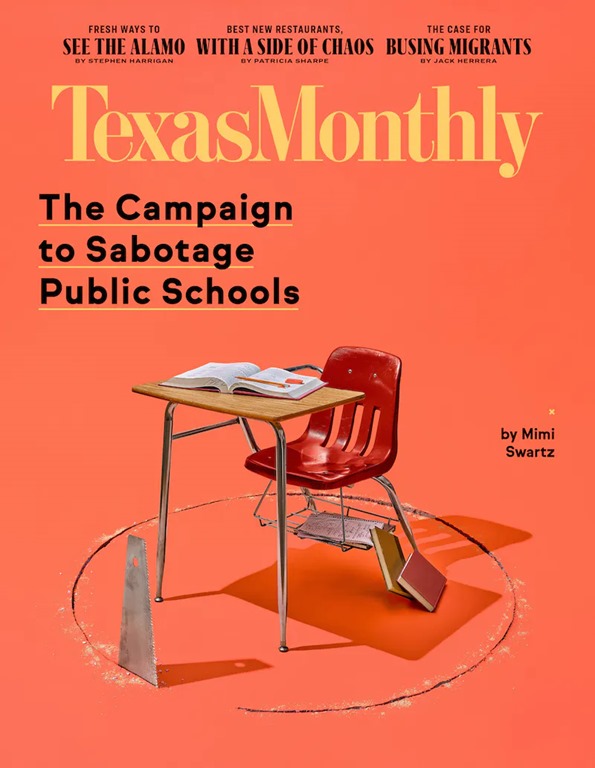 inability to think of just the right word on short notice. But whatever the cause, I owe a big thanks to whoever wrote and approved the headline on the March cover of Texas Monthly: “The Campaign to Sabotage Public Schools” hit perfectly as the word to describe the effort I’ve witnessed for years as radical evangelical Christians have undermined Texas public schools while insisting they are trying to save them. Butter wouldn’t melt in their mouths.
For a quick refresher on the history of free public education in the United States, check out this short summary by the Center on Education Policy at The George Washington University. The effort wasn’t without its shortfalls, but the driving force was the thoughtful insight that the future of America depended on educated Americans.
The Founding Fathers maintained that the success of the fragile American democracy would depend on the competency of its citizens. They believed strongly that preserving democracy would require an educated population that could understand political and social issues and would participate in civic life, vote wisely, protect their rights and freedoms, and resist tyrants and demagogues. Character and virtue were also considered essential to good citizenship, and education was seen as a means to provide moral instruction and build character. While voters were limited to white males, many leaders of the early nation also supported educating girls on the grounds that mothers were responsible for educating their own children, were partners on family farms, and set a tone for the virtues of the nation. The nations’ founders recognized that educating people for citizenship would be difficult to accomplish without a more systematic approach to schooling. Soon after the American Revolution, Thomas Jefferson, John Adams, and other early leaders proposed the creation of a more formal and unified system of publicly funded schools. While some Northeastern communities had already established publicly funded or free schools by the late 1780s, the concept of free public education did not begin to take hold on a wider scale until the 1830s.
It became understood across society that educating all of our children would be a benefit to the nation as a whole, and that the tax money needed to fund that effort was one of the responsibilities of citizenship, whether or not you had children and whether or not you sent them to the public school in your town. Today, that desire and responsibility to promote a societal good is diminishing in some sectors of society; you’ve probably seen these people at work in your community as I have in mine.
The people who believe America is a “Christian nation” and that any effort to respect and accept other beliefs is misguided and unpatriotic. The people who cannot abide that some people have different beliefs and ideas about what is right and how things should be done, especially when those other people do not share their religious beliefs; for these people, “freedom of religion” as a concept means that all Americans are free to worship as they do. The people who protested COVID vaccine mandates as another flavor of criticism of established authority outside their “faith tradition.” The people who now suddenly protest school library books as insufficiently representative of Christian evangelical mores. The people who demonize the people who are willing to acknowledge the history of racism in this country, and the persistence thereof. For them, public schools that teach children about math and science and literature and history to prepare them for participation in the secular world at large, and that do not take as their primary responsibility the religious indoctrination of students, are enemies to be defeated. To be sabotaged, if necessary.
Taken individually, any of these incidents may seem like a grassroots skirmish. But they are, more often than not, part of a well-organized and well-funded campaign executed by out-of-town political operatives and funded by billionaires in Texas and elsewhere. “In various parts of Texas right now, there are meetings taking place in small and large communities led by individuals who are literally providing tutorials—here’s what you say, here’s what you do,” said H. D. Chambers, the recently retired superintendent of Alief ISD, in southwest Harris County. “This divisiveness has been created that is basically telling parents they can’t trust public schools. It’s a systematic erosion of the confidence that people have in their schools.”
The “they” behind this crusade are the current generation of a movement that has been trying to destroy public education for years.
The motivations for these attacks are myriad and sometimes opaque, but many opponents of public education share a common goal: privatizing public schools, in the same way activists have pushed, with varying results, for privatization of public utilities and the prison system. Proponents of school privatization now speak of public schools as “dropout factories” and insist that “school choice” should be available to all. They profess a deep faith in vouchers, which would allow parents to send their children not just to the public schools of their choice but to religious and other private schools, at taxpayers’ expense.
But if privatizing public education is today cloaked in talk of expanded liberty, entrepreneurial competition, and improved schools for those who need them most, its history tells a different story. In 1956, two years after the U.S. Supreme Court handed down its landmark Brown v. Board of Education decision, a group of segregationist legislators in Texas, with support from retiring governor Allan Shivers, began concocting work-arounds for parents appalled by the prospect of racial integration of public schools. One idea: state-subsidized tuition at private schools. That never came to pass, but it was Texas’s first flirtation with vouchers.
The dreaded vouchers. The current effort in Teas, supported now for the first time by the governor as well as the lieutenant governor, uses the buzzwords “school choice” and “educational excellence” to advocate for a system that will take tax money out of the public schools and hand it over to the private schools, including private religious schools. Yes: take public tax money and use it to pay for a religious school education for Texas children.
I don’t know that there was ever opposition to parents pulling their children out of the local public school and sending them to private schools—when they do so at their own expense. My own parents footed the bill to send me to a private high school where they believed I would get a better education than in the Houston public schools. Maybe they were right about that part. But they never presumed to think that their public school tax money should be drawn out of the local public school district to pay their son’s private school tuition. And I don’t want my secular tax dollars today supporting your favored religious institution, regardless of denomination. And yes, that is exactly what this plan would do.
Pro-voucher people reject the argument that vouchers will only benefit the rich: they say vouchers will help the poor save their children from underperforming public schools.
That hasn’t worked out either. In various experiments across the nation, funding for vouchers hasn’t come close to covering tuition costs at high-quality private schools, and many kids, deprived of the most basic tools, haven’t been able to meet the standards for admission.
(Besides, just think about it: why are the schools “underperforming” in the first place? Think it has anything to do with the effort over the years to reduce spending on schools or to divert school tax money into private school tuition?)
Voucher programs in Texas have failed at the legislature in the past because of opposition to the diversion of tax money, and due to the pragmatic concern of rural lawmakers who know that public school districts employ significant percentages of their constituents. Draining the school budgets wasn’t/isn’t in their interests. The lieutenant governor has favored some form of voucher system for years, but not the governor.
Governor Greg Abbott, knowing all too well the political headwinds that vouchers have faced, has long been wary of publicly supporting them, so he has undermined public schools in other ways. While campaigning early last year, he promised to amend the Texas constitution with a “parental bill of rights,” even though most, if not all, of those rights already existed. By then, “parental rights” had become a dog whistle to animate opponents of public education. (As the Texas Tribune put it: “Gov. Greg Abbott taps into parent anger to fuel reelection campaign.”)
During the recent intensifying crisis on the border, Abbott publicly floated a challenge to the state’s constitutional obligation to give all Texas children, including undocumented ones, a publicly funded education—a step his Republican predecessor, Rick Perry, had denounced years earlier as heartless. Then last spring, Abbott made headlines with his first full-throated public endorsement of a voucher program.
So here we are, with distrust in public schools advancing as fast as the latest COVID-19 variant. The forces behind the spread of this vitriol are no mystery. Those who would destroy public schools have learned to apply three simple stratagems: destabilize, divide, and, if that doesn’t work, open the floodgates of fear.
Here come the foot soldiers of the modern digital offensive: they lie about and harass people they disagree with, and amazingly (at least to me) very many of people who read those lies on Facebook believe them! Same terrifying principle as with Alex Jones and his acolytes who not only bought what he had to say about the Sandy Hook school shooting being fake, but then took it upon themselves to attack the bereaved parents. In the TM article, Mimi Swartz’ example of these tactics come from the Central Texas town of Dripping Springs, and she explains the rich and powerful players in the game.
In 2006 [James] Leininger found powerful new allies when [Tim] Dunn, with a major financial assist from the Wilks brothers, formed Empower Texans. Public education became one of its primary targets, in part because the property taxes that funded schools ran counter to their interests as billionaires and in part because they wanted more Texas children exposed to their version of Christian values.
(snip)
What voucher proponents needed most was a powerful champion who was also a gifted salesman. Former sportscaster and right-wing talk-radio host Dan Patrick happily stepped into the role. Elected to the state Senate from Houston’s prosperous, white, northwestern suburbs in 2006, the perpetually youthful but often choleric Patrick was lieutenant governor by 2015. Patrick found school choice and its kissing cousin, property tax reduction, to be winning issues among his right-wing base and his growing cadre of big-money donors, who, along with the backers of TPPF and Empower Texans, also included the billionaire deans of dark money, the Kansas-based brothers Charles and David Koch.
The American Legislative Exchange Council, commonly known as ALEC, is a powerful Koch-supported organization that has devoted much time and money to privatizing public schools nationally. According to a study by the watchdog group Common Cause, Texas has one of the highest concentrations of state lawmakers connected to the organization, at around 32 percent. One of the first bills Patrick introduced in the 2011 legislative session called for eliminating the ceiling on the number of charter schools allowed in the state. It failed, but the relentless Patrick rammed it through two years later. Echoing Republican U.S. senator Ted Cruz, Patrick would also proclaim vouchers to be “the civil rights issue of our time.”
(snip)
The state’s leadership has found other ways to undermine public schools. Texas, according to the latest data, ranks fortieth when it comes to school spending—$10,300 per pupil annually, compared with the national average of $13,500. According to a survey conducted by the Annie E. Casey Foundation, a charitable organization devoted to child welfare, Texas gets what it pays for, ranking thirty-third in the U.S. in the quality of its K–12 education.
Then there is the state’s ongoing loyalty to the STAAR test, the results of which are used to evaluate teacher and school quality. Its efficacy has been widely challenged by educators, parents’ groups, and academic researchers, who have found that the test’s demands are often well above grade level. And because the test is used as a yardstick to grade (and potentially close) schools, test prep has taken over actual teaching in many classrooms.
There’s much more worth your time in the story, which fleshes out the story of the attack on public education, in Texas and elsewhere, in the past couple of generations. Some of it has been simple, racially-motivated white flight to the suburbs, leaving behind city schools with fewer resources available for the students who remain. Not satisfied with their parents’ decision to take their ball and go to a new home, the children and grandchildren of those parents of the 50s and 60s are now trying to grab every last nickel they can out of the public school system to “protect” their own children from the real world. I feel sorry for the children who will have to deal with that world without benefit of a “real world” education.


 HEY, IT'S PAT RYAN'S BLOG!