“The relevant life”

It was Friday afternoon when I saw the headline and giggled a little to myself (no need to let everyone else in on what I was doing).  It struck me as funny that a commencement speaker told a group of graduating high school seniors that they weren’t special, that someone had gifted the graduates with a surprise package of honesty such as they likely don’t receive at home.

Today, I looked at the video of that speech and was surprised—pleasantly—when I found that the people who wrote headlines about the “buzzkill” commencement speaker had missed the whole point.

This is not some blowhard scrounged up to give a graduation day speech: he is Wellesley High School’s own veteran English teacher David McCullough, Jr., son of the historian, apparently a well-respected member of this upper class community in Wellesley, MA.  (He’s given the faculty message at graduation before, said some of the same things six years ago!)  If you watch the people in the background and listen to the other sounds, you see and hear a lot of laughter and head-nodding agreement with where he’s going in this speech—telling the students that “if everyone is special, then no one is” to shake them out of their certificate of participation-filled, everybody-gets-a-trophy world.

…we have of late, we Americans, to our detriment, come to love accolades more than genuine achievement. We have come to see them as the point—and we’re happy to compromise standards, or ignore reality, if we suspect that’s the quickest way, or only way, to have something to put on the mantelpiece…

(snip)

No longer is it how you play the game, no longer is it even whether you win or lose, or learn or grow, or enjoy yourself doing it; now it’s “So what does this get me?”

McCullough’s lively and humorous talk isn’t mean-spirited at all.  He is serious in telling his students that they’ve been coddled by their parents (and the school and American society, to an extent) but those days are over, but his message comes out of love for the kids, and what I think is the right-headed realization that we’ve got to wake them up and stop spoiling them if we wish them to be successful and contributing members of society.

I also hope you’ve learned enough to recognize know how little you know..how little you know now, at the moment, for today is just the beginning.  It’s where you go from here that matters.

(snip)

The fulfilling life, the distinctive life, the relevant life, is an achievement, not something that will fall into your lap because you’re a nice person or mommy ordered it from the caterer.

And without preaching, he spreads the word: do great things but don’t do them for yourself—do them for their own sake, or for the sake of others.

And then, you too will discover the great and curious truth of the human experience is that selflessness is the best thing you can do for yourself; the sweetest joys of life, then, come only with the recognition that you’re not special, because everyone is.

Why we should care about income inequality

I don’t want to get into the argument of the 1% versus the 99% because I think the issue, unaddressed, will hurt 100% of us. The issue is income inequality in the United States, and the good news is I’m not asking anyone to trust my economic arguments. I’m a dope, after all—a journalism major from a state university in the South who never focused on economic theory much beyond the law of supply and demand. But I know what makes sense, and Timothy Noah’s series in Slate does.

The 10-part series on income inequality published in September 2010 has helped me understand the issues, and understand why they matter. It’s not a question of the vast majority of Americans being jealous of the terrific success of others, or of them trying to take away anything the rich have earned. In a current discussion of this subject on Slate, Noah says “Let me start by conceding a point that conservatives often make: Yes, a certain amount of income inequality is necessary in a capitalist system. You have to let the market reward effort and skill. But a system in which inequality of incomes constantly increases over time is worrisome.”

That’s what’s happening in America today: the inequality of incomes is constantly increasing (the series drills down deep into the numbers to prove that it’s more dramatic now than ever), and Noah argues that “creates alienation.”

Income earners at the median have not shared in America’s prosperity. They’ve actually seen their incomes go down (after inflation) during the past decade, and over the past three decades their increases seem pitiful compared both with people earning top incomes (and here I mean not just the top 1 percent but the top 10 and even 20 percent) and with people at the median during the postwar era. For a long time economists said: Wait until productivity rebounds. Then working families will get their share. But when productivity rebounded like crazy in the aughts, working families saw no reward.

What this means is that if you’re at the median you have no positive reason to care how the economy does. Your only motivation is fear—if the economy does really badly you may lose your job. But there’s no upside.

I think this situation has a lot to do with why there’s so much suspicion of institutions that knit the country together—Congress, the media, etc. Logically the suspicion should be directed at the rich, but nobody knows what Lloyd Blankfein looks like. Everybody knows what Barack Obama and John Boehner look like. So people rage against Washington, and government, and you get both the Tea Party and Occupy Wall Street. These groups are quite different in their political orientation, but both groups express contempt for democratic processes.

Read the series: Noah digs through the numbers that show the historical trends of income inequality, and explores the theories for what’s responsible for today’s situation–and he doesn’t just end up blaming Congress or presidents, or Republicans or Democrats, or Wall Street or the educational system, or trade policy or labor unions or immigrants.

Income distribution in the United States is more unequal than in Guyana, Nicaragua, and Venezuela, and roughly on par with Uruguay, Argentina, and Ecuador. Income inequality is actually declining in Latin America even as it continues to increase in the United States. Economically speaking, the richest nation on earth is starting to resemble a banana republic.

Noah’s current book “The Great Divergence” grew out of the research done for the 2010 Slate series, which you can read here for free.

A little good news: scientists stand up to politicians

And by politicians, I mean the knuckleheaded, blindered-by-the-right-wing nitwits who refuse to believe anything that doesn’t support their political beliefs…or, the beliefs they profess to believe, in order to maintain their political support (there, I believe that’s clear now).  You know, the ones who don’t get Daniel Patrick Moynihan’s epigram that people are entitled to their own opinions but not to their own facts, and who don’t get the irony that they don’t get it.

Today I ran across this NPR story about scientists in Tennessee fighting a state law that was promoted as an open-minded effort to allow “teachers to question accepted theories on evolution and climate change,” but which the scientists argued was just another attempt to get creationism taught as a theory on a scientific par with evolution.  The story refers to similar efforts in other states where scientists are fighting other efforts to distort science fact into political fiction.

Allow it?  Questioning theories and explaining how hypotheses are proved and become accepted scientific fact is the basis of science.  Teachers don’t need state lawmakers’ permission to break down and explain the parts of any scientific theory, or they shouldn’t.  Not knowing that, while trying to sneak a little religion into the secular science, the grandstanding pols peel back another layer of their own ignorance…or is it another layer of toadiness?

Slamming your eyes shut and screaming “no no no no no no no I can’t hear you” in the face of inconvenient facts is not the reassuring response I want out of my elected representatives.  I agree with Rice University professor Ken Whitney, who thinks that a candidate’s refusal to acknowledge scientific fact as fact ought to be a deal-killer when we go to the ballot box:

I would have an extremely hard time voting for someone who actively argued that evolution should not be taught, or alternately that intelligent design is a valid concept that we should be teaching our kids in public school science classes.

Note, he said we shouldn’t be teaching it in science classes, and that’s because it’s not scientifically valid.  We have to be open-minded enough not to confuse science with religion if we want to get the most value out of each of them.

Just one question to answer today

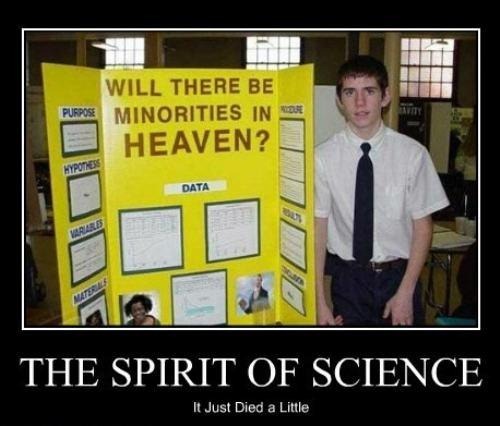
Please, no pushing, you will all get a turn.  This dropped out of the electronic wind earlier this week; I can’t make out what conclusion this rigorous experiment returned, but I thought you’d like a chance to answer the lad’s question—click the comments balloon at the top right.

motivate-this-5

OK, I’ll start:

“Yes, and you will be one of them.”

Star Wars analogies, girls in bikinis, and the spirit of journalism

I’m not the most cynical person around when it comes to the practice of journalism today…really, I’m not. If I was completely cynical about what passes for a lot of the journalism being published these days—if I believed it was a lost cause, a total sellout to the evil forces of what David Shaw called “the four horsemen of the journalistic apocalypse: superficiality, sensationalism, preoccupation with celebrity, and obsession with the bottom line”—then I wouldn’t bother talking about it at all; there’d be no point. I feel there’s still some good in there, or can be, perhaps in the way that Luke Skywalker could feel the Anakin Skywalker that still remained within Darth Vader. I must still try to turn it back to the good side of the Force.

Many of my contemporaries in the post-Watergate generation went into journalism with an idealized and inflated vision of what journalists could do, and we really did (and do) believe in the vital importance of the role of journalism as a watchdog over government power, a role that was understood and respected by the Founding Fathers to a far greater extent than it is by today’s civic and government leaders and a growing percentage of the general public. But without doubt, the excitement of being a reporter was part of the attraction, too.

Jim Romenesko linked to a recent Brain Pickings post highlighting a 1940 Encyclopedia Britannica film from the Your Life Work series, which called the film an “idealistic manifesto for the deeper ethos of journalism as a calling.” Yea…and it’s funny to see how they were selling it to the pre-World War II student body; enjoy…

While you’re at it, take a look at this video that fights against itself trying to disprove the idea that a pretty girl in a bikini is not necessarily a distraction to effective instruction.

And when you’re done, nose around Brain Pickings…some interesting stuff there on the notion of creativity.