Maybe the guy in the tin foil hat was right

We should all be in line to take a whack at the idiots responsible for these completely avoidable exercises in governmental overreach and hubris.  All together now: what the hell were they thinking?  I can’t decide which is more disturbing: the government using its power to harass and tacitly threaten law-abiding citizens based on a perception of their political views, or the government using its power to harass and tacitly threaten journalists in the pursuit of their constitutionally-recognized role as government watchdog.  Both are abuses of government power that fly in the face of what this country is meant to stand for.

Today the attorney general ordered the FBI to investigate the Internal Revenue Service for apparently singling out for enhanced scrutiny the applications for tax-exempt status from what were perceived to be conservative political groups.  Yep, it looks like the party in power has been using the authority of the taxman to reward those with whom it agrees and punish those with whom it does not.  Is there any more textbook definition of abuse of power than that?

I’m not saying that the IRS shouldn’t be thorough in reviewing applications for tax-exempt status; the IRS should be exceedingly thorough in investigating such requests.  Wouldn’t we all be willing to believe there are those among us who would do whatever they could to reduce their tax bills, even lie about the true purpose of their organization?  There are entire political movements built on the effort to reduce taxes, but that doesn’t mean they deserve extra scrutiny.  Whatever’s determined to be the proper amount of review for gaining tax-exempt status should the bar for everyone to pass, and it’s just flat wrong for an arm of the government to single out persons or groups for extra scrutiny based on their actual or perceived political views, including their views about taxes!  (Is this a great country or what?)  The whole idea has conjured up in my imagination that happy visage of Richard Nixon and enemies lists.

It’s just as wrong, and just as dangerous to our liberty, for the Justice Department to seize phone records of journalists.  The DOJ notified The Associated Press last week that at some point earlier this year, and clearly without prior notice, it had seized records for 20 phone lines belonging to AP offices and journalists, including home phones and cell phones.  It did not state a reason why these records were seized; it’s believed to be in relation to an investigation into leaks about how the CIA disrupted a terrorist plot to bomb an airliner.

Our system envisions a strong press as a watchdog on government at all levels, acting as a representative of the people seeking out information that the government wants kept quiet…the stuff that the politicians and the bureaucrats don’t want you to know, that they’ve kept from you out of embarrassment or guilt.  There have been people in the government from the beginning who understood the importance of that role to the overall functioning of society, and who’ve provided sensitive information to reporters despite being told not to do so.  Today we call those people whistleblowers.  When that whistle gets blown the government’s first response is often to decide who will take the blame, and they devote a terrific amount of energy to learning who told the truth.  In some cases they ask a court to order the journalists who ran the story to tell where they got their information; in others, like this one, they just take private information without the knowledge of its owner in the hopes that they’ll be able to deduce who ratted them out.

We used to talk about the “chilling effect” that a variety of government actions would have on the newsgathering process, on the minds of the reporters who might think twice—or more than that—about pursuing a story when faced with the possibility, or the likelihood, that the government was going to fight back.  And this is that.

It’s inconceivable to me that all the people involved in these two growing scandals are merely misunderstood or made poor decisions about how to achieve a legitimate objective, but I don’t think the blame goes all the way to the top.  This president is neither that paranoid nor that stupid…although you’d think that a professor of constitutional law might have impressed on his subordinates some of his relevant thoughts about the proper use of governmental power.  If this news had come out while the last man was president, I would have accepted it as prima facie evidence of the evilness of his administration and its soulless pursuit of instituting theocratic capitalism as our new form of government.  I would have been wrong, but I admit I would have thought it.

When the government spies on reporters and appears to punish political enemies, it gives the tin foil hat crowd encouragement: “The government is spying on you—it’s keeping track of who you call and who calls you, it’s watching what you do and where you go and who you meet, it’s keeping information on your income and your taxes and your friends and who you associate with, and it’s using that information against you.”  Today that sounds a little less ridiculous that it did last week.

Unassigned additional reading:

Ten years on, a partial tally of the Iraq War’s toll on American journalism

There’s no time like a brisk spring Sunday to take a minute to remember the failure of our vaunted American journalism to expose the criminality of the Bush Administration, and call to mind the more than 4000 American deaths and 32,000 American wounded it caused by creating and selling the fiction that got America into war in Iraq in 2003.

Not the entirety of either, I agree.  There were some reporters and columnists who tried to make clear to us the truth on the ground in Iraq, a truth that did not include the presence of either weapons of mass destruction or Al Qaeda.  But there were others—many others—who took the easy path of accepting the government’s word for it, who even became cheerleaders for a war that didn’t need to happen.  And certainly, not every person in a position of power and responsibility in Washington, D.C., was in on the con; but enough of them, high enough up in the administration, were complicit, that it worked.   We continue to pay the price, in lost lives, lost trust, and lost treasure.

So, thanks to Jack Shafer (@jackshafer) for this tweet:

He provides a link to a piece today by Greg Mitchell about his recent column, assigned and subsequently killed by The Washington Post.  The column is highly critical of the news media for its credulous performance covering the run-up to war, and by “highly critical” I mean it simply recalls who did what, and who didn’t do what, and when.

For awhile, back in 2003, Iraq meant never having to say you’re sorry.  The spring offensive had produced a victory in less than three weeks, with a relatively low American and Iraqi civilian death toll.  Saddam fled and George W. Bush and his team drew overwhelming praise, at least here at home.

But wait.  Where were the crowds greeting us as “liberators”?  Why were the Iraqis now shooting at each other–and blowing up our soldiers?  And where were those WMDs, bio-chem labs, and nuclear materials?  Most Americans still backed the invasion, so it still too early for mea culpas–it was more “my sad” than “my bad.”
–
By 2004 it was clear that Saddam’s WMDs would never be found, but with another election season at hand, sorry was still the hardest word.  But a few very limited glimmers of accountability began to appear.  So let’s begin our catalog of the art of mea culpa and Iraq here.

Take the five minutes to read the rest, and remember it the next time you pick up a paper or tune in to the broadcast echo chambers.

It’s not as hard as I thought it would be to praise Congress for doing its job

The Senate took action first, agreeing on spending authorizations to keep the government operating until the end of the fiscal year; the House did the same the next day. Thing is, they both did what needed to be done more than a week before the drop-dead-line that would have seen the government start to shut down for lack of operating funds. How uncharacteristic of them.

In the past few years the American Congress has never missed an opportunity to run right up to the brink of any fiscal catastrophe; like the Road Runner being chased by Wile E. Coyote, it safely came to a screeching standstill in a cloud of dust just on the edge of the abyss (beep beep). To what do we owe this unusual display of fiscal responsibility? I don’t know, but I’d like to order another round.

It had become too easy and too predictable for the thousands and thousands of voices online and on air and in print to chastise House and Senate, Republican and Democrat, for failing/refusing to take care of business. I’d begun to think it was ultimately ineffective as well, but maybe–just maybe–there was still some shard of humanness left deep inside our elected representatives that was tired of being ridiculed and abused, that knew that the voices raised in criticism had a point. It’s not that I’m pleased with the details of the budget the government will operate under for the next six months, but that I’m pleased “the government” got off of its ass and made a decision with something less than the usual quotient of bluster and drama…the “sound and fury” that, as is often the case in our politics, signifies nothing.

So, good on ’em for what they done (there, I said it; are you happy?). And fine, let them go ahead and propose future budgets, have debates and secret meetings and public hearings and horse-trading and try to persuade us all of the virtue of their ideas; that’s the way we’re supposed to try to come to a consensus on public issues. Just because I don’t have the heart or the stomach for this circus right now doesn’t mean the rest of you should miss out on the fun.

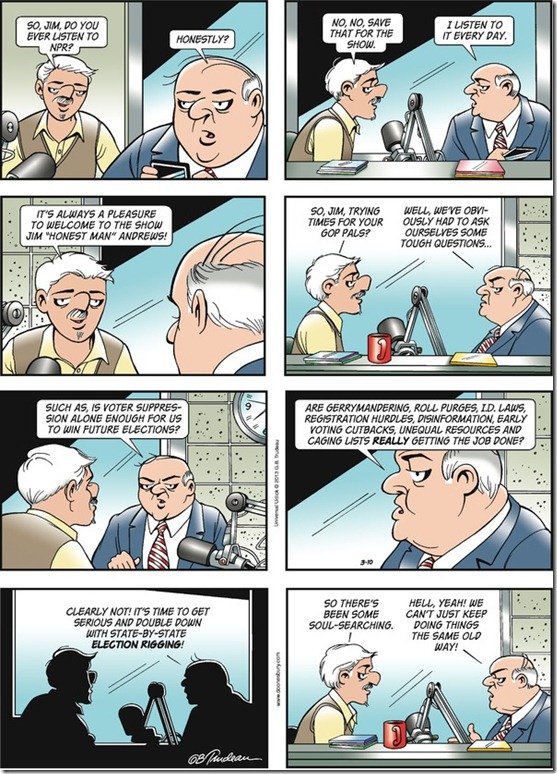
So, the GOP is rethinking how it can appeal to a wider range of voters…

…and Mark Slackmeyer asks how it’s going:

db130310

thanks, Doonesbury and GoComics.com.

As sequesters go, I thought this one was pretty smooth

Notwithstanding the dire warnings from everybody in Washington who said they didn’t want it to happen, but who let it happen anyway, the automatic budget cuts of the sequestration went into effect over the weekend.  No big deal?  Sure doesn’t seem like it, does it, at least not yet; but Slate has a good FAQs on this for those who want to keep an eye out for the signs of the apocalypse:

Can you start with the basics, like what the heck is the “sequester” and where did it come from?

In short, a sequester is a formal term for mandatory cuts to the federal budget. This particular sequester was originally created back in 2011 when lawmakers struck an eleventh-hour debt-ceiling compromise. In theory, the mere possibility of those cuts was supposed to ensure that Congress’s so-called supercommittee would have no other choice but to strike a deal to trim the federal budget by $1.5 trillion over the next decade. Notice we said in theory. In reality, the panel failed to live up to its super name, and so began the slow march toward today.

(snip)

…a trillion dollars? That sounds like a lot.

It is, but it doesn’t happen all at once. The cuts are actually spread out over the next decade. This year’s sequester includes: $42.7 billion in defense cuts (or about an 8 percent reduction); $28.7 billion in domestic discretionary cuts (5 percent); $9.9 billion in Medicare cuts (2 percent); and about $4 billion in other mandatory cuts.

(snip)

The cuts were created in 2011, they went into effect Friday, and the nation will begin to feel the impact in the days that follow. Exactly how soon, we don’t know. But we’ll feel them a little more in the coming weeks, and even more the following month. And even more the month after that. And so on, all the way to either 2021 or whenever Washington decides to replace it with something else.

(snip)

The White House believes that the impact of the cuts over the next several weeks will bring Republicans back to the bargaining table on taxes. The GOP, meanwhile, says that’s not going to happen.

Man, this stuff manages to be both excruciatingly boring and kind of terrifying all at once.

True story. It also may become a little more of both in the coming weeks.

Wait, come again?

The next fight—there’s always a next fight in Washington—will occur over how to keep the federal government running for another year. The current stopgap bill that does that runs through March 27. If and when that expires, we’re looking at one-day-a-week furloughs multiplied by five, for pretty much the entire government. In other words: government shutdown.

Yes indeed: the same people, who more than a year and a half ago planted a booby trap to force themselves to do the right thing but still couldn’t get out of its way, are now less than four weeks away from another self-imposed drop dead date.  If they miss this deadline, the government’s spending authority runs out and the lights go out on almost everything.

What could possibly go wrong?