
Petard, hoist away

Clown-show fascism describes a regime marked simultaneously by hubristic and defiant assaults on the democratic and constitutional order on the one hand and, on the other, a nearly laughable incompetence in just about every other area of the regime’s activity.

Michael Tomasky, The New Republic, April 28, 2025

We can disagree about the goals of any president. In the before times, we all had some point of departure with what every president wanted to do. It was expected, frankly: any honest observer of and thinker about political issues disagreed with the current administration on something, even when it was a president you had voted for (or even a president you worked for!). That’s one reason why the slavish, Stepford Wives-ish acceptance of every grunt and string of incipid cliches out of TFG by MAGA nation is so hard for me to accept.

But whether or not we agree with the goals of a president, or the means by which he or she tries to accomplish them, we all should demand a president who respects the Constitution and the laws and who doesn’t make things worse while trying to implement his plans. And, as is the case with this president, is not blatantly using his office to enrich himself in so many ways “like you’ve never seen before.” The Washington Post’s Dana Milbank makes a strong case that “Across the executive branch, in agency after agency, it’s amateur hour under the Trump administration.” The unnerving of the world economy; the chaos at the Pentagon; the threat to Harvard that was sent by mistake; the deportation that was a mistake but we’re powerless to correct it so shut up you federal judges; the firing of thousands of government workers with no plan to pick up the workload — all these and more, and the cruelty inherent in so much of it, have made the whole world nervous about what he might do next.

And let’s not forget the hypocrisy so prominently displayed but never acknowledged at almost every step. Most obvious, at least to me, is the mountain of executive orders. Has this president even tried to get Congress to pass laws to do what he wants? (A Congress he controls, by the way.) I don’t think so. Many self-described conservatives have for years railed any time a Democratic executive implements policies through executive order, screaming about the abuse of power. In this case, both before and during his first term of office, the man who threw a clot over Barack Obama’s use of executive orders

“The country wasn’t based on executive orders,” Trump said at a South Carolina campaign stop in February 2016. “Right now, Obama goes around signing executive orders. He can’t even get along with the Democrats, and he goes around signing all these executive orders. It’s a basic disaster. You can’t do it.”

has proudly done the same thing, but to a greater extent: Fox News reports (yes, that Fox News) that Trump has signed 135 executive orders so far in his second term, smashing the previous record of 99 by Franklin Roosevelt as he began implementing the New Deal. Trump doesn’t want to govern America, he wants to rule it. He wants to issue orders, edicts, diktats, whims-on-paper, and have his wishes carried out…no need to bother the Legislative Branch. (Don’t get me started on Congress’ abdication of its responsibilities.)

Will we get to a point where those who’ve drunk Trump’s Kool-Aid start to see the real world? Maybe: current polling indicates Trump’s approval rating at the end of his first 100 days — 39% — is lower than any president in 80 years, even beating his own record from 2017. Strong majorities believe his economic policies will cause a recession soon, that his administration is trying to avoid complying with court orders, doesn’t respect the rule of law and is going too far to expand presidential powers. As should be expected, “83% of Republicans said they approve of Trump’s work in office, while 93% of Democrats and 60% of independents said they disapprove.” Also to be expected, Trump’s reaction to his poor showing in the polls is to…call for an investigation of the pollsters for election fraud. (Election fraud? There’s no election.) Remember, nothing bad is ever his fault, there’s always some bad person trying to hurt him. So unfair.

What are we to do? Well, you know me — always looking for the positive. I found some in this column in The Guardian in which the foreign affairs commentator Simon Tisdall expresses confidence that Trump will fall victim to himself. (Remember: “I alone can fix it.”)

Policy failures and personal misconduct do not usually collapse a presidency. The US constitution is inflexible: incompetence is protected; cupidity has a fixed term. Trump is in power until 2029 unless impeached – third time lucky? – for “high crimes and misdemeanors”, or else deemed unfit under section 4 of the 25th amendment.

(snip)

This fight has moral and ethical aspects, too – and, given this is the US, prayer is a powerful weapon in the hands of those who would slay evil-doers. Of the seven deadly sins – vainglory or pride, greed or covetousness, lust, envy, gluttony, wrath, sloth – Trump is comprehensively, mortally guilty. In Isaiah (13,11), the Lord gives fair warning: “I will put an end to the pride of the arrogant and humiliate the insolence of tyrants.” God knows, maybe he’ll listen. Miracles do happen.

Of all the tools in the tyrant-toppling toolbox, none are so potentially decisive as those supplied by Trump’s own stupidity. Most people understand how worthless a surrender monkey “peace deal” is that rewards Putin and betrays Ukraine. Does Trump seriously believe his support for mass murder in Gaza, threats to attack Iran and reckless bombing of Yemen will end the Middle East conflict and win him a Nobel peace prize?

And then there’s his greed – the blatant, shameless money-grubbing that has already brought accusations of insider trading, oligarchic kleptocracy, and myriad conflicts of interest unpoliced by the 17 government oversight watchdogs Trump capriciously fired. His relatives and businesses are again pursuing foreign sweetheart deals. Corruption on this scale cannot pass unchallenged indefinitely. Avarice alone may be Trump’s undoing.

All this points to one conclusion: as a tyrant, let alone as president, Trump is actually pretty useless – and as his failures, frustrations and fantasies multiply, he will grow ever more dangerously unstable. Trump’s biggest enemy is Trump. Those who would save the US and themselves – at home and abroad – must employ all democratic means to contain, deter, defang and depose him. But right now, the best, brightest hope is that, drowning in hubris, Trump will destroy himself.

So keep a good thought. Meanwhile, we’ll have to put up with one of the most annoying aspects of anything that has to do with you know who: his insistence on being the center of attention in all things. As Tomasky puts it today in The New Republic:

Even the gross incompetencies take us into treacherous territory because they contribute to making this all about one man, the man who must be in front of the cameras every day. He doesn’t have policies so much as he has urges, which he must announce to the world on a constant basis in a desperate plea that we keep him front of mind at all times. Some of those urges are cruel; some of them are a joke. What unites them is that they make the story entirely about him.

That is not how it’s supposed to work in democracies. Which we still are, for now, as we reach this 100-day mark. Only 1,361 to go.
The truth shall set you free – Episode 2

Maybe this really isn’t very complicated at all.  Maybe, a growing number of Americans don’t trust the mainstream news media because they don’t like what they see and hear and read, and they don’t understand what journalism is supposed to do.  I first encountered this phenomenon as a journalist way back at the beginning, by which I mean about 1980.

As a kid I somehow understood that the “news” I read in the newspaper and heard and saw on radio and television was intended to inform and educate me about what was happening in the world, not to promote any certain politicians or favored views of the world.  And that’s not to say that news didn’t (or doesn’t) cast some politicians and views of the world favorably, if you consider the ones who were not in the news in the first place for accusations of law-breaking and dirty dealing.  Watergate happened when I was in high school – both the crimes and the reporting that uncovered the crimes – and Woodward-and-Bernstein were making “investigative journalist” a career goal for more and more college students, although that’s not specifically what attracted me…I was looking for an alternative after I decided, as someone who really didn’t enjoy college, that it would take too long to go to law school.  Later I realized I made a mistake turning my nose up at “college” the way I did.  Later I also came to realize that all good journalism involves “investigating” and the term of art was more a promotional pitch than an accurate description of a exclusive branch of the practice.

After having worked for a year on the college newspaper as a reporter and editor (followed by life-affirming experiences as a lunch-rush sandwich maker in a fast food restaurant and then overnight cashier in a self-serve gas station), I got a part-time job in the news department at a local country music radio station.  They needed someone else to cover school board meetings since their reporter was the daughter of the school board president, and someone to write and anchor short on-the-hour newscasts on weekend afternoons and evenings.   That’s what had me on the air reading the first UPI bulletin about the assault on Congressman Leo Ryan and his traveling party at Port Kaituma in Guyana before the news the next day of the massacre at Jonestown.  Before long I was covering city hall and a municipal election while still a student, then going full-time after graduation.  Nine months later I took a job at another station in town (for more money) as a reporter and anchor, lucky to have a terrific friend and mentor there (Olin Murrell, the late musician you may have heard of) who kept my focus on a clear and fair presentation of the stories that made up the daily news.

Olin also hosted the live evening call-in talk show on that station, and late in 1980 he gave me a chance to try it out: be the ringmaster who conducted interviews and managed an open discussion of any topic, able to articulate my opinion and be devil’s advocate with callers as they expressed their opinions, so as to generate a discussion and hold the attention of an audience.  A few years ago I characterized my outlook at that time as “left of center but not crazy; I had more than one caller who complimented me for being funny and so reasonable…for a liberal.”

It was those conversations with a caller named Irene that were the first direct exposure I can remember to the accusation that the news media is liberal and biased against conservatives.  It seemed to be drawn from a false belief that no person who believed in the Conservative cause and ideals – think Ronald Reagan and the Moral Majority – would ever express an opinion contrary to that company line.  It was as if, first, they did not believe that any reporter was capable of quarantining the influence of their personal beliefs when reporting the facts of a story, and second, that any facts reported that did not gild Reagan’s lily must be wrong or have been intentionally distorted to make him look bad.  And this was long before the rise of “alternative facts” or “fake news” and today’s growing mainstream distrust of mainstream reporting.  Where does that come from?

In a thoughtful piece in Slate this month, Ben Mathis-Lilley lays out the case that an economic impact on legacy media from online sources that do not prioritize fair and responsible reporting has made it “increasingly difficult to sustain a media outlet whose business mostly involves the costly process of nonpartisan fact-gathering and reporting.”

That’s especially true at the local level, where newspapers often simply don’t exist anymore—but it’s also true nationally, where the country is headed in the direction of having one reportorial omnipublication (the New York Times) and a few others that are mostly for people who work in business. Concurrently, the right wing has developed its own media apparatus, while social media and streaming platforms now allow public personalities to build their own audiences directly.

Where that mostly leaves the participants in media (defined broadly) is trying to hustle up a career by selling a strong perspective on the world—by having a dramatic and emotionally satisfying explanation for everything that’s happening everywhere. Its marker of success is being able to headline your own podcast or subscription-driven Substack newsletter, and it runs on opinion “takes,” which cost relatively little to produce, but have to compete for space and eyeballs on Google results, X and Bluesky, and Apple News. And in many cases, the more a take reinforces readers’ existing beliefs, the better it does. It’s a truism and a Paul Simon lyric for a reason: All else being equal, people prefer to hear what they want to hear, and disregard the rest.

So, if even the media outlets which are not ideologically bent one way or another are pushed to publish quick, emotional opinions about the news – rather than to report and present “the news” itself – in order to remain profitable and stay in business, it shouldn’t be surprising that more and more Americans have come to believe, through their own experience, that there is a lot of opinion included in mainstream “news.”

What this often (though not always!) rewards is pandering to simple, polemical worldviews—Everyone else is stupid, they’re all lying to you, this or that particular group is responsible for everything in the news that is upsetting—rather than uncertainty or curiosity. It’s a good time to be a person who says everything is bullshit. (Which, to be clear, is a take I usually agree with. There’s lots of bullshit out there!) At the same time, groups that feel like they’re under attack will look for their own messengers to deliver polemical responses which reject every criticism and assign blame somewhere else; this is what “stanning” is. (Crucially, the political center is just as subject to these incentives as everyone else; there are centrism stans, too, who find “illiberalism” at the scene of every crime.) It is a polarization-optimized discourse. And everything it touches gets a little dumber and more difficult to trust.

For a detailed explanation of how the rise of online “news” has threatened the existence of mainstream reporting, check out Phillip Longman’s “How Fighting Monopoly Can Save Journalism” in the first quarter’s Washington Monthly.  It has a thorough background of how digital players have stripped mainstream journalism of its income and contributed to the growth of opinion journalism; I found it very educational with both scary and hopeful aspects:

[With politicians of both parties] repealing or failing to enforce basic market rules that had long contained concentrated corporate power, policy makers enabled the emergence of a new kind of monopoly that engages in a broad range of deeply anticompetitive business practices. These include, most significantly, the cornering of advertising markets, which historically provided the primary means of financing journalism. This is the colossal policy failure that has effectively destroyed the economic foundations of a free press.

An extension of the attitude I first heard from Irene some 45 years ago is evident in our next president, who has a long record of attacking as corrupt and/or unfair any source of information that does not praise him.  That combative attitude is present in Republicans at lower levels of government, too, many of whom (I’m talking about you, Ken Paxton) have taken to refusing to even engage with the “hostile media”…and then pander to their supporters by later attacking those outlets over stories in which they didn’t get a chance to defend themselves!

I think most people want a reliable source for news that is not biased for or against certain politicians or any particular view of how the world should be.  Like the folks in a rural southeastern Colorado county who volunteered to pay more to keep their weekly newspaper from shutting down, from losing their only source of what was happening where they live.  If journalism can find a way to better provide that, affordably, we can still have the educated populace that is critical to our survival as a free people…as Ronald Reagan himself said it, in 1981: “If we are to guard against ignorance and remain free, as Jefferson cautioned, it is the responsibility of every American to be informed.”

This is not your Founding Fathers’ America

When we feel our treatment by our rulers has become so intolerable, so unjust – so inhumane – that we must declare our independence among the peoples and nations of the world, it just makes sense that we should explain to the rest of the world why we are doing it.  Here goes.

–Pat’s paraphrase of the preamble to the Declaration of Independence

The Founding Fathers then laid out the Declaration of Independence of the 13 “united States of America” which included the self-evident truths of the “unalienable” rights that they believed are the birthright of all humans.  Point by point, they laid out their grievances against George III and insisted they had made every good faith effort to resolve differences peacefully.  They explained that they had appealed to the goodness and mercy of “our British brethren” to end the mistreatment from which they suffered, but found them unresponsive.  And in light of those facts, they declared to the world that they and their fellow Americans were going into business for themselves.  The war that had begun the previous year was concluded by treaty in 1783; by 1787 a new Constitution of the United States was approved on behalf of the people of the new nation “in Order to form a more perfect Union, establish Justice, insure domestic Tranquility, provide for the common defence, promote the general Welfare, and secure the Blessings of Liberty to ourselves and our Posterity…”.

That legal framework set out principles to guide our development and our lives, including the principle that no man is above the law.  That idea had a pretty run there, right up until last Monday when the Supreme Court of the United States decided that presidents and former presidents of this great country were effectively kings or queens.  And despots, if they choose to be.

Immunity from prosecution.  The Justice Department has a policy that no sitting president can be prosecuted while in office, but there was no law that said that, and nothing explicit in the Constitution says a former president is immune from prosecution for officials acts taken while in office.  The high-minded concept was that a president was a person given certain powers to exercise – temporarily – on behalf of his country and in its best interests, and who would then return to his life as a regular citizen.  Would President Gerald Ford have granted Richard Nixon a pardon after his resignation over Watergate crimes if anyone had thought that the former president was immune from prosecution?  No one before has ever had the temerity to claim he had immunity from prosecution…or quite frankly, the need for immunity…before you know who.

A man made famous as much for his over-use and abuse of the legal system as for his dubious business skills that necessitated all the suing and threats of suing had nothing to lose and everything to gain (and no shame) by making an unsupported legal claim that had the desired effect of delaying his trial on felony charges of trying to overturn the legitimate results of the 2020 election.  The trial court judge hearing this case rejected the claim of immunity, so did a unanimous panel of the U.S. Court of Appeals.  The Supreme Court…well, the Supremes (1) surprised many when they agreed to hear the case at all, causing a delay until (2) they heard oral arguments April 24 and then (3) “deliberated” the rest of April, all of May and all of June – more than nine weeks – before issuing the ruling.  Guess it takes a while to create a whole new right not found in the Constitution, especially when you had said yourself, under oath, that such a right did not exist:

Hmmm…same folks who said Roe v. Wade was settled precedent. Interesting…

The idea proposed by Trump lawyers in oral arguments was that immunity is needed to protect former presidents from being corruptly prosecuted by their successors; whether or not that is true, there was no such right in the Constitution until this court created it with this ruling.  When was the last time you saw a former president pursued in the legal system by a previous president?  (If you said Biden is doing it to Trump right now, that is the wrong answer; he’s not.)  You haven’t seen it before: not even the lawless Trump went after Barack Obama or his other predecessors!  The assertion that this is a real and dangerous prospect is based on nothing in law or custom or history; it is a projection from Trump’s narcissistic personality disorder wherein he knows what he wants to do to Joe Biden and to every other perceived enemy, and his fevered brain assumes that’s how everyone else operates, too.

Not only did the court create a right that wasn’t there (don’t you just hate those activist judges that Republicans have been warning us about?) but, as argued by Thomas Wolf of the Brennan Center for Justice, “The Court has created an elaborate system of ambiguous rules that will not only ratchet up the complexity of the case against Trump but also erode the checks on presidential illegality. It is both a roadblock to prosecution and an encouragement to more insurrection.”

The procedures the Court has crafted to go with [the new rule] are pitched in Trump’s favor. Whenever the case returns to Judge Tanya Chutkan’s trial court, Trump will be presumed immune by default; the burden will be on the prosecution to establish that he isn’t. The Court’s definition of “official acts” cuts extremely broadly, stretching to “the outer perimeter of [Trump’s] official responsibility.” (The Court refused to say exactly where that perimeter ends.) The prosecution must show that prosecuting Trump for those official acts “would pose no dangers of intrusion on the authority and functions” of the presidency (emphasis added). The prosecution won’t be able to claim an official act was “unofficial” because of the president’s motives for doing it. (emphasis added) And Trump can seek another round of appellate review if the trial court doesn’t rule him immune. Should the government clear these hurdles, it won’t be able to use the “testimony or private records of [Trump] or his advisors” about official acts to prove his guilt. (emphasis added)

The Court justifies all this new complexity as necessary to protect imaginary future presidents from imaginary future prosecutions. It does not, critically, justify it as a response to the acts of the real and credibly accused former president in the case before it. Just as members of the Court’s conservative supermajority consistently steered the conversation at oral argument away from Trump’s charges, they do not even try to grapple with the bigger implications of applying their new rule to the case in front of them or the consequences if their rule ultimately lets Trump skate. Instead, the Court bows out of the case with the tidy but myopic claim that it “cannot afford to fixate exclusively, or even primarily, on present exigencies,” lest “transient results” threaten “the future of our Republic.”

The Court doesn’t engage with the ramifications of its opinion, because it can’t — at least not without exposing the fundamental bankruptcy of the whole edifice it has just built. The majority’s ruling cannot possibly be the rule for any functioning democracy. Trump has been charged with attempting to overthrow the election that threw him out of office. Any rule that would grant a president immunity for that crime would remove the principal check on presidential abuses of authority in our democratic system: the vote. And it would encourage other losing candidates to try the same in future elections. (emphasis added)  It is in this sense that the Court’s opinion is truly lawless. It does not merely invent constitutional rules that are antithetical to our founding commitments or enduring values. It threatens to free presidents from the constraints of law and democracy. And it paves the way for future presidents to try to make good on the most antidemocratic of all propositions: might makes right.

In reaching to resolve future imagined cases of presidential criminality while downplaying the actual criminality before it, the Court has imperiled accountability for Trump’s wrongs. It has done severe violence to our law. And it has left our democracy exposed.

Look at what Trump did while president – I mean, just the things we know he did – when there was no presumption of immunity from later prosecution; just what the hell do you think he’ll do next time if given the chance?   What about his calls for televised military tribunals of Liz Cheney and other enemies?  Immunity!  What about all the assaults on our system being planned by his supporters behind Project 2025?  Immunity!

And what about this threat from the president of the Heritage Foundation that “We are in the process of the second American Revolution, which will remain bloodless if the left allows it to be.”?  Uh, do what we want and you won’t be hurt?  Really?

And this whole depressing development comes on the heels of a televised “debate” in which we saw one candidate for president lie his ass off for 90 minutes and the other look like an elderly deer caught in the headlights; Biden is now telling Democratic governors he’s fine but needs to stop working by 8 p.m.  I got the feeling this is going to get even weirder.

Actual malice, meet demonstrable truth

…not long after Joe Biden had been officially declared the winner of [the 2020 presidential] election, a bunch of disreputable right-wing sore losers—that’s the technical term—began to claim that the Dominion machines had somehow been tampered with, and that votes that had been duly cast for Donald Trump via Dominion machines had been secretly switched over to Biden’s column.

The fact that this thesis was very stupid did not stop it from gaining credence among many Trump voters. These people weren’t just angry that their candidate had lost the election; they were angry that Fox News wasn’t reporting that Trump had actually won the election. In retaliation, many of these Trump fans began to unofficially boycott Fox News, instead tuning in to other right-wing news networks, such as Newsmax, which were much more willing to indulge their conspiratorial fantasies.

Check out more of this nice, fun summary of Dominion Voting systems libel suit against Fox News here.  The libel suit is scheduled to go before a jury in a Delaware court tomorrow, assuming the two sides don’t reach a settlement between now and then.

As a recovering journalist myself, I’ll say it is my belief that it should be hard to get a libel verdict against a journalist, a newspaper or broadcast company.  The U.S. Constitution envisions a free press that facilitates a lively public debate of issues, and in the decision that set today’s judicial standard on libel law, New York Times v. Sullivan, Justice William Brennan wrote for a unanimous court that “debate on public issues should be uninhibited, robust, and wide‐open, and that it may well include vehement, caustic, and sometimes unpleasantly sharp attacks on government and public officials.”  The threat of litigation is often used to by people who come out on the bad end of those debates to try to scare a paper or a station into not running tough stories (see: Trump, Donald J.; litigation; threats of).

But that doesn’t mean that those who publish on paper, who broadcast through the air, or who post online, should have a free hand to say anything they want at any time with impunity; those who have truly been libeled do have recourse.  But keep in mind, reputable publications can make a strong defense by proving the truth of what they published: if a published statement is true, it is not libelous or slanderous. (It was not ever thus: courts no longer automatically consider statements that damage the reputation as obviously libelous.)  If what was published is factually true, it is not libelous and you cannot win a lawsuit alleging libel.

In a case where the plaintiff is a public figure or a public official, Times v. Sullivan set a high bar for proving you were libeled by a publication: you must prove that the defendant published a story “with knowledge that it was false or with reckless disregard of whether it was false or not.”  (A term you’ll often hear that is used to describe that state is to say the publication acted with “actual malice.”)  While publication of an erroneous story is bad and hurts the reputation of the publication, it is not a case of libel against a public figure or institution (which Dominion is) if the publication believed the story was true and had done the required work to gather the facts to come to believe it was true.

In Dominion Voting Systems v. Fox, the voting machine company claims Fox defamed the company by “spreading false claims that the company rigged the 2020 presidential election to prevent former President Donald Trump’s reelection.”

As noted in a New York Times story last week,

While legal experts have said Dominion’s case is unusually strong, defamation suits are extremely difficult to win because the law essentially requires proof of the defendants’ state of mind. Dominion’s burden will be to convince a jury that people inside Fox acted with actual malice, meaning either that they knew the allegations they broadcast were false but did so anyway, or that they acted so recklessly they overlooked facts that would have proved them wrong.

During standard pre-trial discovery in this case, Dominion uncovered information from inside Fox that Fox News Channel and its on-air talent and some of its management leaders knew that the claims against Dominion were not true (“with knowledge that it was false”) but published the stories anyway—over and over again—to keep from offending their viewers who believed the claims from Trump and his lawyers and other sycophants of a rigged election (“with reckless disregard of whether it was false or not”).

As it often does, Fox defends itself by wearing the mantle of mainstream responsible journalism operating in the public interest; it argues it reported the claims made by Trump and others because they were newsworthy.

Fox has argued that while it understood many of the claims made by its guests about Dominion were false, they were still worth covering as inherently newsworthy. Fox’s lawyers have taken the position that there is nothing more newsworthy than claims by a former president of the United States that an election wasn’t credible.

But Judge [Eric] Davis disagreed.

“Just because someone is newsworthy doesn’t mean you can defame someone,” he said, referring to pro-Trump lawyers like Sidney Powell and Rudolph W. Giuliani, who appeared repeatedly on Fox News and Fox Business in the weeks after the 2020 election and linked Dominion to various conspiracy theories.

The judge admonished Fox’s lawyers, saying they cannot make the argument that the false statements about Dominion came from guests like Ms. Powell and not from Fox hosts. That argument is irrelevant, he said, because the fact remains that Fox is responsible as the broadcaster.

“It’s a publication issue, not a who-said-it issue,” he said.

There’s no guarantee to the outcome of a jury trial, of course…but if I may presume to summarize a closing argument for Dominion:

  • Fox lied about Dominion rigging its election machines to steal the 2020 presidential election from Crybaby He-Man
  • Dominion made every effort to inform Fox that what its guests and its hosts were saying on the air was incorrect
  • Fox knew that the accusations against Dominion that were being made on its programs were lies, but permitted them to continue
  • Dominion suffered monetary losses and losses to its reputation as a result of Fox’s broadcasts, and asks for money damages

Nice and neat, and not confusing.

Fox has been lying on the air to its audience for years, telling them (1) what they want to hear, regardless of whether it is true, and (2) what certain politicians have agreed to parrot, to build political consensus and power.  But this time, it lied about a company that was willing to call them out in a court of law, and the case has landed before a judge who has demonstrated his loyalty to demonstrable truth and facts.  For Fox, that is a whole new kind of audience.

The most crucial lesson

Seated at my desk at work with CNN playing numbingly in the background, it was just another autumn Tuesday morning in Houston.  Finally, it soaked in that they were saying a commercial jetliner had crashed into the World Trade Center in New York—where we had been on a vacation weekend just 15 months earlier—and my reaction was to think, that’s crazy: those buildings are near the flight paths to the New York City-area airports, sure, but the pilots are too good at what they do to make that kind of mistake on a bright, cloudless morning.  Must have been a small private plane, with an amateur pilot who got confused.

It never occurred to me that someone would fly a plane into the building on purpose, until I saw what was clearly a passenger jet get lined up and plow right into the middle of the other tower.

We were sent home from work soon after that, so I sat in front of my TV for the rest of the day watching the history.  Riveted.  Fascinated.  Helpless.


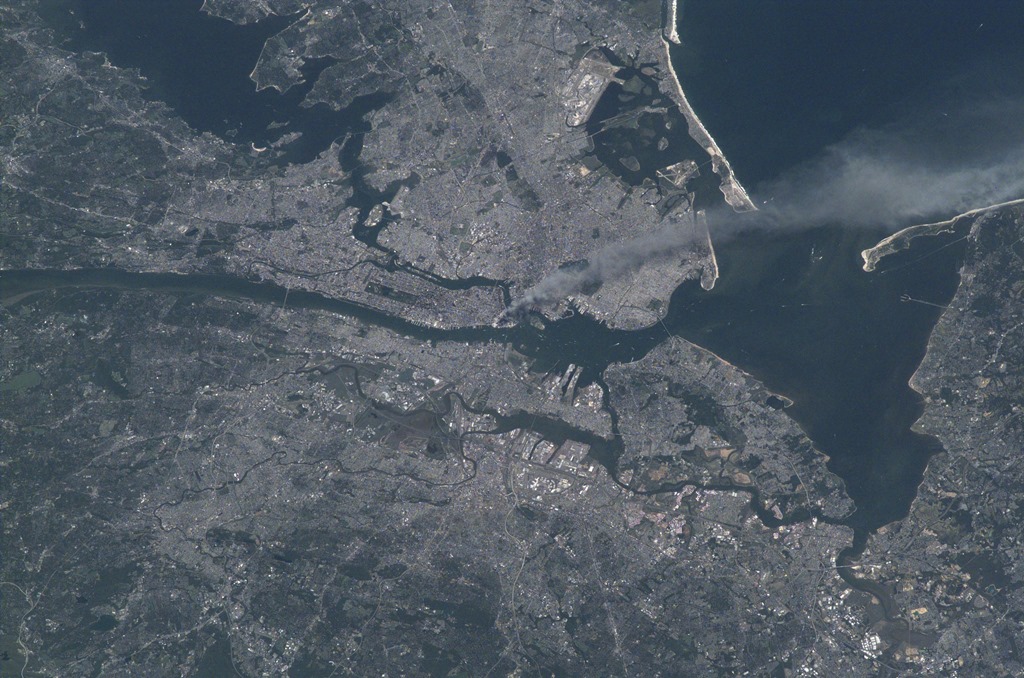
We love anniversaries that come in numbers ending in zero and five, ascribe to them some extra significance, and today is just that way.  There’s no shortage of think pieces out there taking a stab at explaining what we’ve learned about ourselves in the last 20 years, or what we have failed to learn in that time.  There are the first-person memories of being in New York and seeing it happen…or of being inside the towers as they were struck, and shook, and caught fire, and what it was like to save your own life as you joined thousands of others trying to get outside before it was too late.   And then seeing what was out there.  And ultimately, seeing those buildings collapse on themselves.  NASA astronaut Frank Culbertson was the commander of the International Space Station on that day, and he took this picture as they flew above Lower Manhattan just about the time the second tower fell.

iss003e5387_full

Ironically, Culbertson was a Naval Academy classmate, and friend, of Chic Burlingame, who was the captain of the flight that was hijacked that day and crashed into the Pentagon.


America’s war in Afghanistan started as a direct response to the attacks that happened 20 years ago today.  We went after Al Qaeda and its leader Osama bin Laden, and the whole world was on our side: no one questioned the righteousness of the U.S. decision to retaliate against the people behind these unprovoked attacks.  Hell, the rest of the world helped: it was the only time in its existence that NATO invoked the collective defense clause of the treaty.  It took nearly ten full years before Navy SEALs located the Al Qaeda leader in Pakistan and took him out, and ten more years after that before the last American military forces were withdrawn from Afghanistan.

We took our revenge, as we should.  But it still doesn’t feel like we made the best use of the 20 years to understand why the terrorists attacked us in the first place, or to learn how to treat the rest of the world in a way that would make the most dangerous people out there hate us less and be less inclined to attack us.  And meanwhile, America has become a more dangerous place.

Instead of a new order, 9/11…gave rise to the angry, aggrieved, self-proclaimed patriot, and heightened surveillance and suspicion in the name of common defense.

(snip)

In shock from the assault, a swath of American society embraced the us vs. them binary outlook articulated by [President George W.] Bush — “Either you are with us, or you are with the terrorists” — and has never let go of it.

You could hear it in the country songs and talk radio, and during presidential campaigns, offering the balm of a bloodlust cry for revenge. “We’ll put a boot in your ass, it’s the American way,” Toby Keith promised America’s enemies in one of the most popular of those songs in 2002.

Americans stuck flags in yards and on the back of trucks. Factionalism hardened inside America, in school board fights, on Facebook posts, and in national politics, so that opposing views were treated as propaganda from mortal enemies. The concept of enemy also evolved, from not simply the terrorist but also to the immigrant, or the conflation of the terrorist as immigrant trying to cross the border.

The patriot under threat became a personal and political identity in the United States. Fifteen years later, [Donald] Trump harnessed it to help him win the presidency.

In the week after the attacks, Bush demanded of Americans that they know “Islam is peace” and that the attacks were a perversion of that religion. He told the country that American Muslims are us, not them, even as mosques came under surveillance and Arabs coming to the U.S. to take their kids to Disneyland or go to school risked being detained for questioning.

For Trump, in contrast, everything was always about them, the outsiders.

In the birther lie Trump promoted before his presidency, Barack Obama was an outsider. In Trump’s campaigns and administration, Muslims and immigrants were outsiders. The “China virus” was a foreign interloper, too.

(snip)

The legacies of 9/11 ripple both in obvious and unusual ways.

Most directly, millions of people in the U.S. and Europe go about their public business under the constant gaze of security cameras while other surveillance tools scoop up private communications. The government layered post-9/11 bureaucracies on to law enforcement to support the expansive security apparatus.

Militarization is more evident now, from large cities to small towns that now own military vehicles and weapons that seem well out of proportion to any terrorist threat. Government offices have become fortifications and airports a security maze.

But as profound an event as 9/11 was, its immediate effect on how the world has been ordered was temporary and largely undone by domestic political forces, a global economic downturn and now a lethal pandemic.


Journalist, author and filmmaker Chris Tomlinson is an Army veteran and former AP reporter and editor.  In his column in the Houston Chronicle today he provides a background based on what he’s seen and learned fighting and covering wars from back into the 1980s, including the post-September 11 conflicts in the Middle East and Asia, and offers a thoughtful summary of where we ought to turn our attention to prevent another September 11, and probably improve our lives.

In debating the last 20 years, we can talk about the limits of military power, the futility of nation-building, and the inevitable failure of occupations. We can chatter about politics, diplomacy and negotiation. But the most crucial and ignored lesson is one taught to all the children of Abraham.

Do unto others as you would have them do unto you.

Respect is the foundation of peace. We must treat all people with fairness and justice. We must recognize that other nations are not failed attempts to become the United States. Most foreigners do not want to be us; they are proud of the cultures and traditions they spent millennia creating.

We can exchange insights. We should support each other’s progress. We may learn from one another. But we must limit ourselves to setting an example, lending a hand, and sharing knowledge. We must defend ourselves but cannot rely on invading armies, economic sanctions, and cultural imperialism to change the world to look more like us.

Such coercion has triggered a global rise in nationalism and authoritarianism. Tolerance is ebbing. Justifications for injustice are everywhere. Hate is overpowering love in the quest for power. We are not any safer.

Despite the last 20 years, we still value competition over cooperation and war over peace. Some day we may become a nation of philosopher-kings rather than warrior-kings, but for now, we still choose to live by the sword.

A U.S. sailor’s bullet silenced Bin Laden’s voice, but millions more bullets did not bring peace or justice to the world. I no longer report from war zones, instead I write about commerce because the surest path to peace is prosperity for all. Perhaps we can give that a try.