“Biggest con job since the Trojan horse”

The phrase jumped off the obituary page in Houston’s Leading Information Source last June: Elene Davis passed away from “…complications due to congestive heart failure and the 2016 Presidential campaign.”  Imagine if she’d seen what’s gone on in the past week!

Late last month I saved the link to this Garrison Keillor column punching again at Donald Trump, noting that “a panhandler in Times Square sat holding a sign reading, ‘Give me a dollar or I’ll vote for Trump,’ and people laughed and reached into their pockets.”

His bucket overflowed. He stuffed the bills into his jacket, and other panhandlers looked at him with admiration. The man could’ve sold franchises and retired to Palm Beach.  The panhandler knows what every New Yorker knows, which is that the biggest con job since the Trojan horse is taking place in our midst. Millions of Americans are planning to cast their votes for a man who has lived his life contrary to all of their most cherished values. They are respectful, honest, generous, loyal, modest, church-going people with no Mafia connections and good credit records who try not to spout off about things they know nothing about.

The same week USA Today did something it had never done in its thirty-four years of publication: it took sides in a presidential race:

This year, the choice isn’t between two capable major party nominees who happen to have significant ideological differences. This year, one of the candidates — Republican nominee Donald Trump — is, by unanimous consensus of the Editorial Board, unfit for the presidency.

From the day he declared his candidacy 15 months ago through this week’s first presidential debate, Trump has demonstrated repeatedly that he lacks the temperament, knowledge, steadiness and honesty that America needs from its presidents.

Then it went on to spell out the record, that Trump is erratic, ill-equipped to be commander in chief, traffics in prejudice, has a checkered business career, and more.  The Atlantic quadrupled-down when it comes to historical precedent, making only its third endorsement since 1860 and the first since recommending Lyndon Johnson over Barry Goldwater:

Today, our position is similar to the one in which The Atlantic’s editors found themselves in 1964. We are impressed by many of the qualities of the Democratic Party’s nominee for president, even as we are exasperated by others, but we are mainly concerned with the Republican Party’s nominee, Donald J. Trump, who might be the most ostentatiously unqualified major-party candidate in the 227-year history of the American presidency.

(snip)

Hillary Rodham Clinton has more than earned, through her service to the country as first lady, as a senator from New York, and as secretary of state, the right to be taken seriously as a White House contender. She has flaws (some legitimately troubling, some exaggerated by her opponents), but she is among the most prepared candidates ever to seek the presidency. We are confident that she understands the role of the United States in the world; we have no doubt that she will apply herself assiduously to the problems confronting this country; and she has demonstrated an aptitude for analysis and hard work.

Donald Trump, on the other hand, has no record of public service and no qualifications for public office. His affect is that of an infomercial huckster; he traffics in conspiracy theories and racist invective; he is appallingly sexist; he is erratic, secretive, and xenophobic; he expresses admiration for authoritarian rulers, and evinces authoritarian tendencies himself. He is easily goaded, a poor quality for someone seeking control of America’s nuclear arsenal. He is an enemy of fact-based discourse; he is ignorant of, and indifferent to, the Constitution; he appears not to read.

This week the Republican Party’s nominee added something new and bizarre when he repeated to CNN his belief that the Central Park 5 are guilty of a famous 1989 rape and beating of a jogger in Central Park.  That is, he claims that the five men (who were teenagers in 1989) originally convicted of the crime but “exonerated in 2002 when an investigation by the Manhattan district attorney found DNA evidence linking the vicious crime to a previously convicted rapist. That man admitted to acting alone in the crime” are, nevertheless, the guilty parties.  DNA evidence to the contrary, and the confession of the actual guilty party notwithstanding, Trump today insists those five men are guilty of the crime.  It’s one thing to have taken a stand on an issue and then have time and the facts ultimately prove you to be wrong; it happens.  But Trump is incapable of acknowledging the facts laid out for everyone to see, and rather than admit a thoroughly human error–or even, God forbid, just shut his damn mouth–he repeats his error.

Dumb ol’ me, here I am thinking that should be enough to shock some more Trump supporters into realizing just what a moron he is…but then the issue completely disappears when the Washington Post’s David Fahrenthold publishes the Access Hollywood videotape that has dozens of high-ranking Republicans elbowing each other out of the way to jump off the Trumptanic.  (Fahrenthold is the reporter who’s dug into the Trump Foundation and found it to be far less than the charitable organ that’s advertised.)  I won’t pretend to be horrified by Trump’s comments, which on their face do resemble an admission of numerous instances of sexual assault (if you assume he was telling the truth and not just “bragging”), since they reinforce my previously-held belief that he’s a genuine creep, as well as an ignorant narcissistic megalomaniac with the attention span of a three year old.

Question for those now changing their minds on Trump: why now?  Does this incident just seem to be a good excuse that also allows you to pander to the puritanical element of your constituency?  It seems like you’ve passed up plenty of chances to do the right thing…

The Deseret News, among others, is now calling on Trump to drop out; I hope he keeps his promise not to withdraw from the race because I think he’s now on an irreversible slide to a yuuuge loss and I want the Republican Party and the crazy right-wing element that nominated this yutz to feel the pain of what they’ve done while they consider their future…yesterday Craig Mazin storified a Tweetstorm that pretty well sums up the path forward for the GOP.

I’d also like to see NBC News pay for its role.  Producers for Access Hollywood, which is a corporate relation of NBC, brought the tape to the network last Monday and they sent it to their lawyers; while a legal review was prudent, withholding permission to publish out of fear that Trump would sue is plain old cowardice: in real journalism, being sued by powerful people over a big story is sometimes just part of the deal.  So far Trump has apologized and he’s started to accuse others of being bad guys, but he hasn’t threatened to sue anyone.  It appears that someone in NBC who was frustrated at the delays leaked the tape to the Washington Post, leaving NBC to be scooped on its own story.

Now, let’s see how Trump handles the town hall-style debate this evening when, hopefully, the nice people at Washington University will insist on straight answers rather than a string of sentence fragments out of the Republican nominee.  I predict that without a fawning audience to buoy him, the real, ugly Donald Trump is likely to be on full display.


Where we go from here

We’ve endured the Democratic and Republican parties’ conventions, which spit out the nominees for president that we’ve been expecting for many many weeks.  What are we faced with, looking at the 100 days left before the general election?

Donald Trump is not well known, perhaps in his inconsistencies unknowable, but what he has shown us, or what we’ve been able to learn despite him, troubles many people–including some leaders of the Republican Party, who even now refuse to endorse him.  Hillary Clinton is not an unknown, and what we know isn’t especially inspiring. She is not well liked by many Democrats and has been demonized for so long by her enemies on the right that it’s hard to imagine her being able to work with Republicans in Congress and get much done.

Ezra Klein on Vox.com makes the case that we have a choice between normal and not normal.  It seems to me that, given today’s dysfunctional dynamic between Republicans and Democrats, making a “not normal” choice could be a good thing, and I guess many of those who support Trump feel the same way.  But let’s agree that while something better than what we have would be welcomed, simply being different doesn’t automatically make a thing better.  A Trump presidency would not be better.  Not by a long shot.

The Washington Post calls Trump “a unique threat to American democracy”:

He is mounting a campaign of snarl and sneer, not substance. To the extent he has views, they are wrong in their diagnosis of America’s problems and dangerous in their proposed solutions. Mr. Trump’s politics of denigration and division could strain the bonds that have held a diverse nation together. His contempt for constitutional norms might reveal the nation’s two-century-old experiment in checks and balances to be more fragile than we knew.

Any one of these characteristics would be disqualifying; together, they make Mr. Trump a peril.

Frank Bruni in The New York Times finds that Trump’s simple patriotism “doesn’t add up.”:

But there’s nothing simple about a patriotism that allows someone to brag, as Trump has done, about paying as little in taxes as he can possibly get away with, and that permits him to flout an important political tradition of candidates’ releasing their tax returns.

There’s nothing simple about a patriotism that advocates torture, as Trump has also done, when our conduct in waging war is ideally what sets us apart from less principled countries and earns us the respect of the world.

And there’s nothing simple about a patriotism that’s really an amalgam of nativism, racism, isolationism and xenophobia and that denies this country’s distinction as a land of fresh starts, its arms open to a diverse world.

The specter of Trump was enough for Mr. Republican, George Will, to decide to terminate his membership in the Republican Party, for former GOP congressman and MSNBC host Joe Scarborough to urge Republican candidates to keep their distance from the top of the ticket, and for Republican political pro Mark Salter to deliver a clear and concise list of reasons why Republicans with any sense of integrity or shame should avoid him, including:

He’s an ignoramus whose knowledge of public issues is more superficial than an occasional newspaper reader’s. He casts his intellectual laziness as a choice, a deliberate avoidance of expert views that might contaminate his ill-informed opinions.

(snip)

He’s a charlatan, preposterously posing as a business genius while cheating investors, subcontractors, and his own customers. He’s rich because his father left him a great deal of money. He couldn’t turn a profit with a casino, for crying out loud.

(snip)

He possesses the emotional maturity of a 6-year-old. He can’t let go of any slight, real or imagined, from taunts about the length of his fingers to skepticism about his portfolio.

(snip)

He doesn’t appeal to a single honorable quality or instinct in our society. He exploits fear and incites hatred. They are the emotions that impel him. He wants us to make our way in the world as he does: selfish, insecure, angry, scapegoating, small.

Do we want change for the better?  Sure we do.  But do we want to change to someone who is radically outside of the norms of political activity as we’ve known it, and as it’s developed in this country over hundreds of years?  If this is the available choice, I don’t think so, and I’m not alone.  Today Houston’s Leading Information Source joined the group of publications that are already endorsing Clinton because Trump is so damn terrible!

An election between the Democrat Clinton and, let’s say, the Republican Jeb Bush or John Kasich or Marco Rubio, even the hyper-ideological Ted Cruz, would spark a much-needed debate about the role of government and the nation’s future, about each candidate’s experience and abilities. But those Republican hopefuls have been vanquished. To choose the candidate who defeated them – fairly and decisively, we should point out – is to repudiate the most basic notions of competence and capability.

Any one of Trump’s less-than-sterling qualities – his erratic temperament, his dodgy business practices, his racism, his Putin-like strongman inclinations and faux-populist demagoguery, his contempt for the rule of law, his ignorance – is enough to be disqualifying. His convention-speech comment, “I alone can fix it,” should make every American shudder. He is, we believe, a danger to the Republic.

After more than a year of campaigning–a hell of a slog for us voters to endure, if you ask me–this campaign still has more than three months to go, and there’s a danger that we may become inured to the outrageousness of Trump’s actions and words.  Let me warn again: please, do not let the craziness of Trumpism become normal; don’t let yourself come to believe that what he’s doing and saying isn’t so bad because we’ve been hearing it for so long.  They are far from normal, and we need to still be able to see that when election day finally gets here.

It’s a Daily Double!

Now, what was I just saying (in the preceding post): politicians think voters are stupid, yes, but some seem to have no problem letting us voters know that they’re cut from the same cloth.  I give you, former Texas governor Rick Perry.

In a ceremony at the state capitol in Austin on Friday, a day after John Kasich joined all the other Republican presidential candidates on the sideline, which signaled the official start of a full-fledged identity crisis for the Republican Party (how entertaining!), our former governor and erstwhile GOP presidential contestant, a man who endorsed Ted Cruz for president and had called Donald Trump, among other things, “a cancer on conservative politics,” ever-so-casually endorsed Trump and even allowed as how he would campaign for him and wouldn’t mind being his running mate.

Then Perry took the hypocrisy one step further and explained that it’s all just politics:

“If you recall back in 2011, 2012, I probably said some harsh things about Mitt Romney,” Perry said of the first of his two unsuccessful runs for the GOP presidential nomination. “He said some harsh things about me. We are competitors, so the rhetoric is the heat of battle. It’s in the chaos of the presidential bid. … If one doesn’t understand that, then they don’t understand how our process of elections works. We compete, and then we let bygones be bygones.”

So, he really didn’t believe what he trash-talked about Trump before?

“As late as this last week … I said he’s one of the most talented people I’ve ever seen. He knows how to market. He knows how to brand. He’s vanquished 16 pretty capable men and women,” Perry said. “So, from the standpoint of his being capable to lead, to have the vision to take this country forward, I think it’s important to have a president who understands economically how to move this country forward and how to build our military back up – an individual who knows how to govern.[“]

Excuse me: you can say anything you want about another candidate during a campaign, and you presume that I know that you don’t really believe any of it, because it’s all “just politics?”  A campaign is the opportunity to make shit up about your opponents, and it’s OK because while the people are stupid enough to choose who they support based on your lies, they’re also smart enough to know that you’re lying and that’s no big whoop because it’s just politics?

Oh, and another thing: you think Trump is qualified to be president because he can market!?  And somehow you look at Trump and see someone who knows how to govern!?!?  Put your glasses back on, Paint Creek, and take a closer look.


You never forget your first time

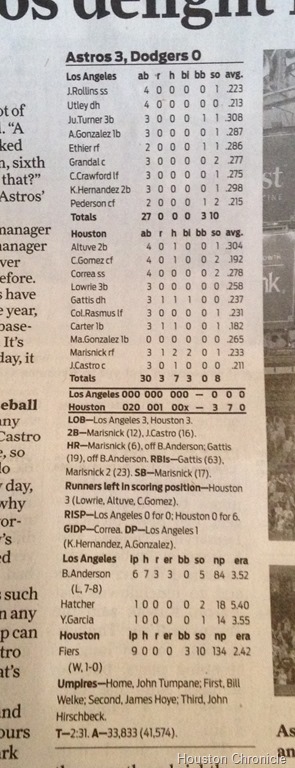
These days a mini-season ticket package for the Houston Astros gets you a seat to 28 games out of the 81-game home schedule, at least one game in every series the team plays at Minute Maid Park over the long baseball season.  My ticket for last Friday night’s game against the Los Angeles Dodgers has been sitting on the shelf in my office since March, drawing no more attention than any of the 27 others on the pre-perforated sheets that I keep in the original mailing envelope.  When a colleague at work asked on Friday morning who that night’s starters would be, I had no idea and had to look it up.

The big news about this interleague series between one-time National League rivals was that Zack Greinke and Clayton Kershaw, the Dodgers’ two best pitchers—two of the best in baseball—were to face the Astros on Saturday and Sunday.  The Dodgers’ Friday starter Brett Anderson was OK but not up to the level of his teammates, and the Astros’ Mike Fiers…well, he’s new here, and hasn’t really shown much so far.  The match-up didn’t generate much enthusiasm.

When I got to my seat the thing that had my full attention was something I’d forgotten.  At the game on Tuesday my friend Paul was wearing an AstrospMLB2-16625621dt blue batting practice jersey with the name and number of a player not on the team any more. He explained that he and other friends had wandered into a store that sells jerseys that were worn by players in real games, and as a joke they decided to treat themselves to the shirts of some players who might be said to have laid the groundwork for the first-place Astros of today.  That is, bad players who aren’t here anymore, or so-so players who’d been traded for better players: Paul was wearing Jarred Cosart’s Number 48, David had Brett Wallace’s Number 29.  He suggested I join the fun.

Sure, why not.  But that night the one store carrying those jerseys closed before I could get there, and Friday night I forgot all about it until I got to our seats and saw Paul.  So, with a giant beer in one hand and a giant soft pretzel in the other, and only fifteen minutes before first pitch, I set off: down from our upper level seats behind home plate to the concourse, around the concourse to a stairwell, down three flights of stairs to the main level, and the rest of the way around to the shop behind center field.  To improve my overall mobility, I stuffed the pretzel in my mouth and swallowed the last of it as I arrived at the Island of Misfit’s Jerseys, and put the can of beer on the ground so I could dig through the racks.  I must have spent four whole minutes grubbing through the hangers until I found a jersey that fit: not only from a player who fit the requirements for inclusion in our little stunt, but a shirt that fit me.  I walked away with the Number 22 of former backup catcher Carlos Corporan, in a size 50.  Jersey sizes run pretty big.

I was feeling it: not content to carry my trophy IMG_0220back upstairs folded up in a plastic bag, I threw it on over the shirt I was wearing, picked up my big beer and retraced my steps back around the concourse to the stairwell, up three flights to the View Deck (no, really, that’s what the upper level is called at Minute Maid Park), back around behind home and back to my section as the national anthem began.  I waited on the stairs, and after “…home of the brave” I bounced up on the front of our section, yelled for Paul’s attention and spun around to show off my prize.  He laughed as I dragged myself up the last six rows and plopped down before the first pitch.

Fiers had a slow start and was throwing a lot of pitches; I was sweating in the air conditioned building, a combination of catching my breath from my impromptu shopping trip and, as mentioned, I was wearing two shirts; before the Dodgers went down in the first I’d unbuttoned the Corporan.  By the end of the second I needed another beer, so that’s another trip down from Row 6, over to the concession stand that sells the cold beer (gotta know these things to be an Astros fan), and then back upstairs; I’d cooled off enough by then that I could button the jersey back up and look presentable.  The Astros’ pitcher had throw to the plate 60 times by the end of the third inning and didn’t look sharp, probably not long for this game.

By that time Paul had adjourned to meet other friends and I was fiddling with my phone, trying to get Twitter to work either with or without the stadium’s wi-fi and not having any luck.  I remember looking up at the scoreboard each inning and seeing that the Dodgers still had no hits, and thinking there was no way Fiers could stay in the game until the end.  But he kept coming back…and back…and back again.  He struck out the side in the 8th.

The Astros did nothing in the 8th, and every eye around me turned to the home team dugout:

Yep, by then I was getting some connection on Twitter and I decided to see if my fat typing thumbs on a tiny virtual keyboard could keep up with the action:

Now wait a minute…

…this could really happen…

(It was Chase Utley’s first game with the Dodgers after the trade, and it took me until the middle of the game to realize: he was back together with Jimmy Rollins, his teammate from the Phillies who’d signed with Los Angeles in the off season.  So much for being aware of what’s going on!)

And that brought up Justin Turner, a Dodger I really had never heard of before…

I think this is going to happen…

Yes, I really think this is about to happen…here comes pitch number 134 of the night:

20150821_astrosdodgers_btc_12IMG_0219First no hitter in Mike Fiers’ career, which now totals just 59 starts, only three of them for Houston since he came over in a trade with the Milwaukee Brewers just under the waiver deadline last month.  It’s the first no hitter ever thrown at Minute Maid Park, now in its sixteenth season, and the first one I’ve seen in person in a baseball-watching career that’s significantly longer than sixteen years.  I’m proud to say that I had enough awareness in the moment to turn on the camera on my phone and point it at the players celebrating on the field, and also at the people around me who were a-whoopin’ and a-hollerin’ and jumpin’ ever’ which way at this most unexpected turn of events on a Friday night.  I’m less proud of my skill at operating the smartphone and Twitter:

Yes, there was grumbling from the Dodgers on Friday about the umpiring, and a story today about accusations of a foreign substance seen in Fiers’ glove, but it really did happen: I got a new shirt just in time to see a little baseball history made in this unlikeliest of Houston Astros’ seasons.

Equal protection: it’s what we do here at the ol’ USA

The first time I wrote about gay marriage rights here was more than four and half years ago  (“Equal justice for all: the gay rights tide has turned,” Oct. 15, 2010) and the kernel of the argument was already formed:

We can proclaim not to understand why people are homosexual, or embrace a religious belief that homosexual activity is a sin, but none of that matters in a tolerant, secular, civil society.  The experts can’t say why a person is sexually attracted to one gender or the other.  And it violates the rights of due process and free speech guaranteed to each American in the Constitution to treat someone differently because of their sexual orientation just as it would to treat them differently because of their gender or their ancestry.

(snip)

You don’t have to “understand” gay people any more than you have to “understand” people of a different race or a different religion.  You only have to understand that these people are Americans like you, who believe in American rights like you do, who want to enjoy American freedoms like you do…

This week, history: a 5-4 decision from the Supreme Court of the United States in Obergefell v Hopkins takes its place alongside the great civil rights and civil liberties decisions of American jurisprudence.  The U.S. Constitution guarantees the right of all Americans to civil marriage, and all its advantages and protections, be they heterosexual, homosexual, bisexual, or asexual.  As far as the civil law is concerned this isn’t about sex: it’s about equal treatment under the law.

Homosexual conduct is no longer a civil crime in this country, and thus is no reason to withhold the full rights and exercise of citizenship from homosexuals.  Homosexual conduct is objectionable within many organized religions, to be sure, and virtually all of the opposition to extending the right to marry to gays and lesbians has come on religious grounds.  For the most part I don’t question the sincerity of that religious belief (although it would be prudent to account for the cynical exploiters, primarily from the political realm).

But that’s beside the crucial point, which is that, in this country, civil law is not answerable to religious law.  The First Amendment guarantees that we each and all get the freedom to practice our religions, but also guarantees that none of those religions wields authority directly over civil society.  The Constitution protects us from any majority that would try to force one or another religious doctrine onto everyone—because the Constitution takes religious liberty for all just that seriously—and guarantees that all men and women deserve equal treatment under law.  Despite the nearly hysterical dissenting opinions of some of his colleagues, Justice Anthony Kennedy’s decision didn’t create a new right; it reminded us about a right that’s been there all along…and my friend Mr. Jefferson recognized the rationale by which Kennedy connected the dots (and Peter Foster of the Daily Telegraph reminded via the Twitterverse) long ago:

Obergefell does not mean that First Amendment protections of religious liberties are at risk, despite what you’ve heard.  Some of that reaction is well-intentioned misinformation; most is hot air from right-wing politicians and conservative religious extremists who need a boogieman to scare their supporters into donating money.  (I’m looking at you, Governor Abbott—thanks, Evan Smith for the Tweet-tip.)  In either case, they are wrong.  Religious organizations are exempt from this ruling, as they are exempt from many other laws, like, say, tax laws.  As Lisa Falkenberg put it in this morning’s Houston Chronicle, this ruling has no applicability to individuals in their private lives or to private religious institutions: “It does not keep anyone from judging, or hating, or even just politely refusing to acknowledge gay people.  No court ruling has ever told a pastor whose wedding he or she can bless.  That hasn’t changed.”

It is possible to believe in the religious sacrament of marriage and still accept this court’s decision on civil marriage rights for homosexuals.  Michigan Representative Justin Amash, a Tea Party/Libertarian/Republican, made the point quite nicely this week on Facebook:

Throughout history, different cultures have defined marriage according to their own customs and practices. Christians, Jews, Muslims, Buddhists, Hindus, agnostics, and atheists do not share identical views on marriage. In fact, significant differences regarding marriage exist even within Christianity.

What makes marriage traditional is not its adherence to a universal definition but rather that it is defined by personal faith, not by government. For thousands of years, marriage flourished without a universal definition and without government intervention. Then came licensing of marriage. In recent decades, we’ve seen state legislatures and ballot initiatives define marriage, putting government improperly at the helm of this sacred institution.

Those who care about liberty should not be satisfied with the current situation. Government intervention in marriage presents new threats to religious freedom and provides no advantages, for gay or straight couples, over unlicensed (i.e., traditional) marriage. But we shouldn’t blame the Supreme Court for where things stand.

To the extent that Americans across the political spectrum view government marriage as authoritative and unlicensed marriage as quaint, our laws must treat marriage—and the corresponding legal benefits that attach—as they would any other government institution. So, while today’s Supreme Court opinion rests upon the false premise that government licensure is necessary to validate the intimate relationships of consenting adults, I applaud the important principle enshrined in this opinion: that government may not violate the equal rights of individuals in any area in which it asserts authority. (emphasis added)

The civil right of marriage is open to all Americans.  We must be diligent about making sure that the implementation of this decision protects the First Amendment rights of those with a religious objection to same-sex marriage, keeping in mind that it doesn’t give them the right to ignore the law.  And while we’re at it we should work on getting rid of the laws which still permit discrimination against gay Americans in the areas of housing and hiring and other aspects of day to day life, and any other laws that violate anyone’s right to equal treatment.  Because we’re Americans, and that’s what we do.