The gaslighting lamp is now off

Here is a thought I hope we all agree with:

“Free, fair elections are the lifeblood of our democracy. Charges of unfairness are serious. But calling an election unfair does not make it so. Charges require specific allegations and then proof.”

If your response was to say, “Wait, who said that?” then I would argue you’re missing the point.  Is there any set of circumstances in which that sentiment would not be correct?

As far as the current election for president is concerned, I am thankful that there are fewer and fewer steps left on the road to us not having to listen to any more of Donald Trump’s fact-free claims that massive voter fraud cost him re-election.  Yesterday a federal appeals court rejected the Trump campaign’s latest effort to overturn the vote in Pennsylvania.  Decisively, succinctly, and leaving no apparent room for reasonable rebuttal.  And for those who believe this matters—or matters most—all three judges on the panel who returned this unanimous decision were nominated to this court by Republican presidents; the one who wrote this opinion was nominated by Donald Trump.  The summary is elegant in its clarity:

“Free, fair elections are the lifeblood of our democracy. Charges of unfairness are serious. But calling an election unfair does not make it so. Charges require specific allegations and then proof. We have neither here.” (emphasis added)

It’s the same story in most of the dozens of lawsuits: the campaign has provided no evidence of the widespread fraud it claims has taken place.  But it continues to make the claims, perhaps hopeful to eventually run into a judge who isn’t too particular about evidence of a crime.  Classic Trump: it’s true because I say it is true, and how dare you question me!

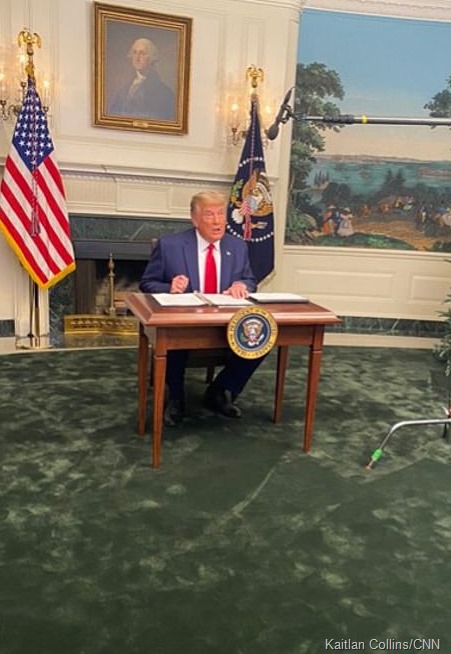
This ruling came a day after the president made his first appearance since the election at which he responded to reporters’36195502-8995371-image-a-10_1606540742101 questions.  The headline out of that was his response when asked if he would leave the White House if the Electoral College votes for Joe Biden; he said he would, and “you know that.”  The fact is, we know nothing of the sort, and we still don’t know it just because he said it.  Because (as I have mentioned from time to time) Donald Trump lies.  About everything.  People who should know better—by which I mean, everybody—saw that performance and came away saying, whew, finally, Trump has promised a peaceful transition of power.  Huh?  Why would you take Trump at his word about this now?
(More broadly, I still don’t get why so many Americans trust him on anything, and are so militant in their defense of him when someone points out a clear falsehood.  The evidence of their own eyes and ears and nose and fingers and memory doesn’t matter to the believers: they stare straight at a patch of black color that Trump has said is white, and they will proclaim without hesitation that it is white…and not, mind you, that they see it to be white, but that it IS white, that there is no wiggle room about it nor any possibility that the color in question could be anything but the color that Trump said it is.  What happened to these people, that they would reflexively support a man who so demonstrably does not support them, and who in his own life does not live up to the personal standards these people have so loudly proclaimed are absolutely necessary for a president?)

I think we need to focus on a point Brian Klaas made yesterday:

https://twitter.com/brianklaas/status/1332313317269000192

“It’s not up to him.”  It’s up to the voters, and they made it pretty clear who they want to be the next president.  Yes, Trump won an historic total of popular votes…but Biden won more, more than 6 million more (and counting), and Biden has won a clear majority of the electoral votes, too—the same number that Trump won four years ago to secure that election.

It was one thing for Trump to win a first term, primarily (I believe) on the votes of people who were not thrilled with him but could not stomach voting for his Democratic opponent.  I’m much more troubled for America’s future when I realize that 74 million Americans voted for Trump this time, knowing what he’s done during the last four years!  The Nobel laureate Paul Krugman has been considering the question, and he generated some thoughtful replies (read the thread):

https://twitter.com/paulkrugman/status/1332338636516454404

…voting for a corrupt, dishonest, incompetent guy who barely conceals his contempt for his own supporters.” I honestly have no idea how we’re supposed to deal with this. To say that many Trump supporters basically engaged in a massive self-own sounds condescending; yet what could be more condescending than pretending that this isn’t exactly what happened?  Again, I have no answer to all of this. I don’t think there are magic words that will make all this resentment disappear; policies that help working Americans might help, but should be done mainly bc they’re the right thing to do. Anyway, I don’t know the answers; all I can suggest is to be honest and promote good policies, knowing full well that the political rewards may be elusive.

Or is it, maybe, as simple as this:

https://twitter.com/PTetlock/status/1176841067808862210

Dear Pat Ryan,

I just thought I’d check in to see how things are going with you.  Some of us have gotten a little curious because we haven’t heard much of anything from you in a while now and we started to wonder what was going on.  I mean, if you say you’re going to write a blog, it is customary to actually write something from time to time.  You know, something to make the customers realize that you’re not stone dead, or ignoring them, or “too busy with work and other things” to be bothered keeping up with your commitments.  C’mon, just six damn posts in the last four months?  What’s the deal?

I mean, fercryingoutloud, in just the last few months you’ve passed up the chance to say something about:

You’ve sort of led people to believe that you cared about civil liberties and the whole gay marriage thing, or were at least interested in the subject, but when

you observe radio silence.  I mean, you gotta understand why the people would at least wonder if you’ve given up, or converted or something.

You even let this great picture on Twitter go by without any acknowledgement!

BkgG_7iIcAE0-Fl

So anyway, I’d just like to say I hope you get your shit together and try to be a little more regular contributor in this space, or the owners may start thinking seriously about changing the name up there at the top of the page.

Watch Cosmos, be less dumb

I wouldn’t be much of a television professional if I didn’t watch a lot of TV, have an opinion on all of it, and insist on sharing that opinion even when you don’t ask.  But I do; I do; and even though you didn’t, here goes.

I hope you’re watching Cosmos.  If you’re not, you can catch it online here as well as on Fox and a few of the Fox-affiliated networks; next new episode is Sunday night.  Astronomer/rock star Neil deGrasse Tyson is an engaging if slightly self-absorbed host for a journey of the imagination that’s not only exploring out in space, but back in time.  This version takes full advantage of the capabilities of the medium in the modern day and tells a great story.  I don’t find it as enthralling as the original with astronomer/rock star Carl Sagan back in 1980, but it’s not fair to compare the two, not for people like me who saw the Sagan series when we were young and the things he talked about were actually new and unknown to us.  For me, it had the advantage of provoking wonderment in a way the current version just can’t; I hope it does for the kids of today.

The new series, produced by Sagan’s widow Ann Druyan, Seth McFarlane and others, is providing easy-to-follow explanations of some difficult scientific concepts.  The writers and producers have found a way to lay things out so you can understand the concept in the same way you eat an elephant (one bite at a time); it’s not scary to learn new things here.  I particularly liked Episode 2 for the explanation of evolution by natural selection.  Anyone who didn’t watch that show with a preset determination that evolution is for atheists could grasp the basics; yes, you’ve got to give up the notion that the Earth is only 6000 years old and that people and dinosaurs lived side by side, but you will understand what the scientific terms “evolution” and “natural selection” really mean.  It should be required viewing for the members of the Texas State Board of Education, that’s for sure.

If you prefer yours in a handy graphical form, here’s a swell chart from Reddit user SlipperyFish done for The Infographics Project (thumbnail image via Thinkstock).  Thanks to Upworthy for the link to this short answer to a perennial favorite dumb question:

v10-534111abc1539ee4c33e5c2815aae6d6

If you know anything, thank a reporter

Is it funny-strange that a blog that comments on reporting and journalism has a category for Woeful Journalism but not one to sing its praises, or is it just funny-sad that there hasn’t been a need to have one?

People who came to journalism post-Watergate and later, like I did, have a lot of complaints about the state of the art/profession/trade as it exists today; I suspect our elders have their own hit parade of infamies that we committed.  But my complaint has never been about how the digital revolution is changing the way information is presented to the reader/listener/viewer/consumer/custo-mer, because to my mind the delivery method is a tertiary concern.  The primary concern should be the content, with a little preserving-and-protecting-a-free-and-independent-press as a secondary.

I’m fine with electronic self-publication (duh!), and there’s not a damn thing wrong with everybody expressing their own beliefs and opinions.  But I don’t ever confuse what I and thousands and thousands of other people do at our own private keyboards with what real, professional reporters do out in the world every day.  Today I ran across two great examples of why that job is hard to do, and why it can be dangerous to do.

When the Earth quakes and the ocean covers the land and nuclear reactors split open, real reporters go to the danger because that’s where the story is.  When a dictator sends his army against its own people to suppress their expression of a desire for freedom, real reporters go to the danger because that’s where the story is.  Real reporters leave their comfortable homes and go where the news is happening, to observe real events and talk to real people, to report, so the rest of us can know what’s going on.  The biggest risk we stay-at-home bloggers take is suffering a fragmented hard drive.

The next time you hear someone complain about the biased news media, remind them that it’s real reporters, working for all kinds of publications, who provide us all with the raw data that pundits and demagogues misconstrue to suit their own purposes, and that sometimes they risk their lives to do it.  More times than you probably imagine, they lose their lives doing it.  We owe them our thanks and our respect.

→UPDATE Mar. 21: Times reporters released by Libya
