
At this point in the discussion there is really only one question left

This has been swirling around in the vast empty expanses of the inside of my head for a few weeks now; it comes up again whenever I hear another story about members of Congress not doing one of their basic jobs, providing for the smooth operation of our federal government.

The House and Senate are supposed to pass a budget to fund operations of the federal government, but they haven’t done so in years.  They’ve passed a series of continuing resolutions, which essentially renew the previous spending plan for government departments.  Today is the last day of the federal government’s fiscal year, the day the previous budget plans expire.  You’d think Congress would take care of that, right?  In fairness, most members of Congress want to pass new spending legislation, but they’re being stymied by extremist Republican/Tea Party members who are still fighting the fight over the Affordable Care Act.  Obamacare.

The president’s signature piece of legislation overhauling the way we provide and pay for health care insurance in this country was approved by Congress after a terrific fight; the law has since been found by the Supreme Court of the United States to be constitutional.  Like a lot of laws, this one doesn’t enjoy the full support of everyone in the country, but it did win support of a majority in Congress and on the Supreme Court, and that’s what it needs to become the law of the land.  It’s a big victory for President Obama, maybe his biggest.

So, why…why, why why, in the wide wide world of sports, do the extremist Republicans think they can convince the president to just give it up?  Because that’s’ what they’re doing right now.

It is Congress’ responsibility to pass the spending legislation, no one else can do it for them; but the extremist Republicans in the House (to this point) will only pass a spending plan that specifically cuts out funding for the new health care insurance law.  Surprise, surprise: the Democrats in the Senate refuse to accept that, and they pass legislation that funds Obamacare and send it back to the House.  Stalemate.

So the extremist Republicans offer a compromise, promising to pass a bill to fund the government if the president and the Senate will agree to delay implementation of the ACA.  And I ask, again: why the hell would they agree to that?

I get it, extremist conservatives don’t like the new law.  Why they’re so vehemently opposed to it is not the point right now; the point, I believe, is that it’s insane for them to think that threatening to hold their breathes until they turn collectively blue is a viable strategy to either force or persuade their political opponents to hand over the marbles they won fair and square.

In a negotiation, in an attempt to come to a compromise solution, one side offers the other something it wants in return for a concession, and they trade offers back and forth until they (hopefully) come to an agreement.  Here, the extremist Republicans aren’t offering the other side something it wants in an effort to come to an agreement…in fact, the thing the other side wants in this case—a new spending plan—is something the Congress is bound by law to provide, no negotiation required.  Instead, the extremist Republicans are threatening to take action (or more accurately for this case, inaction) that will hurt EVERYBODY if they don’t get their way.

I ran across a very interesting short blog post by James Fallows at The Atlantic this morning, in which he distills important points that I think we should all keep in mind as we consider the on-going dysfunction in our government and our politics in the last generation or so: the only fight that really matters today is the one within the Republican Party, and that we are cruelly disserved by any alleged “journalism“ that doesn’t see that and report it plainly.

…the fight that matters is within the Republican party, and that fight is over whether compromise itself is legitimate.** Outsiders to this struggle — the president and his administration, Democratic legislators as a group, voters or “opinion leaders” outside the generally safe districts that elected the new House majority — have essentially no leverage over the outcome. I can’t recall any situation like this in my own experience, and the only even-approximate historic parallel (with obvious differences) is the inability of Northern/free-state opinion to affect the debate within the slave-state South from the 1840s onward. Nor is there a conceivable “compromise” the Democrats could offer that would placate the other side.

(snip)

This isn’t “gridlock.” It is a ferocious struggle within one party, between its traditionalists and its radical factions, with results that unfortunately can harm all the rest of us — and, should there be a debt default, could harm the rest of the world too.

Check out his post for links to some of the journalists Fallows believes are reporting the real heart of the problem…I plan to do that tomorrow if the furlough begins and I find myself with extra time on my hands.
It’s not as hard as I thought it would be to praise Congress for doing its job

The Senate took action first, agreeing on spending authorizations to keep the government operating until the end of the fiscal year; the House did the same the next day. Thing is, they both did what needed to be done more than a week before the drop-dead-line that would have seen the government start to shut down for lack of operating funds. How uncharacteristic of them.

In the past few years the American Congress has never missed an opportunity to run right up to the brink of any fiscal catastrophe; like the Road Runner being chased by Wile E. Coyote, it safely came to a screeching standstill in a cloud of dust just on the edge of the abyss (beep beep). To what do we owe this unusual display of fiscal responsibility? I don’t know, but I’d like to order another round.

It had become too easy and too predictable for the thousands and thousands of voices online and on air and in print to chastise House and Senate, Republican and Democrat, for failing/refusing to take care of business. I’d begun to think it was ultimately ineffective as well, but maybe–just maybe–there was still some shard of humanness left deep inside our elected representatives that was tired of being ridiculed and abused, that knew that the voices raised in criticism had a point. It’s not that I’m pleased with the details of the budget the government will operate under for the next six months, but that I’m pleased “the government” got off of its ass and made a decision with something less than the usual quotient of bluster and drama…the “sound and fury” that, as is often the case in our politics, signifies nothing.

So, good on ’em for what they done (there, I said it; are you happy?). And fine, let them go ahead and propose future budgets, have debates and secret meetings and public hearings and horse-trading and try to persuade us all of the virtue of their ideas; that’s the way we’re supposed to try to come to a consensus on public issues. Just because I don’t have the heart or the stomach for this circus right now doesn’t mean the rest of you should miss out on the fun.

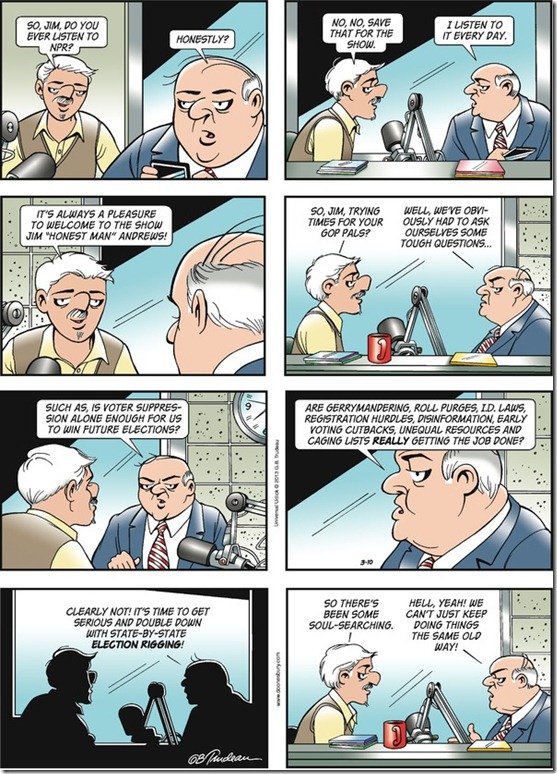
So, the GOP is rethinking how it can appeal to a wider range of voters…

…and Mark Slackmeyer asks how it’s going:

db130310

thanks, Doonesbury and GoComics.com.

The only “real” reality show is just too depressing to watch

Americans today “are turned off and tuned out of the sequestration mess in Washington. To a person, they are sick of the antics of those to whom they have entrusted enormous power.”  So begins David Gergen in his column today, and I can’t find anything in his argument with which to disagree.

The clowns we elected to represent us in Washington—and in many many cases, re-elected…shame on us—have failed to take care of one of the most fundamental things we send them to Washington to do: set a budget for the operation of our government.  Actually, as Gergen correctly notes, they have failed to do that one thing for four years running—so far.  Back in the summer of 2011 they set a trap to force themselves to act, promising across the board budget cuts at the end of 2012 at such a severe level that it was inconceivable they wouldn’t act to stop them from going into effect; when they still couldn’t beat that deadline they passed a law giving themselves two more months to wrap it up.  Well, here we are, two months later, but this time there doesn’t even seem to be the possibility that they can get together to give themselves more time.  The ineptitude is astounding!

It’s not unusual to have the legislative and executive branches of government  disagree about taxes or spending or any other policy issue; historically, someone on one side or the other finds a way to force a resolution.  But as Gergen points out, “we have a rare moment when both Congress and the president are retreating from their responsibilities. It’s hard to recall a time when we were so leaderless.”  The Republicans and the Democrats, the president and Congress, everyone is busy running from microphone to microphone insisting that there’s nothing they can do about it.  And the whole argument has become so tiresome that even in the face of budget cuts that threaten basic services, things we can all pretty much agree that government should be taking care of, a lot of Americans are just yawning and looking the other way.  How many times can the boy cry “wolf” before the villagers ignore the call?

Let’s hope we haven’t thrown in the towel yet, because this sequestration circle jerk isn’t the end of the line: whether these cuts go into effect this Friday or not, there’s a potential government shutdown only four weeks down the road if there’s no agreement on new spending authorization.  If we don’t dig up some leadership somewhere, what’s been going around for the last few years is going to come around again and again and again.  No winners here, America, not if we aren’t willing to find a compromise that keeps the whole thing from crashing down on our heads.

What the hell just happened here?

For someone who didn’t just go over the fiscal cliff, I’m pretty disappointed with our House and Senate and president. Not surprised, but disappointed…if I can summarize out loud, to help organize my thoughts:

Our elected leaders were faced with some $600 billion worth of automatic tax hikes and spending cuts that might or might not have any real impact in reducing the government’s debt and deficit, but which arguably might push our struggling-to-recover national economy back into a recession; they set a deadline for themselves to act a year and a half ago; then they did nothing, waiting until after the national election to bother to talk about it among themselves so the nasty details of our national fiscal crisis wouldn’t intrude on an otherwise uplifting discussion of the issues of the day; and the best they could come up with—even after the deadline had passed anyway—was a bill that raises marginal income tax rates for some well-to-do folks but not for most of us and kicks the budget cuts can down the road again?! So it’ll have to be taken up at the same time as another increase to the debt ceiling—what could possibly go wrong?!?!

It’s a plan that a majority of Republicans in the House voted against, even though—since the Bush-era tax cuts had just expired at the end of 2012—they were, technically, voting against lowering the tax rate for the bottom 98% or so of Americans.  Because there weren’t enough spending cuts.  Or in this case, any.

Which Barack Obama were Republicans negotiating with—was it the same one that the Conservative Industrial Complex consistently criticizes for being too soft, too dumb to get a good deal for America?

I try to look on the bright side: at least they finally agreed on something, even if it was only that going over the fiscal cliff would be a bad thing. Hooray…take an honorable discharge out of petty cash. (Thanks, Hawkeye.)

(Heavy sigh.)