
Same song, next verse

When I was a college student in the capital city of Texas, the mayor once held his regular weekly news conference and was asked to comment on the fact that the state legislature was about to begin another biennial session under the big pink dome.  His immediate reaction was to say “Lock up the kids and dogs.”

America, your legislature is back in business: the House of Representatives has selected Mike Johnson of Louisiana as its new speaker.  Who is that, you ask, and what does he believe in?  Among other things, he

So, we got that going for us…which is not nice.  Ruth Marcus writes in the Washington Post that any sense of relief you might be feeling that a well-known extremist like Jim Jordan was not elected by Republicans in Congress is misplaced.

For Jordan’s shirt sleeves demeanor and wrestler’s pugnacity, substitute a bespectacled, low-key presentation, a law degree and an unswerving commitment to conservative dogma and former president Donald Trump.

This is not an upgrade. It is Jordan in a more palatable package — evidently smoother, seemingly smarter and, therefore, potentially more effective.

Johnson, now serving his fourth term in Congress, was the moving force behind aSpeaker Johnson Supreme Court brief that helped lay the shoddy intellectual groundwork for Jan. 6, 2021. In December 2020, he rallied fellow Republican lawmakers to support Texas’s brazen bid to overturn the election results. In a lawsuit that fizzled almost as soon as it was filed, Texas Attorney General Ken Paxton sought to have the Supreme Court intervene in the election by blocking the certification of electoral college votes in four swing states — Pennsylvania, Georgia, Michigan and Wisconsin — where voting rules had been changed in the course of the election and voters, not coincidentally, had favored Joe Biden. The justices swiftly rejected the case, tartly noting that, “Texas has not demonstrated a judicially cognizable interest in the manner in which another State conducts its elections.”

(snip)

The Johnson brief was a full-throated endorsement of the “independent state legislature” theory, ultimately rejected by the Supreme Court in 2023’s Moore v. Harper. The brief asserted that under the terms of the Constitution, only state legislatures — without any review by state courts or involvement of other state parties — have power to set rules for choosing presidential electors. “The clear authority of those state legislatures to determine the rules for appointing electors was usurped at various times by governors, secretaries of state, election officials, state courts, federal courts, and private parties,” the brief argued.

(snip)

The Texas episode was of a piece with Johnson’s conservative worldview. Before being elected to Congress, he was a senior lawyer and national spokesman for the Alliance Defending Freedom, a conservative group that opposes abortion, same-sex marriage and LGBTQ+ rights.

Running for Congress in 2016, he described himself as “a Christian, a husband, a father, a lifelong conservative, constitutional law attorney and a small business owner in that order, and I think that order is important.” Johnson said he had been “called to legal ministry and I’ve been out on the front lines of the ‘culture war’ defending religious freedom, the sanctity of human life, and biblical values, including the defense of traditional marriage, and other ideals like these when they’ve been under assault.”
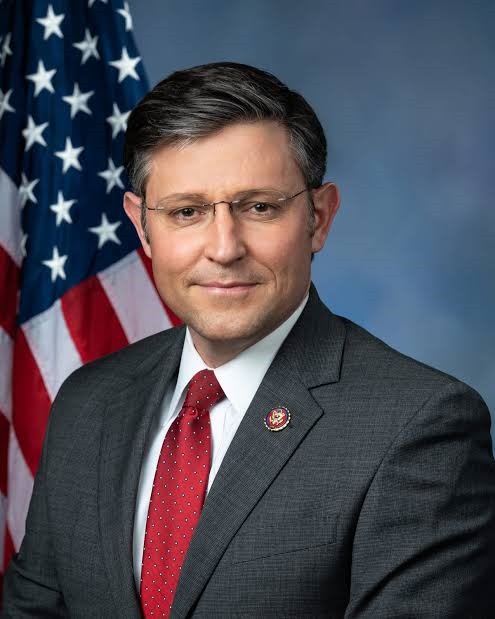
We shall see how well Johnson does in leading the House, or at least its too-small-for-comfort Republican majority, in handling upcoming issues like a possible government shutdown in three weeks, or requests for more aid to Israel and Ukraine, or any of the other normal kinds of business which members of Congress are supposed to take care of on our behalf.  But given his still-declared support of Trump, it’s unlikely Johnson will be much of a leader when it comes to the reality of the need to work with Democrats to get things done: as David Frum wrote in The Atlantic earlier this month, “The rules of contemporary Republican politics make it had to accept reality.  Reality is just too awkward.”

In reality, Trump has been a big vote loser for Republicans. He fluked into the presidency with a Dukakis-like share of the vote in 2016, then lost his party its majority in the House in 2018. Trump got decisively booted from the presidency in 2020; rampaged illegally on January 6, 2021; and then cost his party its Senate majority in the January 2021 runoff elections. His election-denier message damaged his party further in the elections of 2022. His demand for a Biden investigation and impeachment in 2023 is producing an embarrassing fiasco. But no Republican leader dares say these things out loud.

Most taboo of all is working with Democrats, on any terms other than total, one-sided domination: We win, you lose. So [then-Speaker Kevin] McCarthy just had to press ahead, acting as if he commanded a majority when he did not; insulting and demeaning the minority, even though he had to know that he might need their help at any minute.

That minute came. McCarthy sought Democratic votes to save him from his own refractory members, and in return he offered nothing. Not even politeness.

That proposition did not produce the desired results, and so here we are.

Where we are is a country with a solid anti-Trump majority confronting a pro-Trump minority that believes it has a right to rule without concession or compromise.

The only way to produce a stable majority in the House is for the next Republican leader to reach a working agreement with the Democrats to bypass the nihilists in the GOP caucus. But that agreement will have to be unspoken and even denied—because making agreements that show any respect for the other side will be seen by Republican partisans as betrayal. The price of GOP leadership is delivering delusions and fantasies: the delusion and fantasy that Trump won in 2020, the delusion and fantasy that the Republicans did not lose in 2022.

“Delusion and fantasy” might well stand as a new motto for the remnants of a once proud GOP: in the Public Religion Research Institute’s annual American Values Survey, one-third of Republicans believe that “because things have gotten so far off track, true American patriots may have to resort to violence in order to save our country,” almost half think we need a strong leader who is willing to break some rules to get things done, and 29% are strong believers in the QAnon conspiracy movement. In the Washington Post, Jennifer Rubin writes:

Most frightening is how many Republicans buy into white Christian nationalism, a racist ideology that rejects the basic premise of our democracy: “All men are created equal.” One-third of Americans but 52 percent of Republicans agree that “God intended America to be a new promised land where European Christians could create a society that could be an example to the rest of the world.” The number is even higher among White evangelical Protestants (54 percent). Americans who subscribe to white Christian nationalism are more than twice as likely as other Americans to say true patriots might have to resort to violence to save the country.

In a related question, 75 percent of Republicans think the Founders wanted America to be a Christian nation with Western European values.

Rubin also identifies a “positive sign of public sanity” across the ideological spectrum.

Overwhelming majorities of Americans today support teaching the good and the bad of American history, trust public school teachers to select appropriate curriculum, and strongly oppose the banning of books that discuss slavery or the banning of Advanced Placement (AP) African American History.” Moreover, “A solid majority of Americans also oppose banning social and emotional learning programs in public schools.” Though some Republicans have made “anti-wokeism” a key requirement of their political identity, their message is deeply unpopular. “Fewer than one in ten Americans favor the banning of books that include depictions of slavery from being taught in public schools (7%), compared with 88% who oppose such bans.”

Sixty percent say abortion should be legal in most or all cases, compared with 37 percent who say it should be illegal in most or all cases. In a political reversal, “Democrats are now significantly more likely than Republicans to say their support for a candidate hinges on the candidate’s position on abortion,” 50 percent vs. 38 percent.

(snip)

Taking a step back, the overall picture here is a country that is inclusive, respectful of religious differences, pro-democracy and supportive of women’s rights — except when it comes to the largely Republican, mostly White evangelical Christians who reject these fundamental ideas.

When a sizable portion of one of the major political parties, aided by a right-wing propaganda machine and infused with religious fervor, rejects the basis for multiracial, multicultural democracy, we face a severe crisis. Even if Trump does not return to the White House, this radicalized segment will not disappear. How we reintegrate millions of Americans into reality-based, pro-democracy politics in a diverse country remains the great challenge of our time.

The Stakes

“The system” is finally catching up with the non-stop stream of lawbreaking by the former guy and his collaborators that aimed at upending the legal result of the 2020 presidential election.  They were working so hard and fast for so long that it took more than two years for the judges and lawyers on the side of truth, justice and the American way to amass the evidence needed to bring charges, and now the fun has begun.

My favorite character currently is Judge Tanya Chutkan, the federal court judge in Washington hearing the case against Trump (and others) on charges of conspiring to overturn the election.  Her string of figurative “up yours” responses to stupid defense motions is so satisfying: the Trump team isn’t used to being in front of a judge who knows the law, isn’t intimidated by them and their client, and isn’t scared to show it.

For example, this week she rejected arguments from both sides over setting a trial date.  The special counsel suggested jury selection in December and the trial to begin in January…this year; Trump’s lawyers say there is sooo much they have to read to get ready that the trial should be delayed…until 2026!

“These proposals are obviously very far apart,” Chutkan said Monday. “Neither of them is acceptable.”

Chutkan said that Trump will have to prioritize the trial and that she would not change the trial schedule based on another defendant’s professional obligations, for example a professional athlete’s.

The public has an interest in the fair and timely administration of justice, Chutkan said. Trump’s lawyer said going to trial next year would violate Trump’s rights, noting the millions of pages of discovery material that prosecutors have turned over.

“This is a request for a show trial, not a speedy trial,” Trump lawyer John Lauro said of the special counsel’s proposed schedule. “Mr. Trump is not above the law, but he is not below the law.”

After Chutkan ruled, Lauro stood to make an objection on the record and state that Trump’s defense team will not be able to adequately represent its client with that trial date. Chutkan noted his objection and moved on.

Earlier in the hearing, Chutkan said that while the special counsel team’s proposal was too soon, Trump’s proposal of 2026 was not reasonable. “Discovery in 2023 is not sitting in a warehouse with boxes of paper looking at every single page,” Chutkan said.

“This case is not going to trial in 2026,” Chutkan said. She said Trump’s team has had time to prepare already; the public has known about the existence of the grand jury investigating Trump since September, and the identity of many of the witnesses has been known.

In Chutkan’s court, and others hearing cases alleging election interference by Trump and his co-conspirators, defense lawyers are smugly (because how else does a Trump lawyer ever do anything?) letting it be known that their clients couldn’t possibly be guilty of a crime because they honestly believed that the election had been compromised.  This is even a point in a California state bar complaint against John Eastman.  As Jennifer Rubin reported in the Washington Post,

At a critical hearing last week in the California bar proceedings, designated legal expert Matthew A. Seligman submitted a 91-page report, which I have obtained from the state bar, that strips away any “colorable,” or legally plausible, defense that Eastman was acting in good faith in rendering advice to the now four-times-indicted former president Donald Trump.

This report has serious ramifications for Eastman’s professional licensure and his defense in Georgia. Moreover, his co-defendant and co-counsel in the alleged legal scheme, Kenneth Chesebro, who has employed many of the same excuses as Eastman, might be in serious jeopardy in his Oct. 23 trial. (Another lawyer, Sidney Powell, also requested a speedy trial.)

In his report, Seligman addressed whether “the legal positions advanced by Dr. John Eastman in relation to the counting of electoral votes for the 2020 presidential election” were reasonable. Specifically, he assessed whether — as Eastman, Chesebro and others posited — Mike Pence, as vice president, had “unilateral authority to resolve disputes about electoral votes or to take other unilateral actions with respect to the electoral count” or could “delay the electoral count for a state legislature to take action with respect to a state’s electoral votes and whether a state legislature may lawfully appoint electors after the electoral count commences.”

Seligman reviewed the 12th Amendment, the Electoral Count Act of 1887 and “centuries-long practice by Congress” to find that the Eastman positions were so devoid of support that “no reasonable attorney exercising appropriate diligence in the circumstances would adopt them.” In essence, Seligman strips away the pretense that Eastman (and, by extension, Chesebro) engaged in routine legal work.

(snip)

Seligman’s damning report might well determine the outcome of Eastman’s bar proceedings. However, the implications of the report extend well beyond Eastman’s law license. For example:

  • If Eastman engaged in a bad-faith scheme to overthrow the election, then he (and presumably other co-defendant lawyers) lacked any colorable defense under federal law and therefore cannot remove their case to federal court.
  • If Eastman engaged in a bad-faith scheme to overthrow the election, none of his or other lawyers’ conversations are protected under the ambit of the First Amendment any more than a memo explaining how to break into a bank would be.
  • If Eastman engaged in a bad-faith scheme to block the certification of the election, then one could conclude he and others in the alleged “criminal enterprise” had the requisite criminal intent for state charges including a state racketeering charge.

The significance of stripping away the legal plausibility of the cockamamie scheme to undermine our democracy cannot be overstated.

It’s that “undermining our democracy” part that should be most alarming – to us all.  But I don’t think it is, to many of us – certainly not, it seems, to the people who showed up at the arena in Milwaukee this week for the first “debate” among candidates for the Republican presidential nomination.  As Will Bunch wrote in the Philadelphia Inquirer,

As the night dragged on, the only “issues” the crowd seemed jazzed about were brash challenges to scientific truths that it considers elite liberal pieties — like [Vivek] Ramaswamy’s false claim that climate change solutions have killed more people than climate change — or authoritarian vows of violence, like Ron DeSantis’ promise to render any drug dealers at the border “stone cold dead.” None of the eight people on that stage “won” — only Trump, his angry mob, and a 21st-century brand of American fascism that is the enemy of democracy, the writing on the wall.

(snip)

America is entering its most important, pivotal year since 1860, and the U.S. media is doing a terrible job explaining what is actually happening. Too many of us — with our highfalutin poli-sci degrees and our dog-eared copies of the late Richard Ben Cramer’s What It Takes — are still covering elections like it’s the 20th century, as if the old touchstones like debates or a 30-second spot still matter.

What we are building toward on Nov. 5, 2024, might have the outward trappings of an election, but it is really a show of force. What we call the Republican Party is barely a political party in any sense of the word, but a dangerous antisocial movement that has embraced many of the tenets of fascism, from calls for violence to its dehumanizing of “others” — from desperate refugees at the border to transgender youth.

There is, in reality, no 2024 primary because this movement embraced its infallible strongman in Trump eight years ago. And there is no “Trump scandal” because — for them — each new crime or sexual assault is merely another indictment of the messenger, the arrogant elites from whom their contempt is the number one issue. These foot soldiers stopped believing in “democracy” a long time ago — no matter how big an Orwellian sign Fox News erects.

If you watch enough not-Fox cable TV news, you’ll occasionally see an expert on fascism like New York University’s Ruth Ben-Ghiat or Yale’s Timothy Snyder explaining the roots of this American authoritarianism, or you can read a piece like Margaret Sullivan’s Guardian take on the fascist appeal of Trump-clone Ramaswamy. But then it’s back to your regular programming, including a desperate desire to frame today’s clash in the context of long-lost 20th-century democratic norms, and to blame any transgressions on a mysterious “tribalism” that plagues “both sides.”

(snip)

I’ve been inside and outside of Trump rallies in Hershey and West Chester and Wildwood, and what I learned is that the only issue that matters isn’t an issue at all, but their contempt for the media outlets like CNN they believe look down on them and their savior.

(snip)

It was so revealing Wednesday night when Fox News launched its debate coverage by playing a snippet of Oliver Anthony’s No. 1 hit, the blue-collar populist rant “Rich Men North of Richmond,” with its mix of anti-government elitism and a downward punch at welfare recipients. It felt like the Fox message was, “We’re not comfortable talking about what’s really happening with the white working class in America, so we’re just going to turn it over to this angry singer with the big beard.”

The news media better get comfortable talking about what is really happening in places like Anthony’s Farmville, Va. They ought to be explaining both the legitimate anger voiced by the singer’s lament over working overtime hours for low pay, the manipulation of that anger by demagogues like Trump, and the uncomfortable questions about how much of the rage is over threats to outdated and detestable hierarchies of white supremacy and the patriarchy.

(snip)

These are the stakes: dueling visions for America — not Democratic or Republican, with parades and red, white, and blue balloons, but brutal fascism or flawed democracy. The news media needs to stop with the horse race coverage of this modern-day March on Rome, stop digging incessantly for proof that both sides are guilty of the same sins, and stop thinking that a war for the imperiled survival of the American Experiment is some kind of inexplicable “tribalism.”

We need to hear from more experts on authoritarian movements and fewer pollsters and political strategists. We need journalists who’ll talk a lot less about who’s up or down and a lot more about the stakes — including Trump’s plans to dismantle the democratic norms that he calls “the administrative state,” to weaponize the criminal justice system, and to surrender the war against climate change — if the 45th president becomes the 47th. We need the media to see 2024 not as a traditional election, but as an effort to mobilize a mass movement that would undo democracy and splatter America with more blood like what was shed Saturday in Jacksonville. We need to understand that if the next 15 months remain the worst-covered election in U.S. history, it might also be the last.

“What happened happened”

Permit me to ignore my own advice just this once and call attention to current and dangerous behavior by some candidates for the Republican nomination to be president of the United States: their efforts to rewrite history.  Not to alter the timeline by winning the election and creating a future that would be recounted by historians as-yet unborn, but to reach a hand into the past and “revise” the record of what actually happened.  Like the un-impeachment of Donald Trump.  Both of them.

In a recent Salon article Austin Sarat and Dennis Aftergut ridicule the current fever dream among House Republicans to impeach President Biden, and remind us that these same geniuses want the House to change its mind on the historic impeachments of the former guy.

…many of these same MAGA acolytes want to rewrite history by taking the unprecedented and fanciful step of expunging the record of Trump’s two impeachments. Last month, Speaker Kevin McCarthy, desperate to hold onto his slender majority, gave in to those demands when he announced his support for that effort.

That calls to mind a Russian saying from Stalinist times, when rewriting history to suit and flatter a totalitarian leader was de rigueur: “Russia is a country with a certain future; it is only the past that is unpredictable.”

Constitutional experts say there is no mechanism to undo an impeachment; intelligent observers see the effort as a transparent attempt to (choose your own turn of phrase here; I’ll go with) “curry favor” with the former president and MAGA nation.  It’s an effort totally consistent with their modus operandi of ignoring verifiable truth and saying whatever they need to be true in the moment.

Consider the effort in Florida to sanitize the school curriculum on Black history – the whole “slaves learned skills they could benefit from later in life” eyewash.  Florida isn’t alone in this effort to fight attempts to teach a more complete view of the history of Black people in America, but Eugene Robinson says it has the spotlight now because its governor is trying to become president.

It was Gov. Ron DeSantis, running for the GOP presidential nomination as an “anti-wokeness” Savonarola, who inspired this latest effort to both-sides slavery. (Months ago, the state rejected an Advanced Placement course on African American studies, saying it “significantly lacks educational value.”) On Friday, DeSantis blamed the state Department of Education — “I wasn’t involved,” he claimed — but also defended the abomination: “They’re probably going to show that some of the folks that eventually parlayed, you know, being a blacksmith into doing things later in life.”

Where to begin? I’ll start with my own family history. One of my great-great-grandfathers, enslaved in Charleston, S.C., was indeed compelled to learn to be a blacksmith. But he had no ability to “parlay” anything, because his time and labor were not his own. They belonged to his enslaver. He belonged to his enslaver.

To pretend my ancestor was done some sort of favor by being taught a trade ignores the reality of race-based, chattel slavery as practiced in the United States. He was sold like a piece of livestock at least twice that I know of. To say he “developed skills,” as if he had signed up for some sort of apprenticeship program, is appallingly ahistorical. As was true for the millions of other enslaved African Americans, anything he achieved was in spite of his bondage.

(snip)

The problem with all of this is that it seeks to contextualize American slavery as something other than what it was: a unique historical crime, perpetuated over 2½ centuries. Slavery was practiced here on an industrial scale, based on race and the belief in white supremacy, with not just individuals but also their descendants consigned to lifelong servitude.

The Florida curriculum does a similar trick in interpreting the Jim Crow period. It calls for studying “acts of violence perpetrated against and by African Americans” — blaming both sides — but then mentions the “1906 Atlanta Race Riot, 1919 Washington, D.C. Race Riot, 1920 Ocoee Massacre, 1921 Tulsa Massacre and the 1923 Rosewood Massacre.” All of those atrocities, and many more, were White riots against innocent Black victims.

What happened happened. We will not move forward until we truthfully acknowledge where we’ve been.

That acknowledgement is apparently a high hill to climb (a tough pill to swallow?) for many Americans. Some say those people are just racists and that’s why they won’t admit that the demonstrable facts of history are true; Paul Waldman has an alternative explanation:

When you see some of the positions taken by the Republicans running for president on issues that touch upon race, it can be hard to ascribe to them anything but the ugliest motives.

Why, for instance, would Florida Gov. Ron DeSantis and former vice president Mike Pence each announce their intention to change the name of an Army post to honor a Confederate general? Why would DeSantis advocate for new school standards in his state that appear to present slavery as a brief and salutary job training program?

Some will simply answer, “Racism.” But there’s a more complicated answer that better explains what’s happening on the right. The true commitment of today’s Republican Party is not to racism (though there are plenty of genuine racists who thrill to what the GOP offers, and especially to former president Donald Trump). It is to what is best described as anti-antiracism.

In a sense, anti-antiracism is its own ideology. It holds that racism directed at minorities is largely a thing of the past; that whatever racism does exist is a product only of individual hearts and not of institutions and systems; that efforts to ameliorate racism and promote diversity are both counterproductive and morally abhorrent; and, most critically, that those efforts must not only be stopped but also rolled back.

Listen to conservative rhetoric on book banning, affirmative action, teaching history or any of the ways race touches their war on “wokeness,” and you hear this theme repeated: We must stop talking and thinking about racism, and most of all we must stop trying to do anything about racism.

(snip)

Adherence to these kind of anti-antiracist ideas has become “a matter of partisan identity,” going to the core of “what it means to be a Republican,” [political scientist Rachel] Wetts told me. “More than 80 percent of White Republicans endorse these views at very high levels.” In fact, in Wetts and [Robb] Willer’s analysis, the only variable that predicted support for Trump more strongly than anti-antiracism was whether you identified as a Republican.

That helps explain why Republican candidates are so determined to call attention to their efforts to dictate what can be said about race in classrooms, to punish companies for promoting diversity, equity and inclusion (DEI), or even to undo attempts to stop honoring the Confederacy.

(snip)

For some people, “opposition to antiracism is a way of expressing racial animus without explicitly endorsing it,” Wetts said. For others it’s about “distaste, anger and frustration with antiracists themselves,” an expression of revulsion against liberals and everything they want to do. Anti-antiracism is one more way to own the libs.

Feelings have become central to the way conservatives think about race; it’s no accident that many of the laws regarding critical race theory passed in conservative states explicitly outlaw discussions in schools that could make students feel “guilt” or “discomfort.” Anti-antiracism is fueled by White people’s unease with the growing diversity of American society, the knowledge that they’ve lost their dominant position — and to boot, liberals keep trying to make them feel bad.

(snip)

It is easy to see why Republican politicians think anti-antiracism is so potent. It allows people to claim a commitment to equality while opposing policies meant to achieve actual equality. It enables them to proclaim their own victimhood, which has become absolutely central to the conservative worldview.

The lies about history, the Big Lie about the 2020 election: they all fit right in with the the endless stream of lies that have been such an effective campaign message wooing MAGA nation.  And maybe, like most advertising, connecting with the audience at a subliminal level.

F0l4dkcXsAEA4bF

Court rejects race-based solution for race-based unfairness…hopes for the best

It’s no easy trick to find a way for a society to accept responsibility for the wrongs of the past that will satisfy everyone as being fair and effective.  In today’s America, we can’t even agree that “we” have such a responsibility, much less concur on how we can make a good faith effort to address the injustices suffered by the generations of Black Americans since the early 17th century.

Three generations ago America made an effort when Congress passed the Civil Rights Act and the Voting Rights Act.  But many felt more was needed, and as Jerome Karabel explains in today’s New York Times, “In a historic commencement address at Howard University on June 4, 1965, President Lyndon Johnson laid out the intellectual and moral basis for affirmative action.”

Speaking less than a year after the passage of the Civil Rights Act and two months before the passage of the Voting Rights Act, he invoked a metaphor that remains resonant 50 years later: “You do not take a person who, for years, has been hobbled by chains and liberate him, bring him up to the starting line of a race and then say, ‘You are free to compete with all the others,’ and still justly believe that you have been completely fair.”

Affirmative action – race-based preferences in education, hiring and more – have been an attempt to correct historic race-based mistreatment.  Karabel says “After a brief honeymoon of public support, affirmative action was met with a powerful backlash, and the policy has been under attack ever since. Decades of lawsuits and legislation have chipped away at the use of racial preferences. And now, in a 6-to-3 decision, the Supreme Court has consigned them to the grave.”

From the Washington Post:

The Supreme Court on Thursday held that admissions programs at Harvard and the University of North Carolina that relied in part on racial considerations violate the Constitution’s guarantee of equal protection, a historic ruling that will force a dramatic change in how the nation’s private and public universities select their students.

The votes split along ideological grounds, with Chief Justice John G. Roberts Jr. writing for the conservative members in the majority, and the liberals dissenting. While the ruling involved race-conscious programs at Harvard and UNC, it will affect virtually every college and university in the United States.

“The student must be treated based on his or her experiences as an individual — not on the basis of race,” Roberts wrote, joined by Justices Clarence Thomas, Samuel A. Alito Jr., Neil M. Gorsuch, Brett M. Kavanaugh and Amy Coney Barrett. “Many universities have for too long done just the opposite. And in doing so, they have concluded, wrongly, that the touchstone of an individual’s identity is not challenges bested, skills built, or lessons learned but the color of their skin. Our constitutional history does not tolerate that choice.”

Roberts said the admissions programs at Harvard and UNC “lack sufficiently focused and measurable objectives warranting the use of race, unavoidably employ race in a negative manner, involve racial stereotyping, and lack meaningful end points.”

But he added that “nothing in this opinion should be construed as prohibiting universities from considering an applicant’s discussion of how race affected his or her life, be it through discrimination, inspiration, or otherwise.”

(snip)

In a lengthy dissent, Justice Sonia Sotomayor, the court’s lone Latina justice, wrote that it is “a disturbing feature of today’s decision that the Court does not even attempt to make the extraordinary showing required” to reverse precedent [of previous court rulings supporting affirmative action].

Sotomayor, who has said her own life is an example of how affirmative action programs can work, spoke at length from the bench on Thursday, a tactic justices use to mark their profound disagreement with a decision.

“Equal educational opportunity is a prerequisite to achieving racial equality in our Nation,” she wrote, joined by [Justice Ketanji Brown] Jackson and Justice Elena Kagan.

“Today, this Court stands in the way and rolls back decades of precedent and momentous progress. It holds that race can no longer be used in a limited way in college admissions to achieve such critical benefits,” Sotomayor’s dissent said. “In so holding, the Court cements a superficial rule of colorblindness as a constitutional principle in an endemically segregated society where race has always mattered and continues to matter.”

As Jackson put it, “With let-them-eat-cake obliviousness, today, the majority pulls the ripcord and announces ‘colorblindness for all’ by legal fiat.  But deeming race irrelevant in law does not make it so in life.”

If it can find that race can’t be a factor in college admissions, it should only a matter of time before the court expands that reasoning to include private business, and to say that considerations of race – in the form of diversity, equity and inclusion initiatives – are also unconstitutional.

More from Karabel:

While race-conscious affirmative action is no longer permissible, it is worth noting that the Supreme Court ruling leaves intact many other forms of affirmative action — preferences for the children of alumni, preferences for the children of donors and preferences for student athletes, including for such boutique sports as sailing, fencing and squash. The consequences of this change are not entirely predictable, but based on what happened at the University of Michigan and the University of California, Berkeley, after they were barred from pursuing race-conscious admission policies, a sharp decline in Black and perhaps Hispanic enrollments at highly selective colleges and professional schools seems almost certain. To offset the loss, many colleges are likely to switch to a policy of affirmative action based on economic class. Such a policy would attenuate, although by no means eliminate, the racial impact of the Supreme Court’s ruling.

Affirmative action based on economic class is likely to enjoy broader public support than race-conscious affirmative action; according to a recent Washington Post poll, 62 percent of Americans believe that students from low-income families have an unfair disadvantage in getting into a good college. [David Brooks discusses this idea in the New York Times today.]  But affirmative action on its own, whether based on race or economic class, is far too limited a tool to realize the dream of the great civil rights movement of the 1960s for full racial equality. As we confront a world without race-conscious affirmative action, we would do well to remember the Rev. Dr. Martin Luther King Jr.’s admonition that to produce real equality, “the movement must address itself to the question of restructuring the whole of American society.”

I think most Americans agree that race should not matter, in college admissions or anything else.  (Not all agree, I’m afraid…and you know who you are.)  We wish it were true.  But as we all learned in our youth, wishing a thing doesn’t make it so.  Honest people will acknowledge that while we as a society have made great progress, race does still matter today.  Rulings such as this one seem aimed at making sure that some white Americans are shielded from any responsibility for righting the wrongs of the past.  Or of even acknowledging that there were past wrongs that need addressing.  That’s not a viable strategy for righting the wrongs.

(Jelani Cobb on “The End of Affirmative Action” in The New Yorker: “…almost from the outset, critics of the policy could be seen impatiently tapping their watches, questioning how long (white) society was meant to endure the patent unfairness of these racial considerations.”)

Listen for the right alarm

Even in the best of journalism, where the story is at once true and fair, not inflammatory or emotionally manipulative, you still want to catch the attention of the reader/listener/viewer/clicker so that they will read/hear/see your story (and be enriched by the experience).  So don’t think you know all there is to know when the headline on a Pew Research Center poll blares “45% of Americans Say U.S. Should Be a ‘Christian Nation’” because the truth is less alarming than that.

In the past couple of years I’ve written a few times about the concept of Christian nationalism, and not in an approving way.  By definition,

Christian nationalism is the belief that the American nation is defined by Christianity, and that the government should take active steps to keep it that way. Popularly, Christian nationalists assert that America is and must remain a “Christian nation”—not merely as an observation about American history, but as a prescriptive program for what America must continue to be in the future. Scholars like Samuel Huntington have made a similar argument: that America is defined by its “Anglo-Protestant” past and that we will lose our identity and our freedom if we do not preserve our cultural inheritance.

Christian nationalists do not reject the First Amendment and do not advocate for theocracy, but they do believe that Christianity should enjoy a privileged position in the public square. The term “Christian nationalism,” is relatively new, and its advocates generally do not use it of themselves, but it accurately describes American nationalists who believe American identity is inextricable from Christianity.

Most of the Founding Fathers did profess a belief in a Supreme Being. If they believed that the success of their new creation was inextricably linked to Christianity as it was understood in their day – even IF  that is true – that’s not what it says in the structure for government they wrote.  Historical scholarship has lauded the American experiment that protects the rights of citizens to worship freely while disconnecting the religions from having any governmental authority.  It’s been one step on the still-being-paved path to a free society willing to give everyone a chance to contribute and to reap the rewards of their work.

So the headline roaring that nearly half of us think we should be a “Christian nation” is concerning, but it turns out there’s not so much worry there as one might imagine since the survey also finds that we don’t agree what that phrase even means:

For instance, many supporters of Christian nationhood define the concept in broad terms, as the idea that the country is guided by Christian values. Those who say the United States should not be a Christian nation, on the other hand, are much more inclined to define a Christian nation as one where the laws explicitly enshrine religious teachings.

Overall, six-in-ten U.S. adults – including nearly seven-in-ten Christians – say they believe the founders “originally intended” for the U.S. to be a Christian nation. And 45% of U.S. adults – including about six-in-ten Christians – say they think the country “should be” a Christian nation. A third say the U.S. “is now” a Christian nation.

At the same time, a large majority of the public expresses some reservations about intermingling religion and government. For example, about three-quarters of U.S. adults (77%) say that churches and other houses of worship should not endorse candidates for political offices. Two-thirds (67%) say that religious institutions should keep out of political matters rather than expressing their views on day-to-day social or political questions. And the new survey – along with other recent Center research – makes clear that there is far more support for the idea of separation of church and state than opposition to it among Americans overall.

A Washington Post analysis makes clear that this poll hasn’t found a burbling caldron of restive theocrats across the country; in fact, “comfortable majorities want daylight between politics and faith.”

Sixty-seven percent of all adults, for instance, say churches should stay out of politics, while 77% say they should not endorse candidates for elected office.

Among the 45% who want the United States to be a “Christian nation”:

  • 28% want the federal government to declare the country a Christian nation, while 52% say the government should never declare an official religion
  • 24% say the federal government should promote Christian values, while 52% say it should promote moral values shared by many faiths
  • 39% say the federal government should enforce separation of church and state, while 31% say it should stop enforcing it.

Among all United States adults, 15% want the federal government to declare the country a Christian nation (69% do not), 13% say the federal government should promote Christian values (63% favor values shared by many faiths), 54% say the government should enforce separation of church and state (19% say it should stop).

So, the percentage of Americans who don’t believe in the separation of their Christian church from state authority is small…but the success of Christian evangelicals in winning political office is undeniable: give them credit for playing the game on its own terms and taking control of the levers of power at a rate beyond their real numbers in the population.  Those people are the ones fighting to make secular society look more like their preferred variety of Christianity.  Here in Texas they are hard-charging to use public tax dollars to fund private religious education for their children and leave the rest of “the little skoolchirrun of Texas” to languish in an underfunded and second-rate (at best) public education system.

“Texas, a friend used to say, is hard on women and little things” is how Christopher Hooks started a May article in Texas Monthly that let Texas’ Republican leaders have it (no Democrat has won statewide office in Texas since 1994!) over their treatment of children and the public education system:

It is a grotesque and cruel irony that the Republican primary this year, like several years of political activity before it, was dominated by an all-consuming and comically misdirected argument about the protection of children and by a multifront war against long-neglected public schools. There were essentially no contested policy proposals in the GOP primary that would affect the practical and economic circumstances of all Texans. (There rarely are.) There was, however, ceaseless discussion about the well-being of children, their morals, their internal lives.

The most acute panic was over transgender children. In February, [Attorney General Ken] Paxton’s office issued a formal opinion holding that gender-affirming care, such as the prescription of puberty blockers to trans kids, constituted child abuse. Shortly after, [Governor Greg] Abbott tasked the Department of Family and Protective Services, an overworked and underfunded agency he had overseen for close to eight years, with investigating the families of trans kids for such abuse.

The more widespread crisis concerned books. This panic was conjured up by right-wing parents and elected officials in roughly equal measure. The first target was “divisive” material about race. Then, elected officials began to agitate about “pornography” in schools, a category that included mostly literature featuring queer characters. Lawmakers proposed lists of books to be banned. In November, Abbott ordered the Texas Education Agency to investigate cases of pornography in public schools and prosecute those responsible “to the fullest extent of the law” because, he wrote, it had to be a top priority to “protect” Texas students.
Public school teachers and children’s librarians—members of two professions that offer highly beneficial services to society, for little pay—became villains to activist parents and candidates alike. They were called “groomers” and “pedophiles” on social media. In Granbury, near Fort Worth, two women lodged a criminal complaint in May against the local school’s libraries, prompting a police investigation. At a subsequent school board meeting, one of the women opined that a committee assembled to review troublesome books comprised “too many” librarians instead of “people with good moral standards.”

That’s right: no intersection in this Venn diagram of the universes of “librarians” and “people with good moral standards,” according to this woman.  She’s not alone in that kind of sentiment.  It’s so tiresome.

A year of manufactured outrage about the specter of loose morals in public education had the effect of making all of public education worse—which, for some, seemed to be the goal. Test scores have dropped. Even parents who strongly favor public schooling have begun to search for alternatives. State leaders, including Abbott, who have presided over an education system that spends about 20 percent less than the national average on each student, began to lay the framework for a renewed push to expand school choice and perhaps introduce a voucher system in which taxpayer dollars would be used to fund private schools.

Our right-wing lieutenant governor has been championing vouchers for years, and that came up in a terrific column by Chris Tomlinson in the Houston Chronicle this summer that highlighted the on-going effort by right-wing extremists and their rich Texas patrons to “gut Texas public education.”

Their top priority is helping Lt. Gov. Dan Patrick pass a school voucher bill that allows parents to spend state money to send their kids to private, religious schools, effectively defunding public schools. To inspire support for their plan, Patrick and his allies have set public schools up for failure by cutting their budgets.

Texas lawmakers have shrunk state spending per student over the last 15 years. Occasionally, they’ll authorize an increase, only to cut it later. Texas spends $9,900 per student, while the national average is $13,185, the Education Data Initiative reported.

Political vilification, school shooters, and poor compensation have led two-thirds of teachers to consider leaving the profession, the Texas American Federation of Teachers found in polling its members.

Texas already ranks 35th in the nation for pre-K through 12 education, U.S. News and World Report determined. WalletHub ranked the quality of Texas’s education as 33rd in the country. An exodus of experienced teachers will only worsen matters.

Few Texans can afford the $30,000 or more that a top private school charges and most do not want their child enrolled in a fundamentalist indoctrination camp. If we want our children and state to prosper in a competitive global economy, we must defend our public schools from those who would destroy them.

Self-described “conservatives” who demonstrate with their actions (and their money) that they do not believe in the American ideal of a free public education for all, nor do they believe in the separation of church and state or in real freedom of religion.  I can’t say how many of them fall into the 15% of all American adults who want the federal government to declare America a “Christian nation,” but I find it alarming enough to say I will have that in mind on election day.