Civil disobedience + free press = privacy + freedom

On a lazy Sunday reading the paper and following Ed Snowden around the world on Twitter, I came across a couple of gems…

It is my hope that the revelations of the extent of U.S. government spying on its citizens that were sparked by Snowden’s leaks lead us to really talk about it, not just repeat talking points: are we prepared to surrender so much of our privacy and our freedom without a fight?  Do we have any reason to trust the government when it say it’s only looking for bad guys and foreigners and is protecting us?  A Guardian story I came across in Jack Shafer’s Twitter feed makes the point:

At every point in this unfolding story, government ministers and officials on both sides of the Atlantic have been at pains to point out that everything that is done by the NSA and GCHQ is lawful because there is “legal oversight”. The problem is that citizens have to take their word for it because every substantive aspect of that oversight is secret. 

(snip)

The conversation between the state and the citizen has been reduced to a dialogue that the writer would have recognised. It goes like this.

State Although intrusive surveillance does infringe a few liberties, it’s necessary if you are to be protected from terrible things.

Citizen (anxiously) What terrible things?

State Can’t tell you, I’m afraid, but believe us they are truly terrible. And, by the way, surveillance has already prevented some terrible things.

Citizen Such as?

State Sorry, can’t go into details about those either.

Citizen So how do I know that this surveillance racket isn’t just bureaucratic empire building?

State You don’t need to worry about that because it’s all done under legal authority.

Citizen So how does that work?

State Regrettably, we can’t go into details because if we did so then the bad guys might get some ideas.

What it comes down to, in the end, is: “Trust us.” And the trouble with that is that in recent decades our political elites have done precious little to deserve our trust.

Need more proof?  How about the news that the Obama Administration is pushing all federal departments and agencies—not just those concerned with national security—to have employees watch their colleagues but also to “pursue unauthorized disclosures of any information, not just classified material.”

The program could make it easier for the government to stifle the flow of unclassified and potentially vital information to the public, while creating toxic work environments poisoned by unfounded suspicions and spurious investigations of loyal Americans, according to these current and former officials and experts. Some non-intelligence agencies already are urging employees to watch their co-workers for “indicators” that include stress, divorce and financial problems.

“It was just a matter of time before the Department of Agriculture or the FDA (Food and Drug Administration) started implementing, ‘Hey, let’s get people to snitch on their friends.’ The only thing they haven’t done here is reward it,” said Kel McClanahan, a Washington lawyer who specializes in national security law. “I’m waiting for the time when you turn in a friend and you get a $50 reward.”

I concede that there are areas of government operations where the need to protect sensitive information is legitimate, but not every area of government meets that standard.  That’s why it’s important that there are people who leak government secrets, and that we have news publications of every medium that investigate and publish that information.  The leakers don’t have to be saints for us to be thankful they are there, as Ben Smith writes in BuzzFeed today.

There is now a heated debate over the moral status of Edward Snowden — who fled Hong Kong for Moscow en route, reportedly, to Ecuador Sunday — and over whether his decision to flee almost certain conviction and imprisonment in the United States means that his actions can’t be considered “civil disobedience.” These seem like good questions for a philosophy class. They are terrible, boring, ones for reporters, and have more to do with the confusing new news environment than with the actual news.

Snowden is what used to be known as a source. And reporters don’t, and shouldn’t, spend too much time thinking about the moral status of their sources. Sources sometimes act from the best of motives — a belief that readers should know something is amiss, or a simple desire to see a good story told. They also often act from motives far more straightforwardly venal than anything than has been suggested of Snowden: They want to screw someone who is in their way professionally; they want to score an ideological point by revealing a personal misdeed; they are acting on an old grudge, and serving revenge cold; they are collecting chits with the press to be cashed in later.

(snip)

…the new media ecosystem has moved sources to the foreground. They make their cases directly on Twitter or in web videos; in Snowden’s case, he also chose to protect himself by going and staying public in a way that would never before have been fully possible. “Big news will now carve its own route to the ocean, and no one feels the need to work with the traditional power players to make it happen,” David Carr wrote recently. The fact that the public must now meet our sources, with their complex motives and personalities, is part of that deal.

Snowden’s flight is a great, classic international story. It is, as Glenn Greenwald tweeted today, a kind of global White Bronco moment. His roots in web culture; his ideology; his decision-making; these are all great stories. He’s a much more interesting figure than Mark Felt because, at least, he’s a new figure, not a familiar one.

(snip)

Snowden’s flight and its surrounding geopolitics are a good story; what he made public is a better one. I’m not sure why reporters should care all that much about his personal moral status, the meaning of the phrase “civil disobedience,” or the fate of his eternal soul. And the public who used to be known as “readers” are going to have to get used to making that distinction.

It should come as no surprise to anyone that Tom The Dancing Bug has something to say on this subject:

td130607

Thanks to TDB and GoComics.com.

Resurrection without revolution not likely even in the 23rd century

I saw the new “Star Trek” movie this weekend, and I’d recommend it to Trek fans without reservation.  (If you want to see it but haven’t yet, don’t read on—thar be spoilers here.)

I’m still not comfortable with the whole “let’s reset the timeline” thing introduced in the 2009 movie, which I suppose means I don’t like it.  While I appreciate that the new writers and producers don’t want the new stories in what they hope will be a whole string of movies to be constrained by the history established in six previous television series (counting the animated series, 726 episodes in total) and ten previous movies, so far I can’t help but think “that’s wrong” each time I see something that didn’t happen in the original timeline, especially the lovestruck Uhura.  Maybe I’ll get over it.

With that in mind, I have to say I was disappointed in myself for taking quite so long to see the parallels between the new movie’s story and “Star Trek II: The Wrath of Khan.”  Of course I remembered Khan (“I grow…fa-tigued again.”  “ADMIRAL?  ADMIRAL Kirk?!  “I’ll chase him round the moons of Nibia and round the Antares maelstrom and round perdition’s flames before I give him up!”), but I didn’t recognize the hero-selflessly-saves-the-Enterprise motif, with Kirk and Spock exchanging roles and dialogue, until it was completely unmistakable to anyone who saw the 1982 movie.

Back then it took another whole movie to bring the hero back from the dead, but today it just took the last ten or so minutes of this flick.  And I took it all in as presented, jumping right from resurrection of the captain to the relaunch of his ship a year later without giving any consideration to what probably would really have happened in the wake of McCoy’s greatest feat of medical prestidigitation.  Fortunately, our friends at The Awl have turned up the good doctor’s own recollection

Ridiculous, to think it all started over a tribble. A lifeless bundle of fur. I always kept a dead tribble in my Curio of Maladies in those days, for medical reasons, and was especially glad of it when they finally hauled Khan’s body aboard for study after the battle.

Kirk was particularly dead that day; I remember because everyone was crying and the science woman kept all of her clothes on. As is my habit, I injected several of Khan’s more personal fluids (super-fluids, if you’ll pardon the medical terminology) into the tribble to see what would happen.

The tribble returned almost immediately to life. I remember because I thought to myself, “Ah, I seem to have conquered death. Tremendous,” at the time.

As a doctor, this made my job a great deal easier.

As I mentioned before, Kirk was dead—terribly dead—being chock full of radiations and so forth, so I decided he’d make an excellent second test subject for my Home Death Remedy and plugged him with a bit of the super-blood a few minutes later.

(snip)

Within a week, the Federation had clawed itself into thirteen warring factions, all ready to destroy entire star systems at the prospect of getting their hands on that serum.

Kirk was immediately taken to a research-torture facility by a group of scientists from Section 31. In a way, I think we all failed to take into account the interest this shadowy government organization, with the resources to build a super-advanced death-ship in absolute secrecy, might take in a serum that reverses death.

I tried to tell them I was a doctor, but it didn’t even slow them down. They killed most of the crew in their raid, which I thought damned inconvenient, until I remembered the immortality serum I had developed, from super-blood.

(snip)

The rest you undoubtedly know. The wild-eyed men and women who took to showing up at my offices at all hours of the night, bearing the fresh and mangled corpses of their loved ones in their arms, begging for serum. The armies of the frozen half-dead, the resurrected children brought back to crazed and formless life by their deranged, grief-stricken parents, the Blood Colonies.

You wanna talk about changing history…

A rich vein of loopy

Even though the easy and obvious answer should be easy and obvious (duh), a disturbingly large percentage of our fellow Americans aren’t satisfied with taking the easy way.  Good for them, I say: it demonstrates their exceptional American characteristics of ingenuity and perseverance to come up with these unconventional answers, while generating easy laughs for us lazy slobs whose consciences take no offense when we just skate by, exercising nothing more mentally rigorous than logic and reason.

Public Policy Polling conducted a poll in late March that asked people about conspiracy theories, ones “well known to the public, others perhaps to just the darker corners of the internet.”  What did they find?  A rich vein of loopy:

  • 4% believe shape-shifting reptilian people take on human form and gain political power to manipulate society and control the world (probably thinking of Mitch McConnell on this one)
  • 5% believe Paul McCartney died in 1966 (the rest of us think he’s on another world tour)
  • 11% believe the U.S. government allowed the September 11 attacks to happen
  • 13% believe Barack Obama is the anti-Christ (huh?)
  • 14% believe the CIA was instrumental in creating the crack cocaine epidemic of the 1980s
  • 15% believe the medical and pharmaceutical industries create new diseases to make money off of treatments

(As for the 29% who think aliens exist—what’s wrong with the other 71% of you?)

Just so much harmless kookery, right?  Yes, but what about the 20% who believe the government is hiding a link between autism and childhood diseases, or the 37% percent who believe global warming is a hoax?  Those people act on their beliefs to the detriment of the futures of both their children and the planet they share with the rest of us.  What does it say about our society when, more than ten years after the fact, 44% still think that our then-president took the nation to war on a personal vendetta against Saddam Hussein, and another 12% aren’t sure?

What about the people who had elaborate explanations for the Boston Marathon bombing the day after it happened, before anyone but the bombers themselves could possibly have known the truth?

For starters, I suggest you check out the Bad Astronomy blog on Slate, where Phil Plait recently vented a little about the march of antireality in general and just today about the links between the anti-vaccine nuts and the measles outbreak in Wales.  He has a clear-headed approach and a clean writing style that I think you’ll appreciate.

After that? I don’t know for sure…perhaps we can all get some good advice from the 14% who believe in Bigfoot, or the 9%, like Gen. Jack Ripper, who are convinced that fluoridation of our water isn’t just about dental health.

This is a no-brainer…so it’s perfect for this blog

My Houston Astros kicked off their American League existence Sunday night with a big exciting win over the Texas Rangers, and Monday I thought I should write something nice for the blog about the entire event. You see how far I got with that.

Tuesday night my Houston Astros nearly got perfect-gamed for the second time in less than a year, just the kind of thing that the doomsayers who’ve predicted a third 100+ loss season for the Astros needed to be able to say “I told you so.” Yeah, well, you didn’t count on Marwin Gonzalez, did you? (Yes, Marwin Gonzalez. I know.)

This morning I found a post on Awful Announcing that combines the comfort and excitement of Opening Day with the sense of disorientation that we Astros fans are working through as we get acquainted with our new team and league: major league players performing bits of “Who’s on First?

And that made me think, I want to see the original in all it’s glory…and I’m betting, so do you!

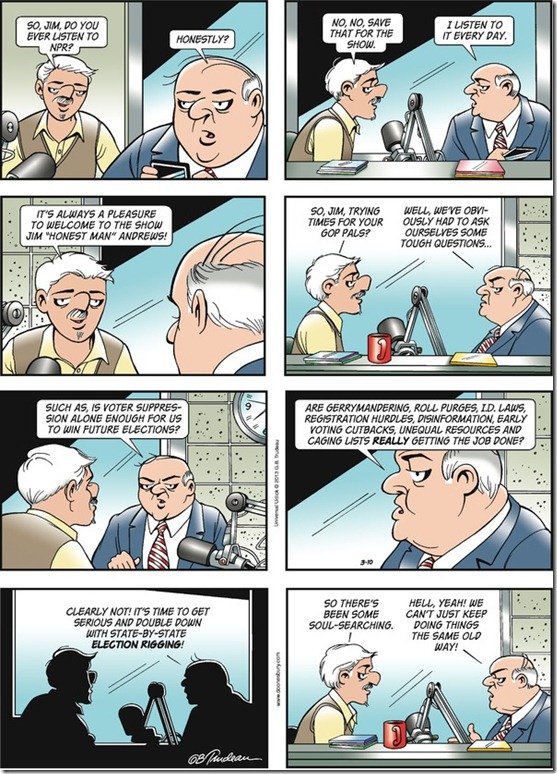
So, the GOP is rethinking how it can appeal to a wider range of voters…

…and Mark Slackmeyer asks how it’s going:

db130310

thanks, Doonesbury and GoComics.com.