First things first–let’s start with the facts

It is said that there are two things you do not want to see being made: sausage, and legislation.  I’m of the opinion that a third thing on that list should be the news—you don’t want to see how a news story comes into being.  But Tom Goldstein, the publisher of SCOTUSblog.com, wants you to see what happened behind the scenes last month in the national reporting of the Supreme Court’s decision on the Affordable Care Act.  In his in-depth post-mortem Goldstein (who has a dog in this fight, to be sure) and his staff pieced together what happened at CNN, Fox News Channel, the White House, and SCOTUSblog.com in the nine minutes between when the court’s decision was handed down and when the error-filled reporting of the decision ended, including how

  • hackers tried to bring down SCOTUSblog
  • the court’s own website failed due to the heavy traffic, so no one outside the court building could access the decision
  • a lack of thoroughness led CNN and Fox to run with incorrect interpretations of the opinion, and
  • people who’d seen those incorrect TV reports refused to believe they were incorrect when confronted with the truth

CNN and Fox News have come in for a lot of deserved criticism for initially reporting the story incorrectly.  Yes, I know they were trying to get it first but so was everyone else, and they waited long enough to understand what the court had ruled before reporting it.  In fact, Bloomberg was first—less than one minute after the chief justice began announcing the decision from the bench—and they got it right!

From what I learned in this piece, I find it disturbing just how much brain power was brought to bear by these two networks that day and still they got it wrong.  Disturbing, but not surprising.  Yes, people make mistakes; but people who care more for flash than for accuracy—for generating heat rather than light—are more likely to make careless mistakes.  Avoiding careless mistakes is—or should be—of paramount importance in this business.

But both CNN and Fox exposed themselves to potential failure by

(a) treating the decision as a breathless “breaking news” event, despite the fact that everyone knew when the opinion was going to be released (and the mandate won’t take effect until 2014), while at the same time

(b) not putting sufficiently sound procedures in place to deal with the potential complications, and

(c) not placing more faith in the consensus view of the wire reports.

To put it another way: read the damn opinion before presuming to tell me what it says.  That shouldn’t be too much to ask, whether reporting a Supreme Court decision or a school board meeting or a fender bender.  Bill Kovach and Tom Rosenstiel suggest that in order “to provide people with the information they need to be free and self-governing,” which is the purpose of journalism, the journalist’s first obligation is to the truth.  Sometimes that can take more than just a few minutes to learn, but we don’t mind waiting.

Other opinions–

The ultimate local news promo

Are you like me: do you hate the local television news? The newscast that addresses you like you’re a four-year-old (“Take your umbrella to work…”) and aims at your emotions rather than your intellect (“Parents terrified by an outbreak of scuffed knees among kindergarteners…”), that buries the lead story (“Allen Stanford sentenced to 110 years for $7 billion Ponzi scheme…”) whenever there’s heartwarming fluff to be dished out (“Woman saved from burning car by stranger weeks ago thinks he’s a good guy…”), the one that ignores the news of the world (“Euro zone economic crisis awaits Greek vote results…”) to spend precious minutes on pointless poofery (“We asked for your opinions on bunnies, and you Tweeted up a storm…”).

And have you always suspected that, deep inside, that those well-scrubbed, bubble-headed bleach blonde boys and girls are actually in on the shameful scam, that they know damn good and well what they and their cross-town colleagues are doing? Then you want to watch this: from the fine folks at WGN-TV in Chicago, the honest local news promo you’ve always wanted to see.

Why we should care about income inequality

I don’t want to get into the argument of the 1% versus the 99% because I think the issue, unaddressed, will hurt 100% of us. The issue is income inequality in the United States, and the good news is I’m not asking anyone to trust my economic arguments. I’m a dope, after all—a journalism major from a state university in the South who never focused on economic theory much beyond the law of supply and demand. But I know what makes sense, and Timothy Noah’s series in Slate does.

The 10-part series on income inequality published in September 2010 has helped me understand the issues, and understand why they matter. It’s not a question of the vast majority of Americans being jealous of the terrific success of others, or of them trying to take away anything the rich have earned. In a current discussion of this subject on Slate, Noah says “Let me start by conceding a point that conservatives often make: Yes, a certain amount of income inequality is necessary in a capitalist system. You have to let the market reward effort and skill. But a system in which inequality of incomes constantly increases over time is worrisome.”

That’s what’s happening in America today: the inequality of incomes is constantly increasing (the series drills down deep into the numbers to prove that it’s more dramatic now than ever), and Noah argues that “creates alienation.”

Income earners at the median have not shared in America’s prosperity. They’ve actually seen their incomes go down (after inflation) during the past decade, and over the past three decades their increases seem pitiful compared both with people earning top incomes (and here I mean not just the top 1 percent but the top 10 and even 20 percent) and with people at the median during the postwar era. For a long time economists said: Wait until productivity rebounds. Then working families will get their share. But when productivity rebounded like crazy in the aughts, working families saw no reward.

What this means is that if you’re at the median you have no positive reason to care how the economy does. Your only motivation is fear—if the economy does really badly you may lose your job. But there’s no upside.

I think this situation has a lot to do with why there’s so much suspicion of institutions that knit the country together—Congress, the media, etc. Logically the suspicion should be directed at the rich, but nobody knows what Lloyd Blankfein looks like. Everybody knows what Barack Obama and John Boehner look like. So people rage against Washington, and government, and you get both the Tea Party and Occupy Wall Street. These groups are quite different in their political orientation, but both groups express contempt for democratic processes.

Read the series: Noah digs through the numbers that show the historical trends of income inequality, and explores the theories for what’s responsible for today’s situation–and he doesn’t just end up blaming Congress or presidents, or Republicans or Democrats, or Wall Street or the educational system, or trade policy or labor unions or immigrants.

Income distribution in the United States is more unequal than in Guyana, Nicaragua, and Venezuela, and roughly on par with Uruguay, Argentina, and Ecuador. Income inequality is actually declining in Latin America even as it continues to increase in the United States. Economically speaking, the richest nation on earth is starting to resemble a banana republic.

Noah’s current book “The Great Divergence” grew out of the research done for the 2010 Slate series, which you can read here for free.

Racism and gun culture? Gotta be time for Bob in the Heights

The reasons why vary from topic to topic, but I don’t always have something worthwhile to say on every hot story du jour while it’s driving the cable news echo chamber nutty; the shooting of Trayvon Martin is one example.  But my friend Bob Eddy has something worthwhile to say about that, and related issues to which it gives rise, and I asked him to say it here; the comments button is right up there:

Watching, and listening, to the continuing story of the Trayvon Martin shooting—which after a good run in the media is already being pushed aside by our latest multiple shooting, in Oakland—I think beyond the hoodies and other nonsensical side stories basically lie two societal issues that continue to plague America today: racism and our gun culture. And I might add, a tip of the hat to today’s rabid media, which remain so ready to leap before looking. As soon as this story became hot (oddly, almost a month after the event) sides were taken. When did it all slide from investigative reporting of known facts toward conjecture and opinion? I’m guessing somewhere around the start of the 24/7 TV news cycle, which also gave birth to the polished and primped Ken and Barbie bobble heads passing for journalists today. Somewhere, Water Cronkite is crying in his grave.

No, I’m not accusing George Zimmerman of being a racist, but much like the Rodney King beating at the hands of the L.A. police and the O.J. Simpson trial, America’s visceral divide has suddenly become exposed and naked to the sun like the sensitive underbelly of a turtle tipped onto its back. Why is it that our country is so reluctant to talk about race—is it painful? Still too touchy a subject even 50 years past the civil rights movement of the 60s? That’s half a century, folks. Healing starts with self-awareness, not denial. The truth sets you free and allows you to move on. These thoughts were recently provoked by an excellent opinion piecein the Houston Chronicle.

Yes, the days of the Jim Crow laws are long gone, and we have a black president (even some black pro football coaches!), but this doesn’t negate the statistical facts (rate of unemployment and incarceration, to name two) that prove racism’s more subtle vestiges remain, revealing a less than level playing field in America today. Using the tragic shooting of Trayvon Martin as an easy example, I challenge anyone to look at me with a straight face and convince me that had the “colors” been reversed, the outcome would have been the same. Yes, I’m talking about a Twilight Zone world where an armed black man trolling the streets of a gated community follows a “suspicious looking” young white man—11 years younger and 20 pounds lighter than he, I might add—ignores the pleas of the 911 dispatcher to stay in his vehicle, and instead challenges, and then shoots the other man dead in a scuffle, declares self-defense, and after a brief trip to the station is set free with no charges filed.  “Well Mr. Washington, everything seems to be in order, just a couple of things to sign here…poor son of a bitch…now you be more careful next time, hear?”

Back on planet Earth, any black man cruising an affluent neighborhood in America today is much more likely (again, check the statistics for racial profiling) to experience only one thing: being pulled over and questioned, and if he’s lucky, that’s all. Ask Robbie Tolan, a [Houston area] 23 year old black male (and son of an ex-professional baseball player) who on New Years Eve 2008 was shot at three times (fortunately only wounded) by the local police after pulling into his parents’ driveway—in front of his hysterical and pleading mom! As a matter of fact, it was the cop’s manhandling of his mother that provoked Tolan, who was already lying on the ground as instructed, to protest. You see, unfortunately mom and dad lived in Bellaire, a predominately white and affluent city tucked inside of Houston, and, well, it was 2:00 in the morning, and there was the (inaccurate) report of a stolen vehicle…

To me, the bottom line is George Zimmerman in all probability wasn’t necessarily a bad guy; evidently, to many, he was even likable and would fall outside the definition, if there is such a quantifiable thing, of a racist. But on that day, against the advice of a 911 dispatcher and contrary to his training as a neighborhood watch person, he provoked a common misunderstanding, it quickly went south, and he chose to defuse the situation with a gun—sentencing Trayvon’s parents to an empty life of grief and unfulfilled dreams. For this he should be held accountable.

For those of you interested in a, granted, lengthy, but reasonable and balanced account of events leading up to this tragic shooting, I encourage reading this story in Sunday’s Times.

Which leads to our second national topic, and an important question I think America needs to ask itself today: are we, as a society, ready to accept armed neighborhood watchdogs? If yes, well, all I’ve got to say is get ready for a lot more of this. Does anyone really feel any safer? Certainly not Trayvon Martin. He’s dead. Welcome to the utopian world of the NRA, where roughly 30,000 Americans a year lose their lives to bullets, and every American—thanks to our permissive own and carry gun laws and under the protection of the “stand your ground” ruling (currently upheld in 27 states)—can legally find themselves judge, jury, and executioner in a split, life-changing second. Ask Joe Horn, of Pasadena, Texas, who in 2007 also chose to ignore the repeated advice of the 911 dispatcher he called, and while still on the line, shotgunned in the back two unarmed Hispanic burglars as they fled his neighbor’s house—and got acquitted of any charges. What a civic hero!

The fact that the latest gun rampage in Oakland is already relegated to “ho-hum,” on page five in my local paper, speaks volumes about our unique American culture. Oh, I know, I can hear the outcry now, as it did after the Virginia Tech massacre: “If only one of those students had a gun!!” Yes, any logical person can see that the answer to easy gun access is, well, more guns. Recently, 22-year-old Trey Sesler of Waller County, Texas had more guns—six, to be exact—and he used them to kill his parents and brother. Ho hum…

Who do we have to blame for this? No one but ourselves and the gutless politicians of both parties who bow down before arguably the most powerful lobbying organization in Washington today. After all, even after the nearly-successful assassination attempt on one of their own, Gabrielle Giffords in Arizona, America watched as Congress, and this Administration, stood united in their silence. I mean, come on, when is the last time the NRA got slapped down on anything? Almost comically, these patriotic defenders of our Second Amendment recently became so imaginative in their quest to stay on a roll that they dreamed up muscling state legislation through in Missouri, Alabama, and Tennessee to protect gun owners from the scourge of discrimination. Say what!? Oh, the oppression and shame!

I guess my biggest puzzlement is I just don’t get the frothing, rampant paranoia of suppression—have you seen this recent “interview” of the NRA’s Wayne LaPierre? Short of mail-ordering a howitzer from the back of a comic book, exactly what can’t your average gun enthusiast today do—hunt with a Gatling gun? Has Obama even mentioned the words “gun control” once since becoming president? Yet gun sales continue to skyrocket, because we all know “He’s going to take away our guns!!” Like the screwball prophets predicting the end of time, it’s coming any day now! Ironically, Barack Obama is the best thing that ever happened to gun shop owners.

Well, enough said…this horse got out of the barn a long time ago, and I can’t imagine what it would take to get it back in. But remember, citizens: stay vigilant! Guns don’t kill people—hoodies do.

Bob in the Heights

[One update: this week the police officers in the Robbie Tolan case, previously acquitted on the criminal charges, were dropped as defendants from Tolan’s civil suit by the federal judge hearing the case. PR]

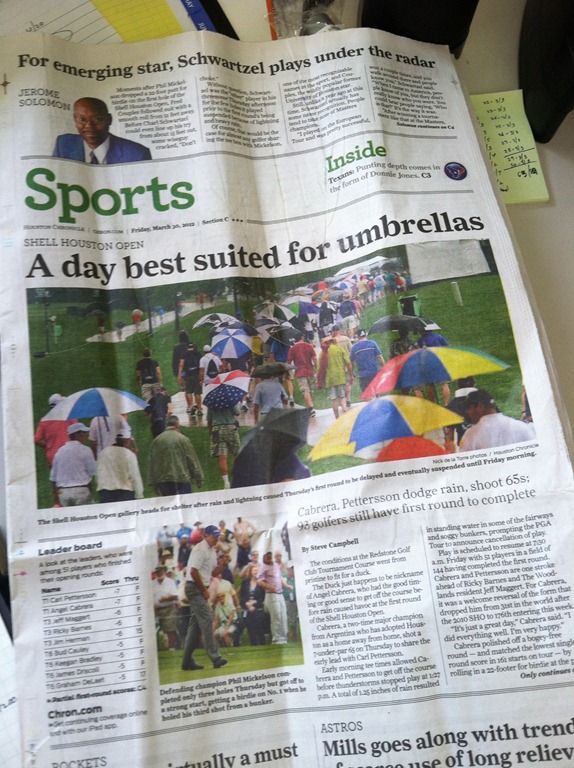
Another day, another sad head-shaking giggle

The PGA Tour is here in the Houston area this week for the Shell Houston Open, which has become a pretty nice stop for the pros the week before the Masters in Augusta,sportsfront Georgia. The Redstone Golf Club’s Tournament Course is set up to mimic the conditions at Augusta National, and the Houston Golf Association pitches the tournament as a great way for players to practice playing in Augusta conditions; it also provides the last opportunity for a player who’s not already in “the first major” tournament of the year to get a last-minute invite if he wins at Houston.

It’s a big deal locally, and the sports section of Houston’s Leading Information Source devotes many pages to promoting the event in advance and then covering the crap out of it when it arrives: two-thirds of the front of today’s sports section is Shell Houston Open stuff, and there’s more inside.

My eye first was drawn to the picture just below the fold of dMickelsoncutlineefending SHO champion Phil Mickelson during yesterday’s rain-shortened first round, where the cutline tells me Mickelson “got off to a strong start, getting a birdie on No. 1 when he holed his third shot from a bunker.”

Then I wandered to the top of the page, where in building a straw man to make some point about Charl Schwartzel, who was playing with Mickelson and Fred Couples Thursday, columnist Jerome Solomon tells me that Mickelson “dropped a 22-foot putt for birdie on the first hole of the Shell Houston Open.”

Solomons leadHuh? I shook my head, and it made that clunky sound of metal rattling around, like Yogi Bear’s did when he got confused. I re-read Solomon’s lead, then I re-read the cutline…then I re-read them both again, just to make sure. Then I looked more closely at the picture, and saw that Mickelson was holding his putter and making the triumphant “I sank it!” gesture. And then I measured: 12 and a half inches away from one another, on the very same page of the paper, and they can’t get the story straight about what the defending champion did on his third shot of the golf tournament.

When I got to a computer it took 45 whole seconds (at PGATour.com) for me to find out that Mickelson drove into a fairway bunker leaving 177 yards, his second shot ended up on the green, and he sank the putt from 22 feet for the birdie. So Solomon’s story was right, the cutline writer was wrong, and the people who layed out and proofed the page were either still suffering rodeo hangover or distracted with dread at the fact that the Astros start their season next week.

Caveat lector!