No news is actually excellent news

It’s not that nothing happened…but today, when the justices of the Supreme Court of the United States decided not to take up any of the pending cases on same-sex marriage, as they were expected to, the decision not to decide—at least not yet—was another sign that homosexual Americans can look forward an end to legalized discrimination sooner rather than later.  Some of them saw no reason to wait—same-sex marriages started in Virginia within hours of the news this morning.

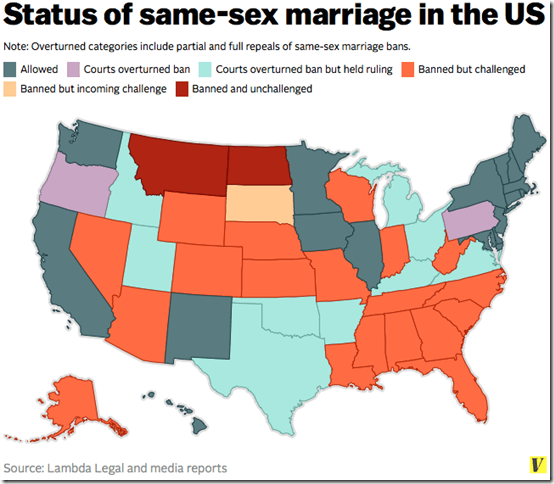
The decision not to hear arguments in any of the cases where federal appeals courts had in essence ruled in favor of same-sex marriage means that those rulings stand, clearing the way for legal same-sex marriages in as many as 11 more states, bringing the number of states on the right side of history to 30 so far (and don’t forget the District of Columbia!).  Vox.com has a good explainer here of what today’s actions mean, with links to an update on where each state’s court case stands and graphics showing how gay marriage is being recognized in law as the right thing to do even in places where many citizens disagree.  But that’s what courts are for, to enforce law and equity in the face of majority ignorance.

Why did the justices decide as they did?  I don’t know, and the justices are not compelled to explain.  But it means that, for whatever reason or reasons, there weren’t at least four justices who were willing to take one or more of these cases right now.  I’ve read some theories that the court decided not to hear any cases because there was no disagreement: all the pending court cases were in favor of allowing same-sex marriage, so they felt there was no conflict that required their special wisdom to resolve.  The argument goes that once there are one or more cases with the opposite finding, the nation’s highest court will step in; I guess we’ll see if that’s so, but this court’s ruling in Windsor v. United States overturning the Defense of Marriage Act as a deprivation of equal protection under the law should give a good hint what they might say.

I’ve said it before (“SCOTUS dumps DOMA: fair, simple, American”), and I’d like to say it again:

This is not about what one religion or another teaches about homosexuality; this is about how the civil law treats American citizens regardless of their religious belief, or their gender or their race or national origin.  A religion is free to believe and teach what it wants about the morality of homosexual behavior or same-sex marriage, and its teachings and laws are important to the members in good standing of that particular faith.  But those teachings are not binding on Americans who are not members of that denomination.  The civil law, which orders how we all deal with one another in the secular society outside the confines of our many private clubs, is blind to such moral questions.  States have the right to decide who can “marry” and who can’t, and the federal government has to treat all “married” couples in the same way, regardless of the gender of the spouses.  Simple, really.  Fair.  American.  Congratulations, U.S.A., on another successful day at the office.

The inexorable march of justice

Another one bites the dust…

Another one bites the dust…

A federal judge struck down Pennsylvania’s ban on same-sex marriage Tuesday, handing gay rights advocates their second legal victory in as many days and striking the last remaining ban in the Northeast.

The state’s laws, which ban same-sex marriages, were struck down as unconstitutional by U.S. District Court Judge John Jones III, who ruled in favor of the 23 plaintiffs whose lawsuit was filed by the American Civil Liberties Union and others.

“We are a better people than what these laws represent,” Jones wrote of same-sex marriage bans in his ruling, drawing comparisons between the civil rights movement and the modern gay marriage movement. ”It is time to discard them into the ash heap of history.”

(snip)

The ruling, from US District Judge John Jones, makes Pennsylvania the second state this week and 11th state since the Supreme Court’s 2013 ruling on same-sex marriage to have its ban overturned in court.  But it’s possible the ruling will eventually be put on hold as it works through the appeals process, which would prevent future same-sex couples from marrying. (The American Civil Liberties Union of Pennsylvania is urging Gov. Tom Corbett, a Republican, to not appeal the ruling.)

Jones, like judges in previous same-sex marriage cases, cited the Equal Protection Clause of the US Constitution and deemed Pennsylvania’s statutory ban on same-sex marriages unconstitutional. Unlike many other states, the state constitution in Pennsylvania doesn’t have a provision barring same-sex marriages.

So, where do we stand?

same-sex_marriage_us_map

What’s with Montana and North Dakota?

Dear Pat Ryan,

I just thought I’d check in to see how things are going with you.  Some of us have gotten a little curious because we haven’t heard much of anything from you in a while now and we started to wonder what was going on.  I mean, if you say you’re going to write a blog, it is customary to actually write something from time to time.  You know, something to make the customers realize that you’re not stone dead, or ignoring them, or “too busy with work and other things” to be bothered keeping up with your commitments.  C’mon, just six damn posts in the last four months?  What’s the deal?

I mean, fercryingoutloud, in just the last few months you’ve passed up the chance to say something about:

You’ve sort of led people to believe that you cared about civil liberties and the whole gay marriage thing, or were at least interested in the subject, but when

you observe radio silence.  I mean, you gotta understand why the people would at least wonder if you’ve given up, or converted or something.

You even let this great picture on Twitter go by without any acknowledgement!

BkgG_7iIcAE0-Fl

So anyway, I’d just like to say I hope you get your shit together and try to be a little more regular contributor in this space, or the owners may start thinking seriously about changing the name up there at the top of the page.

This just in: Arizona governor vetoes “religious freedom” bill

Good for Gov. Jan Brewer, for taking a stand against hate and discrimination.  Nobody over the age of reason is falling for this “religious freedom” argument.  It’s a sign—a good sign—that the extremists see the writing on the wall, and are getting more desperate.

Hell, even a judge in Texas has struck down the state’s ban on gay marriage!  What more evidence do you need that things really are changing…

Happy traditional American holiday season observance

OK, you’ve finally convinced me.  Things were never better than when things were the way they were, back in the good old days when everyone believed in the Constitution and Americans weren’t afraid of their religious heritage; you know, back in the generation of the Founding Fathers and after that, when America was the way God meant it to be:

Not a single state in the Union closed its offices for Christmas on December 25 in 1834. [Abraham] Lincoln marked his first Christmas as President, in December 1861, by holding a Cabinet meeting in the morning and a dinner party in the evening. The Lincoln family never had a White House tree and sent no Christmas cards.

Nobody was much shocked by these omissions.

The public Christmas as Americans know it today did not take form until late in the 19th century. George Washington issued a proclamation on Thanksgiving, but he never made any statement about Christmas (or Easter for that matter). The first state to recognize Christmas as a holiday was Alabama, in 1836, but the North and especially New England resisted. Not until 1856 did Massachusetts accept Christmas as a holiday. The federal government took until 1870 to follow.

David Frum writes that the American attitude about Christmas “back in the day” was one that I think we should learn from.  First, he argues that Americans back then absolutely insisted on keeping church separated from state because of how much they cared about their religions, because they didn’t want government favoring one religion over another: “Better to deliver the mail on Sunday than debate who was right about the Sabbath. Better to issue no religious proclamations than let presidents pick and choose which holy days to mark and how to mark them.”

A second fact also explains the coolness of the early national government to Christianity: the keen awareness of many 19th century Christians of the non-Christian origins of many Christmas traditions.

Christmas is celebrated near the date of the old Roman holiday of Saturnalia. Gift-giving on the day was also a Roman tradition. The Christmas tree, the hanging of wreaths and house-to-house caroling hark back to the pre-Christian German holiday of Yule.

Calvinists had abandoned their outright ban on Christmas observance on the late 17th century. But many Protestant denominations retained a lingering suspicion of the holiday until deep into the 19th century.

Fox News and its co-conspirators can rattle on all they want to about taking Christ out of Christmas and about the terrible secularization of the season, even while filling the rest of the day with ad after ad after insidious Christmas sale ad, but they’re missing (or ignoring) an important point.  That is, the Christmas they claim to be defending is not the Christmas of the birth of Jesus.

It is the Christmas of folkway that is the Christmas so passionately defended by those who talk about “the war on Christmas.”

The Christmas of Santa and Rudolph, and trees and stockings, and candy canes and “Merry Christmas” greetings began to be most publicly celebrated in the United States only after — and only because — the religious impetus for the holiday had already dwindled away.