
The fault is not in our stars

Congress is back in Washington—a warning that reminds me of the comment many years ago by then-mayor Jeff Friedman of Austin, Texas, who, when asked for his thoughts about the fact that the state legislature was coming back to town soon, said “Lock up the kids and dogs.”

The legislative branch and the president are back in town, in theory, to deal with the prospect of more than $600 billion worth of budget cuts and tax increases scheduled to go into effect next week. They’re not making much progress, as you might imagine.

Remember, the “fiscal cliff” is a threat the legislative and executive branches imposed on themselves a year and a half ago. To resolve an impasse over extending the debt ceiling so the government could continue to borrow money and pay its bills, our “leaders” set this time bomb of higher taxes and cuts to federal programs to force themselves to come to agreements on taxes and spending and debt ceilings before the “unthinkable” happened. Well, now we’re on the doorstep of the unthinkable, and look what they’re doing. (By the way, the Treasury department says we’re going to hit the debt ceiling next week!)

Perhaps more annoying than our elected leaders’ inability to govern—for that is what it really comes down to, their inability to do what they were sent there to do—is the realization that the focus on the fiscal cliff isn’t what’s really important anyway. Not to say that higher taxes and program cuts don’t matter, but that the real cause of the government’s economic problems—spending more than we take in—still isn’t being addressed.

The fiscal cliff was a crisis of Congress’ own making, brought on by its inability to address many of the same problems last year. The bigger problem, which lawmakers aren’t addressing, is the lack of sustainable fiscal policy.

We are in this mess in part because for decades leaders from both parties have been reading from the same economic playbook. They haggle over the small change while trying to convince Americans that it will make a profound difference in the country’s finances.

Houston Chronicle business columnist Loren Steffy recently offered another on-target analysis that reminds us the real problem isn’t the fiscal cliff, it’s the historic lack of honesty on the part of the political parties.

The budget battle playing out in Washington is nothing more than a giant national temper tantrum. Since 2001, we have been on a spending jag that has ballooned well beyond the costs of inflation and population growth. We’ve funded wars and prescription drug plans, bailed out banks and automakers and stimulated the economy. These programs have spanned both parties’ control of the White House and Congress.

At the same time, we’ve cut taxes. We now have the lowest average tax rate in about 30 years, yet many still complain taxes are too high and protest any threats to cut or curtail entitlement programs.

For more than a decade, we have demanded more while expecting to pay less. No one wants to admit the party’s over.

But they do want to admit—they’re desperate to admit—that the other party is causing the problem. As for the immediate issue, after the House speaker and the president couldn’t come up with a deal last week John Boehner has insisted that the Senate must come up with a plan and then the House will consider it, while the Democratic leadership in the Senate “stands strong” insisting that the House approve a measure it’s already turned down…or else.  (Or else what?) And just while I’ve been writing this, CNN reported that President Obama is about to make a new offer, until it reported that he won’t.

As disheartening as it is to see our national leadership apparently incapable of acting in the nation’s best interests, the situation becomes damn near depressing when you recognize who is really to blame: it’s us. You; me; them; those guys over there, too—we are responsible for the evolution of a system in which ideological extremists representing the view of a minority of citizens are able to reach positions of national power, and we are responsible for not holding our leaders to account for not putting national interests first, and we are responsible for taking more and more from our government but not being willing to pay for what we take.

The solution to our government’s economic problems won’t come out of Congress this week or next; it won’t come from refusing to reduce spending on government programs (which, frankly, no one is doing), nor from refusing to raise taxes and threatening to hold one’s breath until one turns blue (which, candidly, more than one are doing). It will come, when it comes, with the realization by Americans that America can’t keep putting its everyday expenses on a credit card and only make the minimum payments indefinitely and still expect to remain fiscally healthy.  It doesn’t work like that, and we have the national debt and the federal budget deficit to prove it.

It’s still the economy, stupid

Any system that tries to make candidates for public office come together in one place to talk about what they intend to do if elected is a positive for civic discourse. This week the two major party candidates for president of the United States met on a stage in Denver to talk about domestic issues and that meant, mostly, our country’s economy. They kinda sorta agreed that the fiscal situation is bad and something should be done, and yet the only thing we clearly remember out of the exchange is a lame crack about Big Bird? This is why we have a problem.

Our government’s fiscal affairs are a mess, but the only talk that gains any traction is about something that doesn’t really make a difference. Business columnist Loren Steffy calls it the Big Bird Syndrome, “when politicians imply they will fix the country’s massive fiscal problems by eliminating what amounts to chicken feed in federal spending.” Even though we all agree that a federal deficit exceeding $1 trillion must be reduced—for our own good—the people sucking around for our votes are too afraid of losing support to be serious and specific about how they propose to solve the problem. So they tentatively nibble around the edges:

Perhaps we need to cut these programs because they’re inefficient or we don’t believe government should fund them or we simply don’t like them. But as a deficit reducer, it’s like throwing a few grains of sand over the rim of Grand Canyon and saying you’re fighting erosion.

There are thousands of variables in this equation—spending programs, entitlements, tax rates, deductions, exemptions—and the Simpson-Bowles Commission did a great job envisioning how they might all be leveraged to make progress in reducing the deficit. That framework is still over there on the shelf waiting to be tried if anyone is interested…in Denver both candidates “praised the deficit-cutting framework” without “embrac[ing] the politically unpopular choices” it offered. (What, were the politically popular choices already taken?)

The U.S. government budget works the same as your personal budget and mine; it’s on an entirely different scale, but the basic principles are consistent. From time to time your family and mine spend more than we make, just like Washington, and it’s not always a bad thing: that’s how we pay for houses and cars and educations for our children, for disaster relief and war mobilization. But when we do it as a matter of course, as a way to pay for the “nice to haves” in our lives, and do it over and over for a long enough time, it pushes us into a pit that is damn hard to climb out of.

In that pit, we spend more and more of whatever money we make to repay the interest on the money we borrowed to buy the things we couldn’t afford but thought would be nice to have as well as the borrowed money itself. As the percentage of our income required to pay for the borrowing gets larger, the percentage available to pay for today’s needs gets smaller, and if we don’t reduce our spending to match the available income we have to borrow more to keep up. If there’s no increase in income, or no reduction in expenses, the process repeats and repeats and we spin further and further into debt. This is how banks and credit card companies and loan sharks get rich.

Paying back the loans is hard. Assuming you have no lottery windfall, it probably means doing without or with less for a while (but after you pay back the loan you have more money to spend on what you need or what you want or to save for future spending). That’s not to advocate for trying to pay off the entire national debt right away, but we can’t keep having such a high percentage of our income committed to paying interest—that keeps us from paying for other things that we decide are worth doing, or from reducing the tax burden (hey, how about that concept!). We can’t keep borrowing forever. Growth in the economy will contribute to more revenue without raising tax rates, but the economy isn’t growing fast enough today to make a dent.

This is still the most important issue facing the president and Congress, without exception. But I didn’t hear anyone on that stage in Denver suggest that you or me need to act like responsible adults and do the hard work that’s required: they have plans with lower tax rates (yeah!) and shrinking deficits (wowser!), with milk and cookies served all along the primrose path to solvency!!

They’re telling us what they think we want to hear. They believe we won’t vote for them if they tell us the truth: the economy is a sand castle near the water’s edge, and the tide is coming in…we all have to pitch in, sacrifice some, to protect and strengthen its foundation before the damn thing collapses of its own weight. And, they vaguely promise they have the road map to a solution, and drop only subtle hints about the condition of the road we’ll have to take to get there.

The next two “debates” between the candidates for president and vice president offer another opportunity for some straight talk on this subject. We, and the people who’ll actually be doing the asking in Danville and Hempstead, should be insisting that they give it to us.

The Gospel According to Calvin and Hobbes

Lots of last-minute unavoidable changes made for an especially hectic day at work; I grow more and more fatigued of reading about the political impasse without any real promise of light at the end of the tunnel; they say this is the hottest start to a year since they started keeping records here 120 years ago; and then Bill Watterson reaches out from the past to hit the nail on the head.  Thanks, I needed that.

Calvin

Thanks, GoComics.com.

Racism and gun culture? Gotta be time for Bob in the Heights

The reasons why vary from topic to topic, but I don’t always have something worthwhile to say on every hot story du jour while it’s driving the cable news echo chamber nutty; the shooting of Trayvon Martin is one example.  But my friend Bob Eddy has something worthwhile to say about that, and related issues to which it gives rise, and I asked him to say it here; the comments button is right up there:

Watching, and listening, to the continuing story of the Trayvon Martin shooting—which after a good run in the media is already being pushed aside by our latest multiple shooting, in Oakland—I think beyond the hoodies and other nonsensical side stories basically lie two societal issues that continue to plague America today: racism and our gun culture. And I might add, a tip of the hat to today’s rabid media, which remain so ready to leap before looking. As soon as this story became hot (oddly, almost a month after the event) sides were taken. When did it all slide from investigative reporting of known facts toward conjecture and opinion? I’m guessing somewhere around the start of the 24/7 TV news cycle, which also gave birth to the polished and primped Ken and Barbie bobble heads passing for journalists today. Somewhere, Water Cronkite is crying in his grave.

No, I’m not accusing George Zimmerman of being a racist, but much like the Rodney King beating at the hands of the L.A. police and the O.J. Simpson trial, America’s visceral divide has suddenly become exposed and naked to the sun like the sensitive underbelly of a turtle tipped onto its back. Why is it that our country is so reluctant to talk about race—is it painful? Still too touchy a subject even 50 years past the civil rights movement of the 60s? That’s half a century, folks. Healing starts with self-awareness, not denial. The truth sets you free and allows you to move on. These thoughts were recently provoked by an excellent opinion piecein the Houston Chronicle.

Yes, the days of the Jim Crow laws are long gone, and we have a black president (even some black pro football coaches!), but this doesn’t negate the statistical facts (rate of unemployment and incarceration, to name two) that prove racism’s more subtle vestiges remain, revealing a less than level playing field in America today. Using the tragic shooting of Trayvon Martin as an easy example, I challenge anyone to look at me with a straight face and convince me that had the “colors” been reversed, the outcome would have been the same. Yes, I’m talking about a Twilight Zone world where an armed black man trolling the streets of a gated community follows a “suspicious looking” young white man—11 years younger and 20 pounds lighter than he, I might add—ignores the pleas of the 911 dispatcher to stay in his vehicle, and instead challenges, and then shoots the other man dead in a scuffle, declares self-defense, and after a brief trip to the station is set free with no charges filed.  “Well Mr. Washington, everything seems to be in order, just a couple of things to sign here…poor son of a bitch…now you be more careful next time, hear?”

Back on planet Earth, any black man cruising an affluent neighborhood in America today is much more likely (again, check the statistics for racial profiling) to experience only one thing: being pulled over and questioned, and if he’s lucky, that’s all. Ask Robbie Tolan, a [Houston area] 23 year old black male (and son of an ex-professional baseball player) who on New Years Eve 2008 was shot at three times (fortunately only wounded) by the local police after pulling into his parents’ driveway—in front of his hysterical and pleading mom! As a matter of fact, it was the cop’s manhandling of his mother that provoked Tolan, who was already lying on the ground as instructed, to protest. You see, unfortunately mom and dad lived in Bellaire, a predominately white and affluent city tucked inside of Houston, and, well, it was 2:00 in the morning, and there was the (inaccurate) report of a stolen vehicle…

To me, the bottom line is George Zimmerman in all probability wasn’t necessarily a bad guy; evidently, to many, he was even likable and would fall outside the definition, if there is such a quantifiable thing, of a racist. But on that day, against the advice of a 911 dispatcher and contrary to his training as a neighborhood watch person, he provoked a common misunderstanding, it quickly went south, and he chose to defuse the situation with a gun—sentencing Trayvon’s parents to an empty life of grief and unfulfilled dreams. For this he should be held accountable.

For those of you interested in a, granted, lengthy, but reasonable and balanced account of events leading up to this tragic shooting, I encourage reading this story in Sunday’s Times.

Which leads to our second national topic, and an important question I think America needs to ask itself today: are we, as a society, ready to accept armed neighborhood watchdogs? If yes, well, all I’ve got to say is get ready for a lot more of this. Does anyone really feel any safer? Certainly not Trayvon Martin. He’s dead. Welcome to the utopian world of the NRA, where roughly 30,000 Americans a year lose their lives to bullets, and every American—thanks to our permissive own and carry gun laws and under the protection of the “stand your ground” ruling (currently upheld in 27 states)—can legally find themselves judge, jury, and executioner in a split, life-changing second. Ask Joe Horn, of Pasadena, Texas, who in 2007 also chose to ignore the repeated advice of the 911 dispatcher he called, and while still on the line, shotgunned in the back two unarmed Hispanic burglars as they fled his neighbor’s house—and got acquitted of any charges. What a civic hero!

The fact that the latest gun rampage in Oakland is already relegated to “ho-hum,” on page five in my local paper, speaks volumes about our unique American culture. Oh, I know, I can hear the outcry now, as it did after the Virginia Tech massacre: “If only one of those students had a gun!!” Yes, any logical person can see that the answer to easy gun access is, well, more guns. Recently, 22-year-old Trey Sesler of Waller County, Texas had more guns—six, to be exact—and he used them to kill his parents and brother. Ho hum…

Who do we have to blame for this? No one but ourselves and the gutless politicians of both parties who bow down before arguably the most powerful lobbying organization in Washington today. After all, even after the nearly-successful assassination attempt on one of their own, Gabrielle Giffords in Arizona, America watched as Congress, and this Administration, stood united in their silence. I mean, come on, when is the last time the NRA got slapped down on anything? Almost comically, these patriotic defenders of our Second Amendment recently became so imaginative in their quest to stay on a roll that they dreamed up muscling state legislation through in Missouri, Alabama, and Tennessee to protect gun owners from the scourge of discrimination. Say what!? Oh, the oppression and shame!

I guess my biggest puzzlement is I just don’t get the frothing, rampant paranoia of suppression—have you seen this recent “interview” of the NRA’s Wayne LaPierre? Short of mail-ordering a howitzer from the back of a comic book, exactly what can’t your average gun enthusiast today do—hunt with a Gatling gun? Has Obama even mentioned the words “gun control” once since becoming president? Yet gun sales continue to skyrocket, because we all know “He’s going to take away our guns!!” Like the screwball prophets predicting the end of time, it’s coming any day now! Ironically, Barack Obama is the best thing that ever happened to gun shop owners.

Well, enough said…this horse got out of the barn a long time ago, and I can’t imagine what it would take to get it back in. But remember, citizens: stay vigilant! Guns don’t kill people—hoodies do.

Bob in the Heights

[One update: this week the police officers in the Robbie Tolan case, previously acquitted on the criminal charges, were dropped as defendants from Tolan’s civil suit by the federal judge hearing the case. PR]

Another day, another sad head-shaking giggle

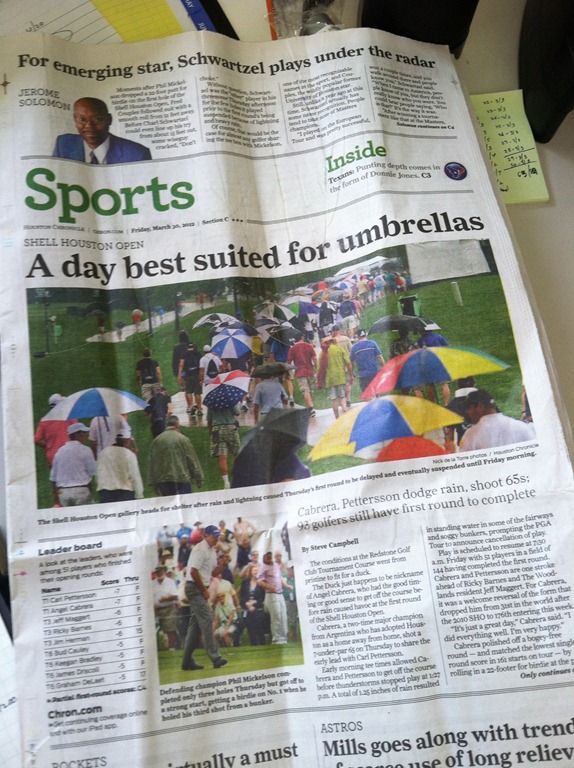
The PGA Tour is here in the Houston area this week for the Shell Houston Open, which has become a pretty nice stop for the pros the week before the Masters in Augusta,sportsfront Georgia. The Redstone Golf Club’s Tournament Course is set up to mimic the conditions at Augusta National, and the Houston Golf Association pitches the tournament as a great way for players to practice playing in Augusta conditions; it also provides the last opportunity for a player who’s not already in “the first major” tournament of the year to get a last-minute invite if he wins at Houston.

It’s a big deal locally, and the sports section of Houston’s Leading Information Source devotes many pages to promoting the event in advance and then covering the crap out of it when it arrives: two-thirds of the front of today’s sports section is Shell Houston Open stuff, and there’s more inside.

My eye first was drawn to the picture just below the fold of dMickelsoncutlineefending SHO champion Phil Mickelson during yesterday’s rain-shortened first round, where the cutline tells me Mickelson “got off to a strong start, getting a birdie on No. 1 when he holed his third shot from a bunker.”

Then I wandered to the top of the page, where in building a straw man to make some point about Charl Schwartzel, who was playing with Mickelson and Fred Couples Thursday, columnist Jerome Solomon tells me that Mickelson “dropped a 22-foot putt for birdie on the first hole of the Shell Houston Open.”

Solomons leadHuh? I shook my head, and it made that clunky sound of metal rattling around, like Yogi Bear’s did when he got confused. I re-read Solomon’s lead, then I re-read the cutline…then I re-read them both again, just to make sure. Then I looked more closely at the picture, and saw that Mickelson was holding his putter and making the triumphant “I sank it!” gesture. And then I measured: 12 and a half inches away from one another, on the very same page of the paper, and they can’t get the story straight about what the defending champion did on his third shot of the golf tournament.

When I got to a computer it took 45 whole seconds (at PGATour.com) for me to find out that Mickelson drove into a fairway bunker leaving 177 yards, his second shot ended up on the green, and he sank the putt from 22 feet for the birdie. So Solomon’s story was right, the cutline writer was wrong, and the people who layed out and proofed the page were either still suffering rodeo hangover or distracted with dread at the fact that the Astros start their season next week.

Caveat lector!